
How many accounts do you need to live off of prop trading? That’s a question a lot of traders are asking. The simple fact is that there’s no magic number. It is determined by your average monthly gains, withdrawals, account size, consistency and living expenses.
If you’re already profitable or working towards funded accounts this guide will assist you to guesstimate what you actually need If you are still struggling to pass evaluations or maintain risk discipline, this is probably not the focus yet. It is more important to build consistency than to have funded accounts.
Many traders will go for five, ten or even twenty funded accounts before they can show that they can manage one. This is usually a stress, not an income, addition.
What Does “Living Off Prop Trading” Really Mean?
Living off prop trading means your withdrawals consistently cover your personal expenses without relying on another income source.
That sounds simple, but many traders underestimate two important realities:
- Monthly payouts fluctuate.
- Prop firms limit risk, leverage, and maximum allocation.
Unlike a salary, prop trading income is rarely identical every month. Some months produce excellent returns, while others produce very little or even nothing if market conditions are poor.
For that reason, experienced funded traders usually plan around average annual income rather than their best month.
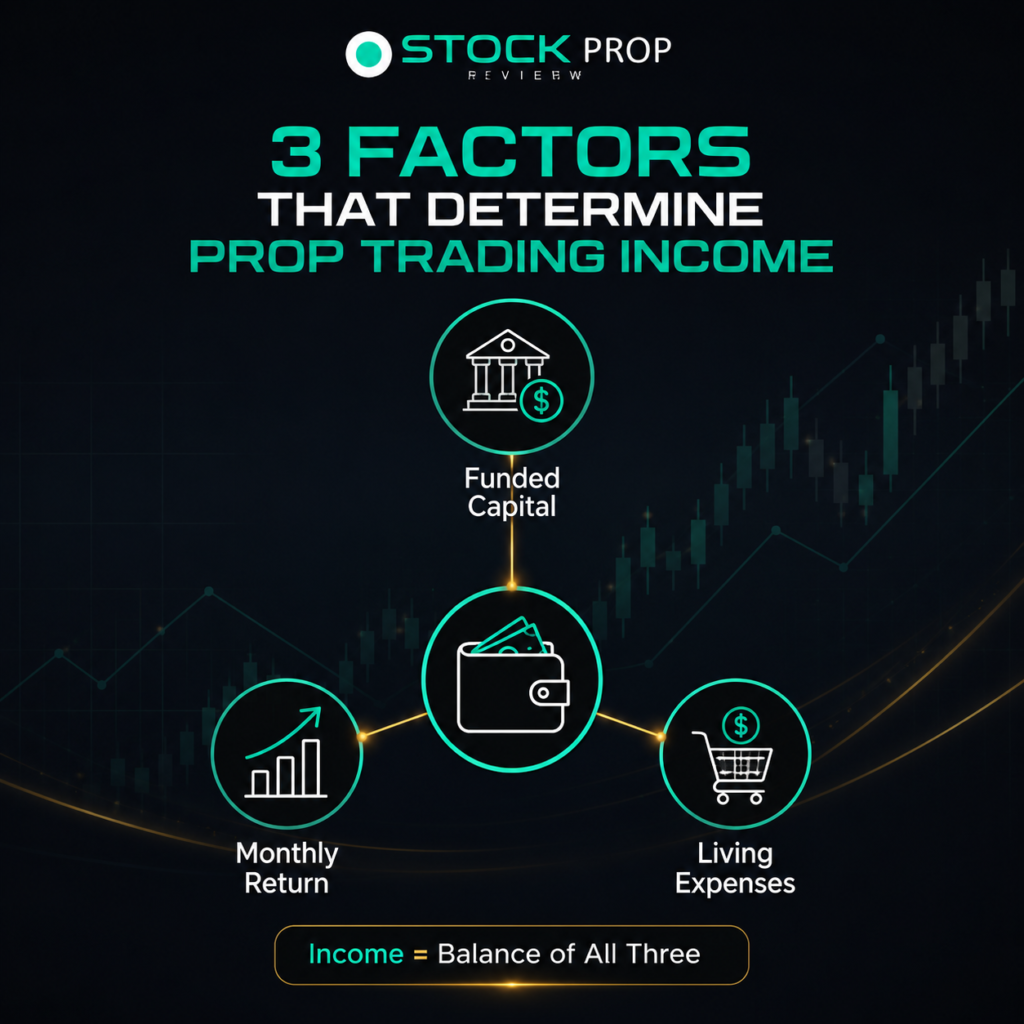
The Three Numbers That Actually Matter
The number of accounts alone tells you very little. Instead, focus on three variables.
| Factor | Why It Matters |
| Total funded capital | Larger capital generally creates larger withdrawal potential. |
| Average monthly return | Consistency matters far more than one exceptional month. |
| Living expenses | Your required income determines how much capital you need. |
Many beginners make calculations based on unrealistic assumptions like making 10% every month forever. Very few traders can sustain those returns and respect the drawdown rules.
Once you have consistency, a safer planning assumption is often 1% to 3% per month.
Realistic Monthly Income Examples
Let’s assume a trader receives an 80% profit split.
| Total Funded Capital | 1% Monthly Return | 2% Monthly Return | 3% Monthly Return |
| $50,000 | $400 | $800 | $1,200 |
| $100,000 | $800 | $1,600 | $2,400 |
| $200,000 | $1,600 | $3,200 | $4,800 |
| $400,000 | $3,200 | $6,400 | $9,600 |
These examples ignore taxes, payout delays, scaling requirements, and losing months.
That is exactly where many online income calculators become misleading.
Why One Funded Account Is Rarely Enough
Many traders dream of replacing their salary with a single funded account.
Sometimes it happens.
Most of the time it doesn’t.
Imagine managing one $100,000 account.
Even producing a respectable 2% monthly return generates approximately $1,600 after an 80% split. For traders living in countries with higher living costs, that may not be enough.
Now consider what happens after one losing month.
Income declines immediately.
Bills don’t.
Traders know that the way to achieve income stability is through diversification, not by pushing one account harder.
Rules That Affect Your Income More Than Account Count
Two traders with identical capital can earn very different amounts because every prop firm has different restrictions.
| Rule | Why It Matters |
| Daily drawdown | Limits aggressive recovery after losses |
| Maximum drawdown | Determines long-term survival |
| Profit split | Directly affects take-home income |
| Maximum allocation | Caps total funded capital |
| Payout schedule | Impacts cash flow |
| Scaling program | Determines future earning potential |
Many articles focus only on funded capital while ignoring these restrictions.
They shouldn’t.
A trader with fewer restrictions often earns more than someone managing larger capital under tighter rules.
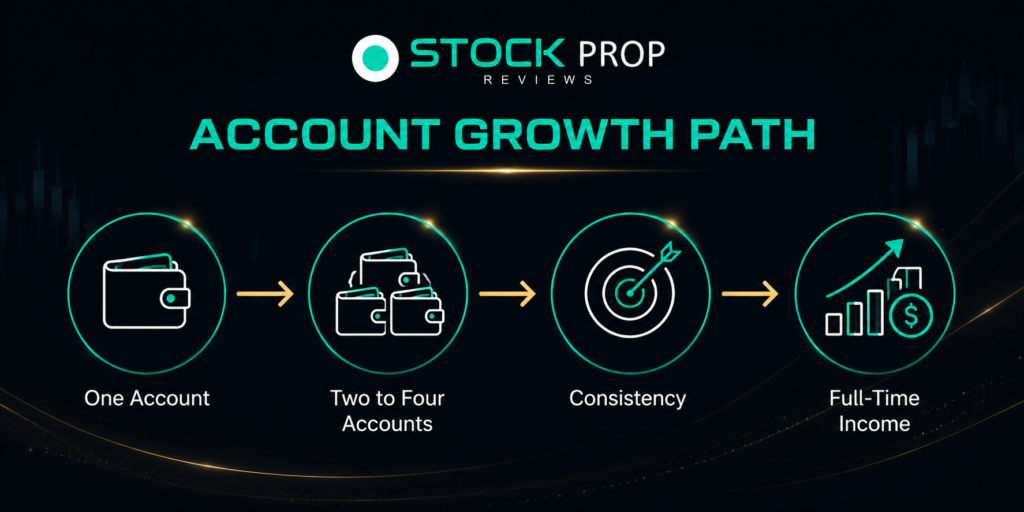
How Many Accounts Do Full-Time Traders Usually Manage?
There isn’t an industry standard, but common patterns emerge.
One account
Best for:
- Consistency in learning
- New funded traders
- Test strategies.
Worst for:
- Replacing full-time employment
Two to four accounts
Best for:
- Risk diversification
- Higher withdrawal potential
- Keeping workload manageable
Many experienced traders stay within this range because execution remains simple.
Five or more accounts
Suitable only if:
- The rules are almost the same.
- Trading is very systematic
- Automated or well organised position management
Otherwise, complexity rises quickly.
Missing one rule or forgetting one open position across several dashboards can erase weeks of profits.
What Competitors Don’t Explain
Most discussions about multiple accounts focus on maximum allocation.
That’s only part of the picture.
Here are the practical problems traders discover later.
Mental fatigue
Monitoring multiple dashboards creates constant decision fatigue.
The market may present one trade, but you’re managing entries, stop losses, drawdown percentages, and position sizes across several firms simultaneously.
Different rules
Not all prop firms measure drawdown the same way.
Trailing drawdown may be used by one firm.
Another implementation uses static drawdown.
Some calculate daily losses utilizing a different method.
What works perfectly for one account, might be against the rules of another firm.
Withdrawal timing
Cash flow is uneven due to different payout schedules.
Traders do not get monthly income, they often have staggered withdrawal dates at different companies.
Psychological pressure
Many traders get conservative, adding to several accounts.
The irony is the bigger pile of money protection effort often leads to worse performance, because every trade feels like a bigger deal.

Common Mistakes Traders Make
Buying accounts before proving consistency
Passing evaluations is different from earning withdrawals.
Many traders buy several challenges before they have proved 6 months of profitable execution.
Assuming maximum allocation equals guaranteed income
Opportunity, not salary, is created by funded capital.
Profits are still subject to market conditions.
Ignoring personal expenses
Living expenses determine how much income you actually require.
A trader needing $1,500 per month has very different capital requirements than someone needing $5,000.
Trading larger to compensate
One losing month often causes traders to increase risk.
Under prop firm drawdown rules, this frequently leads to account loss.
Practical Example
Consider two traders.
Trader A
- One $400,000 allocation.
- Risks with a vengeance
- Gains 8% in a month
- Drawdown breached the next month
Total long-term income becomes unpredictable.
Trader B
- Four accounts of $100K each
- 0.25%-0.5% risk per trade
- 2% average per month
- Withdraws regularly
Trader B usually provides more financial stability albeit with lower headline returns.
That’s the difference between chasing great months and creating repeatable income.
Best Strategy for Different Trader Types
| Trader Type | Suitable Account Approach |
| Beginner | Focus on one evaluation until consistently funded |
| Newly funded | One or two funded accounts |
| Consistent trader | Two to four accounts |
| Futures trader | Depends on contract sizing and firm allocation rules |
| Scalper | Fewer accounts often reduce execution errors |
| Swing trader | Multiple accounts are easier because trades require less frequent management |
Who Should Avoid Multiple Accounts?
Managing several funded accounts is not suitable for everyone.
You should probably avoid expanding if you:
- Lacking success in passing evaluations.
- Often break drawdown rules.
- Switch strategies every couple of weeks.
- Rely on trading income at this point.
- Normal losing streaks get to you emotionally.
More accounts rarely solve inconsistency.
They usually magnify it.
Alternatives to Managing Many Accounts
Instead of opening more accounts immediately, consider these options.
Increase consistency first
A steady trader usually earns more over time than an inconsistent trader with larger capital.
Join a transparent scaling program
Rather than forcing traders to run a ton of separate accounts, some firms slowly build up allocation after consistent performance.
Consider regulated stock prop firms
Some traders aren’t looking to maximize the number of forex funded accounts they can get, but prefer firms with simple rules and transparent risk management.
One such example is TradeThePool. It focuses on stock trading with clear rules and risk transparency. If regulated stock prop trading better suits their goals, readers can get up to 10% discount when buying through our TradeThePool link, so it’s worth considering.
Comparing One Large Account vs Multiple Smaller Accounts
| Factor | One Large Account | Multiple Smaller Accounts |
| Simplicity | Excellent | Moderate |
| Rule management | Easy | More complex |
| Diversification | Low | Better |
| Administrative workload | Low | Higher |
| Psychological pressure | Higher per account | Spread across accounts |
| Income stability | Depends on one account | Potentially more balanced |
Neither approach is universally better.
The right choice depends on your trading process, organization, and emotional discipline.
Internal Resources Worth Reading
Before increasing your funded capital, it also helps to understand how different firms operate.
Read our review of one leading forex prop firm alongside another detailed prop firm review to compare rule structures rather than marketing claims.
If you’re deciding between evaluation providers, our prop firm comparison explains how drawdown models affect long-term profitability.
You should also read our analysis on whether scaling plans are really worth pursuing, as many traders overestimate how quickly higher allocations translate into dependable income.
The Bottom Line
It is less about how many accounts you need to live off prop trading and more about consistency, realistic returns and personal expenses.
For many profitable traders, two to four funded accounts is often enough to diversify without adding too much complexity. Some are comfortable to earn a living from a single larger allocation, while some traders never make consistent withdrawals even with multiple accounts.
Funded accounts are not income guarantees, think of it as business capital. Plan for average performance, abide by drawdown rules and only increase your position once you’ve proven you can handle your current allocation successfully.
If you are more of a stock trader, TradeThePool is a regulated prop trading environment with clear risk rules. There is also a TradeThePool link for readers to get up to 10% off when buying, but this should be seen as one option to consider, not a shortcut to steady profits.
FAQs
Can you make a living from one prop firm account?
Yes but that depends on account size, your average monthly returns, payout rules and your living expenses. One account is not enough to create a stable income for many traders.
Better to have multiple funded accounts?
Having a number of accounts can help spread your income and reduce your reliance on one provider but this also means more administration and a more complex risk management process.
How much funded capital do you need to sustain a living?
There is not one number. A lot of consistent traders are looking at a total funded capital of $100,000 to $400,000. Profitability is far more about consistent execution than headline allocation.
More prop firm accounts, more profit?
No. Not on its own. More accounts mean more potential for earnings, but only if you can follow the rules of each company without adding emotional or operational mistakes.
Are prop firm challenges worth it for beginners?
Generally no. A beginner will usually get more out of mastering one account before adding other evaluations or funded accounts.