Open X, YouTube or Discord and you won’t be long before you see someone celebrating a five figure payout from a prop firm. Those posts are exciting but they also give the impression that large withdrawals happen often. They are not for most funded traders.
When folks are interested in prop trader payouts, they want a clear answer. How much money are funded traders actually pulling out? Sorry, there isn’t one statistic that answers that question. Most proprietary trading firms would rather brag about their biggest scores than their average ones. They rarely tell you how many traders never even get to a withdrawal, or how many lose their funded accounts after the first payment.
That means traders are comparing themselves to a few success stories and don’t have a good sense of what the average experience is.
The article has a different take. We’ll look at industry research, trader behaviour and the practicalities of funded accounts, rather than marketing claims. This isn’t about discouraging anyone from trying their hand at prop trading. It’s to manage your expectations so you can make better decisions, before you pay for a challenge or risk a funded account.”
The Problem With Payout Statistics
Unlike publicly listed companies, prop firms are under no obligation to publish detailed payout data. Some firms regularly announce milestone withdrawals or total amounts paid to traders, which shows that payouts are taking place, but those figures don’t tell the whole story.
Imagine a firm says it has paid traders $50 million. That sounds impressive until you ask a few questions.
How many traders contributed to that number? How many never received a payout? How many earned only one withdrawal before losing their account? Without those details, it’s impossible to understand what the average trader actually experiences.
This is where many articles fall short. They repeat the firm’s headline figures without explaining what those numbers mean in practice.
Looking Beyond Prop Firms
In the absence of full public data on payouts, it’s helpful to step back and consider the wider research on trading.
Many studies of retail trading find a similar result: consistent profitability is rare. According to research summarized by Tradeciety and statistics cited by YieldFund, most retail traders have a hard time generating sustainable returns over time.
Funded trading changes the environment but not the psychology. The trader still has to manage risk, follow a plan, and avoid emotional decision-making. In many ways, prop firm rules make discipline even more important because one mistake can violate a drawdown limit and end the account.
That doesn’t mean most funded traders fail. It does mean that consistently reaching the payout stage is more difficult than many beginners expect.
What Traders Actually Withdraw
There isn’t a universal average payout because every trader follows a different strategy, trades a different account size, and operates under different firm rules. Still, after reviewing industry discussions, trader interviews, and available statistics, a pattern starts to emerge.
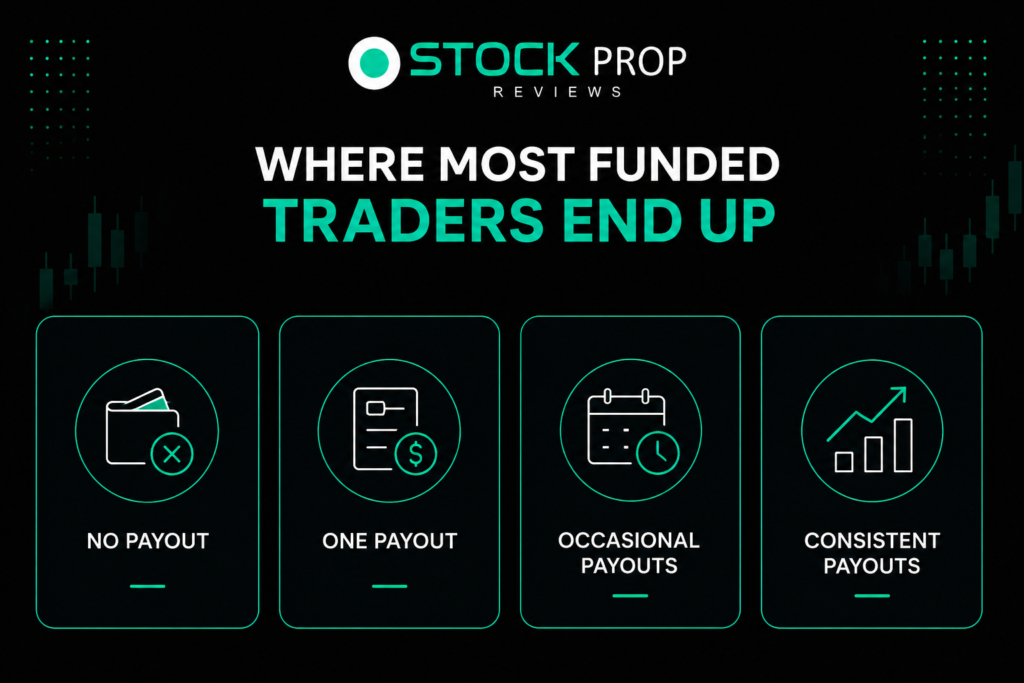
The largest group of traders never reaches a meaningful withdrawal. Some fail during the evaluation stage, while others receive a funded account but lose it before becoming eligible for a payout.
Another sizable group manages to withdraw once. They experience a strong trading period, collect their first payment, and then gradually give those gains back through poor risk management.
Only a relatively small number of traders develop the consistency needed to make withdrawals month after month.
That observation may sound obvious to experienced traders, yet it’s often missing from promotional material. Firms naturally showcase exceptional performance because it demonstrates what’s possible. Traders, however, need to understand what’s typical.
Passing a Challenge Isn’t the Finish Line
One misconception among new traders is that passing an evaluation proves they have become consistently profitable.
In reality, passing an evaluation and keeping a funded account require different skill sets.
An evaluation has a defined target. If market conditions suit your strategy and you manage risk reasonably well, it’s possible to complete it within a relatively short period.
A funded account has no finish line.
Now the challenge becomes repeating the same disciplined process every week without violating drawdown limits or changing your strategy after a few losing trades.
Many traders discover that staying funded is significantly harder than becoming funded.
Why the First Payout Can Be Misleading
The first payout is validation. You’ve followed the rules, made profits and finally seen the money hit your bank account.
Ironically, that is often when traders change their behavior.
Some increase their position size because they feel more confident. Others become impatient and try to repeat their best month immediately. A few begin treating the funded account as their primary source of income before they’ve established a long-term track record.
These changes rarely happen overnight. They creep into a trader’s routine one decision at a time.
The result is familiar. A profitable trader gradually becomes an inconsistent one, not because the strategy stopped working, but because discipline started to fade.
The Difference Between Marketing and Reality
Spend enough time researching prop firms and you’ll notice the same features appearing again and again.
Ninety percent profit split.
Fast payouts.
Large account sizes.
Instant funding.
None of these features are bad. In fact, they can be valuable when combined with fair risk rules and transparent conditions.
The problem is that traders sometimes focus on these benefits while overlooking the factors that have a much bigger influence on long-term earnings.
For example, a firm advertising a 90% profit split sounds attractive. But if a trader repeatedly loses funded accounts, the percentage becomes almost irrelevant.
By comparison, a trader working under an 80% split who keeps the same account for a year may withdraw far more money overall.
This is one of the biggest gaps in competitor content. Discussions often revolve around the percentage of profits traders keep, rather than the likelihood of staying funded long enough to benefit from that percentage.
What Experienced Funded Traders Tend to Do Differently
After speaking with funded traders or reading enough long-term trading journals, certain habits appear repeatedly.
They rarely chase large monthly returns.
Instead, they focus on preserving their account.
That approach sounds conservative, but it makes sense when you remember how prop firms operate. Every account has risk limits. Once those limits are breached, future opportunities disappear with them.
Professional traders understand that protecting tomorrow’s trading capital is often more valuable than maximizing today’s profit.
It’s one reason experienced traders often look less impressive on social media than beginners who happen to catch an exceptional month.
The beginner posts a remarkable payout.
The professional quietly collects smaller withdrawals over the course of a year.
From the outside, the first trader appears more successful.
Financially, the second trader often comes out ahead.
A Realistic Example
Consider two traders managing funded accounts of the same size.
The first trader risks two or three percent on every position. Some months are spectacular, but losing streaks are equally dramatic. Eventually, a drawdown violation ends the account.
The second trader risks half a percent per trade. Monthly returns are modest, and there are periods when almost nothing happens. Yet twelve months later, the account is still active and regular withdrawals continue.
Neither example is guaranteed, but it reflects a pattern seen repeatedly in funded trading.
Longevity usually matters more than intensity.
That’s easy to forget when the trading community celebrates the biggest payouts rather than the longest careers.
Why Expectations Matter
Behavior is influenced by expectation, more than most traders realize.
The person expecting to make thousands in the first month often experiences a pressure to trade on every opportunity. That pressure can lead to forcing trades, taking more risk, or abandoning a trading plan after a few losses.
A trader with realistic expectations behaves differently.
Instead of measuring success by the size of the next withdrawal, they measure it by whether they followed their process.
Over time, that difference becomes significant.
The goal shifts from making one impressive payout to building a trading record that produces many of them.
That mindset doesn’t make headlines, but it has a much better chance of surviving the realities of funded trading.
A Practical Breakdown of Withdrawal Outcomes
Although no major prop firm publishes complete payout distributions, discussions with funded traders and industry observations point to a fairly consistent pattern. The majority of traders either never receive a payout or collect only one before losing their funded account. The group making regular monthly withdrawals is much smaller than social media would suggest.
| Typical Outcome | What Usually Happens |
| No payout | The trader fails the evaluation or breaches a rule before becoming eligible for a withdrawal. |
| One payout | A profitable month is followed by inconsistent execution or a drawdown violation. |
| Occasional payouts | The trader has a working strategy but struggles with consistency during changing market conditions. |
| Regular payouts | The trader follows a repeatable process, manages risk carefully, and protects the funded account over the long term. |
This isn’t meant to discourage new traders. Every consistently profitable trader started in one of the first three categories. The difference is that experienced traders treat setbacks as feedback instead of looking for a new strategy every few weeks.
The Mistakes That Reduce Prop Trader Payouts
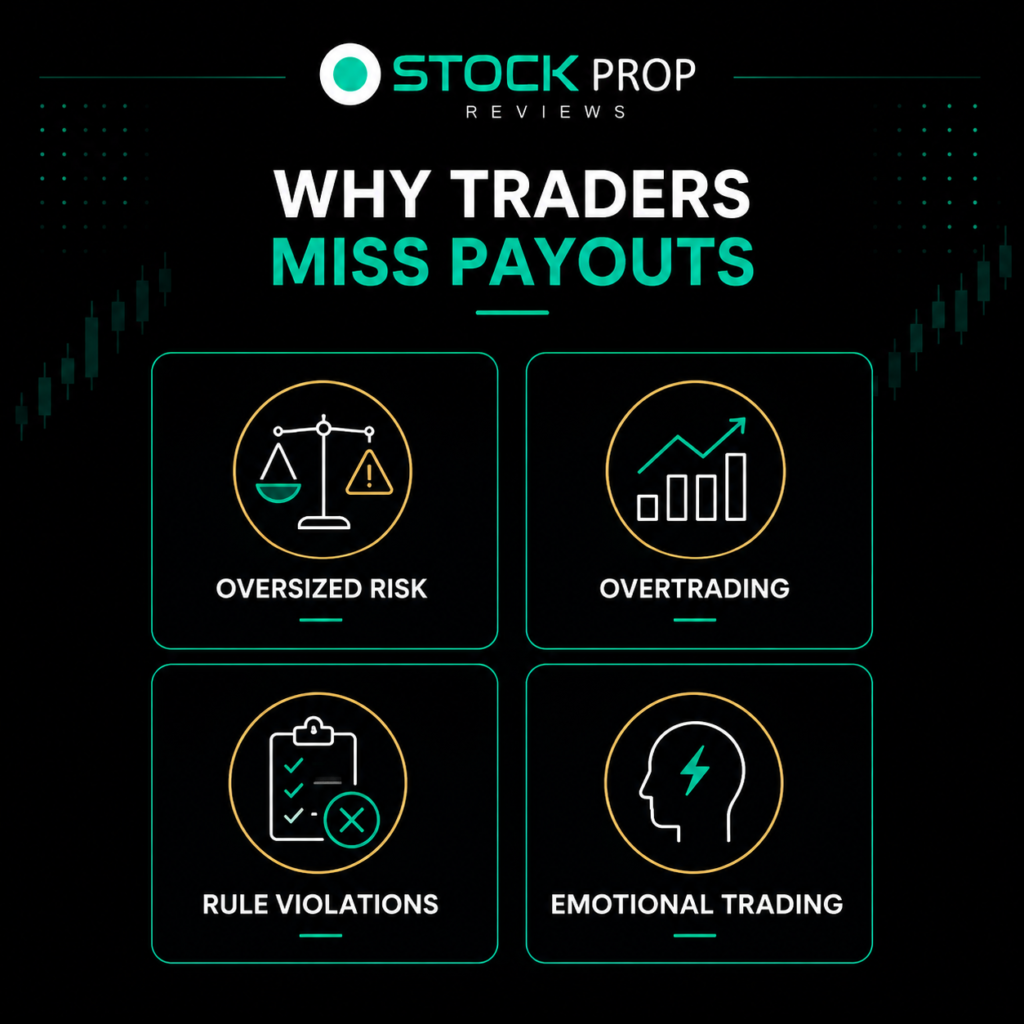
After reviewing dozens of prop firm reviews and trader discussions, the same mistakes appear again and again. They are rarely technical mistakes. More often, they come from changing behaviour once real money is involved.
One of the biggest problems is that after a good week the risk increases. A trader gets paid out , gets confident , starts trading larger positions . The strategy is no better but the exposure is. A few losing trades can wipe out weeks of disciplined work.
Another problem is overtrading. Many funded traders think that since they now have a bigger account, they have to be in the market every day. In fact, seasoned traders often wait on the sidelines when the market environment doesn’t fit their strategy. .
Rule violations are another common reason traders miss withdrawals. It isn’t always because someone ignores the rules. Sometimes they misunderstand them. Daily drawdown limits, trailing drawdowns, restricted news trading, or minimum trading day requirements can all affect whether a payout is approved.
Finally, there’s the temptation to recover losses quickly. Almost every trader has experienced the urge to make back a losing day before the market closes. In a funded environment, that mindset often leads to the mistake that ends the account.
Which Trading Styles Tend to Produce More Consistent Payouts?
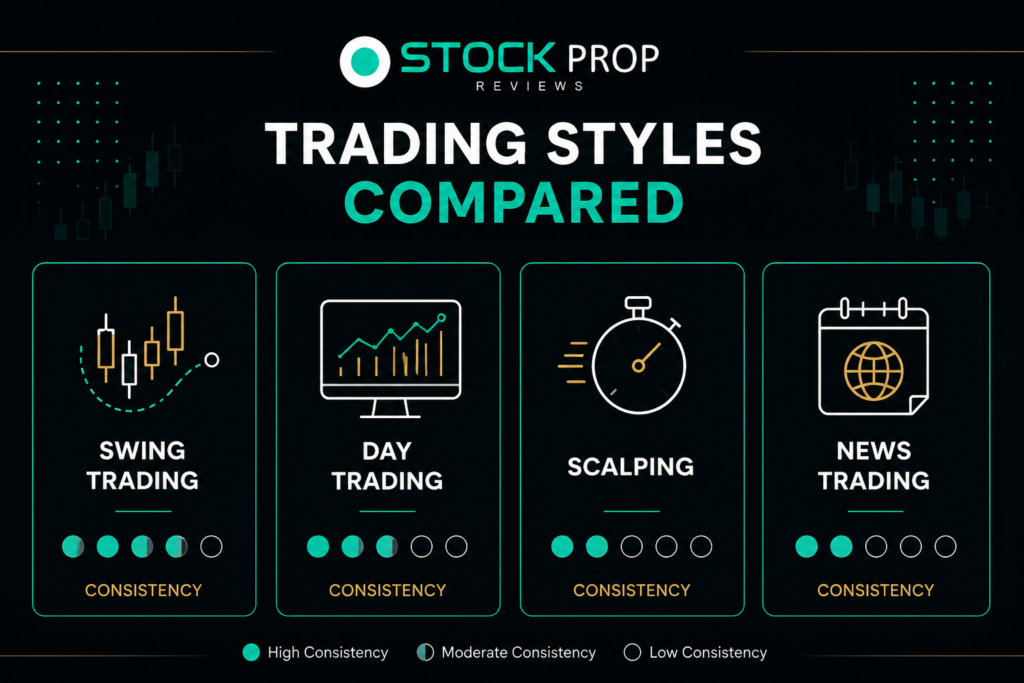
No trading style guarantees success, but some approaches naturally fit the structure of funded accounts better than others.
| Trading Style | Strengths | Challenges |
| Swing trading | Fewer trades, lower emotional pressure, easier to maintain discipline. | Overnight holding rules vary between firms. |
| Intraday trading | Good balance between opportunity and risk control. | Requires patience during slow sessions. |
| Scalping | Frequent opportunities and quick feedback. | Higher transaction frequency increases the chance of emotional trading and rule violations. |
| News trading | Can generate large moves quickly. | Many firms restrict or discourage this approach because of volatility. |
The important point isn’t choosing the “best” strategy. It’s choosing one you can execute consistently without constantly testing your firm’s risk limits.
What This Means for Beginners
Many beginners compare firms by account size or profit split. Those are important details, but they shouldn’t be the starting point.
A better question is whether the firm’s rules match your trading style.
For example, if you hold positions overnight, a firm with strict overnight restrictions may not suit you regardless of its payout percentage. If you rely on fast intraday moves, understanding how the firm calculates daily drawdown becomes much more important than whether it offers an 85% or 90% profit split.
Choosing the right firm is often about compatibility rather than finding the biggest headline number.
If you’re still comparing providers, our FTMO Review and FundedNext Review explain how their funding models, payout schedules, and risk rules differ. You may also find our comparison guide on FTMO vs FundedNext useful if you’re deciding between two of the industry’s most recognised firms.
Who Should Think Twice Before Buying a Challenge?
Prop trading isn’t suitable for every trader, and that’s perfectly fine.
If you need a guaranteed monthly income, a funded account probably isn’t the right solution. Trading income is inconsistent, even for professionals.
Likewise, traders who regularly ignore stop-losses or change strategies after a few losing trades should spend more time developing consistency before paying for evaluations.
A funded account amplifies both good habits and bad ones. If your process is already disciplined, funding gives you more buying power. If your process is inconsistent, funding simply makes those mistakes more expensive.
A Balanced View of Prop Firms
The prop trading industry has improved significantly over the past few years. Evaluation models are more competitive, payout schedules are generally faster, and traders have more choice than ever before.
At the same time, it’s worth remembering that no firm can remove the need for good decision-making.
Changing firms won’t solve poor risk management.
A higher profit split won’t fix emotional trading.
And a larger account won’t automatically lead to larger withdrawals.
Those lessons are easy to overlook because they aren’t as exciting as stories about six-figure payouts, but they are the ones that matter over the long run.
Considering Alternatives
If you like stocks better than forex or CFDs, you may want to check out companies that focus on stock trading, instead of making your strategy fit a model that’s meant for other markets.
TradeThePool is a regulated stock prop firm with full transparency on its trading rules and risk parameters. When comparing funding models, it’s worth comparing these to traditional forex focused firms rather than assuming all prop firms are the same.
Readers of StockPropReviews can receive up to a 10% discount when purchasing through our TradeThePool link. As with any funded account, the discount should be a secondary consideration. Understanding the rules and choosing a model that suits your trading style is far more important.
If you’re still deciding whether funded trading is the right path, our article discussing whether prop trading is worth it explores both the advantages and the limitations in more detail.
The Bigger Picture
The biggest lesson from the available data isn’t that large payouts are impossible. It’s that consistency is much rarer than marketing makes it appear.
Successful funded traders don’t usually have access to secret indicators or exclusive strategies. More often, they simply repeat the same process day after day without letting short-term results change their behaviour.
That isn’t a particularly exciting answer, but it’s one that shows up repeatedly across experienced traders.
When you stop chasing exceptional months and start protecting your ability to trade next month, withdrawals become a by-product of good execution rather than the sole objective.
For anyone entering the world of funded trading, that’s probably the most valuable mindset you can develop.
FAQs
How much do prop traders usually withdraw?
There isn’t an industry-wide average because firms don’t publish complete payout data. Many traders never reach a first withdrawal, while a smaller group earns regular payouts through disciplined risk management.
Why do some traders lose funded accounts after their first payout?
The most common reasons include increasing position size, breaking risk rules, overtrading, and trying to recover losses too quickly. The strategy often remains the same, but the trader’s behaviour changes.
Are large payout screenshots on social media realistic?
Some are genuine, but they represent exceptional results rather than the average funded trader’s experience. They show what is possible, not what is typical.
Does a higher profit split always mean higher earnings?
No. A trader who consistently earns profits with an 80% split can withdraw far more over a year than someone repeatedly losing funded accounts while chasing a 90% or 95% split.
What matters more than the profit split?
For most traders, long-term account survival matters more. Understanding drawdown rules, maintaining discipline, and following a repeatable trading process usually have a much greater impact on total withdrawals than a slightly higher payout percentage.