Most traders are only interested in passing a challenge but spend far less time working out what repeated prop firm challenge fees actually cost over several months. If you need multiple attempts, or you are still paying monthly subscription fees, a challenge that seems affordable on day one can become very expensive.
This guide is for traders who are considering a funded account and wondering if paying recurring challenge fees makes financial sense. This is not for the seasoned trader who is already consistently profitable and can easily afford the costs of evaluation as part of their trading business.
Rather than asking whether a challenge fee is cheap or expensive, a better question is whether the potential reward justifies the total cost and probability of success. This is where a lot of traders make bad choices.
What Are Prop Firm Challenge Fees?
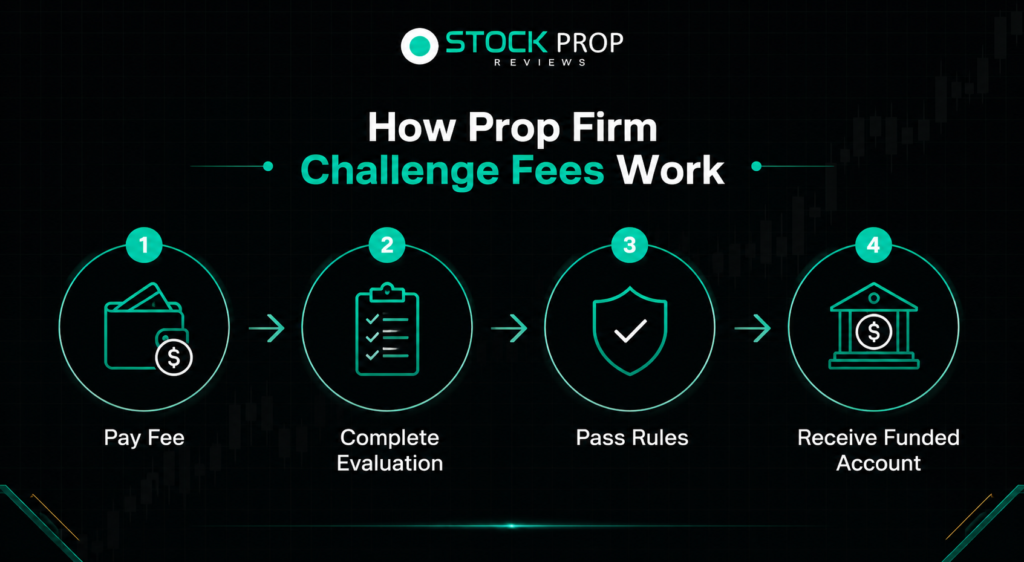
A prop firm challenge fee is the amount a trader pays to participate in an evaluation process before receiving access to funded capital.
The fee covers the firm’s evaluation, platform infrastructure, risk monitoring, and account administration. Depending on the firm, the payment may be a one-time purchase or a recurring monthly subscription until the challenge is completed.
Some firms refund the fee after a successful payout, while others keep it regardless of the outcome. That difference can significantly affect the true cost of getting funded.
The important point is that a challenge fee is not a deposit. It is a business expense that should be evaluated the same way a trader evaluates spreads, commissions, or data subscriptions.
Why Monthly Challenge Fees Feel Cheaper Than They Really Are
The price per month seems more affordable too because the initial payment is lower.
Instead of paying $500 up front, a trader could pay $80 or $100 a month. Psychologically it feels like less of a risk.
The problem is when the evaluation takes more time than expected.
A trader who takes the same challenge for six months may pay more than the price for a traditional one time evaluation.
Many beginners underestimate this because they only see the payment today and not the total payment over time.
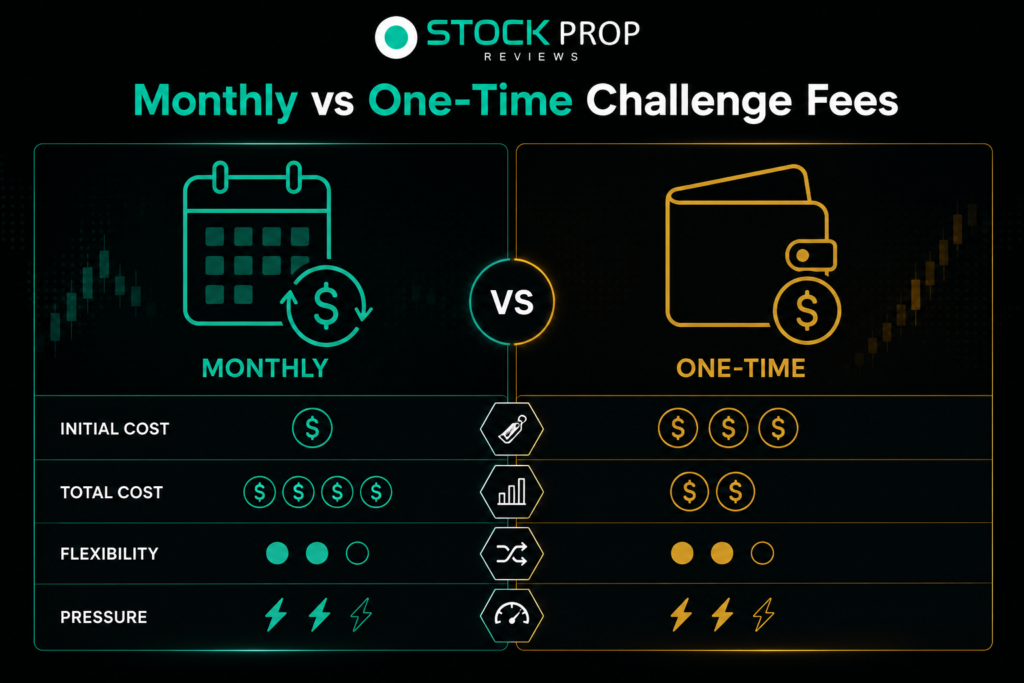
Cost vs Reward at a Glance
| Factor | Monthly Challenge Fees | One-Time Challenge Fee |
| Initial Cost | Lower | Higher |
| Long-Term Cost | Can increase quickly | Fixed |
| Budget Friendly | Yes | Sometimes difficult |
| Pressure to Finish Fast | Higher | Lower |
| Best For | Consistent traders | Traders needing more flexibility |
| Main Risk | Paying repeatedly | Larger upfront commitment |
Neither model is automatically better. The right choice depends on trading consistency and expected completion time.
The Real Cost Most Traders Ignore
Many articles compare challenge prices without discussing how traders actually behave during evaluations.
The biggest cost is rarely the fee itself.
It is the combination of:
- Multiple failed attempts
- Emotional decision-making
- Overtrading to finish before another payment
- Lost trading opportunities elsewhere
Imagine paying $95 each month.
After five unsuccessful months, you’ve spent $475 before reaching a funded account. If another firm offered a $450 one-time evaluation with a refund after passing, the supposedly cheaper option would actually cost more.
This is why experienced traders calculate expected cost instead of advertised price.
Practical Example
Consider two traders.
Trader A chooses a one-time challenge costing $450.
They pass after six weeks and receive a refund after their first payout.
Their effective evaluation cost eventually becomes close to zero.
Trader B joins a monthly challenge costing $95.
They fail twice, restart once, and finally pass after six months.
Total fees paid: $570.
Even though each monthly payment felt affordable, the total expense exceeded the one-time alternative.
This situation is surprisingly common among developing traders.
What Competitors Often Don’t Explain
Many comparison articles discuss fee size but overlook trader psychology.
Monthly billing changes behaviour.
As another payment date approaches, traders often feel pressure to complete the challenge quickly.
That pressure can lead to:
- Increasing position sizes
- Taking marginal setups
- Ignoring trading plans
- Holding losing trades longer
- Trading during unsuitable market conditions
Ironically, these behaviours reduce the chance of passing.
The challenge itself has not become harder. The trader has become less disciplined because of the payment structure.
Understanding this psychological effect is just as important as comparing prices.
Rules Matter More Than the Fee
A low challenge fee is meaningless if the trading rules are difficult to manage.
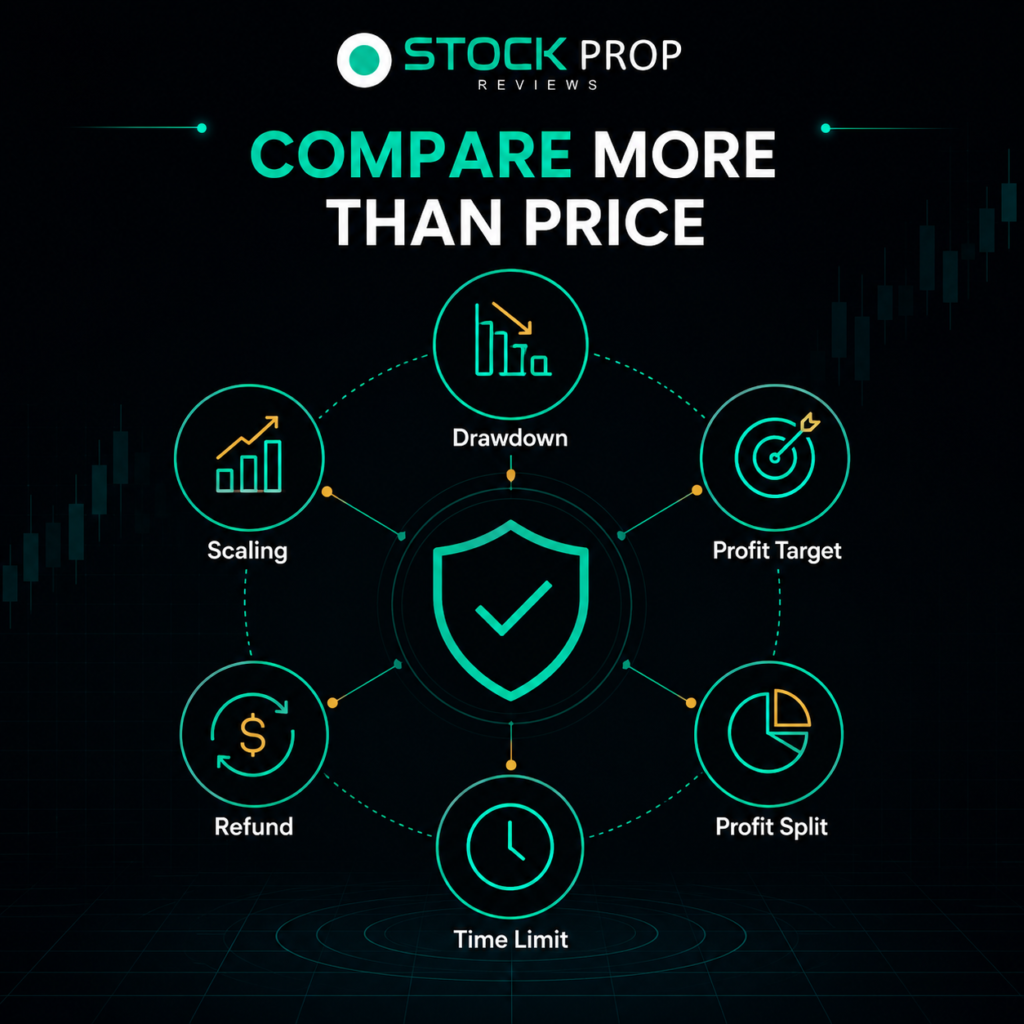
Before paying any evaluation fee, compare the complete rule set rather than the advertised price.
| Feature | Why It Matters |
| Maximum Drawdown | Determines total risk tolerance |
| Daily Drawdown | Limits daily losses |
| Profit Target | Defines evaluation difficulty |
| Profit Split | Affects long-term earnings |
| Time Limits | Influences trading style |
| Consistency Rules | Can restrict aggressive gains |
| News Restrictions | May affect strategy execution |
A trader paying slightly more for transparent rules may achieve better long-term results than someone chasing the lowest fee.
When Monthly Fees Make Sense
Monthly evaluations are not inherently bad.
They can work well for traders who:
Have a tested trading strategy.
Maintain strict risk management.
Expect to complete the evaluation within a short period.
Trade consistently rather than emotionally.
These traders treat the monthly payment as a normal operating expense instead of an investment they must recover immediately.
When Monthly Fees Become Expensive
Monthly challenges can be expensive since traders continue to restart the evaluation.
Some common reasons are:
Overtrading instead of waiting for good setups.
Too much risk after a string of losing trades.
Midway through the challenge, and changing tactics.
Not respecting the drawdown limits
Trying to get back losses fast.
Market conditions are not the cause of most failed evaluations.
They are caused by conflicting decisions.
Common Mistakes Traders Make
Many beginners believe that the only goal is passing fast.
That approach often results in poor performance.
Some traders increase position size simply because another monthly payment is due. Some abandon profitable strategies as being too slow to reach the profit goal.
Another frequent error is comparing challenge fees without taking into account refund policies, payout timelines, and account scaling opportunities.
The price on the ad rarely tells the whole story.
Best For and Worst For
| Best For | Worst For |
| Disciplined traders | Impatient beginners |
| Proven strategies | Strategy hoppers |
| Low-risk traders | Revenge traders |
| Traders with fixed routines | Emotional decision-makers |
The evaluation model should match your trading personality, not just your budget.
Alternatives Worth Considering
If you don’t want to pay a monthly fee there are other options.
Some companies also provide one-time assessments and refund fees after the first payout. Others have instant funding programs, but these tend to require bigger up-front payments and tighter risk controls.
Another alternative is to concentrate on firms with realistic profit targets, rather than just the lowest challenge cost. Paying a bit more for rules that can be achieved may give you more value in the long run.
Readers looking at different models may also find our review of a top forex prop firm, our review of a futures funding provider, and our comparison of one-step versus two-step evaluations helpful before deciding.
Does a Higher Fee Mean a Better Firm?
Not necessarily.
Some premium-priced firms offer excellent technology, responsive support, transparent rules, and reliable payouts.
Others simply charge more.
Likewise, some low-cost firms provide excellent value, while others compensate for cheap entry by imposing restrictive trading rules.
The challenge fee should never be evaluated in isolation.
Instead, consider:
- Rules’ transparency
- Reputation for past payouts
- Drawdown profile
- Platform stability
- Customer Service
- Refunds policy
- Opportunities to scale
Together, these factors determine whether the fee represents value.
A Balanced View on TradeThePool
For traders interested in stock trading rather than forex or CFDs, TradeThePool offers a regulated prop trading environment with clearly defined rules and transparent risk management.
It is worth comparing its evaluation model with other firms before making a decision. Readers can get up to 10% discount when purchasing through our TradeThePool link. That should be viewed as a cost saving rather than a reason to choose the firm.
The trading rules and account structure should always remain the deciding factors.
Should You Pay Monthly Challenge Fees?
There is no universal answer.
For disciplined traders who consistently follow a tested strategy, monthly challenge fees can be an affordable path toward funding.
For traders still learning risk management, recurring payments can quietly become one of the largest expenses in their trading journey.
The smartest approach is to estimate how long you realistically expect to complete the evaluation. Multiply the monthly fee by that timeframe, compare it with one-time alternatives, and then decide which option offers better value.
Looking only at the advertised monthly price rarely tells the full story.
If you’re still researching, it also helps to read our breakdown of realistic payout expectations, our comparison of leading prop firm evaluation models, and our analysis of the truth behind funded account success rates before committing to any challenge.
A well-chosen evaluation can support your trading career. A poorly chosen one can become an expensive lesson, even before your first funded payout.
FAQs
Are prop firm challenge fees refundable?
Some firms refund the evaluation fee after a trader receives their first payout, while others never refund it. Always read the firm’s refund policy before purchasing a challenge.
Are monthly challenge fees cheaper than one-time fees?
They can be cheaper initially, but repeated monthly payments may eventually exceed the cost of a one-time evaluation if the challenge takes longer than expected.
Do higher challenge fees improve the chances of getting funded?
No. The fee does not determine your chances of success. Your trading discipline, risk management, and ability to follow the firm’s rules have a much greater impact.
Should beginners choose monthly evaluations?
It depends on their consistency. Beginners who are still changing strategies or struggling with risk management may end up paying more through repeated monthly subscriptions.
What should I compare besides the challenge fee?
Examine drawdown limits, profit targets, refund policies, payout history, scaling plans, trading restrictions and overall transparency of the firm. For long-term profitability, these factors are often more important than the fee itself.