
A funded account allows traders to increase their buying power without risking large amounts of their own capital, and this is what attracts many aspiring traders to prop firms. The question is, is it realistic to make $ 5,000 / month consistently?
The short answer is yes, but only insofar as the percentage of disciplined traders is small.
If you are looking for easy income after passing one challenge, this article is not for you. If you want the realistic breakdown of what it takes, how the payouts actually work, and why so many funded traders never reach that income level, keep reading.
No promises. No marketing. We talk about trading math, risk management and the truths your competitors don’t want you to know.
Quick Verdict
You can make $5,000 a month with prop firms, but it’s not something most traders can do consistently in their first year.
Success depends on several factors:
| Factor | Impact on Monthly Income |
| Account size | Higher buying power creates more earning potential |
| Profit split | Determines how much you actually keep |
| Drawdown rules | Limits how aggressively you can trade |
| Trading consistency | More important than occasional big wins |
| Emotional discipline | Often separates funded traders from failed ones |
Most traders fail because they focus on income goals instead of executing a repeatable trading process.
What Does It Mean to Earn Money From Prop Firms?
A proprietary trading firm provides capital to traders who pass its evaluation process. Instead of depositing tens of thousands of dollars yourself, you trade the firm’s account under predefined rules.
When profitable, profits are shared according to the firm’s payout model.
For example:
- Account size: $100,000
- Monthly return: 8%
- Gross profit: $8,000
- 80% profit split
- Trader payout: $6,400
So the example looks very attractive on paper. But it is much harder to maintain an 8% return per month while respecting drawdown restrictions than many ads would lead you to believe.
The Numbers Behind a $5,000 Monthly Income
Many articles simply state that larger funded accounts produce larger payouts.
The missing part is understanding the required performance.
Here’s an example using common industry profit splits.
| Funded Account | Monthly Return | Profit Split | Approximate Trader Income |
| $50,000 | 10% | 80% | $4,000 |
| $100,000 | 6.25% | 80% | $5,000 |
| $150,000 | 4.2% | 80% | $5,040 |
| $200,000 | 3.1% | 80% | $4,960 |
Notice something important.
The larger the account, the lower the percentage return needed to reach the same income.
However, larger accounts also come with stricter discipline because breaking drawdown rules usually means losing the account regardless of previous profits.
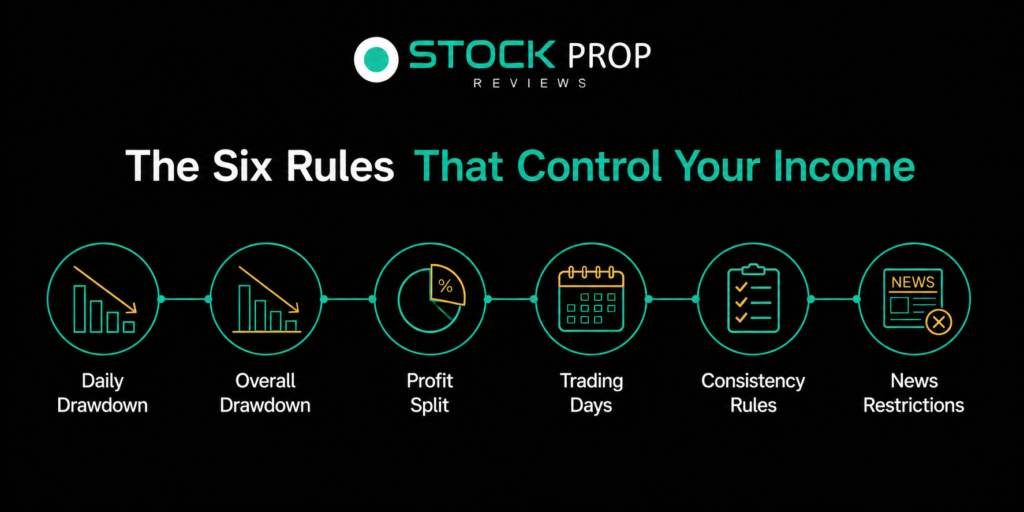
Rules That Affect Your Earnings
The account balance alone never tells the full story.
These rules determine whether reaching $5,000 is practical.
| Rule | Why It Matters |
| Maximum daily drawdown | Prevents large losing days |
| Overall drawdown | Protects the firm’s capital |
| Profit split | Directly affects take-home income |
| Minimum trading days | Delays payouts |
| Consistency rules | Restrict oversized winning trades |
| News restrictions | May eliminate high-volatility opportunities |
Many traders calculate potential profits without considering these limitations.
That creates unrealistic expectations.
Real Trading Scenario
Imagine two funded traders.
Trader A makes $9,000 in one week but violates the daily drawdown rule after giving profits back.
Final payout: $0
Trader B earns only $1,500 each week while keeping risk consistent.
After four weeks:
- Weekly profits: $6,000
- 90% payout
- Trader receives $5,400
The second trader earns less per trade but actually gets paid.
This is closer to how long-term funded traders operate.
Why Most Traders Never Reach $5,000
Passing an evaluation is only the beginning.
The real challenge starts once the account is funded.
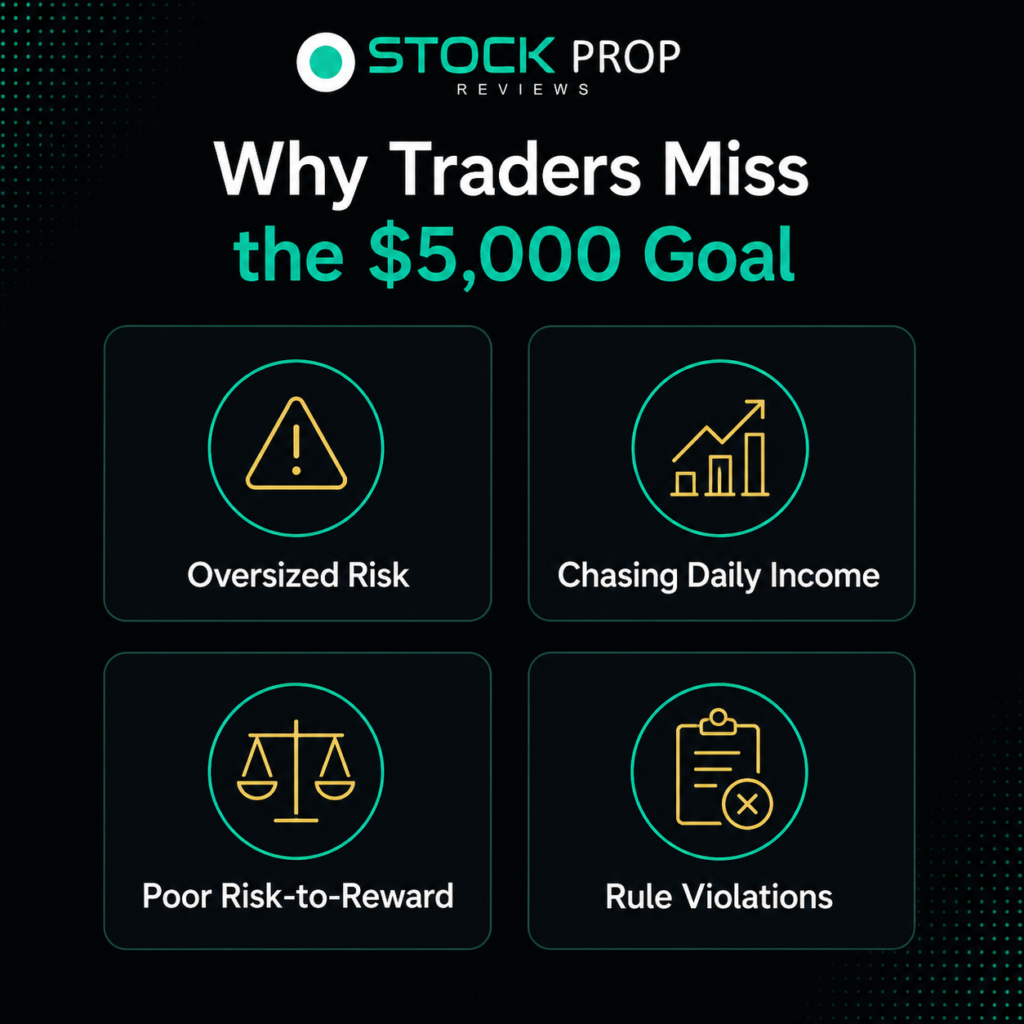
Several patterns appear repeatedly among traders who lose funded accounts.
Trading Too Aggressively
Many traders tend to up position size after a few winning trades.
Instead of protecting profits, they try to grow accounts faster.
One emotional trading session can break drawdown rules
Chasing Daily Income
Professional traders think in probabilities.
Struggling traders often think in daily salary targets.
The market does not provide identical opportunities every day.
Forcing trades usually leads to unnecessary losses.
Ignoring Risk-to-Reward
Many funded traders become obsessed with winning percentage.
In reality, a trader winning only half of their trades can still be profitable with proper risk management.
Breaking Firm Rules
This remains one of the biggest reasons funded accounts disappear.
Copy trading, prohibited strategies, overnight holding restrictions, and consistency requirements often cause avoidable failures.
What Competitors Usually Don’t Explain
Many articles discuss potential gains, but they shy away from the issue of sustainability.
Three important realities need more attention.
First, withdrawals are rarely the same from month to month.
Professional traders have profitable months, slower months and sometimes even losing periods.
Secondly, scaling programs requires time.
It usually takes months of consistent performance to go from one funded account to managing several accounts.
Finally, bigger payouts mean more psychological pressure.
Making $500 is a very different feeling than running positions that can make or lose thousands of dollars.
The technical approach is usually the same.
The emotional challenge is far greater.
Can Beginners Reach $5,000 Per Month?
Eventually, yes.
Immediately after becoming funded?
Usually not.
Beginners often underestimate how long it takes to build consistency.
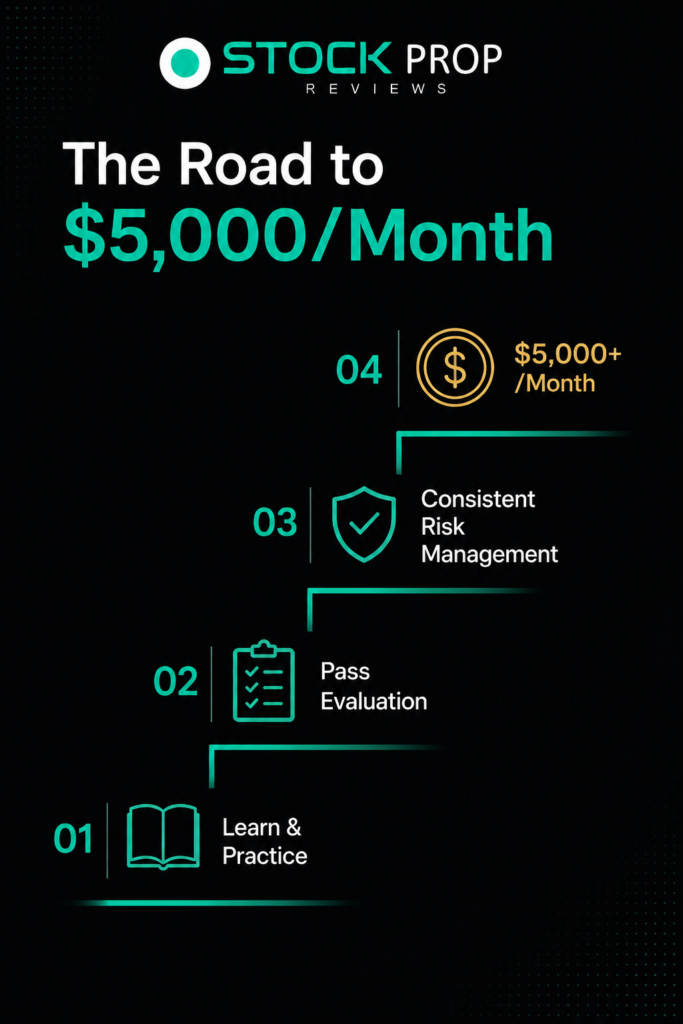
A realistic progression might look like this:
- first six months: Learning implementation and risk control
- Six to twelve months: Continual passing marks.
- Twelve months and beyond: Building multiple funded accounts, improving consistency.
Some traders move faster.
Many take longer.
There is no standard timeline.
Strategy Fit
Different trading styles produce different income profiles.
| Trading Style | Suitable for $5,000 Goal? | Reason |
| Swing trading | Good | Fewer trades with larger moves |
| Day trading | Good | Consistent opportunities if disciplined |
| Scalping | Mixed | Spread and execution become critical |
| News trading | Often limited | Many firms impose restrictions |
| Revenge trading | Poor | Frequently violates risk rules |
The best strategy is usually the one that remains consistent under the firm’s rules.
Should You Depend on Prop Firm Income?
For most traders, no.
At least not initially.
Funded trading income is variable.
Some months exceed expectations.
Others produce little or no payout.
Treating prop trading as a guaranteed salary creates unnecessary pressure that often hurts performance.
Many experienced traders first build several months of consistent withdrawals before relying on prop income for living expenses.
Who Should Avoid Trying to Earn Money From Prop Firms?
Funded trading is not suitable for everyone.
You should probably avoid prop firms if you:
- Want steady monthly income.
- Often revenge trade after you lose.
- Do not exchange journals.
- Change tactics all the time.
- Unable to follow predetermined risk rules.
A funded account amplifies both good and bad trading habits.
Alternatives Worth Considering
Not every trader needs the same type of funded account.
Depending on your goals, these options may fit better.
If you prefer forex and CFDs, read our detailed FundingPips review to understand its evaluation rules and payout structure.
If lower evaluation costs matter more, our FunderPro review explains how its funding model differs from competitors.
If you’re unsure which model suits your trading style, our comparison of instant funding versus challenge-based prop firms breaks down the major differences.
For traders questioning whether funded trading is still worthwhile, our guide on the truth about prop firm payouts explores both the opportunities and limitations.
Where TradeThePool Fits
TradeThePool is a little different though, which is good if you’re more into stock trading than forex or CFDs.
It’s a regulated stock prop firm with clear trading rules and defined risk limits, which many traders like if they’re trying to build long-term consistency.
Readers can get up to 10% discount when buying through our TradeThePool link.
Never let price be the determining factor. Always check if the firm’s rules fit with your trading strategy before purchasing an evaluation.
FAQs
Can you make $5,000 per month from prop firms?
Yes, but it usually requires a sufficiently large funded account, consistent profitability, strict risk management and several months of successful trading. Most funded traders don’t get to this stage straight away.
What size funded account will I need?
There is no single answer. Many traders will aim for $100,000 or more in their accounts, but the size of account you need depends on your average monthly return and your profit split.
Can beginners replace a full time income from prop firms?
Not usually. If you are a beginner, do not think about funded trading as your main source of income right away. First, you should learn to be consistent.
What is the biggest reason traders lose funded accounts?
One common reason is the violation of the drawdown rules. Account terminations usually stem from emotional decisions, large positions and inconsistent risk management.
Do I need to have several funded accounts?
Not necessarily. Some of the more experienced traders make a good living from one big account, others spread across a number of firms to increase capital and lessen the reliance on one firm.
Final Thoughts
The possibility to earn money from prop firms is real, but the path is rarely as simple as promotional content suggests.
A $5,000 monthly payout is achievable for disciplined traders who consistently protect capital, respect firm rules, and think in terms of long-term probabilities rather than short-term income targets.
The traders who succeed usually have one thing in common.
They stop chasing monthly income and focus instead on executing the same high-quality process every trading day.