
Most prop firm scaling plans promise an easy road to bigger accounts and bigger paychecks. That seems like a good idea. Trade consistently, stick to the rules and your buying power increases over time, without having to add your own capital.
But the reality is more complex.
The scaling plans are real but the income that is often expected by traders is not. A scaling plan is only valuable if you can reliably protect capital and profit over months, not days.
This guide is for traders who are thinking about a funded account and for traders who are trading a funded account already. It also helps anyone comparing firms by long term earning potential, not just challenge fees.
Not for traders who want quick income or expect every profitable month to automatically unlock a bigger account.
What Are Prop Firm Scaling Plans?
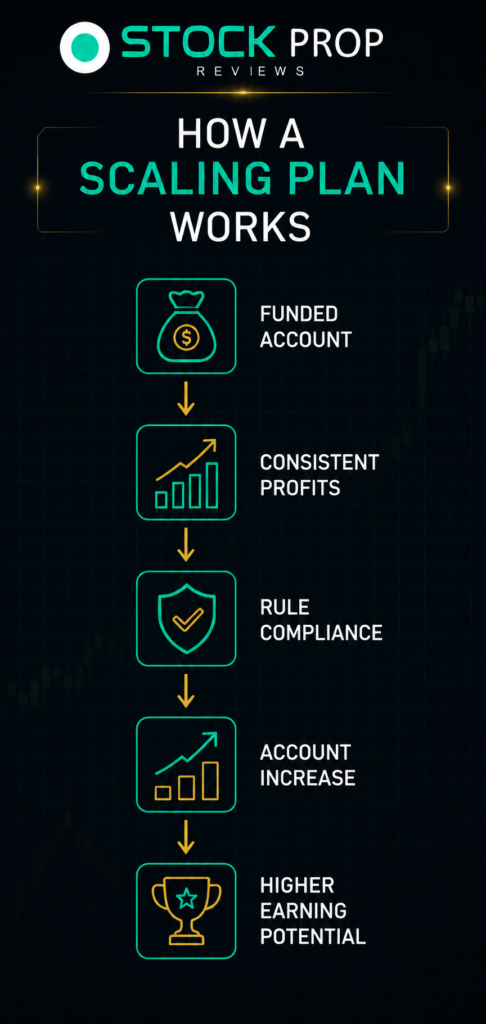
A prop firm scaling plan is a structured program that increases a trader’s account allocation after meeting predefined performance milestones.
Most firms require traders to:
- Maintain profitability for several payout periods.
- Avoid violating drawdown rules.
- Demonstrate disciplined risk management.
- Continue following all account rules.
If those conditions are met, the firm increases the account size, allowing larger position sizes and potentially larger payouts.
The important detail many advertisements skip is that scaling is earned through consistency, not simply making one large winning trade.
How Prop Firm Scaling Plans Actually Work
Although every firm has different rules, the structure is usually similar.
| Feature | Typical Requirement |
| Profit target | Consistent positive returns |
| Trading period | Multiple payout cycles |
| Maximum drawdown | Must stay within limits |
| Rule violations | Usually none allowed |
| Account growth | Percentage increase after milestones |
| Profit split | May stay the same or improve |
A trader might begin with a $50,000 funded account and gradually qualify for larger allocations after meeting performance benchmarks over several months.
Notice that time is usually part of the equation. Scaling rarely happens after one exceptional week.
Why Scaling Income Looks Bigger in Marketing Than Reality
This is where expectations often become unrealistic.
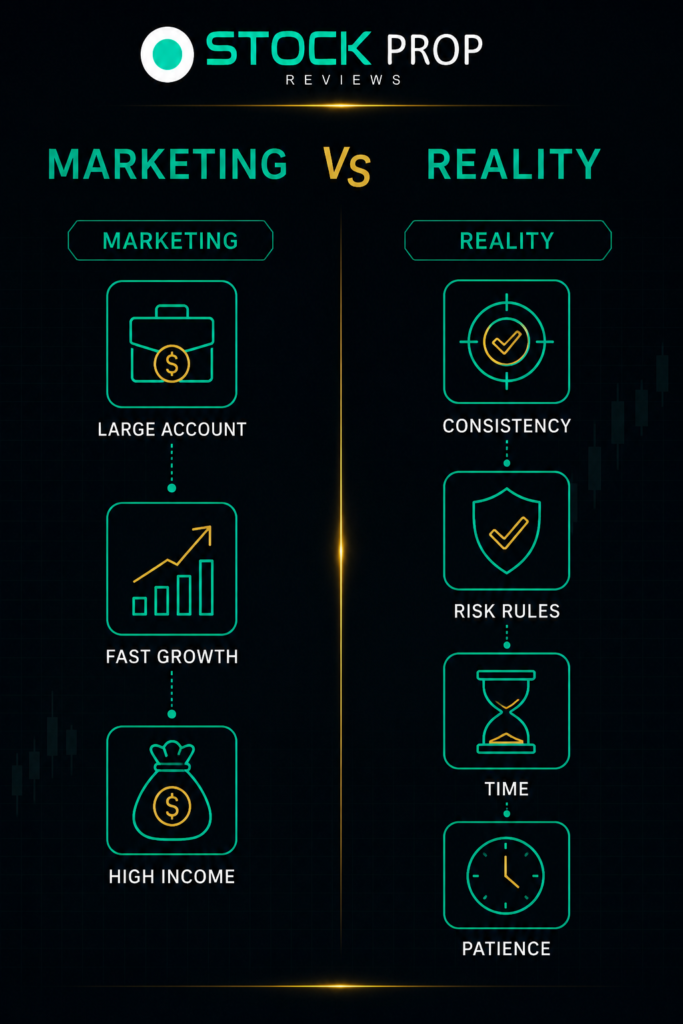
Many promotional pages highlight the maximum possible account size. A trader sees headlines about reaching several hundred thousand dollars or even seven-figure buying power.
What they rarely explain is the path required to get there.
Between the starting account and the largest allocation, traders must survive months of disciplined execution without breaking risk rules.
A few difficult trading weeks can reset progress or eliminate the account entirely.
That doesn’t make scaling plans misleading. It simply means the advertised destination is much easier to market than the journey.
The Biggest Misunderstanding About Prop Firm Scaling Plans
Many beginners believe scaling means guaranteed income growth.
It does not.
A larger account only increases earning potential. It also increases psychological pressure.
Imagine two traders.
Trader A earns 5% on a $50,000 account.
Trader B earns 5% on a $200,000 account.
The second trader makes significantly more money, but only because they maintained the same discipline despite managing a much larger allocation.
Many traders discover that keeping the same emotional control becomes harder as account size increases.
Real Trading Scenarios Where Scaling Breaks Down
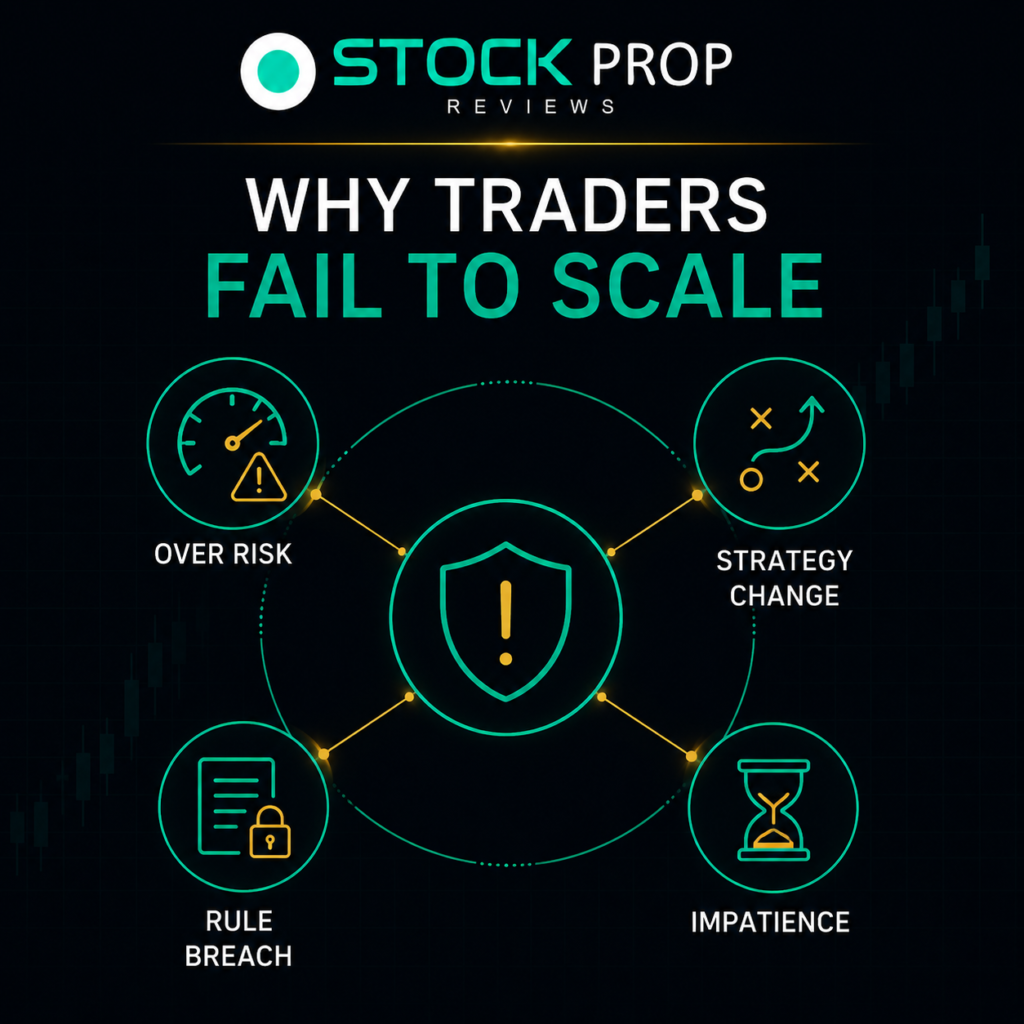
Scaling plans usually fail because trader behavior changes.
One common scenario is increasing risk too early.
A trader performs well for several months, gets closer to the next scaling milestone, then begins taking larger positions to speed up the process.
Instead of qualifying for a larger account, they exceed daily drawdown and lose funding.
Another scenario involves payout withdrawals.
Some traders withdraw every available dollar while expecting rapid account growth.
In reality, consistent performance often matters more than maximizing every payout.
There is also the problem of strategy drift.
The approach that worked on a smaller account may be abandoned as traders begin chasing larger monthly profits.
That change often destroys the consistency required for scaling.
What Most Competitors Don’t Explain
Many articles describe scaling, but miss several practical realities.
First, scaling does not remove risk.
Drawdown limits still apply to higher buying power. Having a bigger account doesn’t mean you should trade bigger.
Second, scaling rewards survival as well as profitability.
Many funded traders that do make it are making small monthly returns and avoiding large losing periods.
Third, the size of an account is not the same as personal earnings.
Traders don’t actually take home the full amount after taxes, profit splits, payout schedules and periods without profits.
Finally, more often than not, consistency beats spectacular returns.
Professional traders know this. And marketing pages often don’t point it out.
Comparing Different Types of Scaling Plans
Not every scaling program rewards traders in the same way.
| Feature | Aggressive Scaling | Conservative Scaling |
| Account growth | Faster | Slower |
| Performance requirements | Higher | More gradual |
| Psychological pressure | Higher | Lower |
| Risk of setbacks | Greater | Lower |
| Best suited for | Experienced traders | Consistent traders |
Neither model is universally better.
A conservative scaling plan may ultimately produce better long-term results because traders are less tempted to force performance.
Best Traders for Scaling Plans
Scaling plans work best for traders who:
- Use one proven strategy.
- Always respect risk limits for each trade session.
- Embrace incremental account growth.
- Think in months not days
These traders usually understand that protecting capital comes before maximizing returns.
Who Should Avoid Prop Firm Scaling Plans?
Scaling plans may not be suitable if you:
- Frequently switch trading strategies.
- Depend on trading income immediately.
- Regularly exceed your planned risk.
- Prefer high-risk, high-reward trading styles.
For these traders, the pressure of maintaining eligibility can become a disadvantage rather than an opportunity.
Sometimes a smaller funded account with steady withdrawals is the more practical choice.
Strategy Fit Analysis
Different trading styles interact with scaling plans differently.
Swing traders often benefit because they typically take fewer, higher-quality setups and avoid excessive trading.
Day traders can perform well if they maintain strict daily risk limits.
Scalpers may face greater challenges when firms enforce minimum holding times, consistency rules, or strict daily drawdown limits.
News traders should pay particular attention to restrictions around major economic events, as some firms limit or prohibit trading during high-volatility announcements.
The best scaling plan is the one that aligns with your existing strategy rather than forcing you to change how you trade.
Are Prop Firm Scaling Plans Worth It?
Yes, but only under the right expectations.
Scaling plans create genuine opportunities for traders who consistently manage risk over long periods.
They are less valuable for traders searching for rapid income growth.
The difference between marketing and reality is simple.
Marketing focuses on the maximum account.
Professional traders focus on the probability of reaching it.
That mindset often determines who eventually qualifies for larger allocations.
Alternatives to Chasing Scaling Plans
Some traders may achieve better long-term results through different approaches.
One option is trading a smaller funded account with consistent withdrawals instead of constantly pursuing larger allocations.
Another approach is managing multiple funded accounts across different firms, provided doing so complies with each firm’s terms.
For stock traders, TradeThePool offers a regulated stock prop trading environment with clearly defined rules and transparent risk parameters. Readers can get up to 10% discount when purchasing through our TradeThePool link. The focus should remain on whether the firm’s rules fit your strategy rather than the size of its scaling promise.
Quick Verdict
Prop firm scaling plans are legitimate, but they should not be viewed as guaranteed income programs.
Their value depends almost entirely on the trader.
Consistent execution, disciplined risk management, and patience matter far more than ambitious marketing claims.
Before choosing a firm, spend as much time evaluating the scaling requirements as you do comparing challenge fees or profit splits.
If a firm’s growth path matches your trading style, a scaling plan can become a meaningful long-term advantage instead of just another advertising headline.
If you’re interested in stock-centric prop trading, TradeThePool is still worth a look, with its transparent rule structure and regulated operating model. Readers can also get up to 10% discount when buying through our TradeThePool link if it fits their trading goals.
You may also find it useful to read ourFTMO review andFundedNext review to compare how different firms approach account growth. Our comparison of FTMO vs FundedNext highlights differences in funding models, while our article on the truth about prop firm payout claims explores another area where marketing often creates unrealistic expectations.
FAQs
Are prop firm scaling plans guaranteed?
None of the scaling plans are performance-based. Traders need to achieve profit targets at all times, and stay within all risk rules.
Can beginners realistically reach the largest account size?
Some do, but most beginners underestimate the consistency required. Building experience on smaller allocations usually produces better long-term results.
Do all prop firms offer scaling plans?
No. Some firms focus only on funded accounts without account growth programs, while others make scaling a core feature.
Is a larger funded account always better?
Not necessarily. Larger accounts increase earning potential but also increase psychological pressure and require the same disciplined risk management.
Should a scaling plan influence which prop firm I choose?
It should be one factor, but not the only one. Evaluate drawdown rules, payout policies, trading restrictions, and whether the firm’s structure fits your trading strategy before deciding.