The question most traders seeking funded account income want an answer to is a simple one: how much money can a $25,000 funded account realistically make every month?
The honest truth is that most consistent traders make far less than the social media screenshots imply. Disciplined traders with strict risk management will make several hundred to a few thousand dollars a month. Aggressive traders will blow their funded accounts before they get paid multiple times.
This guide is for aspiring and funded traders looking for realistic income expectations. This is not for anyone looking for a guaranteed monthly return or someone looking to earn a full-time salary right after getting a funded account.
What Is Funded Account Income?
Funded account income is the share of trading profits paid to a trader after successfully trading capital provided by a proprietary trading firm.
Unlike personal trading, the trader does not own the account balance. Instead, they receive an agreed percentage of profits, usually between 70% and 90%, provided they stay within the firm’s trading rules.
For a $25,000 funded account, your monthly income depends on five factors:
- Monthly return
- Profit split
- Maximum drawdown
- Trading consistency
- Whether you keep the account long enough to receive payouts
The account size alone tells you very little.
Quick Verdict
A $25K funded account can give a meaningful side income for disciplined traders but will seldom replace a full time salary in the first year.
Many traders underestimate the impact of drawdown limits, losing streaks, payout schedules and psychological pressure, and overestimate returns. Traders who stay funded tend to focus on capital preservation rather than maximizing monthly gains.
Monthly Income Examples
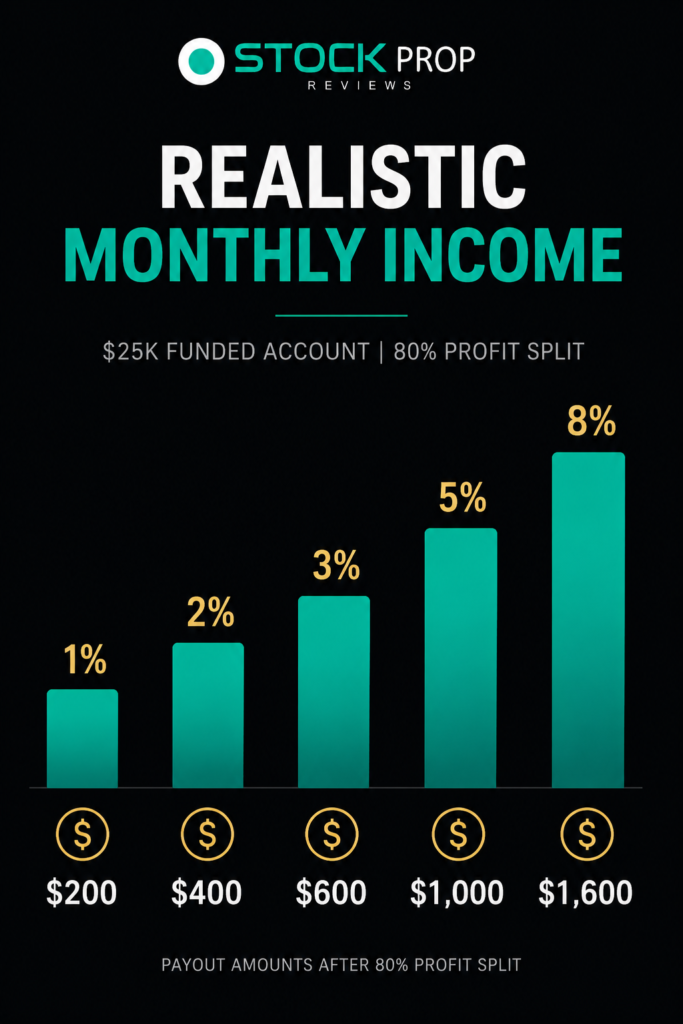
The table below assumes an 80% profit split.
| Monthly Return | Gross Profit | Trader Payout |
| 1% | $250 | $200 |
| 2% | $500 | $400 |
| 3% | $750 | $600 |
| 5% | $1,250 | $1,000 |
| 8% | $2,000 | $1,600 |
These numbers assume every profit qualifies for payout and no rules are violated.
In reality, the results are usually lower, as traders have losing weeks, smaller position sizes after drawdowns, and sometimes delays in payouts.
Why Most Traders Never Reach These Numbers
Competitors often focus on profit potential without discussing account survival.
The biggest challenge is not making 5% in a month.
It is repeating that performance while staying inside every trading rule.
A typical funded trader may experience:
- Several consecutive days of losing
- Lower confidence following draws
- Fear of breaking max daily loss limits
- Over-trading to recoup losses
- Lower quality trade selection and emotional decisions
These factors reduce long-term funded account income far more than market conditions.
Rules That Directly Affect Your Income
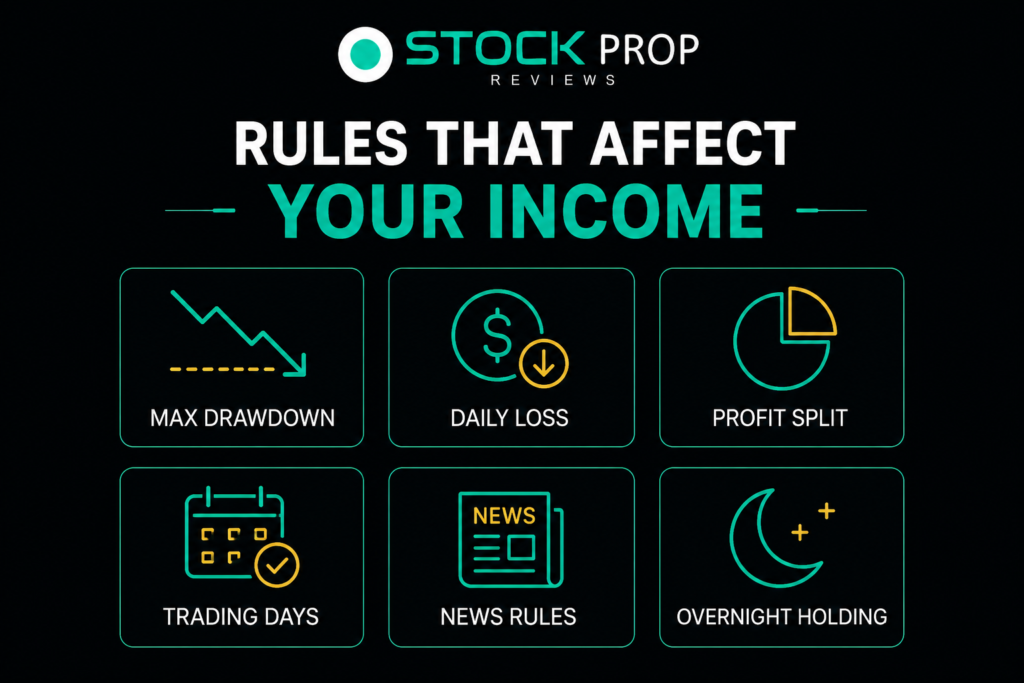
Every prop firm structures its rules differently, but several limits have the biggest impact on monthly profitability.
| Rule | Why It Matters |
| Maximum drawdown | Determines how much losing you can survive |
| Daily drawdown | Prevents recovery through aggressive trading |
| Profit split | Directly affects take-home income |
| Minimum trading days | Can delay withdrawals |
| News restrictions | May eliminate high-volatility opportunities |
| Overnight holding rules | Limits certain swing trading strategies |
Many new traders calculate expected income without considering how these restrictions affect execution.
A Realistic Trading Scenario
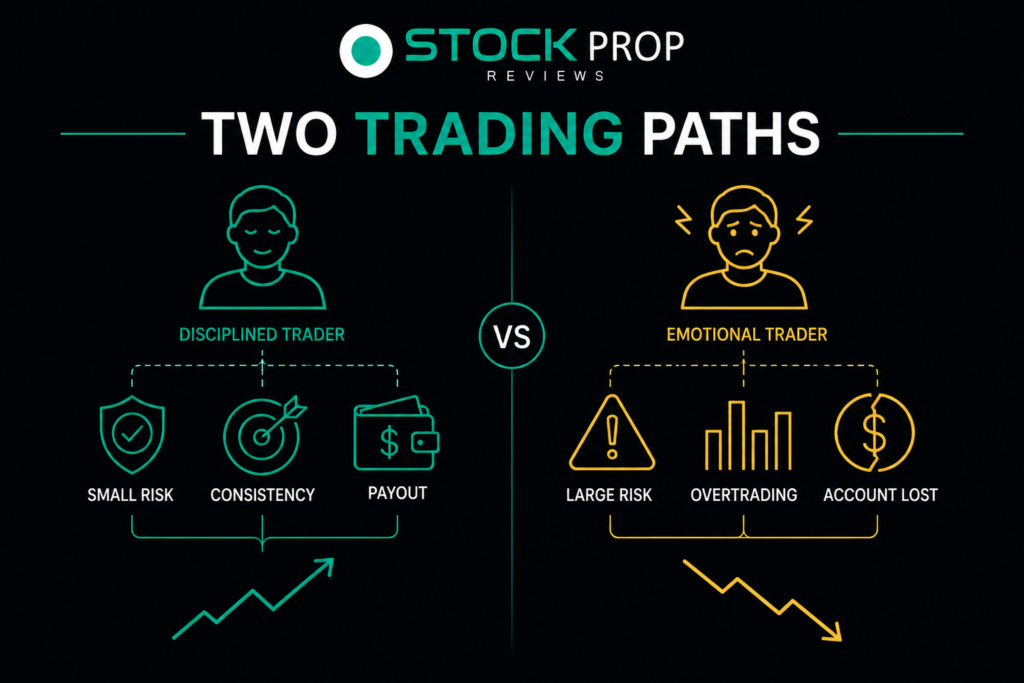
Consider two traders using identical $25K funded accounts.
Trader A
- Risks 0.25% per trade
- Wins 48% of trades
- Average reward-to-risk ratio of 2:1
- Trades selectively
- Accepts small losing weeks
After one month, the account finishes up roughly 4%.
After an 80% split, the trader receives around $800.
Trader B
- Risks 2% per trade
- Increases size after losses
- Trades during every market session
- Chases daily profit goals
The trader reaches the daily drawdown after several bad trades and loses the funded account before receiving another payout.
Both traders had similar market opportunities.
Only one managed risk properly.
What Competitors Often Don’t Explain
There are a lot of articles that calculate income based on ideal monthly returns but leave out a number of practical considerations.
Consistency Matters More Than One Great Month
Generating one exceptional payout is easier than producing twelve profitable months.
Professional funded traders think in annual performance rather than monthly excitement.
Drawdown Reduces Future Earnings
A trader down 6% usually cannot continue trading exactly the same way.
Position sizes often become smaller, reducing future income potential.
Psychology Becomes Harder After Your First Payout
Ironically, receiving your first withdrawal creates additional pressure.
Many traders become overly cautious because they fear losing future payouts.
Others become overconfident and violate risk limits.
Both mistakes reduce long-term profitability.
Common Mistakes That Destroy Funded Account Income
Most failed funded accounts are not caused by poor market analysis.
They fail because traders ignore risk.
The most common mistakes include:
Trading too large
Increasing position size to accelerate income usually ends with a drawdown violation.
Treating payouts like a salary
Markets do not produce identical monthly returns.
Some months naturally generate fewer opportunities.
Ignoring expectancy
Winning percentage alone means little.
A trader winning 45% of trades with strong reward-to-risk ratios can outperform someone winning 70% with poor trade management.
Breaking firm rules
Even profitable trades can become worthless if they violate trading conditions.
Strategy Fit Analysis
Best for
A $25K funded account works well for traders who:
- Already follow a written trading plan
- Understand position sizing
- Focus on consistency
- Accept modest monthly returns
Worst for
It is less suitable for traders who:
- Need immediate full-time income
- Frequently revenge trade
- Constantly change strategies
- Depend on high leverage
- Ignore risk management
Can You Earn a Full-Time Living?
Technically yes.
Practically, not immediately.
Suppose a trader consistently earns 5% every month.
That produces approximately $1,000 after an 80% split.
While impressive, this income may not cover living expenses in many countries.
Professional funded traders often scale gradually by managing multiple funded accounts instead of expecting one $25K account to provide financial independence.
The Psychology Behind Sustainable Income
Many traders believe skill alone determines profitability.
Experience suggests psychology matters just as much.
The traders who survive multiple payout cycles usually:
- Take your losses small and fast.
- Forget cheap set-ups.
- Don’t chase monthly goals.
- Think of trading as probability, not certainty.
Ironically, when traders stop concentrating on monthly income they often become more profitable.
Comparing Different Return Expectations
| Monthly Goal | Realism | Long-Term Sustainability |
| 1% | Very realistic | High |
| 2% | Realistic | High |
| 3% | Achievable | Moderate to High |
| 5% | Difficult but possible | Moderate |
| 8% or higher | Rare over long periods | Low |
Higher returns almost always require higher risk.
The question is whether those returns remain repeatable without violating firm rules.
Should Beginners Expect High Funded Account Income?
Probably not.
New funded traders should focus on learning to protect the account first.
The first objective should be staying funded for several months rather than maximizing the first payout.
A trader who earns modest but consistent profits usually has a much stronger long-term outlook than someone chasing exceptional monthly returns.
Alternatives Worth Considering
Different traders benefit from different funding models.
If a traditional $25K account does not fit your strategy, consider:
- Smaller evaluation accounts that allow gradual scaling.
- Instant funding programs with simpler evaluation requirements.
- Regulated stock-focused firms for traders who prefer equities over forex or CFDs.
For stock traders seeking greater regulatory oversight, TradeThePool offers a transparent funded model with clearly published trading rules and risk parameters. Readers can get up to 10% discount when purchasing through our TradeThePool link. The focus should still be on understanding the rules rather than assuming any funded account guarantees income.
Additional Resources
Also if you are researching funding firms it helps to look at independent prop firm reviews rather than just marketing materials. You can read detailed reviews of FTMO, FundedNext and other firms to see how they compare in terms of drawdown rules, payouts and trading restrictions.
Our prop firm comparison guide lets you compare the different funding models before making a decision.
And finally, traders often find it useful to read opinion pieces that explain why passing a challenge is only the beginning, and why maintaining a funded account is usually much harder than earning one.
FAQs
What realistic funded account income can I expect from a $25K account?
Many regular traders make $200-$1000 a month after splitting the profits depending on their strategy, market conditions and risk management.
Is a $25K funded account sufficient to replace a salary?
No, for most traders. It can be a nice source of additional income but to replace a full time salary you are generally looking at larger capital allocations or multiple funded accounts.
How much should I be earning each month?
Most experienced traders believe 2% to 5% per month is achievable with disciplined risk management.
Why do successful traders still blow up their funded accounts?
Most account failures are not due to poor analysis of the market. They are caused by breaking the drawdown rules, scaling into losses, trading emotionally, or ignoring firm-specific limitations.
Should stock traders choose TradeThePool?
TradeThePool is a regulated stock prop firm with transparent risk management and clear rules for trading. Readers can receive up to 10% discount when purchasing from our TradeThePool link. Like any prop firm, traders should read through the rules and make sure they fit their trading style before signing up.