While many traders are focused on passing a challenge, they never ask a more important question, when is a prop trading career really profitable? Break even analysis answers that question by comparing all you invest with what you realistically earn over time.
This guide is for traders that want to get funded, traders considering proprietary trading and traders that pay for evaluations. This is not for traders seeking quick money or guaranteed returns. One payout doesn’t make a prop trading career, consistency does.
Prop trading is not the same as a normal trading account . There are other costs involved such as evaluation fees , resets , platform subscriptions , and time spent preparing for evaluations . Armed with this knowledge, traders can decide whether the time and money spent on chasing funding is worth it.
Quick Verdict
A prop trading career becomes financially worthwhile only after your cumulative payouts exceed every cost associated with getting funded and staying funded. For many traders, this takes several months rather than several weeks.
The biggest mistake is assuming that passing one evaluation means you’ve already succeeded. In reality, the evaluation is simply the beginning of a much longer process.
What Is Break-Even Analysis in a Prop Trading Career?
Break-even analysis measures the point where total earnings equal total costs.
For a proprietary trader, this means adding together every expense involved in becoming and remaining funded, then comparing those costs with actual withdrawals.
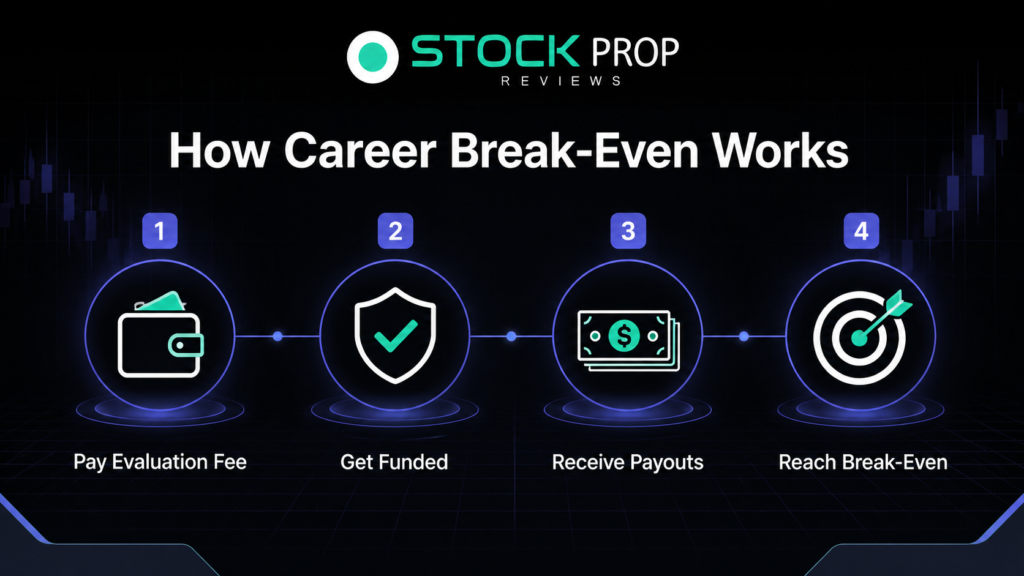
Once total withdrawals exceed total expenses, you’ve reached career break-even.
This differs from trade-level break-even, where traders move a stop loss to their entry price after a position gains value. Career break-even looks at your trading business as a whole instead of individual trades.
Why Career Break-Even Matters More Than Passing a Challenge
Passing an evaluation is an achievement, but it does not automatically make trading profitable.
Many traders pay for multiple evaluations before earning their first payout. Others receive one withdrawal before violating a drawdown rule and losing the account.
From a financial perspective, neither trader has necessarily recovered their investment.
A realistic prop trading career should be measured over months rather than individual trading challenges.
The Real Costs Most Traders Forget
Evaluation fees are only one part of the equation.
Additional expenses often include:
- Repeated failed challenges
- Account reset charges
- Subscriptions to trading platforms
- Pricing market data
- VPS hosting for automated systems
- Upgrades to the Internet and equipment
- Educational support
While each expense may seem small individually, together they significantly increase the amount a trader must recover before becoming profitable.
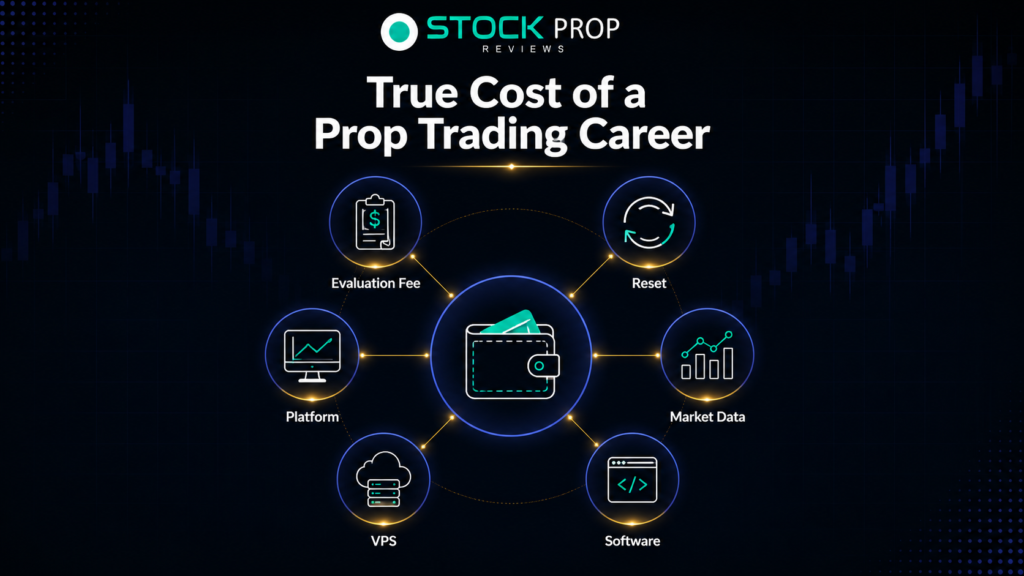
Example Monthly Cost Breakdown
| Expense | Estimated Cost |
| Evaluation fee | $150 |
| One reset | $80 |
| Platform subscription | $35 |
| Market data | $20 |
| VPS (optional) | $30 |
| Miscellaneous software | $25 |
| Total | $340 |
This example does not include the value of your time. For many traders, preparation requires dozens or even hundreds of hours before receiving a funded account.
Calculating Your Career Break-Even
The calculation is straightforward.
Career Break-Even = Total Trading Costs ÷ Net Monthly Trading Income
Let’s say you have expenses of $900.
If you average $300 a month after splitting the profits, it will take you around three months of consistent profitability to just break even.
If your monthly payouts vary a lot, it can take a lot longer to hit break-even.
This is why consistent withdrawals are so much more important than one amazing month.
Example
| Item | Amount |
| Total evaluation costs | $600 |
| Software & platform costs | $180 |
| Miscellaneous expenses | $120 |
| Total investment | $900 |
| Average monthly payout | $300 |
| Estimated break-even | 3 months |
The calculation changes if you fail another evaluation or need additional resets.
Every new expense pushes your break-even point further away.
Why Most Traders Never Reach Career Break-Even
There’s a lot of talk in the prop trading world about passing challenges, but not a lot about being profitable over the long term.
Some patterns appear to be common among unsuccessful traders.
The first is overstating returns.
Social media often shows traders earning thousands of dollars each month. What those posts don’t show are prior failed evaluations or months with no payouts or accounts that were eventually lost.
Another frequent problem is that rule violations are underestimated.
A trader could be consistently profitable but after increasing position size, accidentally blow through the maximum drawdown for the day. One emotional decision can wipe out months of disciplined trading.
Some traders also continue to buy new challenges after every failure without first improving their trading process.
Then the evaluation fees out-weight the income from the trade.
A Realistic Trading Scenario
Let us say there are 2 traders.
Trader A buys one challenge, passes it, gets four consistent payouts, and grows his account slowly.
Trader B buys 6 challenges over 6 months, passes 1, breaks a drawdown rule before payout and then buys another challenge.
Both traders could have similar trading ability.
Risk management and patience are the differences.
Expenses remain in check and Trader A hits career break-even.
Trader B keeps spending, without a steady income in place.
This is a very common pattern among retail traders.
Profit Splits Affect Break-Even More Than Many Expect
Many proprietary firms advertise profit splits of 80%, 90% or more.
These numbers are important but not to be looked at in isolation.
If a trader keeps failing tests before being eligible for a payout, then a generous profit split is not much of an advantage.
Likewise, profit share (with definite rules and sensible targets) might be less but lifetime earnings more, due to traders living longer.
Many successful traders prefer predictable payouts over headline percentages.
Drawdown Rules Can Delay Profitability
Every funded account includes risk parameters.
These commonly include:
- Daily max loss
- Maximum drawdown in total
- Position size limitations
- Limitations of news trading
- Weekend Holding Policy
Breaking any one of these rules can immediately end an account.
Each reset or replacement account increases total career costs and extends the time needed to recover previous expenses.
This is one reason experienced traders focus on preserving funded accounts instead of maximizing monthly returns.
What Most Competitors Don’t Explain
Many articles describe break-even analysis using traditional business formulas or individual trades.
What they rarely discuss is the difference between trade break-even and career break-even.
A trader can move every stop loss to break-even and still lose money over an entire year because evaluation fees, resets, subscriptions, and failed accounts continue accumulating.
Another overlooked point is opportunity cost.
Time spent repeatedly restarting evaluations cannot be spent generating payouts from an existing funded account.
Professional traders think in terms of long-term capital preservation rather than passing individual challenges.
A sustainable prop trading career depends less on exceptional winning trades and more on avoiding unnecessary setbacks.
That shift in thinking is often what separates traders who eventually build reliable income from those who remain trapped in an endless cycle of evaluations.
Common Trader Mistakes That Delay Break-Even
Most traders don’t fail because their strategy lacks an edge. They go wrong because they fail to appreciate the cost of inconsistency over time.
One of the biggest mistakes is to consider every failed challenge as bad luck. Buying another evaluation rarely fixes the constant breaking of the same rule, whether it be daily drawdown, overtrading or revenge trading. It just adds another bill.
Another error is to risk too much in an effort to quickly recover evaluation fees. Some traders, after putting their money into a challenge, feel the pressure to “make it back” as fast as possible. This often results in oversized positions and emotional decisions that violate the rules of the account.
Another costly habit is ignoring trading records. Unless you see your results it’s hard to understand if losses are due to poor execution, poor market conditions or a strategy that is no longer working well.
Finally, a lot of traders work out profits but never work out expenses. A $2,000 payout sounds good until you realize you spent $1,500 on evaluations, resets, software and data over the same period.
Strategy-Fit Analysis
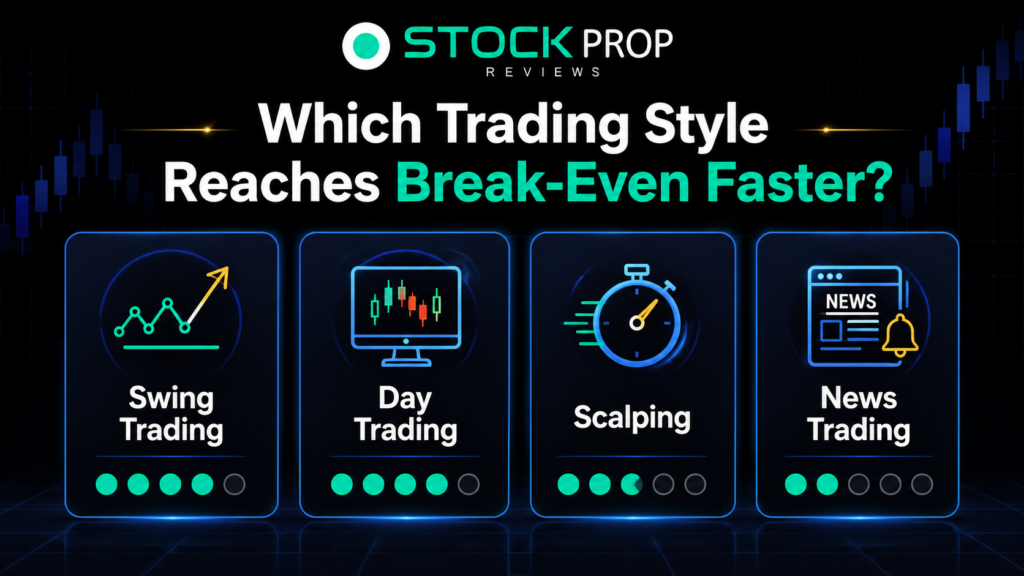
Not every trading style reaches career break-even at the same pace.
| Trading Style | Break-Even Potential | Main Challenge |
| Swing Trading | High | Fewer trading opportunities may delay payouts. |
| Day Trading | Moderate to High | Requires discipline to avoid overtrading. |
| Scalping | Moderate | Frequent trades increase the chance of rule violations. |
| News Trading | Low to Moderate | Many firms restrict or prohibit high-impact news trading. |
| Algorithmic Trading | Moderate | Platform compatibility and execution rules vary by firm. |
Swing traders tend to have fewer drawdown violations as they make fewer trades with a focus on higher quality setups. Scalpers can create more opportunities but are also under more execution pressure and more likely to break risk limits.
There is no one “best” strategy for everybody. The correct way is to follow the firm’s rules consistently and produce repeatable results.
The Psychology Behind Career Break-Even
Break-even analysis is more than just numbers. It also reveals trader psychology.
Many traders become impatient after being funded. Rather than protect the account, they increase position sizes to make profits faster. Ironically, this often delays profitability because one large loss can wipe out weeks of steady gains.
Experienced funded traders think differently. Their main aim is to keep the account alive. The larger payouts are a result of consistency, not reckless risk-taking after they have a track record of regular withdrawals.
Patience won’t make for exciting social media screenshots, but it often does lead to better long-term financial outcomes.
Who Should Consider a Prop Trading Career?
A prop trading career may suit traders who:
- Have a proven strategy with consistent historical results.
- Can follow strict risk management rules.
- Are comfortable treating trading as a long-term skill rather than a quick source of income.
- Accept that some months may produce little or no profit.
For these traders, proprietary firms provide access to larger buying power without requiring significant personal capital.
Who Should Avoid It?
A prop trading career may not be suitable if you:
- Depend on trading income to pay monthly living expenses.
- Frequently break your own trading rules.
- Expect to become profitable after one challenge.
- Constantly switch strategies after short periods of underperformance.
- Prefer complete freedom without account restrictions.
In these situations, trading a small personal account while improving consistency may be a better starting point.
Alternatives to a Prop Trading Career
If proprietary trading does not match your goals, there are other ways to build trading experience.
Personal Trading Account
A personal account gives full flexibility, with no evaluation rules. The downside is slower account growth, because you’re using your own money.
Copy Trading
More experienced traders can also earn more income by allowing other traders to copy their trades. However, there is a verified performance and reputational responsibility associated with it.
Long-Term Investing
Those who are more interested in accumulating wealth than in earning active trading income usually find diversified investing less stressful and time consuming.
Each option has different risk, capital and income characteristics. The decision is not based on marketing claims, but on your financial objectives and your temperament.
What to Look for Before Choosing a Prop Firm
The break-even point depends partly on the quality of the firm you choose.
Before purchasing an evaluation, consider:
- Evaluation fee and reset costs.
- Daily and overall drawdown limits.
- Profit split and payout schedule.
- Trading restrictions.
- Platform availability.
- Customer support.
- Reputation for processing payouts consistently.
The evaluation price is all that matters to many traders. A cheaper challenge can be more expensive if the rules make long-term success difficult.
Our analysis of FundedNext and FTMO when comparing firms shows how differences in drawdown rules and payout structures affect trader results. Also check our FTMO vs FundedNext comparison to see which model suits your strategy better. If you want to read more about this, check out our article on the truth about passing prop firm challenges, where we discuss why consistency is more important than speed.
A Note on TradeThePool
Trade for traders who are more interested in stock markets than forex or CFDs.TradeThePool is another one to check out, with clear risk rules and a focus on regulated stock trading.
Readers can get up to 10% discount when they buy through our TradeThePool link.
A discount should never be the reason for choosing a firm. The first step is to find a company that fits your trading style and appetite for risk.
Final Thoughts
The hallmark of a successful prop trading career is not passing one evaluation, but sustainable profitability.
Career break-even means looking past challenge fees to include all costs involved in becoming and staying funded. Traders who understand this tend to be better position size, account selection and long-term risk managers.
Those traders who most consistently reach break-even are seldom the ones who are shooting for the biggest monthly payout. They’re the ones who tend to guard capital, respect risk limits and run trading like a professional business, rather than a short term opportunity.
FAQs
How long does it take to breakeven in a prop trading career?
There is no fixed time. Traders who get consistent payouts can recover their costs in a few months while others can take a lot longer if they keep buying new evaluations or lose funded accounts.
Is it profitable to pass a prop firm challenge?
No. Only passing the evaluation qualifies you for funding. You are making money when your total payouts are higher than all your trading expenses.
Which costs do I have to look at for a break-even analysis?
Include evaluation fees, reset fees, platform subscriptions, market data, software, VPS services and any other recurring expenses directly related to your trading activities.
Will a bigger profit split get me to break even faster?
Maybe, but only if you always meet the payout criteria. What’s the use of a generous profit split if you can’t withdraw your profits because you keep breaking the rules.
Is prop trading a beginner’s career?
It can be so if beginners first develop a tested trading strategy, understand risk management and accept that it normally takes time to become consistently profitable. Evaluating too early often leads to higher costs without better results.