Many traders aim to pass evaluation, get paid out and scale accounts. Few spend enough time understanding prop trading taxes until tax season rolls around. This can often cause reporting errors, surprise tax bills, or bad record keeping.
This guide is for funded traders, evaluation traders, futures traders, and anyone who makes money from a proprietary trading firm. This does not apply to traders who are employed directly by a financial institution under a conventional employment contract, whose tax treatment is often different.
The main thing is straightforward. The prop firms do not determine your tax liability. It’s your country’s tax laws. How you get paid, whether as contractor income, business income, salary or trading income, depends on your local tax rules and the legal relationship with the prop firm.
If much of your income comes from trading, it might be worth getting in touch with a qualified tax professional in your country before taking advice from the internet.
What Are Prop Trading Taxes?
Prop trading taxes refer to the taxes you owe on money earned from proprietary trading firms.
Unlike trading your own brokerage account, most funded traders receive payouts from a company rather than directly realizing profits inside their own investment account. That difference matters because the income may not always be treated as capital gains.
In many countries, prop firm payouts are commonly reported as:
- Earnings from self-employment
- Business earnings
- Contractor earnings
- Regular income (taxable)
The exact classification depends on local tax laws rather than the prop firm’s marketing.
That is why two traders earning the same $20,000 from the same prop firm may face completely different tax obligations depending on where they live.
Why Prop Firm Payouts Create Tax Confusion
Many beginners assume they are investing company capital like employees at institutional trading desks.
In reality, modern retail prop firms operate differently.
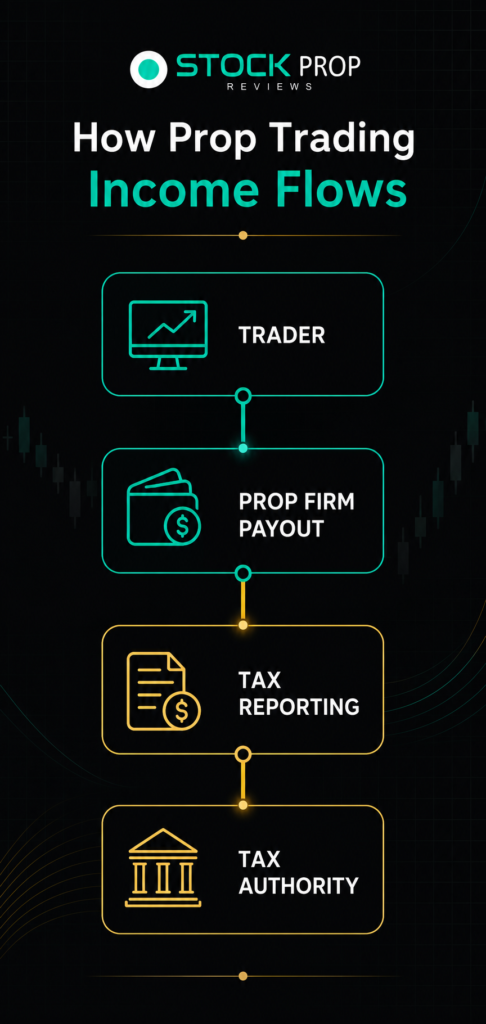
A typical funded trader:
- Costs for an assessment
- Signs an independent contractor’s agreement
- Takes a percentage of simulated/funded profits
- Takes care of own taxes
This creates confusion because the trader is neither a traditional employee nor simply investing personal savings.
Competitors often stop at saying “consult your accountant.” While that advice is important, it does not explain why traders become confused in the first place.
How Prop Firm Income Is Commonly Taxed
Although every country has unique tax rules, the general approaches look similar.
| Situation | Common Tax Treatment |
| Independent contractor payout | Ordinary taxable income |
| Registered trading business | Business income |
| Employee trader | Employment income |
| Personal investment account | Capital gains or investment income (varies) |
The key point is that prop firm payouts are frequently treated differently from gains inside your own brokerage account.
Many traders incorrectly assume lower capital gains tax rates automatically apply.
That assumption can become expensive.
Practical Example
Imagine two traders each earn $40,000.
Trader A
Trades: personal brokerage account.
Depending on local law, profits can be treated as capital gains.
Trader B
Monthly payouts from prop firms.
Instead, local authorities might view those payouts as contractor or business income.
Despite earning the same amount, their tax calculation may be completely different.
This is why searching only for “capital gains tax” often gives funded traders the wrong answers.
Does Your Prop Firm Deduct Taxes?
Usually, no.
Most retail prop firms send your payout without withholding income taxes.
That means the responsibility generally falls on you to:
- Track earnings
- Save money for tax payments
- Report income accurately
- Keep supporting records
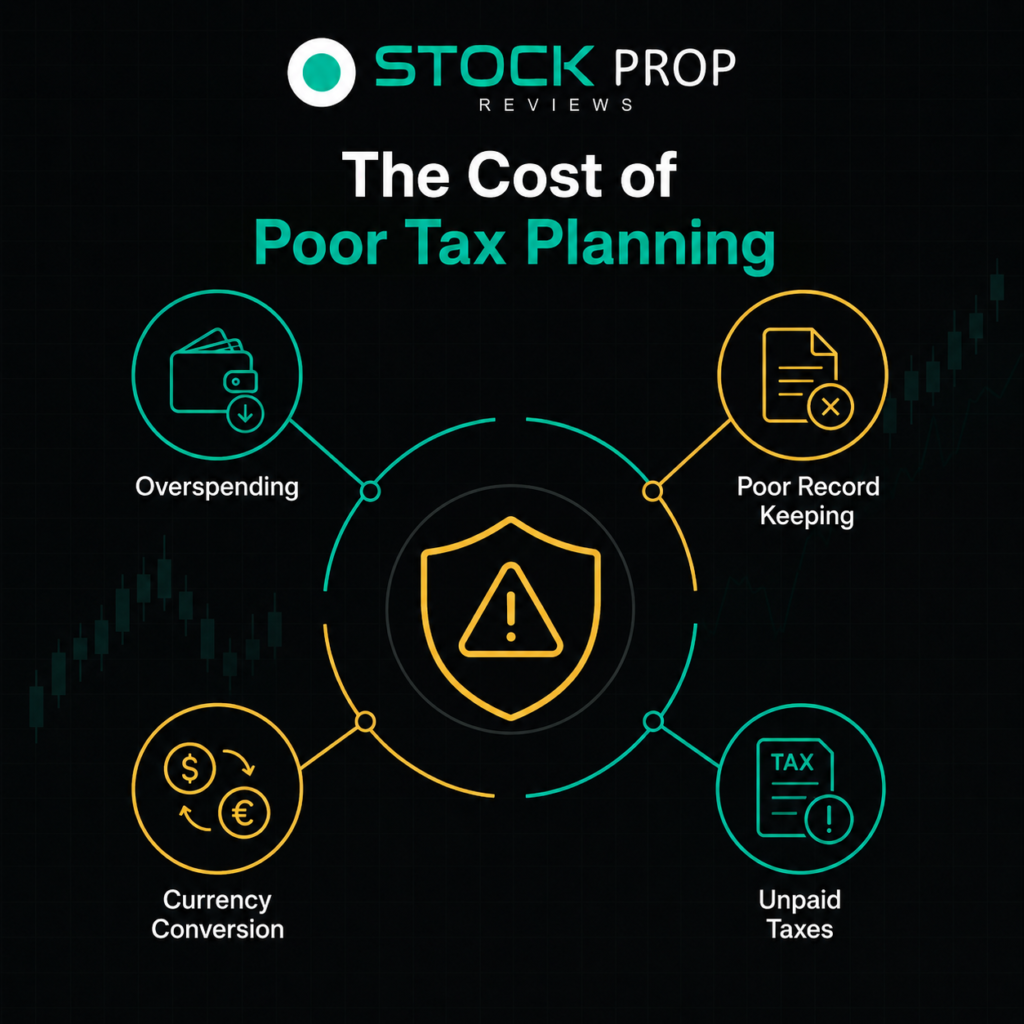
A common mistake is spending every payout immediately without setting aside money for taxes.
When tax season arrives, traders sometimes owe thousands that they no longer have available.
Record Keeping Matters More Than Most Traders Think
One overlooked reality is that tax reporting starts long before filing a return.
Good traders already document:
- Evaluation of purchases
- Subscriptions by platform
- Monthly payments
- Trading updates
- Bank transfers
- Currency conversion
- Software costs
Even if you are right in your figures, poor records cause problems.
If tax authorities want to see proof, having organized documentation can save a ton of time and stress.
Expenses You May Be Able to Deduct
Tax deductions vary by country.
However, traders operating as businesses or independent contractors may be able to claim legitimate business expenses where permitted by law.
Examples can include:
- Assessment fees
- Programs for mapping
- Broker Platforms
- Subscriptions for market data
- Expenses: Home Office
- Internet expenses
- Training for the trade
- Fees for accounting
- Computer equipment.
Not every expense automatically qualifies.
Buying an expensive monitor does not guarantee a deduction simply because you occasionally trade on it.
Documentation remains essential.
Common Tax Mistakes Funded Traders Make
Many mistakes have little to do with trading performance.
Instead, they come from misunderstanding how payouts work.
Assuming payouts are tax free
Receiving money through cryptocurrency, bank transfer, or payment processor does not eliminate tax obligations.
The payment method rarely changes taxable status.
Confusing evaluation fees with trading losses
Assessment costs are generally business expenses if deductible under local rules.
They are not usually reported in the same way as losses from investment trading.
Ignoring foreign income rules
Most prop firms are international.
Depending on where you live, there may be additional reporting requirements if you receive income from another country.
Forgetting exchange rates
If payouts arrive in USD but taxes are filed in another currency, conversion rates become important.
Many traders overlook this entirely.
Waiting until tax season
Trying to organize twelve months of trading records in one weekend rarely ends well.
Monthly bookkeeping is far easier.
What Competitors Often Don’t Explain
Most tax articles focus on definitions but miss practical situations funded traders face.
Multiple prop firms
In a given year many traders are paid by more than one firm.
You should normally track each payment separately, but include it in your overall taxable income where appropriate.
Failed evaluations
Repeated evaluation purchases can become a significant cost.
Understanding whether these fees qualify as deductible business expenses requires reviewing local tax rules.
Currency fluctuations
Suppose you receive a $5,000 payout when the exchange rate differs from the day you file taxes.
Currency conversion rules can affect your reported income.
Partial-year trading
Some traders begin prop trading halfway through the tax year.
That changes record keeping and estimated tax calculations but is rarely discussed in competitor articles.
Real Trading Scenario
The trader passes two tests and begins to receive monthly payments.
The first few months are good bringing in close to $18000.
Feeling confident, the trader upgrades his equipment, pays off his personal debt and withdraws most of his earnings.
Then tax time rolls around a few months later.
No money was set aside for taxes, and so the trader will either have to borrow or use savings.
There was nothing wrong with trading.
“Financial planning was the mistake.
Much more often than traders realize, this happens.
Psychology Plays a Bigger Role Than Taxes
Many traders mentally treat payouts as disposable income.
That mindset can become dangerous.
Professional traders often separate every payout into categories:
- Tax reserve
- Emergency savings
- Business reinvestment
- Personal income
This creates consistency and reduces stress during tax season.
Good trading discipline should extend beyond chart analysis.
Should You Register a Business?
The answer depends on your country, income level, and legal requirements.
Some traders benefit from operating through a registered business.
Others may have no reason to do so.
Factors worth discussing with a tax adviser include:
- Annual earnings per share
- Possibilities of deduction
- Accounting standards
- Retirement Contributions
- Registering a Local Business Rules
Avoid registering a business solely because another trader online recommended it.
Tax planning is highly location specific.
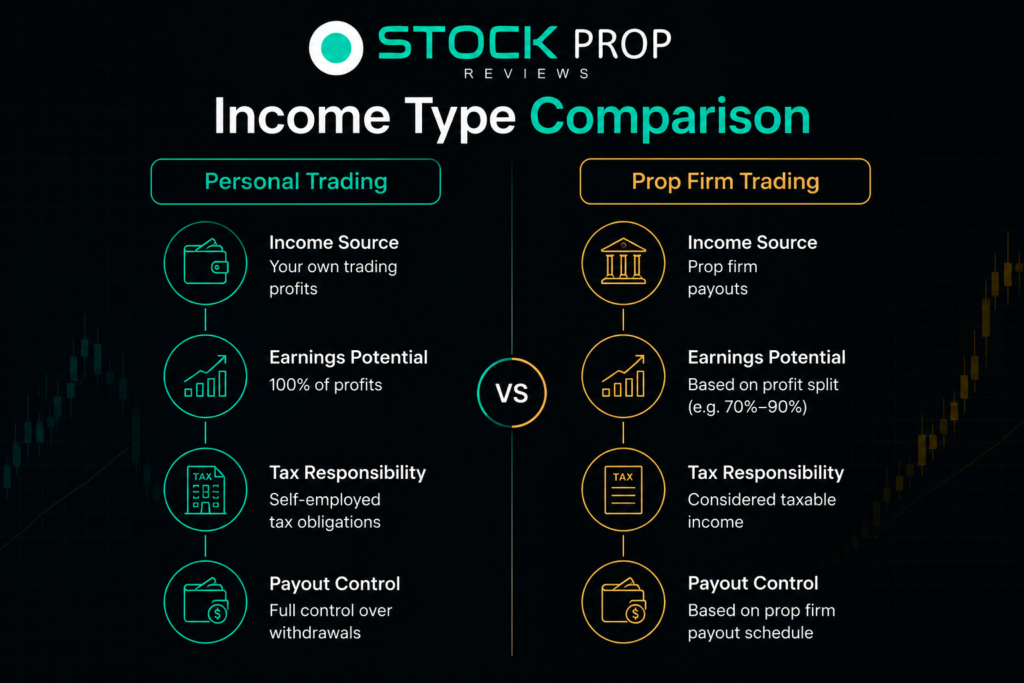
Comparing Personal Trading vs Prop Firm Income
| Feature | Personal Trading | Prop Firm Trading |
| Uses your own capital | Yes | Usually no |
| Receives payouts from company | No | Yes |
| Income classification | Often investment income | Often contractor or business income |
| Evaluation fees | No | Usually yes |
| Profit split | No | Yes |
| Tax treatment | Country dependent | Country dependent |
This comparison highlights why copying tax advice intended for retail investors may not fit funded traders.
How Different Prop Firms May Affect Documentation
Tax laws are typically country-specific rather than prop firm-specific, but the quality of documentation can differ between firms.
Some companies provide detailed payout histories and invoices.
Others require traders to organize their records manually.
“Clear reporting makes tax-time a lot easier.
For instance, traders who have compared firms often mention documentation and payout reliability when reading our FTMO review or Funding Pips review.
If you care about transparency, then make documentation part of your evaluation criteria, not just profit splits.
Choosing Transparent Firms Matters
Less headache in accounting by clean payout histories.
Due to the regulated stock trading model and transparent operating rules, TradeThePool is considered by some traders.
Better documentation won’t absolve you of your tax responsibilities, but it can make record keeping easier.
Readers can get up to 10% discount buying through our TradeThePool link.
Who Should Pay Extra Attention to Taxes?
Taxes deserve even more attention if you:
- Earn regular monthly income
- Trading with multiple prop firms
- Make enough trading income to replace a job.
- Accept international payments
- Operate with cryptocurrency payment methods
The more complex your income becomes, the more valuable professional tax advice becomes.
Who This Guide Is Not For
This article is less relevant if you:
- Only paper trade for practice
- Have never received a payout
- Trade exclusively inside a personal retirement account
- Work as a salaried institutional trader whose employer handles payroll taxes
Your reporting obligations may be entirely different.
Related Reading Before Choosing a Prop Firm
Understanding taxes is only one part of becoming consistently profitable.
You should also compare firm rules, payout structures, and drawdown policies before committing to an evaluation.
Helpful resources include:
- Our review of FTMO for rule transparency and payout structure.
- Our Funding Pips review covering risk limits and funded account experience.
- Our comparison of firms with different payout models and evaluation rules.
- Our analysis explaining why passing an evaluation doesn’t always mean you’re profitable.
Understanding both taxation and trading rules gives a more complete picture of the real cost of funded trading.
Final Thoughts
Taxes are not usually the most exciting part of prop trading but they are one of the easiest ways to lose money by making avoidable mistakes.
It will save you a lot of stress to know how your payouts are classified, keep your records organized, set aside for taxes, and consult when needed.
No prop firm can guarantee you lower taxes by just changing how it pays traders. Your local tax laws are the final authority.
If transparent rules and documentation are as important as trading conditions, TradeThePool is a regulated stock prop firm to consider. Readers can get up to 10% discount when buying via our TradeThePool link, but always check if its structure fits your trading style before buying.
FAQs
Are profits from prop firms taxed?
Yes, most countries. Prop firm payouts are generally considered taxable income, but the income classification will depend on your local tax laws.
Do Prop Firm profits count as capital gains?
Not all the time. Many funded traders are paid as contractors or business income, rather than capital gains. The rules differ by jurisdiction.
Are Prop Firm Assessment Fees Tax Deductible?
Maybe. In some countries, evaluation fees can be claimed as a business expense, in others they cannot. Please consult your local tax rules or seek the advice of a qualified tax advisor.
Are prop firms reporting my income to tax authorities?
Some companies may provide payout statements or tax documents, some companies may not. Even if you do not receive a tax form, you are usually still responsible for reporting taxable income.
Do you need an accountant for prop firm trading?
If you get regular payouts, trade through several firms, or make a significant amount of trading income, a tax pro can help you avoid reporting errors and find legitimate deductions.