Prop firm payout delays sound like a minor operational issue, but in practice they shape how traders behave. You can’t ignore this if you already have money or plan to trade with a prop firm.
This article is for traders who have money in their accounts, traders who are still in the evaluation stage, and anyone who expects to make regular withdrawals. Not for casual demo traders who aren’t getting real payouts yet.
The main problem is easy to understand. When a trader expects to get paid and it doesn’t happen on time, they change how they make decisions. Even if the plan is good, the execution starts to go off track. That’s where most of the damage happens.
What are prop firm payout delays
Prop firm payout delays are the time between when a trader can take out their profits and when the money actually gets to them.
A lot of companies say they can process things quickly on paper. In reality, timelines often get longer because of internal checks, batching systems, or conditions that aren’t clear.
A trader might think they will get their money in a few days, but they might have to wait one or two weeks. That difference makes things uncertain, and uncertainty changes how people act.
Why payout timing matters in real trading
There are already delayed rewards in trading. You take a chance and then find out later if you were right.
Prop firms make that delay longer. Traders stay in a waiting state instead of closing a profitable period and locking in results.
In real life, it goes like this:
A trader reaches their profit goal and asks to withdraw money. They don’t step back; instead, they keep trading because the payout is still coming. People think profits are “unreal” until they get paid.
That small change changes how risk is dealt with. Traders become more attached to open equity and less strict about keeping it safe.
The psychological impact of prop firm payout delays
Discipline weakens when rewards are uncertain
Most traders stay disciplined because they know that following the rules will help them get paid.
That link gets less clear when payments are late.
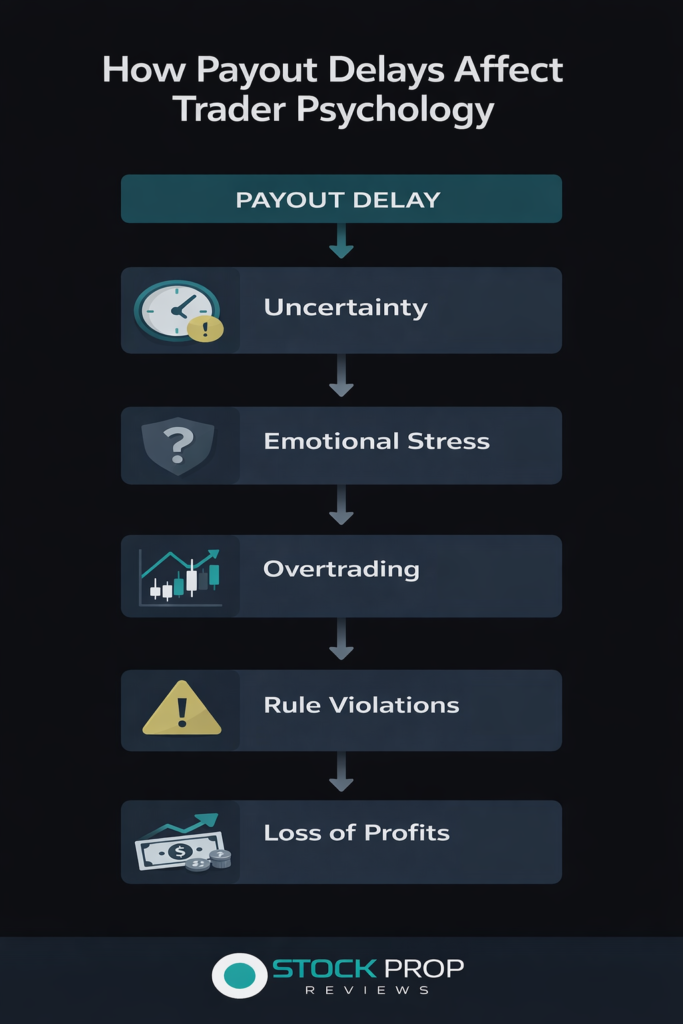
You hit the target and followed the rules, but you still haven’t heard if you won. This causes small changes over time:
- Making trades that aren’t part of the plan
- Holding positions for longer than usual
- Closing early because of doubt
These are not big mistakes. They are small changes that add up.
Overtrading becomes more likely
A common reaction during payout delays is to keep trading instead of protecting gains.
The thinking is straightforward. If the payout is not processed yet, the account is still active, so why not grow it further?
In practice, this often leads to giving profits back.
A trader who had a clean equity curve starts forcing trades during the waiting period. A few losses later, they fall below payout eligibility. The delay did not just postpone income. It triggered a loss of discipline.
Trust in the firm starts to erode
People don’t talk about trust very often, but it’s very important for funded trading.
Traders need to think that:
- The rules are always followed.
- The company will pay what it owes.
- You can count on the process.
When payments are late and there isn’t clear communication, people start to doubt.
That doubt doesn’t stay by itself. It makes it hard to concentrate. The trader stops thinking about the quality of the trade and starts thinking about the company.
That change makes things worse than most people think.
Emotional reactions after payout issues
If a payout is delayed too long or rejected unexpectedly, the reaction is rarely neutral.
Traders feel frustration, sometimes even anger. The next trades are often taken in that state.
This is where revenge trading appears, not because of market losses, but because of process frustration.
The trader is no longer responding to price. They are reacting to the situation.
What most competitors don’t explain
A lot of content talks about how fear and greed affect trading. That’s only part of the story.
Structural factors are just as important.
The difference between evaluation and funded stages
Payouts aren’t real during evaluations. Traders only care about following the rules.
Once you have money, your behaviour changes. Delays make that effect even stronger.
Most competitors don’t make this change clear.
Hidden conditions around payouts
A lot of companies say they have simple payout rules, but in reality, they add conditions:
- Minimum number of days to trade
- Requirements for consistency
- Internal risk assessments
These things aren’t always clear right away. Traders only find out about them after they ask to withdraw.
Frustration starts when what you expect and what actually happens don’t match up.
Long-term consistency is rarely discussed
Passing a challenge is one phase. Maintaining performance over months is a different problem.
Delayed payouts disrupt routine. There is no clear cycle of trading, withdrawing, and resetting.
Without that cycle, traders struggle to maintain consistency even if their strategy works.
Common trader mistakes during payout delays
The biggest mistakes aren’t technical. They are about behaviour.
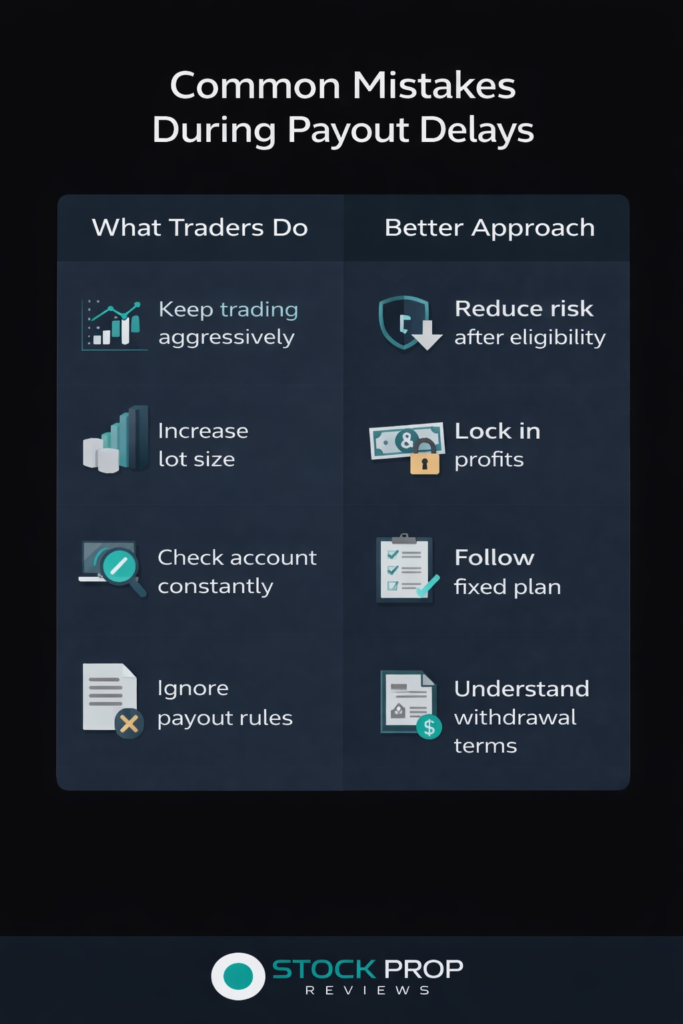
While they wait for payouts, a lot of traders keep trading at full size. Some people take more risks to make the wait “worth it.” Some people start checking their accounts all the time and reacting to small changes.
Not paying attention to payout terms when picking a company is another common problem. Traders pay attention to profit goals and drawdown limits, but they don’t pay attention to withdrawal conditions.
There is also a bigger misunderstanding. People often think of prop trading as a steady job. When payouts are late, that expectation puts pressure on traders, which then affects their decisions.
Data versus behavior
From a statistical point of view, delays in payouts shouldn’t change your edge. Your risk-reward ratio and win rate stay the same.
But trading isn’t just about numbers. It is how you act when you’re under pressure.
Behaviour changes when the timing of rewards changes. That has an effect on how things are done, and how things are done has an effect on the results.
Two traders who use the same strategy can do very different things based on how they deal with uncertainty about payouts.
Do payout delays always matter
Not equally.
A highly disciplined trader with no dependence on payouts can operate without being affected much. They treat trading as a long-term process and ignore short-term disruptions.
However, most traders are not in that position.
If you check your account frequently, think about withdrawals in advance, or rely on payouts for income, delays will influence your decisions whether you notice it or not.
Strategy-fit analysis
Scalpers are the ones who feel the effects the most. They like to get quick feedback and see results often. Delays throw off that rhythm.
Intraday traders can handle things better, but they still feel pressure to lock in profits.
Swing traders are less exposed because they hold their positions for longer, but big floating profits can still cause stress.
Traders who work full-time and get paid are the most at risk. When payments are based on costs, any delay causes stress.
Fast payout firms versus slow payout firms
It’s not just easier.
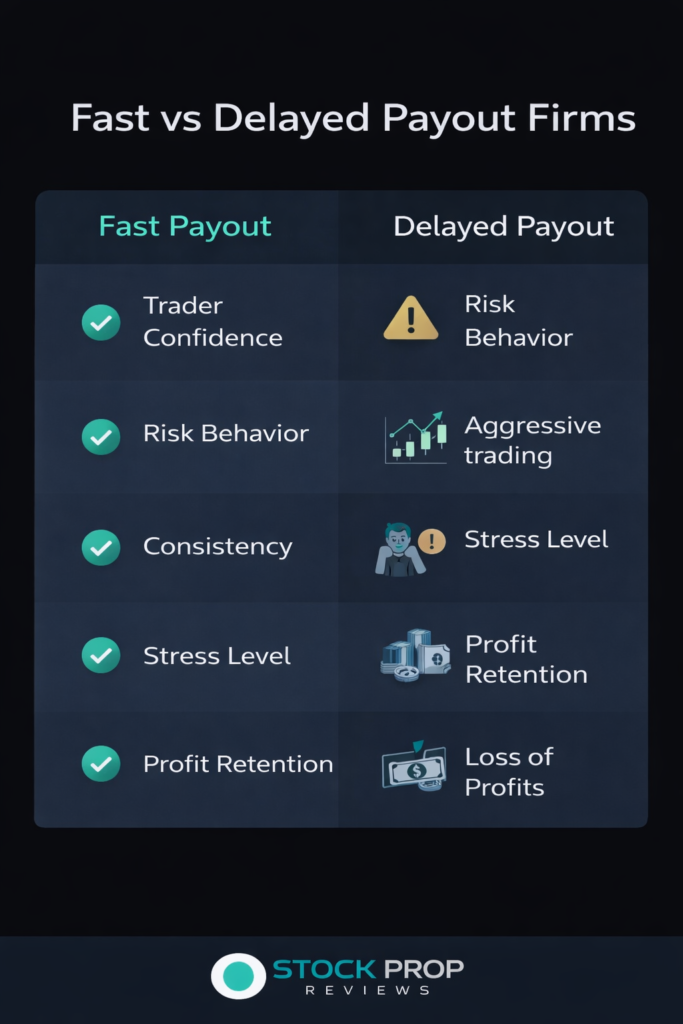
Faster payouts help people stay disciplined. Traders end a profitable period, take a break, and start over mentally.
Traders are in an open loop because of delayed payouts. They keep trading while they wait, which often means taking risks that aren’t necessary.
This has a bigger effect on consistency than most changes to the rules.
Alternatives and better structures
Some companies make these problems less of a problem by giving clear payout schedules and processing times. Predictability helps, even if the payout isn’t right away.
Some others let traders take out a portion of their profits without completely stopping trading.
TradeThePool is an example of a regulated stock prop firm where the rules and procedures are clearer. The structure is more like that of professional trading environments, which makes things less uncertain.
When readers buy through our TradeThePool link, they can save up to 10%.
This doesn’t get rid of trading risk, but it does make the operational side more predictable.
Internal context for deeper evaluation
When comparing companies, it’s important to look at more than just how quickly they pay out.
Our review of low drawdown prop firms shows how withdrawal behaviour and risk limits work together.
Comparing different prop firm models shows how different providers have different payout structures.
You can also read the breakdown of whether funded trading is easier than personal trading to see why these structural details are more important than most traders think.
Who should avoid firms with payout delays
People who trade and need to make regular withdrawals should be careful. People who are just starting to learn discipline are also at risk.
If you already have trouble with overtrading or making decisions based on your feelings, delayed payouts will probably make those problems worse.
The pressure goes up even more without a financial cushion.
Practical ways to handle payout delays
The first step is to make sure that your trading decisions and payout expectations are separate. Don’t worry about when to withdraw; just focus on execution.
Once you can get paid, you can protect your profits by lowering your risk or taking a break. During that time, you don’t have to take every market opportunity.
Keeping track of your own actions is also helpful. While you wait, pay attention to whether you trade more, change the size of your positions, or check your account more often.
Lastly, pick companies based on how open their processes are. What people actually get paid is more important than what marketers say.
Final perspective
Delays in prop firm payouts are more than just a hassle. They are a structural factor that affects how traders act.
Most traders spend time perfecting their entries and exits, but they don’t think about how the market affects their choices.
That gap causes mistakes that could have been avoided.
Knowing how payout timing affects psychology gives you a real advantage. It won’t change your strategy, but it can help you carry it out.
FAQs
Do delays in prop firm payouts affect performance?
Yes. Even if the strategy is good, they often cause people to trade too much and not manage their risks well.
How long does it usually take to get paid?
It depends on the business. Some processes happen in a few days, while others can take one to three weeks, depending on how long internal checks take.
Should I trade while I wait for my payout?
Many traders do better when they lower their risk or wait until the payout is confirmed.
Are late payments a sign of trouble?
It’s normal for things to be late sometimes. If there are repeated delays without clear communication, it could mean there are bigger problems.
Who are the best traders at dealing with delays?
Traders who take a long-term view and don’t depend on quick payouts are better at dealing with delays.