Prop firm scaling plans are a set of programs that enable your funded account to scale after you meet certain performance criteria. Simply put, if you trade well over time, the firm will increase your capital.
Sounds pretty simple, right? Unfortunately most traders do scaling wrong. It’s not just about meeting profit targets. It’s about being able to be consistent under added psychological pressure.
This guide is for traders who are skilled at risk management and looking to grow funded accounts. This is not for those still struggling to get through challenges, or relying on high-risk strategies to generate returns.
What Are Prop Firm Scaling Plans
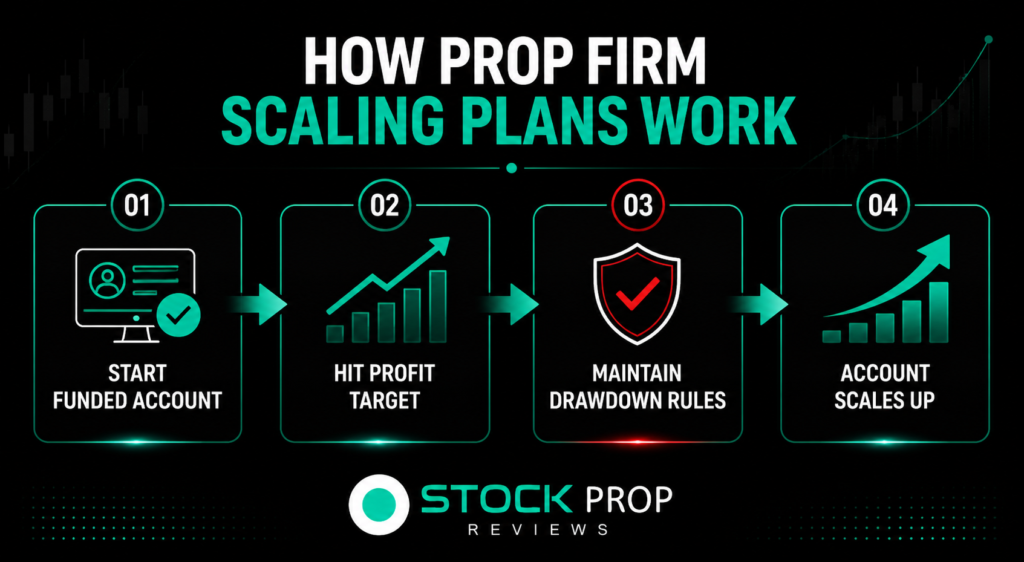
A prop firm scaling plan is a rule-based system that enables you to increase your account size as you show consistent performance. The key word here is consistency, not profitability.
A typical structure is as follows:
- You produce a specific % return
- Drawdown limits are retained
- You sustain performance over a fixed period of time
For example, a trader with a $100,000 account might need to make 10 percent in three to four months. If the criteria are met the firm bumps the account up to $125,000 or $150,000.
Many traders overlook that scaling does not reset risk. It amplifies that.
Why Scaling Plans Are Misunderstood
“A lot of the competition is for maximum account sizes, so $1 million plus. “It makes scaling look like an express lane to bigger paychecks.”
In fact, scaling creates new problems.
A trader comfortable risking 0.5 percent on a $50K account may be reluctant to do the same when it’s a much larger sum on a $200K account. Changes in execution. More sluggish decision-making. Mistakes are more expensive.
And then there’s the time thing. Scaling is seldom immediate. Some companies require several months of steady performance before they add to capital. Trade during this time it is very common to overtrade or to force setups just to get to the target earlier.
Comparison of Prop Firm Scaling Plans
| Firm | Starting Capital | Scaling Condition | Max Capital | Drawdown Model | Profit Split |
| FTMO | $10K to $200K | 10% over 4 months | Up to $2M | Static | Up to 90% |
| The Funded Trader | $50K to $200K | Profit cycle based | Up to $1.5M | Mixed | Up to 90% |
| FundedNext | $15K to $200K | Payout consistency | Up to $4M | Static | 80 to 90% |
| TradeThePool | $20K to $260K | Performance based | $1M+ | Risk based | Up to 80% |
This table looks simple, but it hides the most important detail. Scaling rules change how you trade, not just how much you earn.
FTMO Scaling Plan Explained
Quick verdict
Structured and realistic but slow and demanding.
One of the most talked about is the FTMO scaling model. Traders are required to take 10 percent profit and stay disciplined for four months. When it is reached the account is boosted by 25 percent.
The time requirement separates most traders. It’s not hard to hit 10 percent once. The trick is to do it for any amount of time without breaking the rules.
In real life, a lot of traders do well at first and then lose focus. Either they stop trading correctly once the target is reached or they take unnecessary risks in order to speed up the results.
Another factor is the emotional pressure. As the account grows, the same percentage risk feels more significant. Traders tend to reduce position size unconsciously which deteriorates performance.
Who should avoid it
Those that do poorly here are generally looking for rapid scaling or are impatient.
If you want to go further, you can check our in-depth FTMO review where we go over rule behaviour in live conditions.
The Funded Trader Scaling Plan
Quick verdict
Flexible but more easily abused.
The Funded Trader does not implement scaling by strict time windows but by cycles of trading. This offers traders more freedom, but that flexibility can backfire.
Traders are aware that scaling is associated with each cycle, and are more aggressive in pursuing faster growth. They add a little risk, then a little more, rather than changing their usual setup. That change, at first, isn’t obvious, but it adds up. .
One common pattern is initial success followed by a rule breach. Not because the trader is not good, but because the structure allows for faster promotion.
What is not obvious
Flexible scaling is tough on undisciplined behaviour, but it is also rewarding of discipline.
Who should avoid it
Traders without a fixed risk model or those who tend to adjust position size based on recent performance.
As an alternative, some traders prefer stricter environments. Our comparison of one step prop firms shows why tighter rules sometimes lead to better outcomes.
FundedNext Scaling Plan
Quick verdict
High ceiling, but different way to grow.
FundedNext connects the scaling to the payout behaviour, not the profit. To move up, traders must demonstrate consistent withdrawals over time.
That makes you think differently about trading. Instead of allowing profits to build up you are encouraged to take them out regularly.
Some traders do well within this structure. Others struggle because it destroys compounding
A common problem is traders holding onto their positions for longer than necessary, hoping to build up a bigger buffer before they withdraw. That gets in the way of scaling very often.
Reality check
Scaling is no longer about big numbers, it is about repeatable performance cycles.
Who should avoid it
Traders that like to run profits for long periods of time or for those who want aggressive growth.
TradeThePool Scaling Model
Quick verdict
More real market trading but slower progress.
TradeThePool has a different structure to most of the forex prop firms. It assesses risk management and trading behaviour, rather than simply focusing on percentage targets.
This model is suitable for traders who already think in terms of risk rather than returns.
For example, a trader who is good at managing positions and keeping exposure in check can scale without having to chase high percentage gains. This adds stability but is less attractive for those seeking rapid account growth.
Another distinction is the asset class. It is focused on stocks, so the volatility and execution are different than forex or indices.
Readers can get up to a 10% discount when buying through our TradeThePool link.
Who it fits
Traders who prioritise consistency and risk control over speed.
Strategy Fit and Scaling Reality
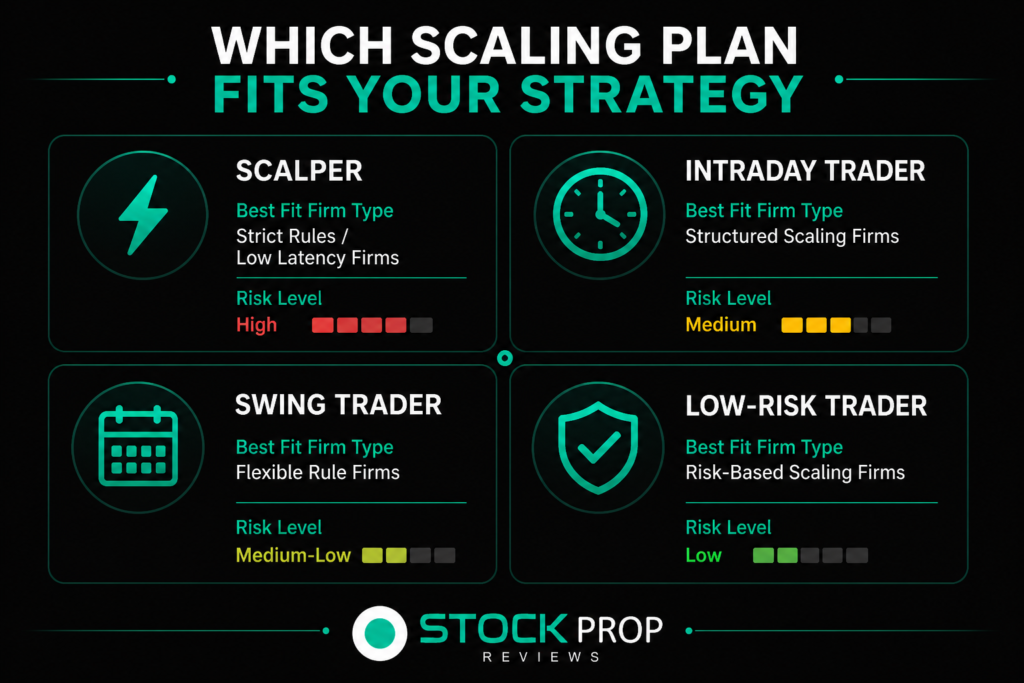
Scaling plans do not benefit all styles of trading equally.
Scalpers often have a hard time because scaling up increases execution pressure. With size being larger small changes in spread or slippage become more noticeable.
Intraday traders tend to do better, especially in structured environments where a consistent approach is rewarded over time.
The flexibility offered by firms is good for swing traders, but they have to be careful to control drawdown as they hold positions for longer periods.
The most successful are usually the low-risk traders. Not because they make more, but because they don’t have big setbacks.
What Most Traders Get Wrong About Scaling
The biggest misconception is that scaling will automatically lead to higher income.
In practice scaling often slows traders down. They become more cautious, second-guessing trades or cutting size to protect profits. Performance does not improve, it levels off.
Another myth is that the larger the account the easier it is to trade. No. It doesn’t. The psychological effect becomes much bigger.
A trader who is comfortable with a $500 loss may react very differently to a $2,000 loss, even if the percentage risk is the same.
Common Failure Patterns
Most scaling failures follow a similar path, from real trading observations.
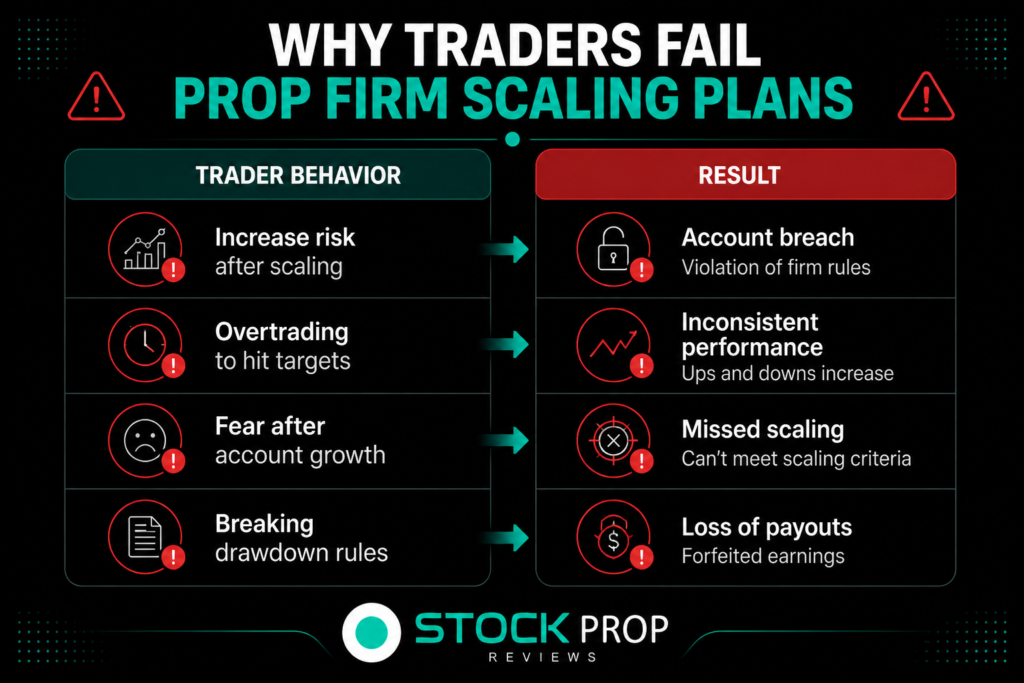
A trader with a small account does well. Builds confidence. They add a little risk after scaling to keep the same percentage returns. There are a few losing trades and instead of adjusting they try to get back in fast.
That’s where the rules get broken.
Another pattern is over-protection. Traders get gun shy after scaling and stop taking good trades. Scaling criteria are not satisfied and performance degrades.
Both extremes end up in the same place. Account breach or stagnation.
What Competitors Usually Skip
Most of the articles are about things such as the maximum capital or how to split profits. They don’t talk about the transition phase much.
Scaling is not a trophy. This is to see if your process can take the heat.”
There is little discussion about time either. Higher capital levels can take a year or so to reach. Many traders lose their consistency during that period.
Want a realistic perspective? Read our article on why traders fail prop firm challenges . It covers the decline in performance after the first success.
Alternatives to Scaling Plans
There are ways to grow other than scaling.
Some traders prefer to have a fixed account size and regular withdrawals. This approach reduces the pressure and creates steady income by not following the higher capital.
Some prefer firms with less complicated rule structures. Our analysis of funded account models reveals that fewer rules often leads to better long-term consistency.
The trick is to match the structure to your trading behaviour, not to chase the biggest account size.
Realistic Take on Prop Firm Scaling Plans
Scaling is best for traders who already have strict risk management and do not depend on big wins.
It doesn’t reward aggressive trading.” It rewards repeatability of execution.
Traders who are successful with scaling tend to think of it as a consequence. They put the process first and then the account growth follows.
People who chase scaling directly often force outcomes, and that rarely ends well.
If you’re a trader who prefers a more transparent structure, TradeThePool offers a risk-based model rather than arbitrary targets. TradeThePool link for readers to get up to 10% discount on purchase.
FAQs
What’s the best prop firm scaling plan?
There is no one best option. FTMO is the better option for disciplined traders, while FundedNext may be more attractive to those who are comfortable with growth based on payouts.
How long does scaling take prop firms?
Depending on the firm and how consistent you are, each stage generally takes a few months.
Do most traders reach high scaling levels?
No. Most traders fail before they reach the advanced stages of scaling up.
Do you have to scale to make money in prop firms?
No, most traders would prefer steady withdrawals to an ever-growing account size..
Can beginners use scaling plans?
Beginners should first learn consistency. Scaling only works if your trading process is stable.