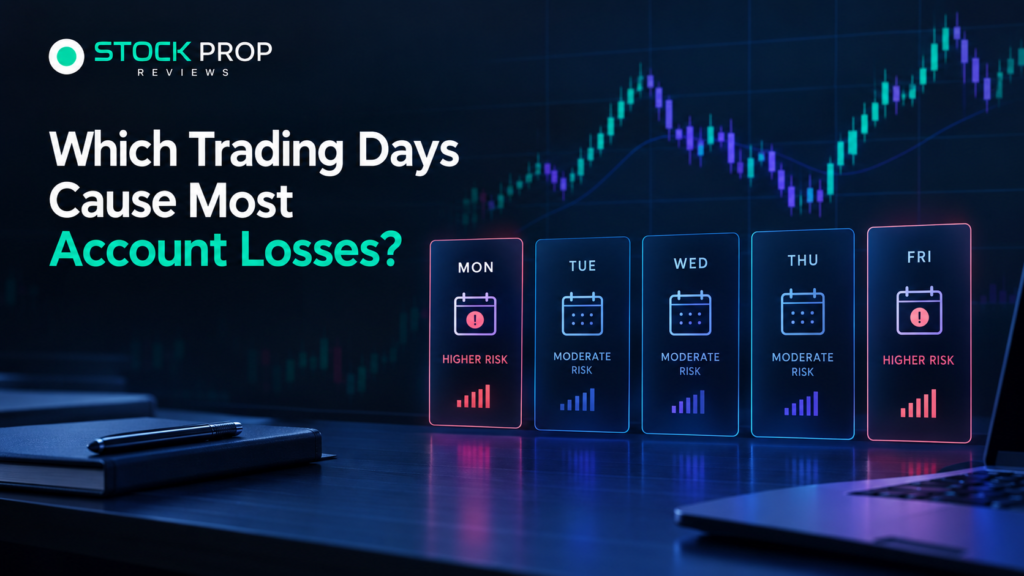
If you want the worst trading days, there is no evidence to support a simple rule that one weekday always loses more money than others. Historical research does find that stocks and currencies show recurring day-of-the-week effects, with Monday often showing weaker or more volatile conditions, and Thursday or Friday showing different patterns depending on the market. (Wiley Online Library)
For funded traders, however, the more useful question is different: Which trading days make it easier to turn normal market noise into an account drawdown or rule violation?
This analysis is primarily for funded, forex, stock and short term traders who are managing daily loss limits and or max drawdown. It is not intended for investors with diversified positions for months or years, as weekday effects have much less practical relevance for that style.
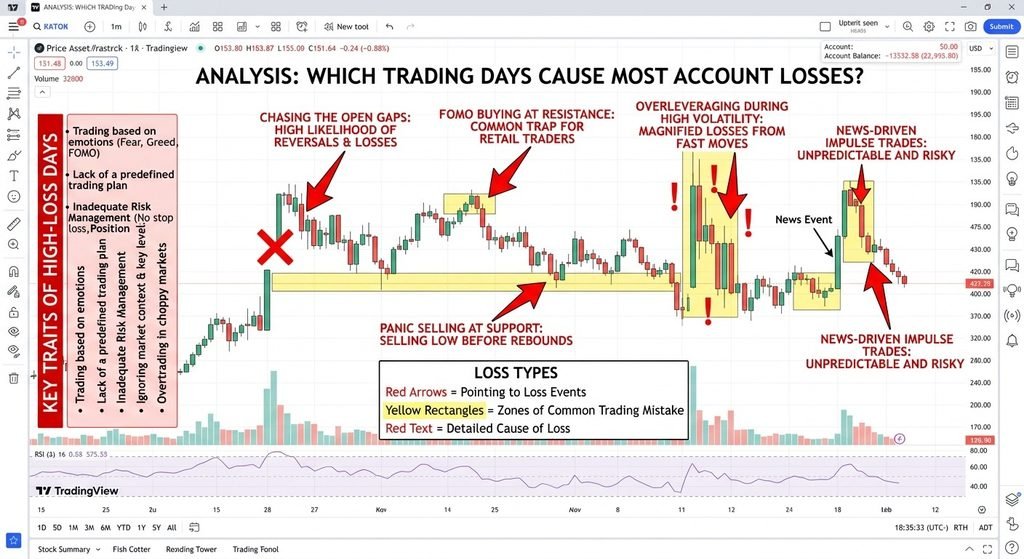
Quick answer: Which are the worst trading days?
Monday and Friday are the days of most interest to short-term traders, but for different reasons.
Monday can bring a mix of weekend information, shifting market expectations and greater uncertainty. The literature on stock markets has repeatedly found weaker Monday returns or higher Monday volatility, though the strength of the effect varies across markets and periods.
Friday can create a different problem. Liquidity and participation can change as traders reduce exposure ahead of the weekend, while positions held through the close may face gap or news risk.
That does not mean every Monday or Friday is a bad trading day. A high-quality setup on Monday can still be valid, while a poorly managed trade on Wednesday can still destroy a funded account.
The important distinction is between statistical tendency and individual trading outcome.

What the day-of-week data actually shows
Academic research gives us a more complicated picture than the usual “avoid Monday and Friday” advice.
An early study by McFarland, Pettit and Sung found that dollar-denominated foreign exchange price changes were higher on Mondays and Wednesdays and lower on Thursdays and Fridays across the currencies studied.
A later study covering 12 currencies from 1985 to 2014 found positive returns on Monday through Wednesday and lower returns on Thursday and Friday. However, the authors also found that these calendar effects had weakened over time.
That matters because a historical weekday anomaly is not the same thing as a permanent trading edge.
This matters because a historical weekday anomaly is not a permanent trading edge.
The same story is told in stock market research. Analysis of US stock indexes from 1928 to 2023 shows that Mondays have lower conditional returns and higher volatility than Fridays
Another important finding is that some of the traditional “Monday effect” occurs outside normal trading hours. Research by Rogalski found that the negative Friday-close-to-Monday-close effect in stock indexes was concentrated in the non-trading period from Friday close to Monday open, while average open-to-close trading-day returns were similar across weekdays in that sample.
So saying “Monday causes losses” is too simplistic.
The more accurate conclusion is that certain market conditions associated with the start and end of the trading week can change volatility, liquidity and risk distribution.
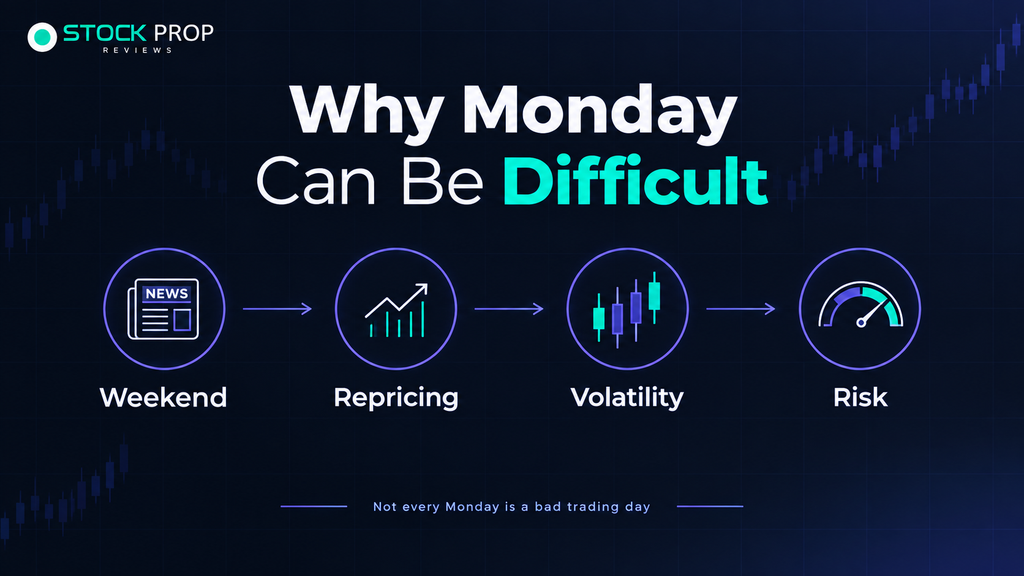
Monday: why the first trading day can hurt
Monday is often difficult for short-term traders because the market has to absorb information accumulated while it was closed.
That information can include:
- geopolitical developments
- economic announcements
- company news
- changes in interest-rate expectations
- weekend positioning
- gaps between Friday’s close and Monday’s open
For stocks, the weekend gap is particularly relevant because news can arrive when the cash market is closed.
For forex, the market operates continuously through the week, but the transition from the weekend into the new trading week can still create unusual price behavior.
ATAS identifies the first and last working days of the week as periods requiring caution, arguing that Monday can initially be less active while market participants establish their weekly direction.
Daily Price Action makes a similar practical observation, describing Monday as a difficult day for some forex traders and emphasizing that the quality of the setup matters more than simply following a weekday rule.
For a funded trader, the danger is not necessarily that Monday produces more losing trades.
The danger is trading uncertainty with normal position size when the market is not behaving normally.
A trader might take three marginal setups because the week has just started. The first loses 0.5R. The second loses 0.5R. Instead of stopping, the trader increases size on the third trade because they want to finish the day positive.
The weekday did not cause the breach.
The combination of uncertain conditions and poor risk control did.
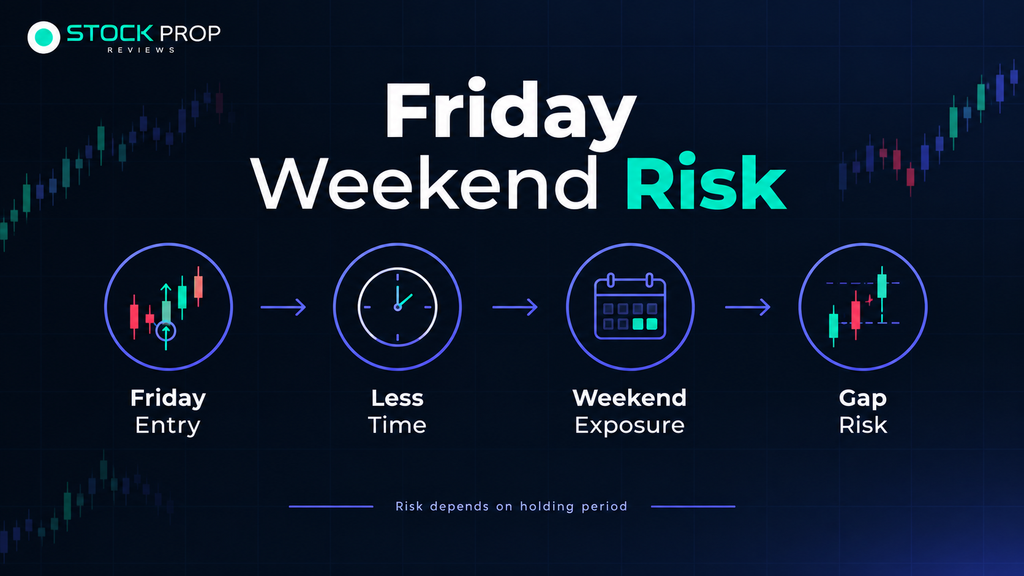
Friday: the hidden weekend risk
Friday has a different problem.
A trader opening a new position late in the week has less time to allow the trade to develop before the weekend.
This becomes particularly important for swing traders and anyone holding positions through market closures.
Daily Price Action identifies the final trading day as a difficult period because liquidity can fall and traders may become reluctant to hold new risk into the weekend.
ATAS similarly highlights Friday as a period when liquidity can change and weekend exposure creates additional uncertainty.
For prop traders, there is another layer.
Suppose a trader has made 4% during the week and needs another 1% to reach a payout objective. Friday arrives. Instead of protecting the existing profit, the trader starts looking for a trade capable of producing that final percentage.
The trader is no longer trading the same strategy.
The target has changed the behaviour.
This is one reason weekday analysis should be connected to psychology rather than treated as a simple calendar strategy.
Tuesday to Thursday: are they actually safer?
Tuesday through Thursday are often presented as the “best” trading days.
There is some practical logic behind this. By Tuesday, the market has absorbed some of the information from the weekend and Monday session. Wednesday and Thursday can also contain significant economic releases and strong institutional participation.
But calling these days universally safer would be misleading.
Wednesday can contain major central-bank decisions, inflation data and other market-moving releases.
Thursday can also produce large moves around economic data.
The real distinction is therefore not:
Good days vs bad days
It is:
Normal conditions vs abnormal conditions
A Tuesday immediately before a major central-bank decision can be more dangerous for a short-term trader than an ordinary Monday.
The biggest factor competitors miss: news beats the calendar
Most articles about the worst trading days focus heavily on Monday and Friday.
That misses one of the most important variables.
Economic news can matter more than the weekday itself.
ATAS specifically warns against trading immediately before or after important news and gives central-bank decisions and NFP as examples of events that can create dangerous volatility.
Daily Price Action similarly recommends filtering major events rather than simply relying on a calendar-based trading schedule.
For scalpers, this matters even more.
A five-minute setup can look technically perfect before CPI or an interest-rate decision. The problem is that the next few minutes may contain enough volatility to trigger a stop before the underlying market direction becomes clear.
The setup was not necessarily wrong.
The timing was unsuitable for the strategy.
Worst trading days for different trading styles
| Trading style | Days that can require extra caution | Main risk |
| Forex scalping | Monday, Friday, major-news days | Liquidity and sudden volatility |
| Stock day trading | Monday, Friday, major earnings/news days | Gaps and changing participation |
| Swing trading | Friday before weekend | Weekend gap and event risk |
| Funded trading | Any day near daily drawdown limit | Risk escalation |
| News trading | Scheduled high-impact releases | Extreme volatility |
| Futures scalping | Major economic-release sessions | Fast moves and execution risk |
This is why there is no single answer to “What is the worst trading day?”
The answer depends on asset, timeframe, strategy and account rules.
How traders actually lose accounts on bad days
The first loss usually is not the problem.
The reaction to the loss is.
Consider a funded trader risking 0.5% per trade.
The trader loses on Monday morning.
Instead of accepting the loss, they take another setup. That loses another 0.5%.
The trader is now down 1%.
They decide the market is about to reverse and increase their next position to 1%.
That trade loses.
The account is now down 2%.
At this stage, the trader may still be well inside the firm’s maximum drawdown. But psychologically, the situation has changed.
The trader starts thinking about recovery instead of execution.
This is where a normal losing session can become an account-loss sequence.
Our research on why traders fail prop firms examines this distinction between a strategy losing money and a trader changing the strategy after losses.
Why weekday statistics should not become another trading rule
This is where statistical analysis can become dangerous.
A trader discovers that Monday has historically produced weaker returns and decides to stop trading every Monday.
That sounds disciplined.
But if the trader’s own strategy has positive expectancy on Monday, they have just removed valid trades because of a broad market statistic.
The opposite mistake is equally common.
A trader discovers that Tuesday through Thursday historically produced stronger average returns and assumes every Tuesday is a high-probability trading day.
It is not.
Calendar effects are population-level observations. They do not tell you what the next individual trade will do.
Research also shows that some calendar anomalies have weakened or disappeared in more recent samples, which is another reason not to build an entire strategy around an old weekday pattern.
A better way to use worst trading day statistics
Instead of automatically banning certain days, funded traders can use weekday statistics as a risk filter.
Track your own results by:
- weekday
- trading session
- instrument
- setup type
- average R
- win rate
- average loss
- maximum losing streak
- news exposure
After 50, 100 or more trades, the data becomes much more useful than a generic internet rule.
For example, suppose your journal shows:
| Day | Trades | Win rate | Average result |
| Monday | 30 | 43% | -0.18R |
| Tuesday | 35 | 57% | +0.31R |
| Wednesday | 32 | 53% | +0.17R |
| Thursday | 34 | 55% | +0.24R |
| Friday | 28 | 39% | -0.27R |
That does not prove Monday and Friday are objectively bad trading days.
It tells you that your current strategy has performed differently on those days.
That is actionable information.
The prop-firm angle most competitors overlook
A market can be statistically volatile without being dangerous to a trader who controls risk.
Likewise, a quiet market can become dangerous when a trader keeps taking low-quality trades.
The important variable for a funded account is the relationship between daily loss capacity and normal strategy variance.
If your firm allows a 5% maximum loss and your strategy regularly experiences four consecutive 1% losses, the account structure may be poorly matched to the strategy.
That problem exists regardless of whether those losses happen Monday or Thursday.
When comparing funding models, traders should therefore examine the risk architecture rather than focusing only on account size or profit split. Our prop firm comparison covers how different firms structure drawdown, targets and other constraints.
TradeThePool and trading-day risk
For stock traders who want a rules-based environment, TradeThePool publishes its trading objectives, drawdown parameters and trading conditions publicly. Its current program includes stock and ETF trading, with different parameters depending on the account model.
One important clarification is necessary for accuracy: TradeThePool should not be described as a regulated financial institution or regulated prop firm. Its own terms state that Five Percent Online Ltd. operates as a proprietary trading firm and is not a financial institution or other business subject to financial regulatory authorities.
What traders can assess is its published rule structure and risk requirements. The firm currently offers stock and ETF programs and publishes details such as daily pause, maximum loss, profit targets and consistency requirements.
Readers can get up to 10% discount when purchasing through our TradeThePool link.
The discount should not be the reason to buy an evaluation. The relevant question is whether the firm’s current rules fit your strategy, holding period and tolerance for drawdown.
Common mistakes when trading difficult weekdays
Treating Monday or Friday as automatic no-trade days
A calendar rule can become just as restrictive as overtrading. Your own data should determine whether avoiding a particular day actually improves your results.
Increasing size after a losing session
This is one of the fastest ways to turn ordinary variance into a drawdown problem.
Ignoring economic releases
A weekday label does not tell you whether CPI, NFP, a central-bank decision or major earnings announcement is approaching.
Confusing volatility with opportunity
Large candles can look attractive, but fast price movement also increases the probability of poor entries, slippage and stop-outs.
Using historical averages without checking the sample
A weekday effect from an old study may not describe today’s market structure.
Who should be most cautious?
Beginners should be particularly careful about turning weekday statistics into a mechanical strategy.
Scalpers also need to be selective because their strategies are more exposed to short-term liquidity and volatility changes.
Funded traders have an additional constraint: they cannot simply wait out a drawdown indefinitely if the account has a fixed daily or maximum loss threshold.
Swing traders should pay particular attention to Friday because weekend exposure can introduce gap risk that does not appear in a normal weekday-only backtest.
The practical takeaway
The “worst” trading day does not exist.
History does demonstrate the presence of recurring weekday effects with particular emphasis on Monday returns and volatility. Several trading sources mention Monday and Friday as days when an extra degree of caution may be required.
But the stronger lesson for funded traders is this:
The worst trading day is usually the day when your strategy, market conditions and risk behaviour stop fitting together.
Monday may be difficult because the market is absorbing weekend information. Friday may be difficult because traders are reducing exposure before the weekend. Wednesday may be dangerous because of a major economic release.
None of those conditions automatically produces a loss.
The account becomes vulnerable when the trader responds to difficult conditions by taking more trades, increasing position size or abandoning the original setup criteria.
That is why your own trading journal is more valuable than a blanket rule to avoid one weekday.
Track the results. Separate news trades from normal trades. Compare the same setup across different days. Then reduce exposure when your data shows that a particular environment is consistently damaging your results.
The goal is not to predict which day will lose money.
It is to avoid giving a normal losing day enough risk to become an account-ending day.
FAQs
What are the worst trading days?
Monday and Friday are commonly identified as difficult periods for short-term traders, but there is no universally worst weekday. The effect varies by asset, strategy, timeframe and market conditions.
Is Monday a bad day to trade forex?
Not really. Historical studies have found different Monday effects in currency markets . Lower or varying participation at the beginning of the week is often mentioned by traders and trading educators . Your own strategy data is more applicable than a general Monday rule.
Is Friday the worst day for trading?
Friday can create additional risk because of reduced participation, weekend positioning and the possibility of holding exposure into the weekend. However, that does not make every Friday trade statistically bad.
Should funded traders avoid Monday and Friday?
Not by default. A better path is to examine your own results by weekday, and reduce risk if market conditions or your strategy’s historical performance suggest it.
What matters more than the day of the week?
News events, liquidity, volatility, setup quality, position size and the account’s drawdown limits can have a larger practical impact on whether a trade becomes a meaningful account loss.