Most traders don’t blow up prop firms because they don’t have a profitable strategy. They don’t succeed because they can’t follow through with that strategy when pressure is involved.
The pressure changes everything.
What looked easy during backtesting all of a sudden gets hard with daily drawdown limits, eval deadlines, funded account rules in play. Traders become reactive when they are patient. Respectful traders are starting to push trades through. The strategy is the same but the behaviour around it changes.
This article is for beginner and intermediate prop traders trying to figure out why traders fail prop firms even when their strategy looks profitable. This is not for traders looking for a shortcut or “secret” system.
The uncomfortable truth is that many losing traders already have a working edge. What they don’t have is the ability to live long enough to let that edge work itself out properly.
A Winning Strategy Does Not Mean Constant Profits
This is one of the biggest misunderstandings in prop trading.
A profitable strategy is not supposed to win every week. Some traders intellectually understand this, but emotionally they still expect smooth results. Once losses appear, they start interfering with the system.
That usually begins with small changes.
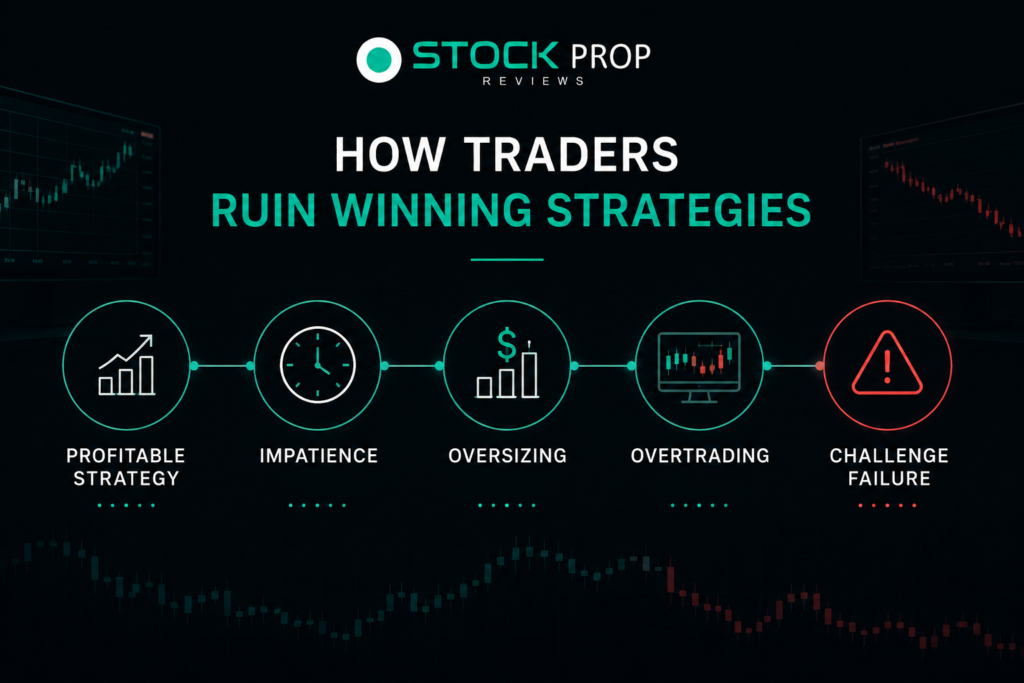
A trader cuts a winning trade early because they want to protect profits. Then they widen a stop loss because they are trying to avoid another losing trade. After that, they take a setup that was never part of the plan because they feel behind on their target.
Individually, these decisions seem minor. Together, they completely change the expectancy of the strategy.
A lot of prop traders are not failing because their strategy stopped working. They are failing because they stopped trading the strategy correctly.
Why Prop Firm Rules Affect Trader Psychology
Trading a personal account feels very different from trading inside an evaluation model.
When traders use their own account, there is usually more flexibility. In prop firms, every mistake feels magnified because the rules are always in the background.
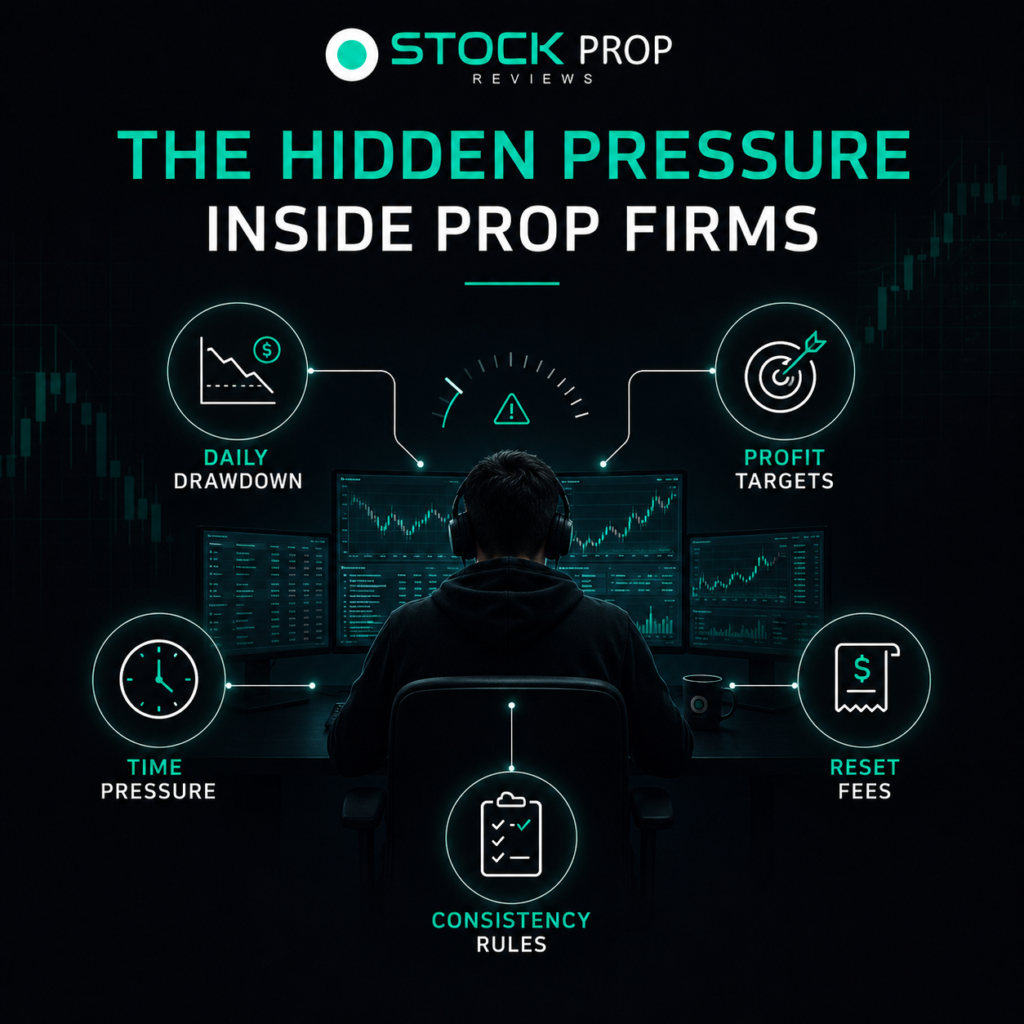
A trader can know exactly what setup they want, but still hesitate because they are thinking about:
- Daily drawdown limits
- Maximum account loss
- Evaluation deadlines
- Consistency rules
- Reset fees
This creates a defensive mindset.
Instead of focusing on execution, traders start focusing on avoiding failure. That shift is subtle, but it changes decision-making fast.
Many competitors talk about discipline in a generic way. What they often miss is how evaluation structures themselves influence trader behavior. Even experienced traders can become overly cautious or overly aggressive depending on how the account is structured.
The Problem With Chasing Evaluation Targets Too Quickly
A common mistake in prop trading is trying to complete challenges faster than the strategy naturally allows.
This happens all the time with newer traders.
They calculate that they need 8% or 10% profit, then mentally divide the target across a few trading days. Once that happens, patience disappears.
A swing trader suddenly starts taking intraday setups. A trader who normally risks 0.5% begins risking 2%. Someone who usually takes two trades a day suddenly takes eight.
The logic sounds reasonable at the moment because the trader believes they are “pushing through” the challenge.
In reality, they are abandoning the exact behavior that made the strategy profitable in the first place.
A profitable system cannot survive reckless execution for very long.
Most Traders Underestimate Emotional Fatigue
One thing that’s not talked about honestly much in the prop industry is how mentally exhausting trading can be during evaluations.
The problem is not only fear.
Repetition.
Hours staring at charts, a string of losses, missing a good trade and then trying to keep cool the next day wears a trader down faster than they think.
That fatigue will eventually spill over into execution.
The trader becomes impatient to wait for confirmation. They begin arriving early. They skip the journaling. They get frustrated and stop reviewing mistakes.
Over time, emotional exhaustion slowly eats away at consistency.
This is why some traders are good for a week or two and then suddenly spiral. It’s not always a failure of strategy. Sometimes bad decisions are simply a function of mental fatigue.
Backtesting Does Not Prepare Traders for Live Pressure
Backtesting is helpful, but it leads to a lot of overconfident traders.
Testing in the past removes the unknown. The data exists and the trader knows it already. Losses are easier to take because they’re not happening in real time.
Live prop trading is not the same.
If real rules and account limits are involved traders respond emotionally to normal market behaviour What seemed like a losing streak in the test is suddenly personal.
Here is where execution begins to fail.
Suddenly a trader who has followed every rule in backtesting all of a sudden:
- Closing trades prematurely
- Good setups skipped
- Increase position size after losses
- Trading outside of their plan
The strategy itself may still have a positive edge. The trader just stops using it consistently under pressure.
Why Risk Management Fails in Real Trading
Most traders think risk management means placing a stop loss.
That is only part of it.
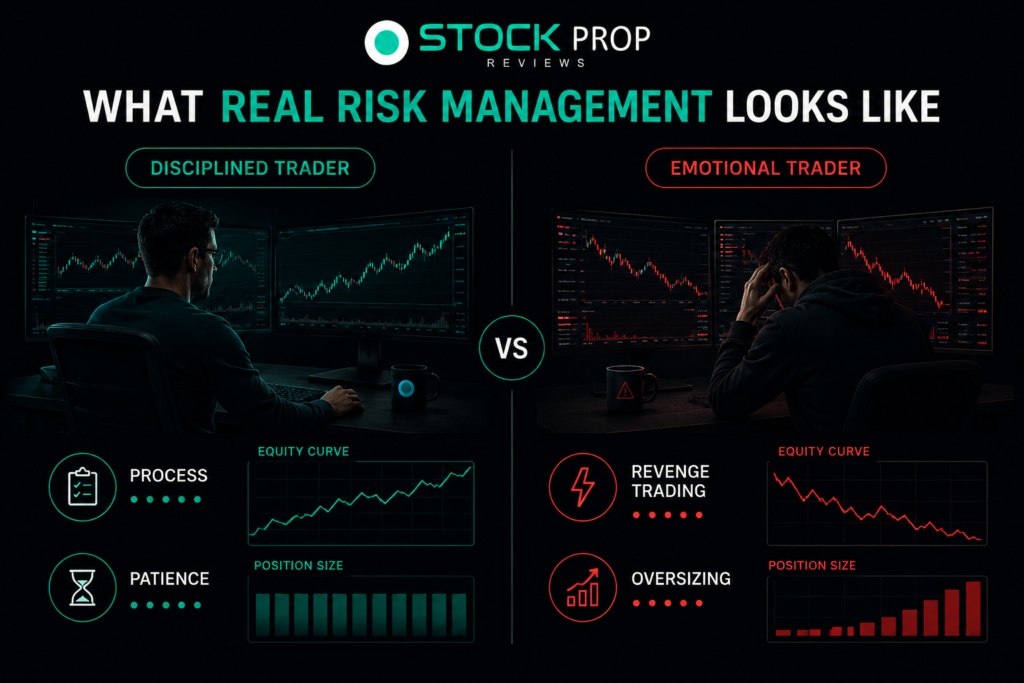
Real risk management is about maintaining stable behavior during difficult periods. The problem is that many traders respect risk only when things are going well.
Once frustration builds, discipline starts disappearing.
A trader loses several trades in a row and decides to “make it back” quickly. Position size increases slightly. Trade frequency increases slightly. Rules become more flexible.
The account usually collapses shortly after.
What makes this dangerous is that the trader often knows they are breaking their system while it is happening. Emotional trading rarely comes from ignorance. It usually comes from impatience and frustration.
Scalpers Face a Different Psychological Challenge
Scalping looks attractive because it offers frequent opportunities, but psychologically it is one of the hardest trading styles to sustain.
More trades mean more decisions. More decisions mean more emotional exposure.
A swing trader may only need to manage a few important setups each week. A scalper may face dozens of stressful moments every single day.
That pressure compounds over time.
Many scalpers pass evaluations because they can generate quick profits during strong periods. The problem appears later when emotional fatigue starts affecting consistency.
This is one reason funded accounts are often harder to maintain than challenge accounts.
Strategy Hopping Keeps Traders Stuck
One losing month causes doubt. Doubt leads to changing indicators. Then the trader changes markets, timeframes, or risk models.
The cycle repeats constantly.
A lot of traders never stay with one strategy long enough to understand its real statistical behavior. They abandon systems during normal drawdowns and move to something else that feels more exciting or more “accurate.”
Professional traders usually become profitable through repetition, not constant reinvention.
They learn how their strategy behaves during different market conditions. They collect enough data to trust the process even during losing periods.
Most struggling traders never reach that stage because they reset the learning process repeatedly.
Social Media Makes Prop Trading Worse for Many Traders
This part deserves more attention than it gets.
A trader can be following their plan correctly and still feel like they are failing because of what they see online.
Social media constantly pushes fast payouts, oversized gains, and aggressive challenge completions. Traders begin comparing normal progress to unrealistic expectations.
That comparison creates pressure to speed things up.
The result is usually overtrading, oversizing, or abandoning risk management altogether.
Quiet consistency rarely gets attention online, but it is what keeps traders alive long term.
Who Should Avoid Prop Firms for Now
Not every trader benefits from jumping straight into evaluations.
Some traders need more time developing consistency before adding external pressure.
This especially applies to traders who:
- Constantly change strategies
- Struggle with emotional revenge trading
- Depend on trading income immediately
- Cannot tolerate losing weeks
- Increase size impulsively after losses
For these traders, a smaller personal account may actually be more useful than repeatedly buying challenge accounts.
The goal early on should be stable execution, not proving something quickly.
Alternatives Some Traders Handle Better
Not every trader performs best in a fast-paced forex challenge environment.
Some traders handle stock-focused firms better because the pace feels more structured. Firms like TradeThePool appeal to traders looking for a regulated stock prop environment with transparent risk rules and slower decision-making compared to highly leveraged forex models.
Readers can get up to 10% discount when purchasing through our TradeThePool link.
Other traders improve significantly once they move toward swing trading rather than high-frequency execution. Fewer decisions often lead to better emotional control.
Sometimes the solution is not finding a better strategy. It is finding an environment that fits the trader’s personality more realistically.
What Successful Prop Traders Usually Understand
The traders who survive in prop firms are not usually the most aggressive traders.
Most of them just have a better understanding of probabilities.
They know losing streaks occur. They know consistency is more than a hot week. They don’t treat every drawdown as an emergency.
Most importantly, they quit trying to make themselves feel confident before every trade.
Confidence changes daily. Process does not.
That’s the mindset shift that separates traders who trade for a living from traders who keep starting over.
FAQs
Why do traders fail prop firms with profitable strategies?
Most traders go broke because they cannot perform consistently under pressure. Poor risk control, overtrading and emotional decision making generally destroys otherwise profitable systems.
Is psychology more significant than strategy in prop trading?
Strategy is important, but psychology is what determines if the strategy is followed correctly in live conditions.
Why do the traders pass the challenges but lose the funded accounts?
After getting funded, many traders become more aggressive. Others find it hard to stay disciplined when pressure and withdrawals are real.
Do prop firm rules promote emotional trading?
Some evaluation structures can be high pressure with tight drawdown limits or aggressive targets particularly for new traders.
Can Prop Firms Make Beginners Money?
Yes but beginners that focus too much on passing too soon often have a difficult time. Slower trading, more process-oriented trading tends to produce better long-term results.