
There is no industry-wide reliable number for average funded account lifespan. There isn’t much public data and most prop firms don’t publish enough account level data to create a representative average. What the evidence does suggest is that reaching the funded stage is not the same thing as maintaining an account. Survival is very much a function of size of risk, structure of drawdown, rules for payout and behavior of traders once the pressure of an evaluation is gone.
This article is for traders who are researching funded accounts, preparing for their first funded stage or trying to understand why passing a challenge doesn’t always lead to long term payouts. It is not intended for traders looking for a guaranteed account-survival formula or a single statistic that will tell them how long their own account will last.
What is a funded account lifespan?
Funded account lifespan is the period a trader remains active on a funded account before the account is closed, breached, replaced through scaling, or otherwise stops being available for trading.
That definition sounds simple, but there is an important problem with comparing lifespan figures between firms.
One firm may define failure as hitting a maximum drawdown. Another may close inactive accounts. A third may replace an account after scaling. Some firms also operate simulated funded environments rather than traditional brokerage accounts.
As a result, “average lifespan” can mean very different things depending on the firm’s rules and the dataset being studied.
What the available data actually tells us
The most useful public research currently points to a large drop-off between starting an evaluation, reaching funded status and receiving a payout.
One recent dataset from PropSim reports that 4.5% of challenge starters reached a funded account, while its analysis of challenge failures found daily loss limits responsible for 55.3% of failures. It also found inactivity accounting for 40.1% of failures.
Another 2026 analysis of over 300,000 prop-firm accounts, meanwhile, found roughly 14% reached funded status, and about 7% ever got a payout. The numbers should not be considered as one universal industry rate since the dataset and methodology differ from PropSim’s.
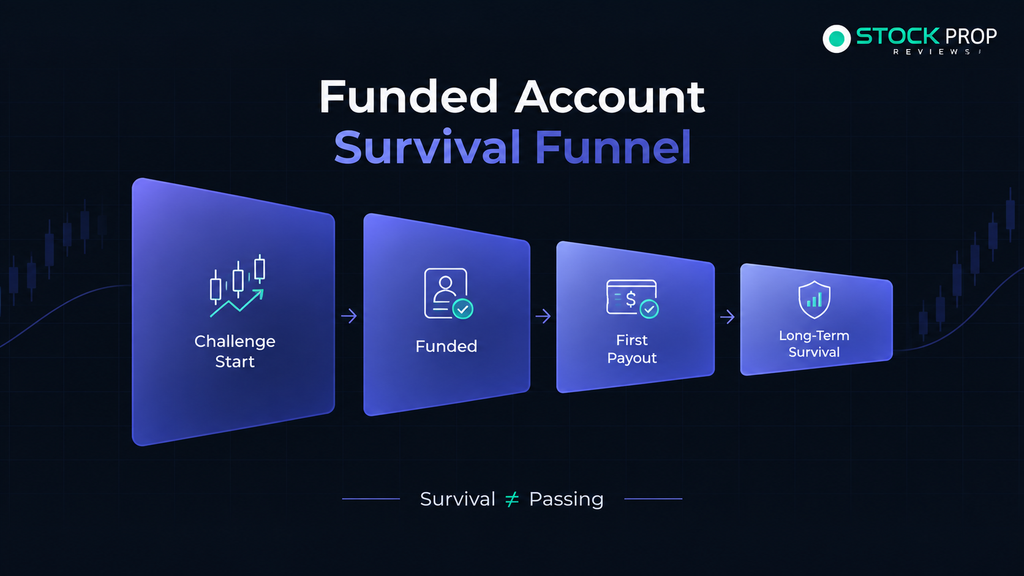
The important point is the funnel itself.
A trader can:
Start evaluation → pass evaluation → receive funded account → survive drawdown → reach payout → continue trading
Each stage removes traders.
That means funded-account survival should be studied separately from challenge pass rates.
Is there an average funded account lifespan?
Not with enough reliable public data to give one industry-wide figure.
Some research attempts to measure survival over fixed periods rather than calculating a single lifespan. For example, one recent dataset examined 90-day funded-account survival according to how quickly traders completed their evaluations. Traders who completed an evaluation within 10 trading days had a reported 90-day survival rate of 41.3%, compared with 67.8% for traders taking 11 to 25 days and 73.2% for those taking 26 to 60 days.
This does not prove that taking longer automatically makes a trader better. It does suggest that the way a trader reaches funding can matter after the evaluation is finished.
A fast challenge pass may involve unusually high position sizing or concentrated risk. That approach can work when the objective is to reach a target, but the same behaviour can become dangerous when the account’s main objective changes from hitting a target to preserving drawdown.
Another recent model produced an even wider range of outcomes. Among trader profiles with evaluation grades within 2% of one another, its modeled funded-account closure rates within one year ranged from 14.2% to 75.2%. This is a model rather than an audited industry dataset, so it should be viewed as an illustration of how different risk profiles can produce very different survival outcomes, not as a measured industry failure rate.
Why funded accounts fail faster than traders expect
The biggest misunderstanding is treating funding as the finish line.
The evaluation usually gives the trader a target. Once funded, that target may disappear. The trader is then managing a limited loss allowance while trying to produce profits that can eventually be withdrawn.
That changes the psychology.
Imagine a trader has a $100,000 nominal account with a $5,000 maximum loss. A trader who thinks in terms of the headline $100,000 balance may take positions that are far too large for the actual risk budget.
The practical account is nearer to this:
$100,000 nominal size → $5,000 risk boundary → little room for mistakes
The trader, if he loses 1% of the risk budget on 5 trades in a row, has already used a significant part of his available cushion. A few more losses, slippage or a particularly volatile session can tip the account toward breach.
And so the apparent size of the account can give a false sense of security.
The first major lifespan problem: oversized risk
Oversizing is one of the simplest ways to shorten funded-account lifespan.
A trader may risk 0.25% of a personal account but increase risk substantially after receiving a funded account because the account appears larger.
The reasoning often sounds logical:
“I have more buying power, so I can trade bigger.”
The problem is that buying power and drawdown capacity are not the same thing.
A trader with a $100,000 account and a $5,000 loss limit does not have $100,000 of practical loss capacity.
This is why a trader can have a profitable strategy and still have a short funded-account lifespan.
The strategy may have an edge. The position size may simply be incompatible with the firm’s drawdown.
The second problem: trading differently after passing
Passing an evaluation can create a psychological shift.
During evaluation, the trader may be focused on reaching a specific target. After funding, that target may disappear and be replaced by payout objectives.
Some traders respond by becoming too conservative. Others do the opposite and increase risk because they feel they have already “made it.”
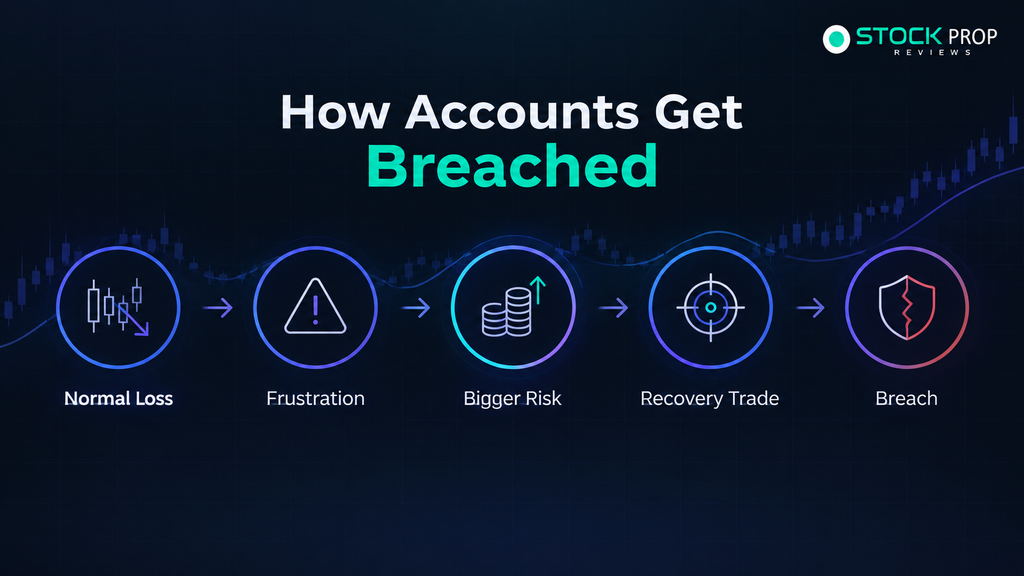
The latter creates a common sequence:
Normal loss → frustration → larger position → recovery trade → drawdown pressure → breach
The first losing trade is rarely the entire problem. The escalation that follows can be.
This is also why a single win rate is not enough to evaluate funded-account survival.
Two traders can have the same win rate while having very different account lifespans because their position sizing and responses to losing streaks are different.
The third problem: payout pressure
Payouts can introduce another form of risk.
A trader who has just built a profit buffer may start thinking about the amount that can be withdrawn. If the trader then increases risk to reach a larger payout quickly, the account can move from profitable to vulnerable surprisingly fast.
For example:
First payout → bigger target → higher risk → profit giveback
The danger is not the payout itself. The danger is changing the trading process because the trader now has a financial objective attached to the account.
This is one area where competitors often focus too heavily on advertised payout percentages and not enough on what happens between payouts.
What competitors often miss about account lifespan
Many prop-firm articles focus on three numbers:
- Account size
- Profit target
- Maximum drawdown
Those numbers matter, but they do not tell the whole story.
A trader should also examine how the firm handles daily losses, trailing drawdown,inactivity, position sizing, news, overnight positions, payout conditions, consistency requirements and scaling.
These rules can change how long an account remains usable.
For example, TradeThe Pool’s current program terms include requirements concerning daily risk, position volume, trade duration, consistency and certain overnight or earnings restrictions. Its terms also state that scaling can result in the existing account being closed and a new account being opened with new parameters.
That matters when calculating lifespan. An account ending because of a breach is not the same event as an account being replaced as part of scaling.
A better way to measure funded account survival
Instead of asking only “How many months does a funded account last?”, traders should look at several survival measurements.
| Measure | What it tells you |
| 30-day survival | Whether the trader can handle the first adjustment period |
| 90-day survival | Whether the strategy remains stable beyond the initial funded stage |
| First-payout rate | Whether traders are surviving long enough to withdraw |
| Multiple-payout survival | Whether the account can support repeatable withdrawals |
| Median lifespan | The middle outcome, less distorted by unusually long-lived accounts |
| Breach reason | What actually ends accounts |
| Risk per trade | How quickly normal losing streaks consume the drawdown |
The median can be more useful than a simple average because a small number of extremely long-lived accounts can distort the mean.
Unfortunately, most firms do not publish enough account-level data to calculate these figures independently.
That is a major limitation in any article claiming to know the “average” funded-account lifespan.
What actually extends a funded account lifespan?
The most practical factor is usually not finding a strategy with an exceptionally high return.
It is keeping normal losing periods from becoming account-ending events.
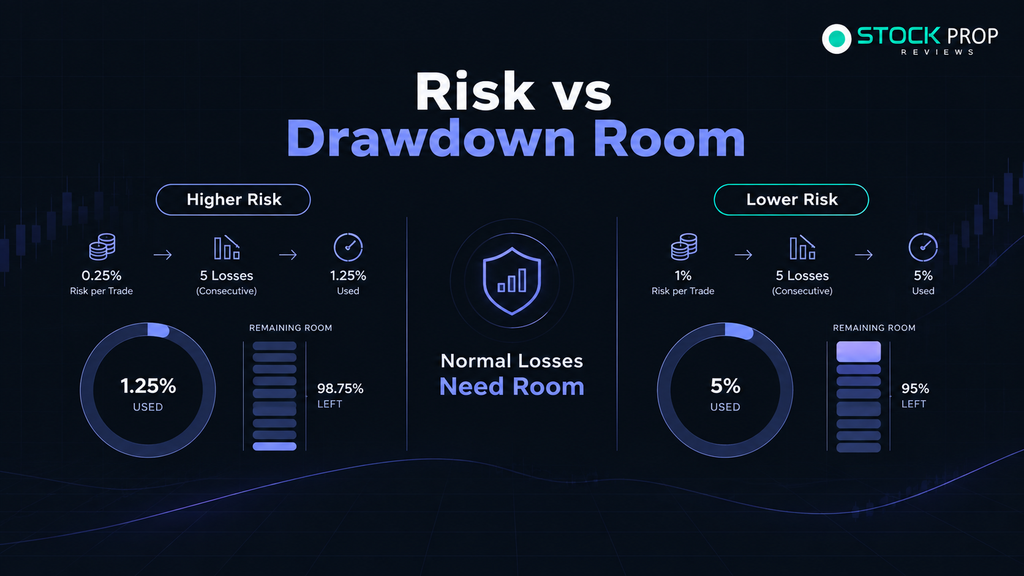
A trader risking 0.25% per trade has more room to experience a losing streak than a trader risking 2% per trade under the same drawdown limit.
Consider two simplified traders:
| Factor | Trader A | Trader B |
| Risk per trade | 0.25% | 1.0% |
| Five consecutive losses | -1.25% | -5% |
| Effect | More room remains | Drawdown pressure rises sharply |
| Recovery requirement | Lower | Much higher |
The example does not establish an ideal risk percentage for every firm. Different strategies, drawdown models and trading frequencies require different calculations.
The important principle is that ordinary variance should not be capable of ending the account.
Funded account lifespan by trading style
Scalpers face a different lifespan problem from swing traders.
A scalper may make many trades each day, increasing exposure to commissions, spread changes, execution conditions and daily loss limits.
A swing trader may take fewer trades but face overnight gaps, earnings announcements or restrictions on holding positions.
A trader using a high-frequency strategy may therefore need to focus heavily on execution and daily loss controls, while a swing trader may care more about overnight rules and gap risk.
There is no universally safe trading style for funded accounts.
The relevant question is whether the firm’s rules are compatible with the way the trader actually trades.
Common mistakes that shorten account lifespan
The most common mistakes are usually behavioural rather than mysterious.
A trader passes an evaluation using aggressive risk, then carries that risk into the funded stage.
Another trader takes a normal loss and immediately tries to recover it with a larger position.
A third trader reaches a payout threshold and increases exposure because the account now feels “safe.”
There is also the opposite problem: becoming so focused on avoiding a breach that the trader abandons the strategy that produced the original results.
Inactivity can be important too. Not all account failures are due to a losing trade. As the latest data set from PropSim shows, 40.1% of the challenge failures in its sample were due to inactivity.
Who should be cautious about funded accounts?
Funded accounts deserve extra caution from traders who:
- Requires aggressive returns to make model worth it
- Always increase position size after losses
- No daily loss limits to adhere to
- Expect to hold trades through events firm restricted
- Strategies Change Frequently
- Use the account’s nominal size as personal capital
- Need fast money from trading
A funded account can provide access to a larger trading framework without requiring the trader to put the full nominal account value at risk, but the restrictions can be significant.
The trader still has to operate inside the firm’s risk structure.
Trade The Pool as a stock-focused example
TradeThe Pool is useful as an example because its model is focused on stocks and ETFs rather than futures or forex. Its current program documentation publishes specific rules covering risk, position volume, trade duration, consistency and other trading conditions.
One important clarification is necessary: TradeThe Pool’s own website says the online prop-trading arena is not regulated and states that the company is not a financial institution or other regulated financial-services entity. I would therefore not describe it as a regulated stock prop firm.
For traders researching the model, the more relevant questions are whether the stock universe, drawdown rules, trading restrictions and payout structure fit their strategy.
Readers can get up to 10% discount when purchasing through our TradeThePool link.
For further reading, see our TradeThe Pool review, our Topstep funding model analysis, and our comparison of challenge passing versus funded-account survival.
The bigger lesson from funded account lifespan
The evidence does not support a single number such as “funded accounts usually last X months.”
What it supports is a more useful conclusion: funded-account survival varies substantially according to trader behaviour and account rules.
A trader who passes quickly through aggressive risk may have a very different survival profile from a trader who reaches funding gradually with smaller exposure. Likewise, a fixed-drawdown account can behave very differently from a trailing-drawdown account.
The account’s advertised size tells you very little about lifespan by itself.
The more useful calculation is:
How many normal losing trades can your risk model absorb before the firm’s drawdown limit becomes a problem?
If the answer is only a handful, the account may be fragile even when the strategy itself is profitable.
That is the part of funded-account lifespan that gets missed when the discussion focuses only on pass rates, account sizes and profit splits.
FAQs
How long does the average funded account last?
There is no reliable average for the whole industry. A single figure for lifespan is unreliable . Public datasets measure different populations and definitions of failure .
What causes funded accounts to fail?
They can be oversize, drawdown breaches, revenge trading, rule violations and inactivity, and they can be very high. New data further show that the main reasons for account failure are daily loss limits and inactivity. .
Does passing a prop firm challenge mean the trader is likely to keep the funded account?
No. Passing an evaluation and surviving the funded stage are separate outcomes. Research measuring 90-day survival has found differences based on how quickly traders completed their evaluations.
What matters most for funded account survival?
The drawdown structure, risk per trade, daily loss limit, strategy volatility and the trader’s ability to follow the firm’s rules all matter. Account size alone is not a useful measure of survival.
Is funded account lifespan the same as payout lifespan?
No. An account can survive with no payout and a trader can get at least one payout without demonstrating long-term survival. Multiple-payout survival is a more useful measure of sustained performance, but firms rarely publish enough data to calculate it reliably.