Passing a prop challenge and staying in a funded account are two different trading problems. The survival of a funded account is less about a trader being able to hit a short-term profit target, and more about being able to protect the remaining drawdown after funding.
This article is for traders who are comparing evaluation models, getting ready for their first challenge or trying to understand why passing an evaluation doesn’t automatically mean regular payouts. It isn’t for traders looking for a formula with a guaranteed pass-rate or a shortcut to funding.
Public industry estimates generally place evaluation pass rates in the single digits, although the exact number varies by firm, account model, population and methodology. FunderPro, for example, mentions several public estimates of around 5% to 10% for evaluation passes, and also discusses reward rates among funded traders. That is not an industry-wide statistic. (Advocate Pro)
The more useful question is what happens between passing the challenge and getting the rewards over and over again.
Challenge Passing Is Not Funded Account Survival
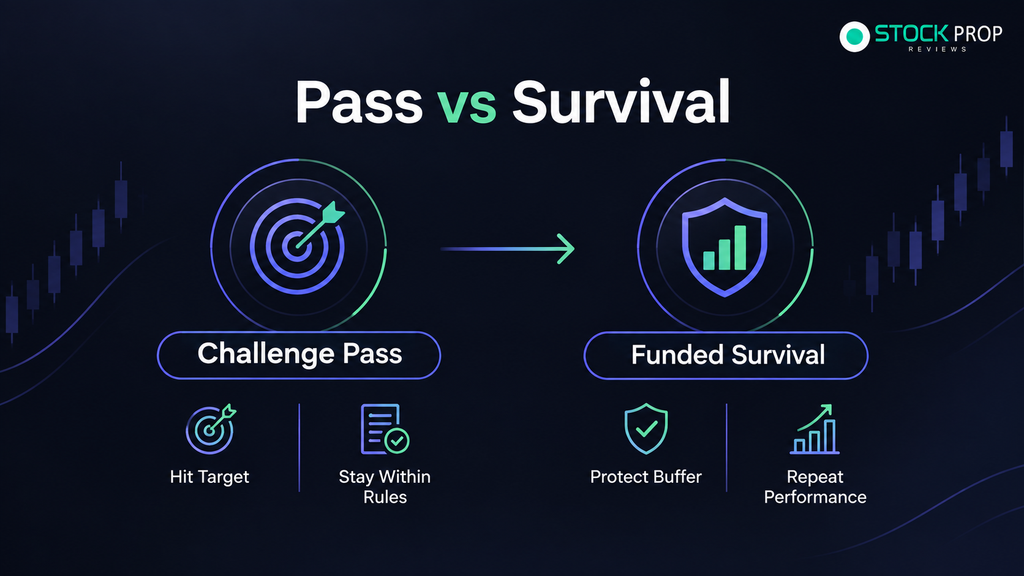
A challenge normally asks the trader to satisfy a defined profit objective without violating daily or maximum drawdown rules.
A funded account adds a different problem: the trader now has to preserve enough capital to continue trading while managing withdrawals, changing psychology, and sometimes a different set of restrictions.
That distinction matters.
A trader can make 8% or 10% during an evaluation by taking concentrated risk. The same behaviour can become destructive after funding because there is no longer a single target to chase. The objective changes from reaching a number to remaining inside the risk boundary.
For Traders describes challenges as simulated evaluations where profit targets and drawdown limits determine progression. It also highlights drawdown as a major reason accounts fail.
What the Available Data Actually Shows
There is no universal industry database that tracks every challenge purchase, failed evaluation, funded account and subsequent payout over the complete trader lifecycle.
That limitation is important.
Published pass-rate figures are often based on a particular firm’s customers, selected datasets or third-party estimates. They can also use different definitions of “pass.” One source may count reaching a target, while another may count completing all verification requirements or receiving a reward.
In FunderPro analysis for 2025, the evaluation pass rate becomes independent of the share of funded traders who get a reward. It mentions the public estimates of approximately 5% to 10% for evaluation passes and that only a smaller population reaches the reward stage. (FunderPro) CTI also claims that about 80% to 95% of traders fail challenges, but its article cites these figures with outside research instead of as a general audited industry statistic. (City Traders Empire)
So the safest interpretation is this:
Passing is a strainer. Challenge The problem is funded account survival.
The two rates cannot be taken as interchangeable.
Challenge Pass Rate vs Funded Account Survival
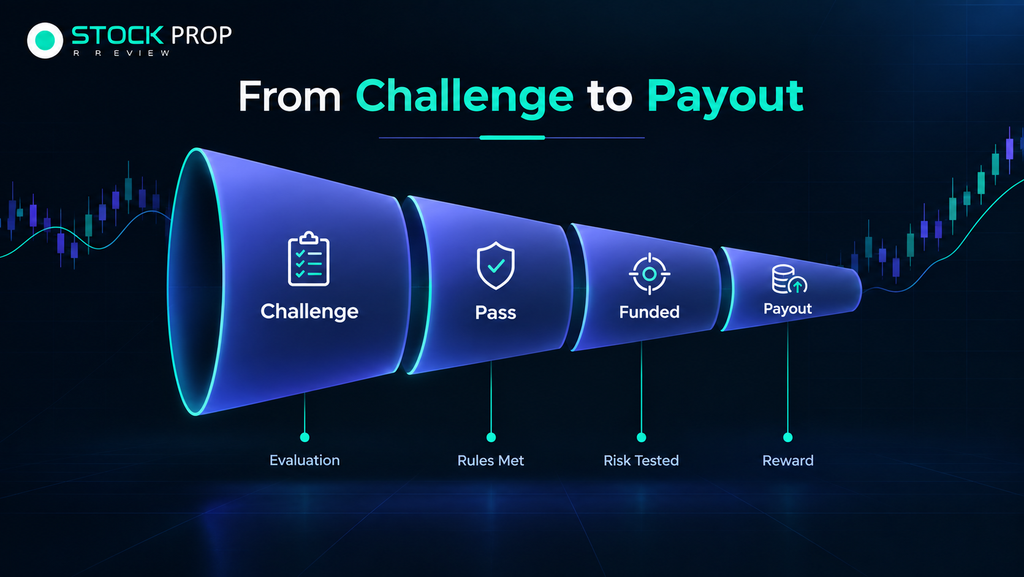
| Stage | Main objective | Typical failure pressure | What traders often misunderstand |
| Challenge | Reach profit target | Over-risking, deadline pressure, drawdown | Profit target is only one part of the test |
| Verification | Repeat performance | Changing strategy after a pass | A successful first phase does not prove repeatability |
| Funded account | Protect capital and generate eligible profit | Oversizing, payout pressure, drawdown | Funding is not the finish line |
| Post-payout trading | Continue operating | Giving back profits or increasing size | A previous payout does not create extra risk capacity |
This is where many generic “how to pass” guides stop too early. They focus on reaching the target but spend less time examining what happens after the trader has already demonstrated that they can do it once.
Why Traders Pass Challenges Then Fail Funded Accounts
The first problem is often a change in risk behaviour.
Imagine a trader risking 0.5% per trade. They build a challenge from $100,000 to $108,000 through a series of controlled trades and passes.
After funding, the trader sees a profitable setup and starts risking 1% because the account is already up. A few losses follow. The trader then increases size again to recover the lost profit.
The strategy has not necessarily changed.
The risk behaviour has.
This is one reason the challenge and funded stages can produce different outcomes even when the trading system remains identical.
Urban Forex identifies repeated low-quality decisions, overtrading, unclear setups and inappropriate risk sizing as major causes of account deterioration.
The Drawdown Buffer Matters More Than the Account Size
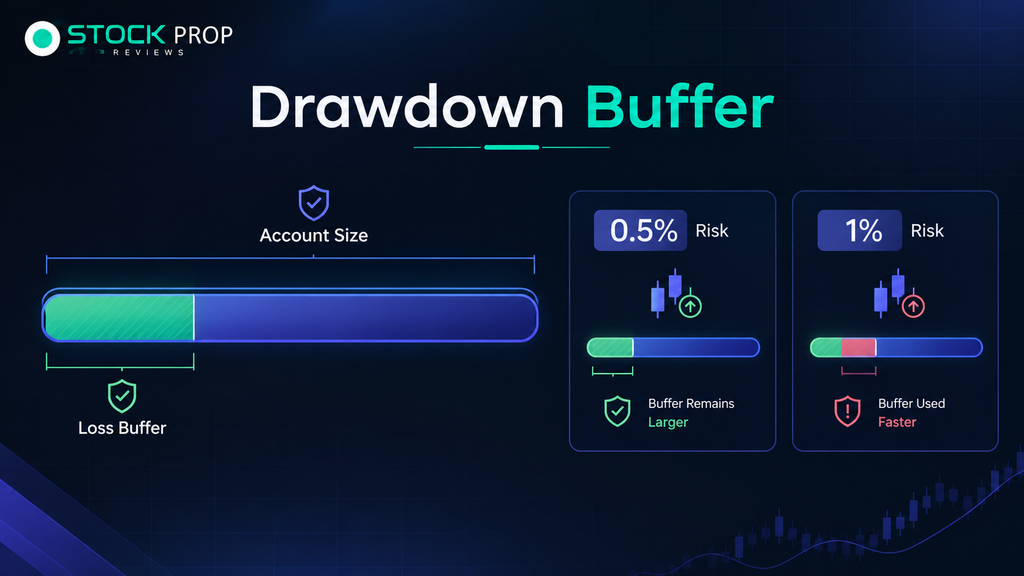
Just because you have $100,000 in your account doesn’t mean you have $100,000 of usable risk.
The usable failure buffer is $10,000 if the maximum loss is $10,000.
That is the number a trader should be thinking about when determining how much to trade.
This same distinction is reflected in AIFO’s current risk guidance. It offers a planning range of 0.25%-0.50% for many traders, while noting that actual risk must be reduced as the remaining daily or max-loss buffer gets smaller.
Say you have a hypothetical $100,000 account and a 10% max loss.
Ten full losing trades at 0.5% risk would theoretically chew up the entire maximum-loss allowance.
At 1 % risk . 10 losses gets you the same mathematical end point , in half the number of trades .
That’s not to say that 0.5% is safe for everyone. Actual results may vary due to slippage, commissions, correlated positions, daily limits and floating losses.
The basic principle is that risk should be measured against the failure buffer, not the headline account size.
Why the First Payout Changes Trader Behaviour
A first payout can create a new psychological problem.
During a challenge, the trader thinks:
“How do I reach the target?”
After funding, the question becomes:
“How much can I withdraw without damaging the account?”
Those are different incentives.
Suppose a trader earns 5% and withdraws part of it. The trader may then feel pressure to rebuild the account quickly. Another trader may become excessively conservative because they do not want to lose money after finally reaching the funded stage.
Both reactions can damage performance.
This is why funded account survival should be measured over multiple trading cycles rather than by one successful evaluation.
The Payout Pressure Cycle
A common sequence looks like this:
First Payout → Bigger Target → Higher Risk → Profit Giveback
The first payout proves that the trader can generate an eligible reward. It does not prove that the trader can repeat the process indefinitely.
The danger comes when a payout becomes a new psychological benchmark.
A trader who previously considered 2% monthly performance acceptable may suddenly decide that the next account must produce 5% or 10%. That can lead to more trades, larger positions and lower-quality setups.
The trading edge may remain unchanged while the behaviour around it deteriorates.
Static vs Trailing Drawdown Can Change Survival
Drawdown architecture is one of the biggest differences between prop firm models.
A static drawdown remains tied to a defined starting point. A trailing model can move the loss floor as the account reaches new equity highs.
For example, CTI currently describes its 2-Step model as using a 10% static drawdown alongside a 5% daily drawdown, while its 1-Step model uses a 5% balance-based trailing drawdown and no daily drawdown.
These structures can produce very different trading experiences.
A strategy that needs room to let winners develop may behave differently under a trailing loss floor than under a static one.
This is why comparing firms only by the advertised profit split misses an important part of the risk equation.
A Simple Survival Example
Let’s look at two hypothetical traders, both trading with a $100,000 account.
Trader A risks 1/4% per trade.
Trader B may risk 1% per trade.
They both have the same 45% win rate and the same 1.5:1 reward/risk ratio.
If the average of Trader B’s strategy is performing well, in a good period the target may be reached sooner.
But a losing streak also eats the risk buffer faster.
Let’s say they both drop six straight.
Trader A loses about 1.5% before trading costs.
Trader B is down roughly 6%.
Neither trader has failed automatically, but their psychological and mathematical positions are very different.
Trader A still has a lot of ground to cover.
Trader B could start to change position size, to look for recovery trades or to take setups outside the original system.
This is where the survival of funded accounts can break down.
What Competitor Guides Often Miss
Most challenge guides concentrate on preparation, position sizing and reaching the target.
Those are useful, but they do not fully explain the lifecycle.
The missing question is:
What behaviour changes after the target has already been achieved?
Another overlooked issue is selection bias.
The traders who successfully complete a challenge are already a filtered group. Looking only at successful traders can make the funded stage appear easier than it is for the wider population.
There is also a measurement problem.
A trader who receives one payout and then loses the account has technically achieved a payout but has not demonstrated long-term funded account survival.
A more useful dataset would track:
- Attempts at challenges
- Challenge succeeded
- Unlocked funded accounts
- Initial payments
- Second and subsequent payments
- Account hack after paying
- Frequency of Payout
- Average drawdown prior to payout
- Risk per trade (
- Account active count
Without those measurements, claims about “success rates” should be treated cautiously.
Common Trader Mistakes After Passing
Increasing risk immediately
Passing creates confidence. Confidence can become oversizing when traders start treating the account as proof that their risk capacity has increased.
It has not.
Trying to recover a slow month
A funded account does not require a fixed monthly return unless the specific model says otherwise. Creating an artificial monthly target can turn a normal slow period into unnecessary trading.
Treating profits as free risk
A trader who makes $3,000 may feel comfortable risking more because the account is already profitable.
But the drawdown rule still exists.
Changing the strategy after funding
Some traders use conservative risk during evaluation and then switch to a more aggressive approach after funding.
That removes the benefit of having tested the original process.
Ignoring floating losses
A position can be profitable or losing before it is closed, and different firms calculate their limits differently. AIFO specifically notes that traders need to understand whether daily and maximum loss calculations incorporate equity, floating losses and the account’s particular drawdown model.
How to Think About Funded Account Survival
A useful framework is to break down three numbers:
Goal: How much money do you want to make?
Buffer: How much can be lost before the account becomes compromised?
Risk: How much do you risk on each trade?
The evaluation takes the trader toward the goal.
The buffer keeps the account alive .
Risk is how quickly the trader can consume that buffer.
This is why a low risk trader can take longer to hit a target but have a more sustainable process once funded.
That is also why the highest publicized profit split should not be the automatic factor in picking a model for a trader.
Strategy Fit Matters More Than Headline Pass Rates
A scalper, swing trader, futures trader and stock trader can face completely different constraints.
A strategy may require overnight holding. Another may depend on news volatility. A third may rely on tight stops and frequent entries.
The account model has to accommodate those characteristics.
Our FTMO review examines how drawdown, news restrictions and account structure affect different trading styles. Our TradeThePool review looks at the separate considerations involved in equity-focused prop trading. A broader prop firm comparison is useful when the question is not simply which firm has the highest advertised split, but which rule structure matches the trader’s method.
Our analysis of backtested strategies also covers another important issue: a strategy can look attractive in historical testing but still be poorly suited to a prop firm’s drawdown and execution constraints.
TradeThePool and the Survival Question
TradeThePool is worth a look in and of itself for stock traders, as its model is built around equities, not as an afterthought to a wider forex product.
Before you buy, you should assess its published rules and risk framework, especially how it handles position sizing, loss limits and the management of equity positions.
One point of fact is worth noting: Based on the information released so far, TradeThePool cannot be considered a stock prop firm regulated. The business describes itself as a proprietary trading firm in its own documentation, not a regulated financial institution. Rule transparency and regulatory status are two different issues. Readers are eligible to receive up to 10% discount when purchasing through our TradeThePool link.
Who Should Focus on Survival Rather Than Passing Faster?
The biggest warning sign is a trader whose entire plan revolves around completing the challenge as quickly as possible.
Speed can be useful, but it should be a consequence of the strategy rather than the objective.
A trader should be particularly cautious if they need:
- Large percentage gains in a short period
- Increasing position size after losses
- Multiple recovery trades
- High leverage to reach the target
- A fixed income expectation from every account
Those behaviours can produce a successful challenge in a favourable market period, but they can also make the funded stage difficult to sustain.
A Better Way to Measure Success
Try instead of asking:
“I can do this, yeah?”
Ask: “
“Can I replace this risk model for six months without changing my behaviour?”
That question brings weaknesses out earlier.
If a trader cannot trade comfortably within the drawdown structure of the account, the funded stage is probably not going to fix that problem either.
The evaluation is not a hurdle prior to the actual trading starts. It is a premonition of the constraints that govern the later narrative.
FAQs
What is funded account survival?
Funded account survival is the ability to remain within a prop firm’s trading and drawdown rules long enough to continue trading and receive eligible rewards. It is different from simply passing an evaluation.
Is the challenge pass rate the same as the payout rate?
No. A challenge pass rate measures traders reaching the required evaluation conditions. A payout rate measures a later stage. A trader can pass an evaluation but breach the funded account before receiving a reward.
Why do traders pass challenges and then fail funded accounts?
Common reasons include increasing risk after funding, trying to recover losses quickly, changing strategies, overtrading and misunderstanding the funded account’s drawdown or payout conditions.
What risk per trade helps with funded account survival?
There is no universal percentage. AIFO currently presents 0.25% to 0.50% as a planning range for many traders, but stresses that the final risk should depend on the remaining loss buffer and the firm’s specific rules.
Does a higher profit split mean better funded account survival?
No. Profit split and survival are separate variables. A higher split does not compensate for a drawdown model, trading restriction or payout condition that does not fit the trader’s strategy.
Final Trader Perspective
The difference between passing and surviving is the goal.
Challenge: A prize for hitting a defined target, while playing by the rules. A funded account is rewarded for living long enough to go through that again.
This is why pass rates alone on challenges do not tell the whole story.
The more relevant question from a trader level is not how fast an account can reach it’s target. It is if the trader can maintain the same risk, strategy and decision making after the target has disappeared.
That’s the real test of survival of the funded account for most traders.