A common risk control in proprietary trading is the daily loss limit. They are there to stop traders from turning a bad day into a disaster.
The problem is daily loss limit scalping is a unique challenge. Scalpers will often make dozens of trades, using tight stop losses and depending on statistical advantage over a large number of executions. Sometimes a rule put in place to protect traders can get in the way of the natural flow of a profitable scalping system.
This article is for funded traders, evaluation candidates and active scalpers that trade often during the session.
This is not for swing traders holding positions for days or traders only taking one or two setups per week.
Knowing why daily loss limits impact scalpers in different ways can help traders select the right prop firm, manage risk more effectively, and avoid unnecessary account blowouts.
What Is a Daily Loss Limit?
The daily loss limit is the most money a trader can lose on one day of trading before they have to stop trading.
This is a rule used by prop firms to limit excessive risk and protect their capital allocations.
For example:
| Account Size | Daily Loss Limit | Maximum Daily Loss |
| $50,000 | 4% | $2,000 |
| $100,000 | 5% | $5,000 |
| $200,000 | 3% | $6,000 |
Once the threshold is reached, traders may be locked out of the platform or automatically fail an evaluation.
At first glance, this seems reasonable. Most traders agree that having a hard stop can prevent emotional damage.
The issue emerges when the rule interacts with high-frequency trading strategies.
Why Scalpers Feel Daily Loss Limits More Than Other Traders
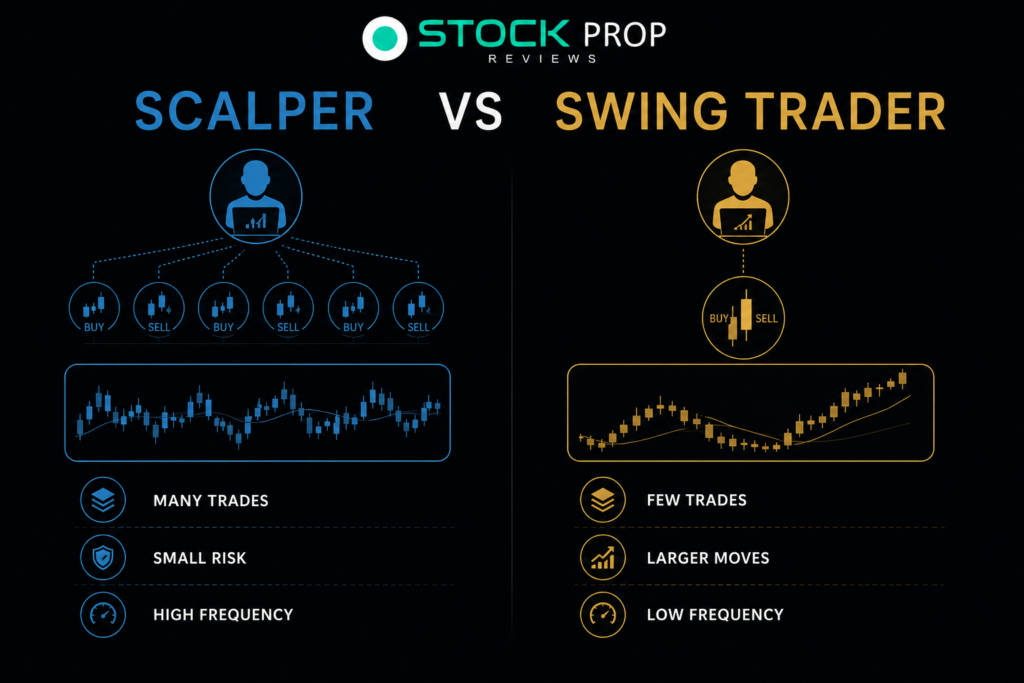
A swing trader may take one trade and risk 1% of the account.
A scalper may take twenty trades and risk 0.25% per trade.
Although total risk exposure may be similar, the path toward profitability is completely different.
Scalpers rely on repetition. Their edge often comes from executing the same setup many times and allowing probability to work over a larger sample size.
Daily loss limits can interrupt that process.
Consider this scenario:
A scalper can expect to win 55% of the trades they make at a 1:1 reward-to-risk ratio.
Profitable in over 50 trades.
But six straight losses in the first hour of trading could bring the trader dangerously close to the maximum daily loss limit.
The strategy itself is still statistically valid, but the trader is forced to trade defensively or to stop trading altogether.
This creates a problem that competitors rarely talk about.
The risk rule may be capturing short-term variance rather than true strategy quality.
What Most Competitors Don’t Explain
Most articles explain daily loss limits as a psychological safety tool.
That is true.
What often gets ignored is the relationship between loss limits and trading frequency.
A trader that takes 3 trades a day experiences variance differently than a trader that takes 30 trades a day.
Scalpers naturally encounter:
- More streaks of losing
- Increased transaction costs
- More execution errors
- Further random market noise exposure
Even profitable scalping systems can experience clusters of losses.
A daily loss limit may effectively reduce the number of trades needed for the statistical edge to appear.
The result is that some traders fail evaluations despite following their strategy correctly.
This does not mean daily loss limits are bad.
It means traders must understand how the rule affects their specific style.
The Hidden Psychological Pressure on Scalpers
Daily loss limits change trader behavior.
This effect becomes stronger as the account approaches the threshold.
Many scalpers begin trading differently after two or three losses.
Common reactions include:
- Jumping valid ideas
- Stop losses on the move.
- Locking in profits too soon
- Bigger position sizes to make up for losses
- Not trading whatsoever
Ironically, these behaviors often cause the rule to trigger.
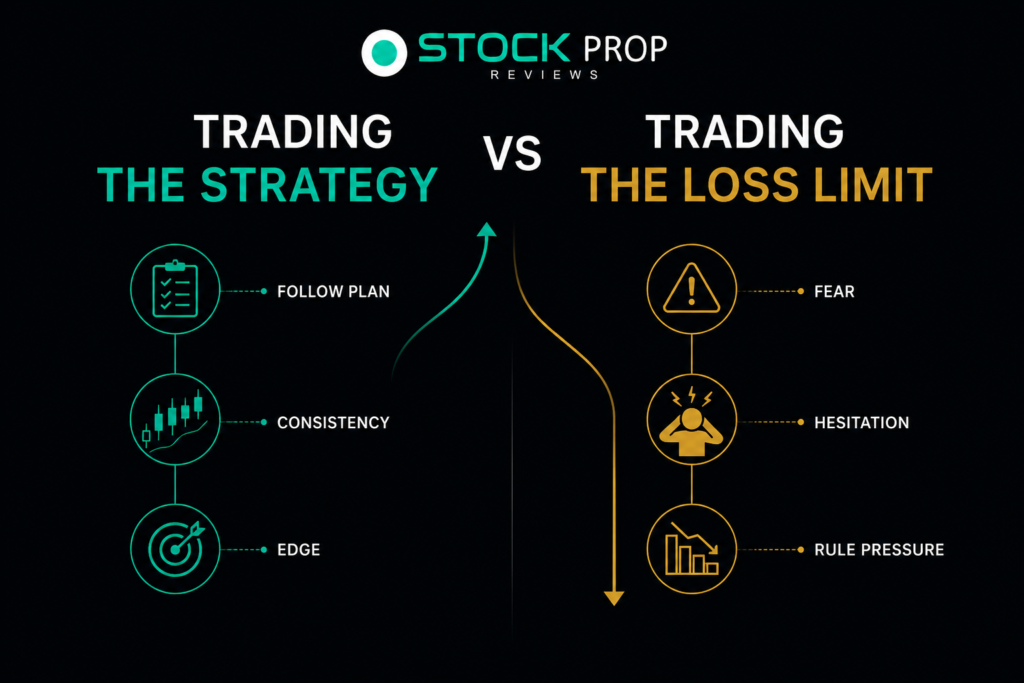
The trader is no longer executing the original system.
They are trading the loss limit instead.
This distinction matters because many funded traders believe strategy failure caused the problem when the real issue was behavioral adaptation to the rule.
Real Trading Scenario
Imagine a futures scalper trading the open.
Their strategy historically produces:
- 54% WR
- Reward to risk 1:1
- Average 25 trades a day
A six-trade losing streak is statistically normal.
In a personal account, the trader continues executing and eventually recovers through volume.
In a prop evaluation with a strict daily loss limit, that same losing streak may leave almost no room for further trading.
The trader is effectively prevented from reaching the sample size needed for the edge to work.
Many evaluation failures happen this way.
Not because the strategy lacks an edge.
Because the account rules are incompatible with the strategy structure.
Daily Loss Limits and Prop Firm Evaluations
Evaluation accounts often amplify the problem.
Most firms require traders to:
- Achieve profit goals
- Keep within max drawdown limits
- Daily loss limits
These objectives can conflict with one another.
Traders need higher activity to reach profit targets fast.
Higher activity increases the probability of violating daily drawdown limits.
This sets up a balancing act that many new traders don’t catch.
When reviewing prop firms, traders should pay attention not only to profit targets but also to how daily loss rules are calculated.
Some firms calculate loss from the start-of-day balance.
Others use trailing calculations.
The difference can significantly affect scalping performance.
Readers comparing risk structures may also find value in our analysis of prop firm drawdown models and our review of FundedNext’s risk framework.
When Daily Loss Limits Actually Help Scalpers
The debate needs to be fair.
Limits on daily losses are not bad in themselves.
These are a godsend to many scalpers.
They help when:
- Traders revenge trade
- Emotional decision making seems
- Market conditions change rapidly.
- Volatility goes abnormal
- Discipline collapses
Even if there is no rule, experienced traders will often set their own personal daily loss limits.
The difference is flexibility.
A self-imposed limit can be adjusted with the evolution of strategy performance.
A prop firm rule can’t.
That distinction is why some professional scalpers dislike rigid external limits, but still have strict personal risk controls.
Common Mistakes Scalpers Make
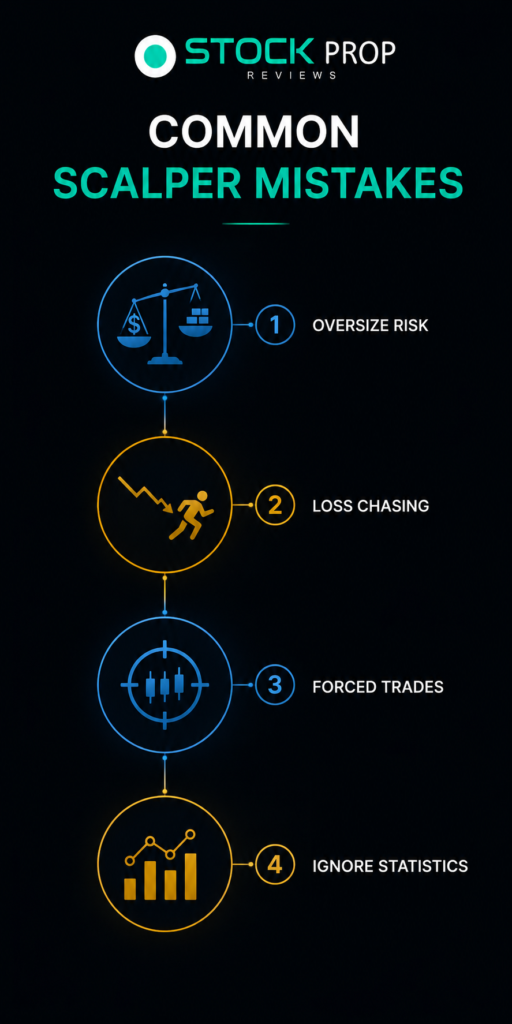
Using Swing Trader Risk Models
Many scalpers use risk percentages designed for low-frequency trading.
The result is too much drawdown on normal losing streaks.
Risk models should be a function of anticipated trade frequency.
Ignoring Losing Streak Probabilities
Every strategy has a mathematical chance of consecutive losses.
Traders often backtest win rates but they don’t study the behaviour of streaks.
Knowing the expected drawdowns helps to see if the rules of a firm are realistic.
Increasing Size After Losses
This is one of the fastest ways to hit a daily loss limit.
The pressure to recover losses often causes traders to abandon proper position sizing.
Trading Lower-Quality Setups
As traders approach profit targets, some begin forcing trades.
This increases losses and often triggers risk limits.
Best and Worst Trading Styles for Daily Loss Limits
| Trading Style | Compatibility With Daily Loss Limits |
| Swing Trading | Excellent |
| Position Trading | Excellent |
| Intraday Trend Trading | Good |
| Momentum Trading | Moderate |
| Scalping | Challenging |
| High-Frequency Scalping | Most Challenging |
This does not mean scalping cannot work.
It simply means traders must choose firms whose risk rules align with their strategy.
Alternatives for Scalpers
Scalpers who frequently encounter daily drawdown issues should evaluate alternatives.
Firms With More Flexible Drawdown Structures
Some firms place greater emphasis on overall account drawdown rather than strict daily thresholds.
This may better suit high-frequency traders.
Larger Account Buffers
A larger account with the same strategy often reduces the probability of touching daily limits.
Regulated Stock Prop Trading
TradeThePool and other firms provide equity traders with transparent stock-specific risk structures and clear rules. Readers can enjoy up to 10% discount when buying via our TradeThePool link.
The trick is to figure out whether the firm’s risk model fits with your strategy, not just chase the biggest headline number of funding.
Daily Loss Limit vs Maximum Drawdown
Many traders confuse these two concepts.
| Feature | Daily Loss Limit | Maximum Drawdown |
| Time Period | One Trading Day | Entire Account Life |
| Purpose | Prevent Bad Days | Protect Overall Capital |
| Scalper Impact | High | Moderate |
| Swing Trader Impact | Low | High |
A trader may never violate overall drawdown rules but repeatedly struggle with daily loss restrictions.
This is particularly common among active scalpers.
For a deeper discussion, see our comparison of daily drawdown versus trailing drawdown models.
Who Should Avoid Firms With Strict Daily Loss Limits?
A strict daily loss rule may not be ideal for:
- High-frequency scalpers
- News traders
- Traders relying on large sample sizes
- Algorithmic systems generating many signals
- Traders with naturally volatile equity curves
On the other hand, beginners often benefit from these protections because they reduce the damage caused by emotional mistakes.
This is why the “best” risk structure depends heavily on experience level and trading style.
Our recent opinion piece on whether prop firm rules improve trader discipline explores this trade-off in greater detail.
Quick Verdict
“Daily loss limits exist for a reason. They protect capital and keep emotions from boiling over.
But the daily loss limit scalping makes a special conflict.
Scalpers are based on repetition, statistical probability and larger trade samples. A strict daily loss threshold can interrupt that process before the strategy has had a chance to play out.
Many account failures are not due to a broken strategy, but rather to the trader’s frequency and the firm’s risk model being poorly matched.
Before joining any prop firm, scalpers should spend as much time evaluating drawdown rules as they do evaluating profit targets.
The most trader-friendly firms are not necessarily those with the biggest funding numbers. They are often the ones whose risk structure aligns with how traders actually operate.
For traders seeking transparency, regulated environments, and clearly defined risk parameters, TradeThePool remains one option worth examining. Readers can get up to 10% discount when purchasing through our TradeThePool link.
FAQs
Can a scalper work if there is a daily loss limit?
No. Many successful scalpers are profitable within the realm of daily loss limits. The problem is that the limits must leave enough room for normal strategy variance.
Why do scalpers hit daily loss limits more frequently?
Scalpers will make more trades and therefore be more likely to experience short-term losing streaks and temporary drawdowns.
Daily loss limits for beginners?
Sure. Many beginners find daily risk caps useful because they can stop emotional overtrading and big losses.
Are Daily Loss Limits at Prop Firms Unfair?
No.Their function is to protect capital. Problems arise when the rule is not compatible with the trader’s strategy or the expected drawdown profile.
Scalpers, what matters more to you, daily loss limits or max drawdown?
Both are important, but the daily loss limits tend to have a greater day-to-day impact, because they directly impact trading activity and how often trades can be executed.