A company that splits the profits 90% or even 100% sounds like a no brainer. The natural assumption for most traders is that the more profit they retain, the more money they have. This is often not the case.
The prop firm profit split is just one side of the equation. It also depends on how often you can withdraw your profits, how easy it is to meet the payout requirements, and if you can keep the account open long enough to receive multiple payouts.
This article is written for traders who are comparing proprietary trading firms before buying a challenge or funded account. If you’re only looking for the highest advertised percentage, this guide might challenge a few assumptions. If you want to get a sense of what you will actually earn in six or twelve months, the figures become much more meaningful.
Quick verdict
A better profit split doesn’t mean much if you can’t consistently qualify for payouts.
Most seasoned funded traders would prefer to take 80% of the profit in a company with simple rules rather than chase a 95% split with difficult withdrawal conditions. Steady payouts usually trump flashy marketing.
What does a prop firm profit split actually mean?
The profit split is simply the percentage of trading profits paid to the trader after a successful withdrawal request.
If you make $10,000 and the agreement is an 80% split, you receive $8,000 while the firm keeps $2,000. On paper, the calculation is straightforward.
Real trading rarely is.
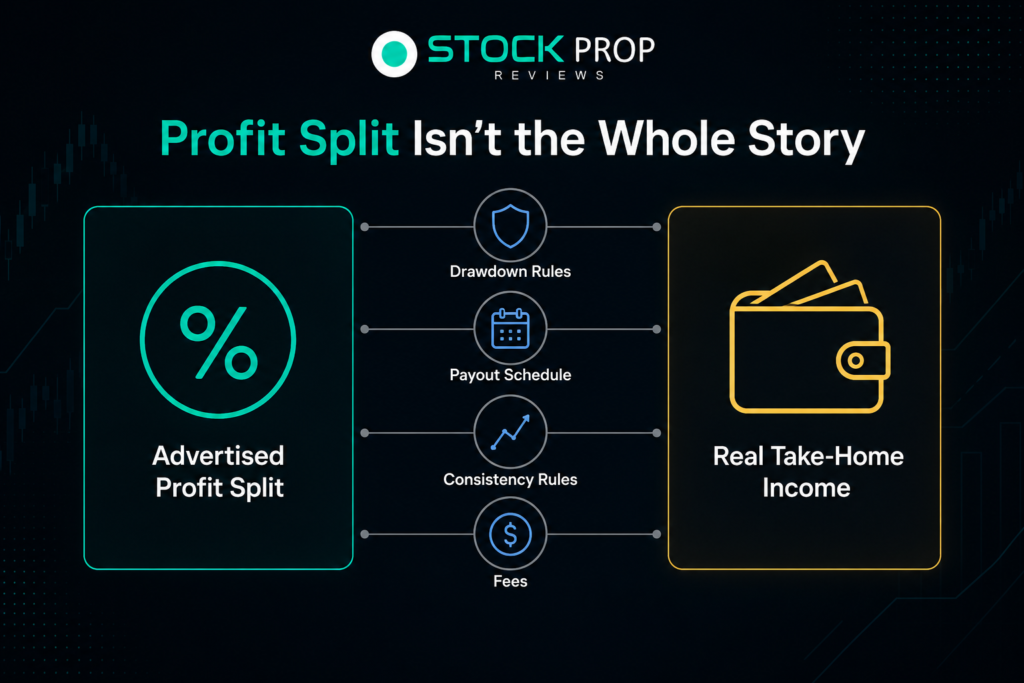
Your final payout depends on several other factors that aren’t reflected in the advertised percentage. These include drawdown limits, payout schedules, consistency rules, challenge costs, reset fees, and, perhaps most importantly, whether you still have the funded account by the time payday arrives.
This is why comparing firms by profit split alone often leads traders to the wrong conclusion.
Comparing profit splits on paper
| Profit Split | Profit on $5,000 Gain | Trader Receives |
| 80% | $5,000 | $4,000 |
| 85% | $5,000 | $4,250 |
| 90% | $5,000 | $4,500 |
| 95% | $5,000 | $4,750 |
Looking only at the table, choosing 95% seems obvious.
Now imagine the firm paying 95% requires thirty trading days before the first withdrawal, limits how much profit can come from a single day, and has strict consistency rules. Suddenly the comparison becomes much less clear.
Why your take-home income is usually lower than expected
One mistake newer traders make is assuming every profitable trade eventually becomes money in their bank account. That isn’t how funded trading works.
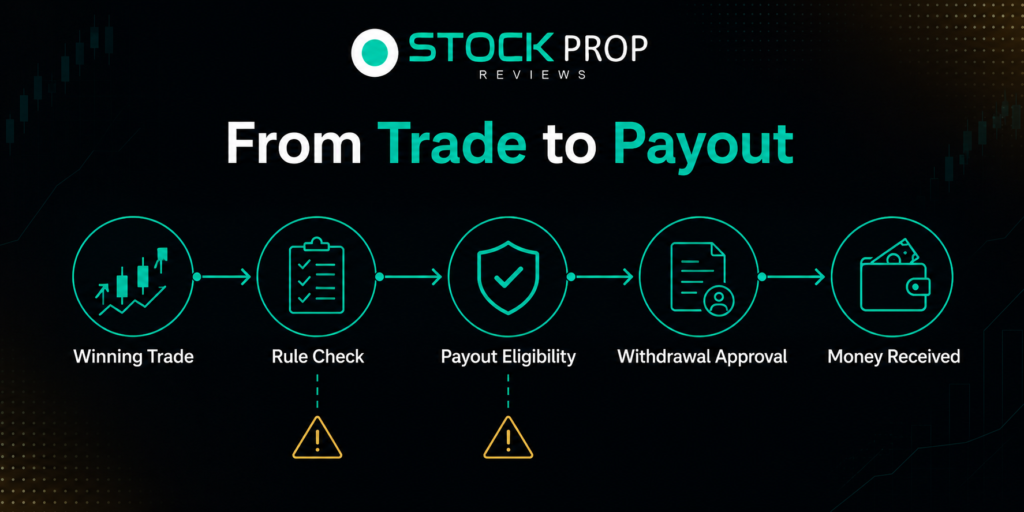
Between a profitable month and an actual payout are several conditions that every trader has to satisfy.
A common example is the payout schedule. Some firms process withdrawals every week, while others require traders to wait until specific dates. Delayed access to profits may not seem like a major issue, but it affects cash flow, especially for traders relying on trading income.
Another factor is account longevity. A trader who keeps an account active for eight months with an 80% split will often earn far more than someone who repeatedly loses accounts while chasing a higher percentage elsewhere.
The percentage matters. Staying funded matters even more.
The rules that have a bigger impact than the profit split
When traders compare firms, profit split often receives the most attention because it is easy to understand. The rules governing payouts deserve just as much attention.
Drawdown limits
Every funded trader eventually experiences losing trades. The question is how much room the firm gives you before the account is lost.
A tighter drawdown leaves less room for normal market fluctuations. Even profitable traders can breach limits during periods of volatility.
If your account disappears before your first withdrawal, the advertised profit split becomes meaningless.
Consistency requirements
Some firms expect to spread profits over several trading days, rather than to make them in one exceptional session.
Imagine making $4,000 on one good news trade and then coasting the rest of the month. Depending on the firm’s rules, that performance may delay your withdrawal request until your trading is more balanced.
These policies may not be unfair, but should be reviewed before purchasing a challenge.
Challenge and reset costs
This is one area many comparisons barely mention.
Suppose two traders each generate $30,000 in gross trading profits during the year.
The first trader passes one evaluation, keeps the account, and withdraws regularly.
The second trader fails several evaluations, pays multiple reset fees, and finally earns a larger profit split after receiving funding.
Despite receiving a better percentage, the second trader may finish the year with less money after accounting for additional costs.
A realistic comparison
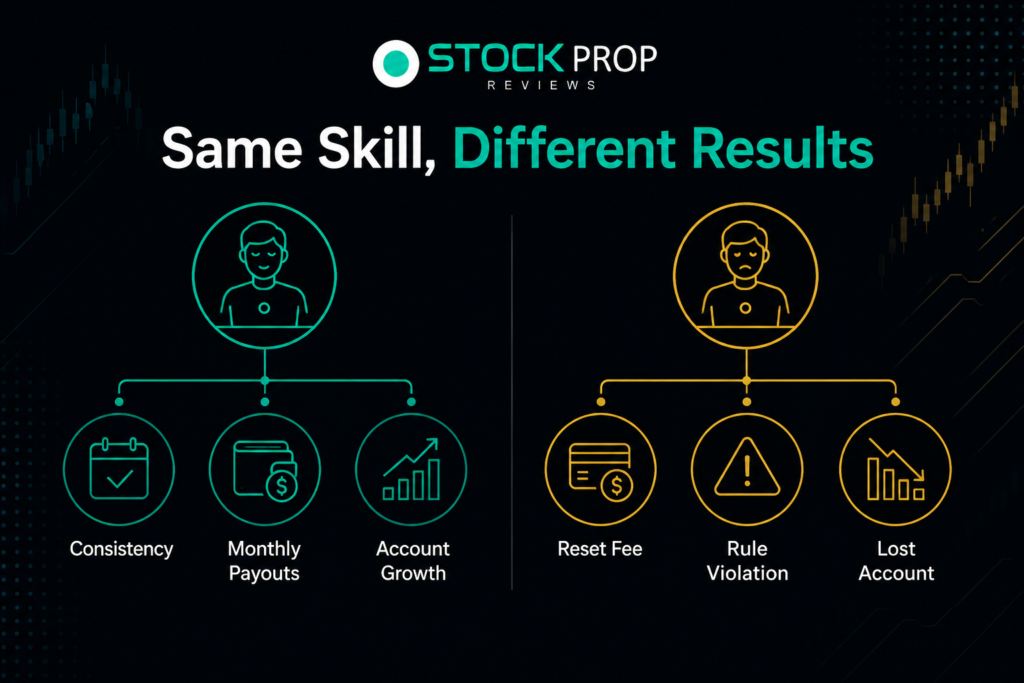
Take for example two traders of equal trading skill.
Trader A joins a company that offers 80% profit split. The rules are easy, the withdrawals are predictable and the trader is focused on account preservation.
Trader B chooses a competitor advertising with 95% split. The review is harder, the consistency rules are stricter, and many payout requests are delayed due to technical rule violations.
Trader A has been taking profits every month for twelve months. Trader B has some impressive numbers on paper, but has spent more time restarting evaluations than collecting payouts.
No trader was better at reading the market. The difference was in the account management and not in the percentage of profit.
That is a reality funded traders understand well.
What most comparison articles leave out
Many websites compare firms by placing payout percentages side by side in a table. That information is useful, but it tells only part of the story.
The more important question is whether the payout system fits the way you trade.
A discretionary trader who occasionally has very strong trading days may struggle under strict consistency rules. A swing trader may care more about overnight holding policies than profit sharing. A scalper may value execution quality above everything else.
In other words, the best firm depends on your trading style, not simply the highest percentage on the homepage.
Another overlooked point is psychology.
A trader who feels pressured to protect a funded account often begins making decisions that have little to do with market analysis. Winners are closed too early. Valid setups are skipped because of fear. Losing positions are held longer in the hope of avoiding another evaluation fee.
The firm hasn’t changed. The trader’s behaviour has.
Which traders benefit most from higher profit splits?
Once a trader has developed consistent execution, higher profit splits become more meaningful.
Experienced traders who rarely violate risk rules usually extract more value from generous payout structures because they survive long enough to receive repeated withdrawals.
For newer traders, however, the difference between an 80% and 90% split is often overshadowed by inconsistent performance.
Improving trade selection, controlling risk, and protecting the account generally produce much larger gains than searching for another five percent in profit sharing.
Choosing a firm that matches your trading style
The right choice depends less on marketing and more on how you trade every day.
Scalpers should pay close attention to execution quality, spread conditions, news restrictions, and daily loss limits.
Swing traders often place greater value on flexible holding policies and reasonable drawdown rules.
Index traders may prioritise consistency requirements, while stock traders might prefer firms operating within a regulated framework.
This is why reading detailed prop firm reviews is often more useful than comparing payout percentages alone. Reviews reveal how firms operate after the marketing claims end.
You may also find our comparison of leading prop firms helpful if you’re weighing several providers with similar pricing and evaluation models. If you’ve wondered whether headline offers always reflect reality, our article discussing common myths in the prop firm industry explores that subject in more detail.
Are higher profit splits always sustainable?
A generous payout is attractive, but it should never be viewed in isolation.
Every proprietary trading firm has operating costs. Firms need to fund technology, customer support, risk management, payment processing, and business development.
When unusually high profit splits are advertised, it is worth asking how those payouts are supported over the long term. Sometimes the offer is part of a promotion. Sometimes it applies only after meeting specific milestones.
Reading the full payout policy is rarely exciting, but it often answers questions that marketing pages leave unanswered.
Should beginners chase the biggest payout?
Usually not.
Most beginners are still learning how to manage risk under pressure. During that stage, a transparent rulebook is often worth more than a slightly larger profit share.
The traders who remain funded for months tend to be patient rather than aggressive. They understand that consistency produces income, while shortcuts usually produce another challenge fee.
A lower payout from a firm whose rules are easy to understand may ultimately generate more income than an attractive percentage attached to conditions you struggle to satisfy.
A note on TradeThePool
If you are trading stocks rather than CFDs or futures, then TradeThePool is an option worth looking into as it is a regulated stock prop firm that has clear risk parameters. The appeal is less about headline marketing and more about rule clarity.
Readers of StockPropReviews can get up to 10% discount when buying through our TradeThePool link. You should view that discount as a minor saving on costs, not as the main reason for choosing a firm. .
The bottom line
The highest profit split with a prop firm does not always mean highest income.
The long term earnings are from staying funded, being eligible to withdraw, knowing the rules and trading consistently enough to get paid out month after month.
Next time you buy a challenge, spend less time comparing %s and more time reading the payout policy. That one habit will probably save you more money than getting another five percent in profit sharing.
FAQs
What is a good profit split of 80%?
Yeah. An 80% split is still considered competitive in the industry, particularly when paired with sensible drawdown limits and transparent payout regulations.
Why do some traders earn less despite higher profit splits?
More percentage doesn’t make up for repeated account failures, delayed withdrawals, or expensive resets. These things will erode real earnings far faster than most traders anticipate.
What else is there to compare besides the profit split?
Look at drawdown rules, withdrawal schedules, consistency requirements, account fees, scaling opportunities and the overall reputation of the firm to process payouts.
Is it always better to split 100% profit?
Not necessarily. Some offers are only valid for certain conditions or for a promotional period. Always read the payout policy, don’t just believe the headline figure.
How can I figure out my real net income?
Start with realistic trading profits not best case scenarios. Then look at fees, when you will get paid, taxes if applicable and the likelihood of keeping the funded account for several months. That calculation gives a much more accurate estimate than comparing profit split percentages alone.