
Many traders assume that passing a prop firm challenge comes down to finding a profitable strategy. In reality, some of the biggest obstacles are not market-related at all.
Complex prop firm rules can prevent otherwise capable traders from reaching funded status, even when their trading edge is sound. While risk management rules are necessary for any firm offering capital, there is a point where rule structures become so complicated that they start filtering out disciplined traders alongside reckless ones.
This article examines how rule complexity affects trader performance, why many profitable traders fail despite having an edge, and what competitors often overlook when discussing prop firm evaluations.
Quick Verdict
Prop firm rules aren’t entirely bad. There are limitations on drawdowns, position sizing and consistency requirements. All for good risk-control reasons.
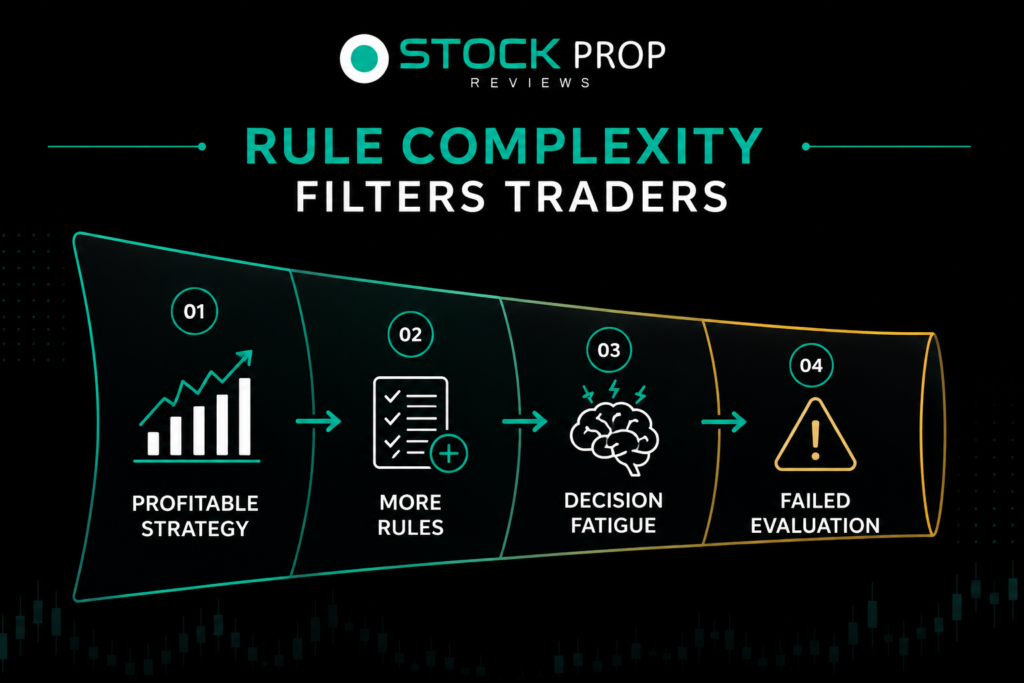
The problem is that overlapping restrictions create decision fatigue and traders focus more on avoiding rule violations than executing their strategy.
Often the firms with the best long-term trader retention are not the ones with the easiest rules. They are the companies with the most transparent and clear rules.
A trader who is constantly afraid of breaking a rule is seldom at his best.
What Are Complex Prop Firm Rules?
Complex prop firm rules refer to evaluation or funded-account restrictions that go beyond standard risk management requirements.
Examples include:
- Daily calculation of drawdown based on equity versus balance
- Consistency score requirements
- Concealed scaling constraints
- Time-based trading restrictions
- Maximum profit days percentage
- Minimum number of trading days
- Restrictions on positions about news events
- Lot size uniformity requirements
Individually, most of these rules appear reasonable. Problems emerge when several are combined into a single evaluation process.
A trader may need to track six or seven separate conditions while also analyzing the market and managing risk.
At that point, the challenge becomes partially a compliance exercise rather than a trading assessment.
Why Winning Traders Still Fail Evaluations
Many competitors focus on failure rates without explaining why profitable traders fail.
The assumption is often that failed traders simply lack discipline.
Real trading experience suggests otherwise.
Consider a trader with a proven strategy that wins 55% of trades while maintaining a 1:2 risk-to-reward ratio. On paper, that trader should be profitable over time.
However, imagine the following scenario:
- Daily drawdown limit: 5%
- Maximum overall drawdown: 10%
- Minimum trading days: 5
- Maximum profit day: 30%
- News trading restrictions
- Consistency requirements
Now the trader must monitor multiple non-market variables throughout the challenge.
One large winning day may create a consistency issue.
A profitable news trade may violate a restriction.
A temporary floating drawdown may breach an equity-based limit despite eventually becoming a winning trade.
The trader’s edge has not disappeared. The environment has changed.
The Psychology Behind Rule Complexity
Trading performance depends heavily on mental bandwidth.
Every additional rule consumes attention.
Professional traders already manage:
- Market structure
- Risk management
- Position sizing
- Trade execution
- Emotional control
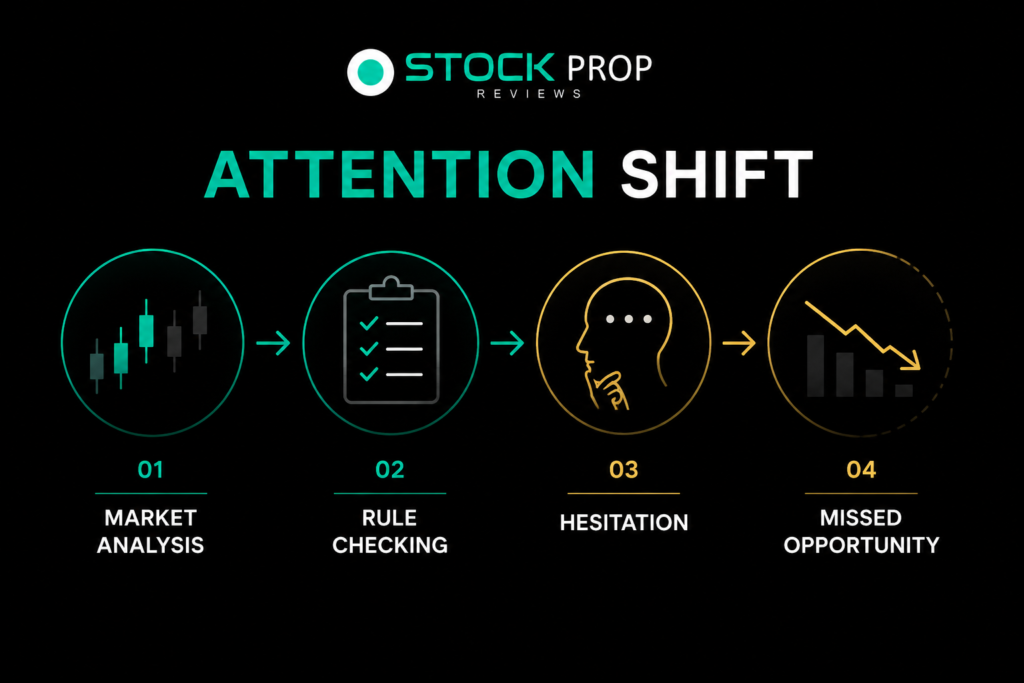
When a prop firm piles on the admin requirements, traders often experience what psychologists refer to as cognitive overload.
Rather than asking:
“Is this a good arrangement?”
They start asking:
“Is this thing gonna break any rules?
It is such a small change, but it makes a huge difference in decision-making.
Many traders start to get cold feet.
Some others get out of trades too early.
Some stop taking valid setups completely.
Then performance suffers, even though the market conditions haven’t changed.
What Competitors Don’t Explain About Prop Firm Failure Rates
Many articles discuss pass rates but rarely examine how rule structures influence those statistics.
A challenge with strict but simple rules may actually be easier to pass than a challenge with moderate limits and highly complex conditions.
For example:
| Firm Type | Risk Limits | Rule Complexity | Trader Experience |
| Simple Rules Firm | Strict | Low | Predictable |
| Moderate Rules Firm | Moderate | High | Mentally Demanding |
| Flexible Rules Firm | Flexible | Low | Easier Adaptation |
Complexity is usually the hidden variable, not strictness.
Most traders adapt naturally to defined risk parameters.
Rules make uncertainty and they wrestle.
This is an important distinction because traders often only compare firms based on pricing, profit targets or drawdown percentages.
Equal attention to complexity of rules is due.
The Difference Between Risk Protection and Rule Traps
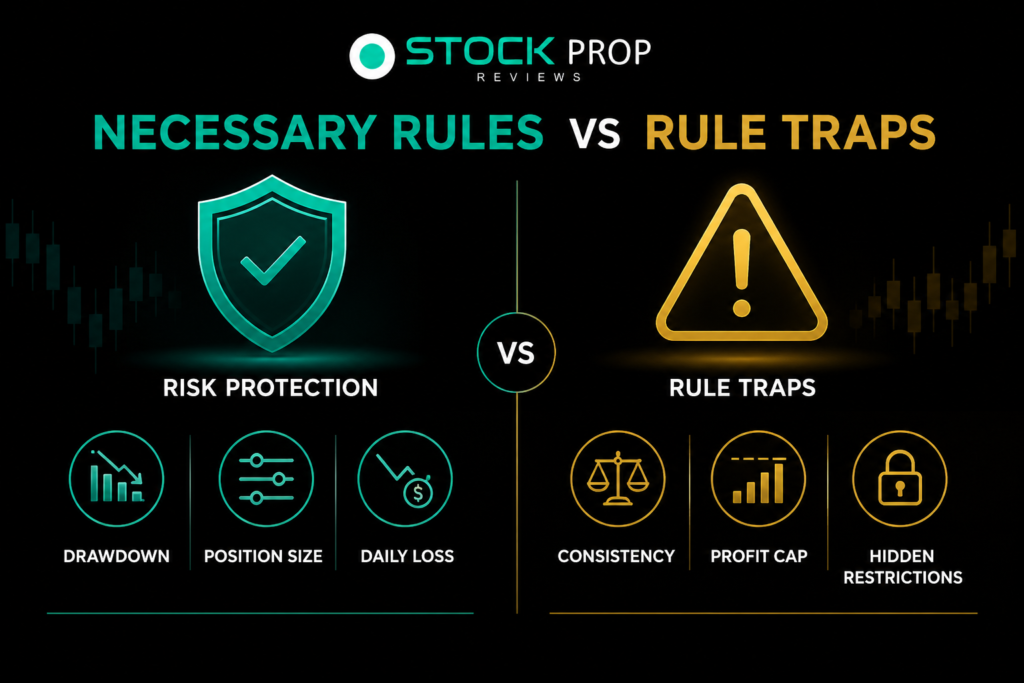
Prop firms need risk controls.
Without them, firms would expose themselves to unacceptable losses.
Reasonable protections include:
- Maximum drawdown limits
- Daily loss limits
- Basic risk management requirements
- Position size controls
The line becomes blurry when rules begin targeting trader behavior rather than risk exposure.
For example, maximum profit day rules are controversial.
Proponents say they stop gambling-like behavior.
Critics say they penalize traders for making money.
Consistency requirements can help support stable trading, but can also penalize traders with strategies that inherently have inconsistent profit distributions.
Not all profitable strategies have smooth equity curves.
For instance, trend following systems are often reliant on the occasional outsized winners.
Those approaches might get inadvertently filtered out by complex rules.
How Scalpers Are Affected Differently
Scalpers often suffer more from rule complexity than swing traders.
A swing trader might place a handful of trades each week.
A scalper may execute dozens in a single session.
Each additional restriction increases operational risk.
Common challenges include:
- News restrictions during active sessions
- Lot size limitations
- Consistency metrics
- Trading hour restrictions
A scalper who is profitable in live market conditions may suddenly find themselves modifying their strategy purely to satisfy evaluation requirements.
That adjustment can significantly reduce performance.
This is one reason many traders fail to replicate personal-account results inside prop firm challenges.
Why Simpler Rule Structures Often Produce Better Traders
There is an argument that simpler evaluation models create a more accurate assessment of trading ability.
A straightforward challenge answers a basic question:
Can the trader generate profits while respecting risk limits?
Once multiple secondary conditions appear, the evaluation begins measuring compliance skills alongside trading skill.
Those are not necessarily the same thing.
A trader who excels at navigating administrative restrictions may pass despite mediocre market performance.
A trader with strong market skills may fail because of a technical violation.
Neither outcome accurately reflects trading ability.
The Counterargument: Why Complex Rules Exist
To be fair, prop firms do not create complicated rules without reason.
Several concerns drive these policies.
Some traders attempt to exploit challenge structures.
Others engage in excessive risk-taking.
Some use unsustainable strategies that produce short-term gains but create long-term risk for the firm.
Complex rules can help identify these behaviors.
Supporters argue that consistency requirements and behavioral restrictions reduce firm risk and improve funded trader quality.
There is some truth to that argument.
The challenge is finding the right balance.
Rules should identify dangerous behavior without discouraging legitimate trading styles.
The best firms typically maintain that balance better than competitors.
How to Evaluate Rule Complexity Before Buying a Challenge
Traders should spend more time reviewing rules than marketing materials before buying an evaluation.
Ask these questions:
So how many individual restrictions are there to monitor in trading?
Are drawdown calculations easy to understand?
Are there some hidden consistency conditions?
Are profit limits affecting the strategy’s performance?
Are the limits of the news restrictions clearly defined?
Can we explain the rules in a few minutes?
If the answer to the last question is no, the evaluation may be more complex than necessary.
Most traders spend hours looking up payouts and discounts, but rarely read the rulebook.
And that mistake can be costly.
Firms With Clearer Rule Structures
Different traders like different things, but firms with relatively transparent rule frameworks tend to attract experienced traders.
To compare the evaluations, readers may want to check out our breakdown of funded account requirements, our in-depth review of leading futures firms, and our examination of common prop firm myths still circulating online .
TradeThePool is often mentioned by stock focused providers as their model is built around stock trading, not the mechanics of forex challenge. The firm is transparent about the risk parameters and what you can expect from the trading.
Readers will receive a 10% discount via the TradeThePool link.
That should not be taken as a reason to join any firm. The more important factor is whether the rule structure is compatible with your trading style.
Who Should Avoid Firms With Complex Rules?
Certain traders are particularly vulnerable to complicated evaluation structures.
New traders often struggle because they are already learning market mechanics.
Adding multiple compliance requirements increases confusion.
Strategy-based traders may also encounter problems if their edge relies on flexibility.
Scalpers face additional operational challenges due to high trade frequency.
Conversely, traders who enjoy structured environments and detailed process management may adapt more easily.
The key is understanding your own strengths.
A rulebook that suits one trader may be completely unsuitable for another.
Alternatives to Highly Complex Evaluations
If the complexity of rules is a concern, traders can look at a number of alternatives.
Begin by looking for companies that focus on transparent risk parameters and well defined drawdown rules.
Secondly, compare the structure of the challenges, not only the price.
Third, consider regulated stock-centric environments such as TradeThePool. Expectations there are generally easier to understand than some multi-layered challenge models.
Readers can get up to 10% discount when buying through our TradeThePool link.
Again, transparency is more important than a discount.
A clear rulebook can save a lot more money than a discounted evaluation fee.
The Real Question Traders Should Ask
The majority of traders ask:
“What’s the rule?”
Better question:
“How many of these rules will I have to keep in my head when I am trading?”
That difference often makes the difference.
The market is tough enough as it is.
Even profitable strategies can struggle when complex prop firm rules force traders to divide their attention between execution and compliance.
The best evaluation models are not necessarily the least restricted or the ones with the largest profit splits.
These are the traders who know the rules inside out before they make their first trade.
A good prop firm should test your trading ability.
It shouldn’t be like traders have to be experts in wading through unnecessary complexity.
FAQs
Do Complex Prop Firm Rules Lead to Profitable Traders Failing?
Yes . Some profitable traders fail evaluations, because they break secondary restrictions, even if they have a positive trading expectancy . Sometimes the complexity of rules can be a greater obstacle than market performance.
Are stricter prop firm rules always a bad thing?
No. Good rules can be simple and clear. Complexity is often less of a problem than strictness.
Why Do Prop Firms Have Consistency Rules?
Consistency rules are used by firms to prevent excessive risk-taking and to determine sustainable trading behavior. But, on the other hand, these rules may be detrimental to strategies that depend on occasional big winning trades.
How do traders measure rule complexity?
Check every restriction before buying an assessment. Emphasize drawdown calculation, consistency requirements, profit cap, news restriction and trading restriction. Bad rules can make needless problems if they are hard to explain well.
Which traders are most affected by complicated prop firm rules?
This is often true for scalpers, beginners and traders with flexible discretionary strategies who have to make decisions often while keeping track of various restrictions.