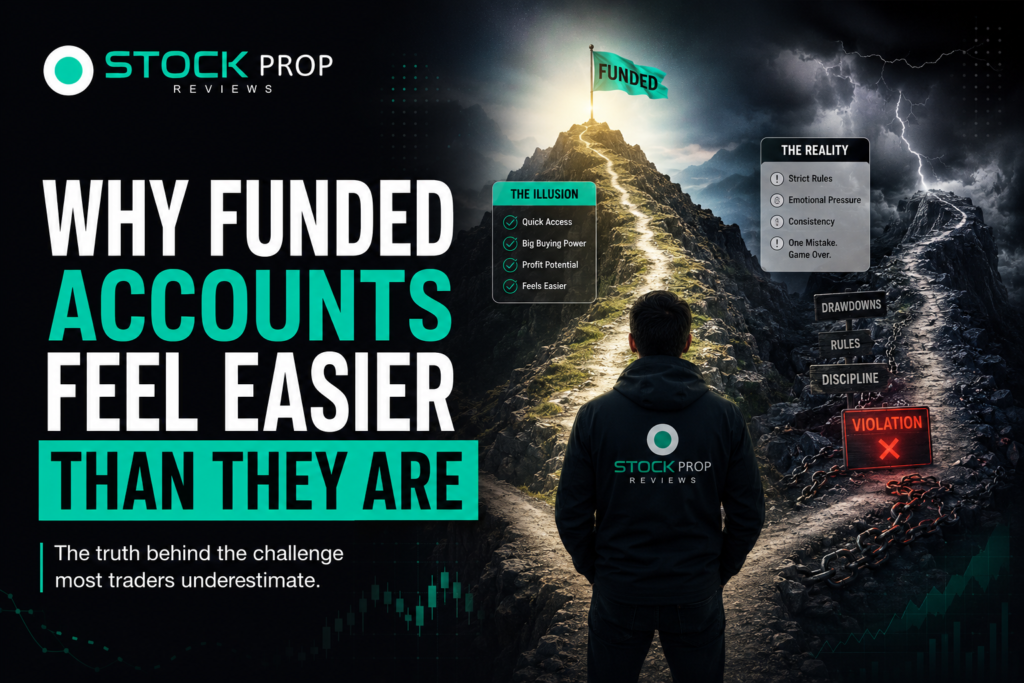
It’s usually only after a failed evaluation that traders think should be easy to pass that they experience the tough side of funded accounts psychology.
The problems that prop firms create seem easy in theory. Hit profit target and get access to a bigger account . Keep below the drawdown limit . That seems much easier and safer than creating a personal account from the ground up.
That’s why many traders underestimate it.
The psychological pressure inside funded trading is like nothing you will experience in demo trading or even small retail trading. A plan that does well on a typical account can fall apart entirely when daily drawdown rules, payout expectations and evaluation deadlines begin to factor in.
This article is for the beginner and the evaluation trader looking for a realistic look at funded trading psychology. It’s not written for traders looking for shortcuts, instant funding hype or social media fantasy numbers.
The Part Most Traders Misunderstand
A funded account is not a test of your strategy.
It’s a test of how much your decision making can stand the pressure.
That pressure often comes in stages.
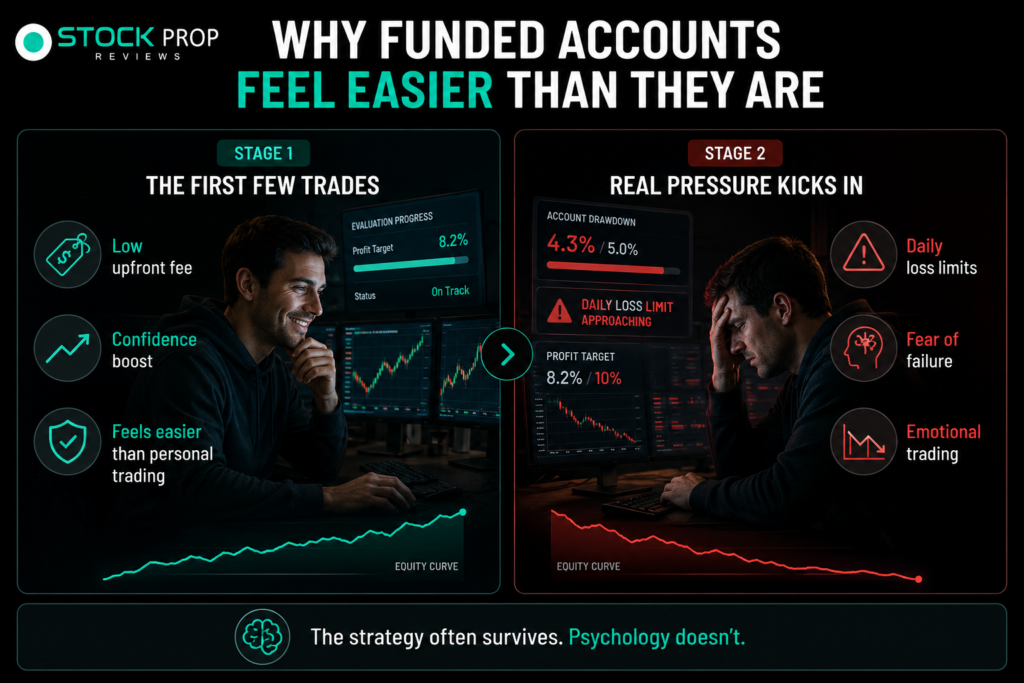
At first, traders often feel a sense of peace as they are not wagering significant amounts of their own money. A $100 or $200 challenge fee is manageable. Losses don’t seem as “real” as a blown personal account does.
And then the psychology changes.
As a trader approaches a drawdown limit or a payout target, emotion begins to impact execution. Traders start looking at their PnL instead of price action. The bad trades look good because they are faster to recover but skip the good setups.
This is where many funded traders lose control, unknowingly.
Why Funded Trading Feels Easy Early On
Often the first stage of any evaluation is misleading.
The trader comes in with confidence, with low emotional attachment and a clear target in mind. Because the account is not personally funded with years of savings, the execution can feel initially less messy than normal.
That moment of comfort is a dangerous illusion.
A lot of traders mistake emotional detachment for skill.
You can tell after the first rough session.
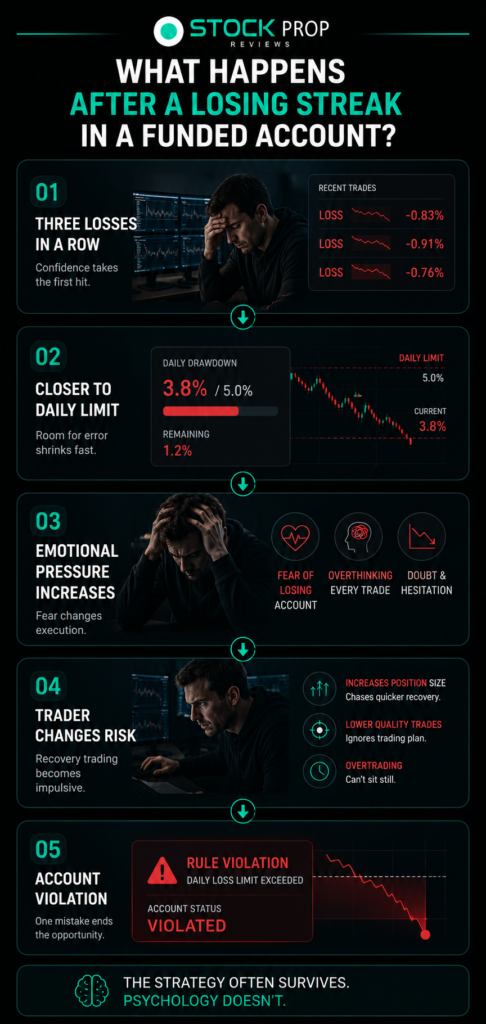
Say you have a trader who usually risks 0.5% per trade. After three straight losses, they’re suddenly near the daily limit. Instead of staying with the same risk model, they up size a bit and recover faster.
It’s that one decision that usually gets the collapse going.
Most bad evaluations come not from terrible strategies. They stem from a single emotional shift that changes how the trader deals with risk.
The Problem With Social Media Expectations
A lot of new traders enter prop firms with completely unrealistic expectations.
Social media is filled with passing certificates, payout screenshots, and “funded in five days” stories. Very few traders show the months of failed evaluations behind those wins.
That changes how beginners view funded trading.
Instead of treating evaluations like professional risk assessments, traders start treating them like speed competitions. The goal becomes passing quickly rather than trading properly.
The result is predictable.
They overtrade, increase leverage, and force setups that do not match their plan.
Ironically, the traders who survive longest in funded accounts are usually the slowest and least exciting traders to watch.
Daily Drawdown Rules Change Trader Behavior
One thing competitors rarely explain properly is how much daily drawdown rules affect psychology.
Retail traders are used to flexibility. If they have a bad day, they can reduce size tomorrow and recover gradually.
Funded accounts do not always allow that freedom.
A trader who loses 3% early in the day on a 5% daily limit suddenly feels trapped. Every new trade carries emotional weight because one mistake could end the account immediately.
This pressure changes behavior in subtle ways.
Some traders stop taking valid setups because they are afraid of losing. Others do the opposite and become aggressive because they feel they must recover quickly before the session ends.
Neither reaction is healthy.
The trader is no longer responding to the market naturally. They are reacting emotionally to account restrictions.
Passing an Evaluation Is Not the Hard Part
Surprisingly many traders can pass evaluations one time.
Usually it’s harder to keep the account.
This is where the psychology of funded accounts gets much more serious.
The emotional attachment increases when traders are funded. Suddenly, the story seems worth telling. Traders are already mentally calculating future payouts before the trades are closed.
That mental switch is a lot to ask for.
A trader who felt relaxed during evaluation can suddenly second guess entries, take profits too early, or completely avoid setups because they are afraid of losing funded status.
Others go in the other direction and get reckless after their first payout. In prop trading, confidence becomes overconfidence fast.
Professional traders understand this cycle. Most of the newer traders don’t realise it until they have already broken the account.
Real Scenarios Traders Experience
A typical situation is as follows:
Trader takes 8% profit towards 10% appraisal target. Instead of sticking to the same disciplined execution, they start forcing trades to get done with the challenge more quickly. The position size starts to grow and the frequency of trades increases appreciably.
The account is gone in two sittings.
The strategy didn’t suddenly become ineffective. The trader just stopped following it.
Another common example is post-financing.
Trader passes. Trader is successful, but too cautious. Now that there is payout potential tied to the account, every trade feels important. The execution is tentative, inconsistent.
Many traders are surprised to discover that they traded better prior to being funded.
The Hidden Issue of Challenge Recycling
This is another area that rarely gets discussed honestly.
Many traders fail multiple evaluations in a row while convincing themselves they are “close” every time.
A trader may spend:
- $100 on one challenge
- $200 on another
- More resets after near passes
After several months, the total cost becomes significant.
At that stage, emotional pressure increases again because traders are no longer just trying to pass. They are trying to recover previous challenge losses.
That mindset is dangerous.
Recovery-focused trading almost always leads to worse decisions.
Why Good Traders Still Fail Prop Firms
Just because you’re a profitable trader does not mean you are a fit for a prop firm.
Some traders can tolerate wider drawdowns, slower swing positions or more flexible recovery methods. Some prop firm rules punish such styles severely.
Hence, why rule compatibility is more important than many beginners realise.
In one environment a scalper may do very well, and in another it may do very poorly. A swing trader might have a winning strategy but lose due to overnight holding restrictions that don’t suit their style.
That’s why it’s more important to read real prop firm comparisons rather than just chase the cheapest challenge fee.
Our analysis of firms with no minimum trading days shows that the structures of the rules completely change the behaviour of the trader depending on the personality and style of the strategy.
What Consistent Funded Traders Usually Do Differently
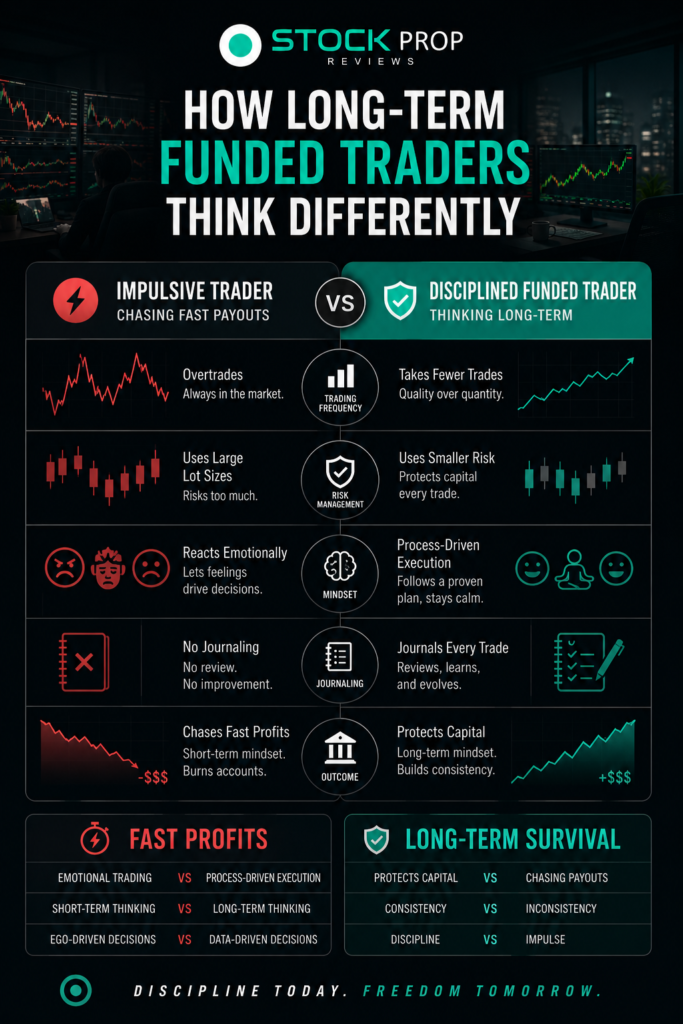
Long-term funded traders are normally less aggressive than beginners expect.
They often risk far below the maximum limit allowed. They skip sessions frequently. Some only take one or two trades per day.
From the outside, this can look overly cautious.
In reality, they understand that survival matters more than fast growth.
Most experienced funded traders stop thinking in terms of single payouts. They focus on staying stable for months instead of trying to double accounts quickly.
That mindset shift is usually what separates traders who keep accounts from traders who repeatedly fail evaluations.
Are Funded Accounts Bad?
Not necessarily.
For disciplined traders, funded accounts can provide structure, external risk control, and access to more capital than they could personally afford.
The problem is not the funded model itself.
The problem is the way it is marketed.
Many firms advertise scaling plans and large payouts aggressively while spending very little time discussing failure rates or emotional pressure. Beginners end up believing funded trading is mainly about finding a winning strategy.
It is not.
Psychological control matters just as much as technical skill.
A More Realistic Way to Approach Prop Trading
The best traders are generally those who see evaluations as professional appraisals rather than money-making opportunities.
They are willing to accept slower progress.
They know it’s part of the job to keep the account safe.
And most importantly, they stop forcing outcomes.
For some traders, it might make even more sense to spend time trading a small personal account before attempting multiple evaluations. Personal stories seem to teach emotional accountability faster because losses feel more direct and unavoidable.
Some traders also prefer firms with more transparent structures, rather than heavily gamified marketing models. For example, TradeThePool is often mentioned by stock traders who are looking for regulated environments and more clear risk frameworks.
Readers can get up to 10% discount using our TradeThePool link.
But the important thing is not the discount. It’s about knowing if the rules really work with your trading style and emotional tendencies.
You can also learn a lot from reading around the broader discussions about prop firm risk psychology and how different evaluation models affect trader behaviour over time.
The Reality Most Traders Learn Late
Funded accounts feel simpler because it’s not as expensive to start as with a big account of your own.
But they are often harder emotionally.
The pressure to follow strict rules, hit payout targets and avoid mistakes creates a culture where discipline trumps excitement. Many traders discover that their biggest problem is not market analysis, but how they react emotionally under pressure.
That is why long term survivors among traders tend to be less emotional, less aggressive and less obsessed with quick gains.
Shiny side of online Prop trading gets attention.
It’s usually the boring side that keeps traders funded.
One final thing to note is that traders who want more structured stock-focused environments sometimes look into firms like TradeThePool because of their focus on transparency and defined risk management. Readers can also get up to 10% off when they buy through our TradeThePool link.
FAQs
Why do funded accounts seem easier in the beginning?
The emotional pressure is initially less as traders are risking smaller upfront fees than their own personal savings.
Why do funded traders fail?
Funding changes the behaviour of many traders. The fear of losing funded status or payouts can impact the quality of execution.
Is funded trading harder than trading on your own?
Yeah, a lot of traders. The strict rules of drawdown and the pressure of evaluation create a different psychological environment.
What’s the biggest mistake that funded traders make?
But not just bad strategies . Most failures are from increasing emotional risk after losses .
Accounts for beginners with funding?
Can help some with the structure but a lot of beginners find better discipline by trading small personal accounts first.