Passing a prop firm challenge is tough enough. Keeping an account funded is usually even harder. The reason is easy. Most traders don’t lose their accounts because they suddenly forget how to trade. They break one rule of a prop firm that could have been avoided and lose them.
Finding profitable setups is as important as knowing the cost of breaking one rule whether you are getting ready for your first evaluation or already trading a funded account. This article is for traders who want to protect their capital and avoid preventable mistakes. This is not for traders looking to find loopholes or get around a firm’s risk controls.
One missed rule can wipe out weeks of progress. Often the financial loss is only part of the damage.
What Is a Prop Firm Rule Violation?
A prop firm rule breach is any time a trader violates one of the rules they agreed to before beginning an evaluation or funded account. All proprietary trading firms have their own rulebook, but the goal is usually the same. The firm is seeking traders who can generate returns while managing risk.
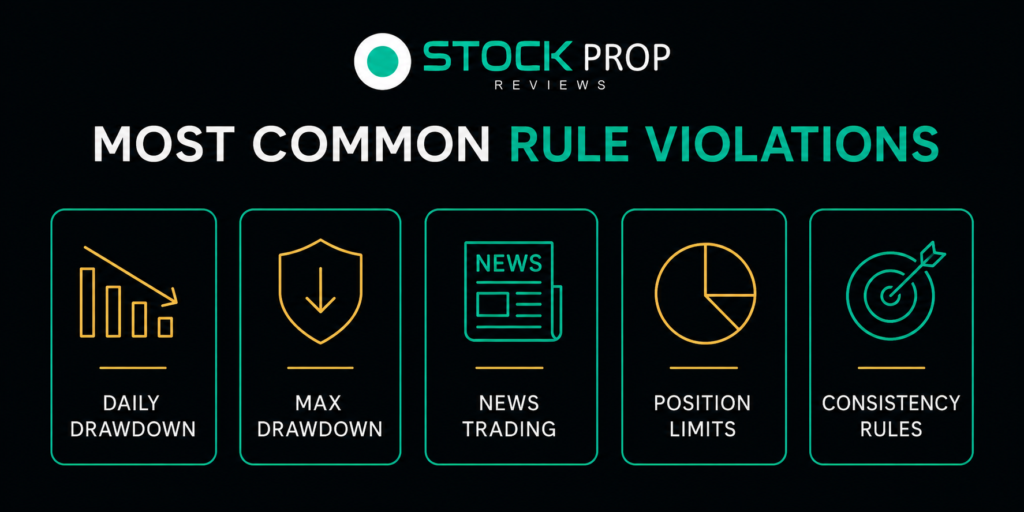
Typical violations include exceeding the daily loss limit, exceeding the maximum drawdown, trading during restricted news events, holding positions when rules say you cannot or using strategies that are not allowed.
Many traders believe that if they are making money then it is OK to break the rules. It doesn’t. If a rule has been broken, then typically the outcome of the trade is irrelevant.
This is surprising to a beginner, but that is how professional risk management operates. Breaking a risk limit on an institutional trading desk is a compliance issue, not a trading mistake.
Why One Small Mistake Can Have a Big Cost
The immediate cost of a failed evaluation is simple to calculate. And you lose the challenge fee and have to decide if you want to try again.
The hidden costs are much harder to quantify.
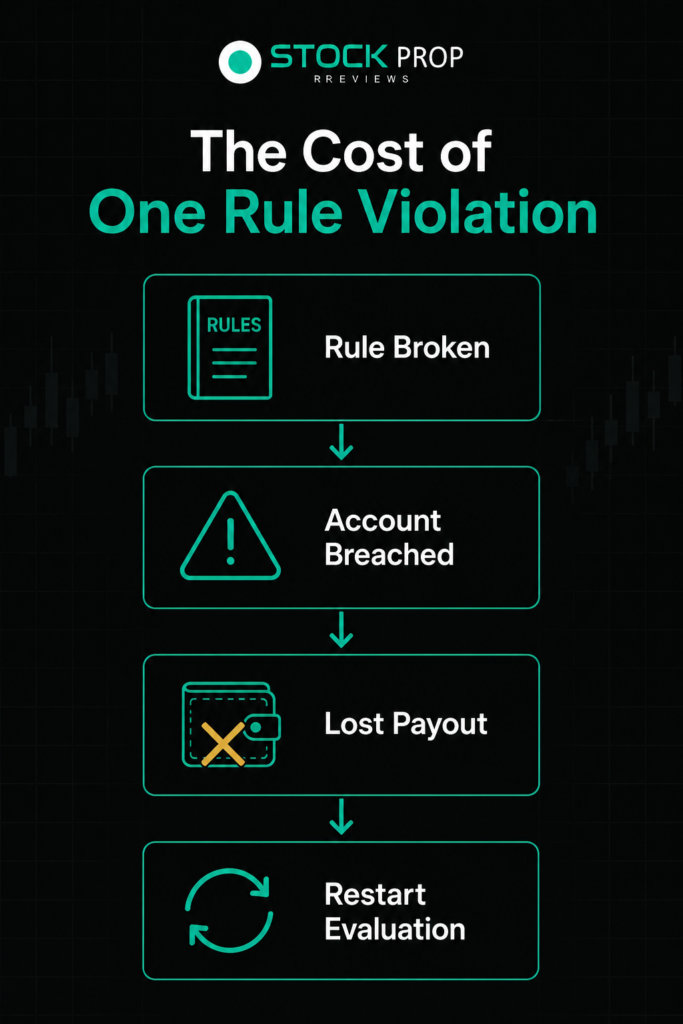
Imagine a trader who spends six weeks steadily making a profit. They stick to their trading plan, avoid emotional decisions and finally reach the stage where regular payouts are within their reach. Then one afternoon they add to their size after a losing trade. The market goes against them, they blow the daily drawdown limit just a little bit, and the account closes.
Technically, only one rule had been broken.
Six weeks of work in practice, future earning potential, confidence and often the discipline that got them there, lost.
This is why experienced traders often say the first priority is to protect the account. Profit comes second.
The Rules That End Accounts Most Often
Although every firm uses different terminology, the same rules appear repeatedly across the industry.
| Rule | Why It Exists | Typical Result if Broken |
| Daily drawdown | Limits short-term risk | Account failure or breach |
| Maximum drawdown | Protects firm capital | Account closure |
| News trading restrictions | Controls volatility risk | Trade or account may be invalidated |
| Position holding limits | Reduces overnight exposure | Rule violation |
| Consistency requirements | Discourages excessive risk | Delayed or rejected payout |
The exact numbers differ between firms, which is why reading the rulebook carefully matters more than relying on advice from social media.
Most Rule Violations Are Not Technical Problems
One misconception repeated across many trading communities is that traders fail because they lack market knowledge.
In reality, plenty of skilled traders lose funded accounts.
They understand price action, know how to identify trends, and have profitable strategies. What lets them down is decision-making under pressure.
Consider a trader who has followed every rule for three weeks. They enter one losing trade late in the afternoon. Instead of accepting the loss, they convince themselves that the market will reverse. They move the stop loss, increase the position, and watch the floating loss grow.
The analysis may even prove correct eventually.
The problem is that the account breached the daily loss limit long before the market recovered.
The market was not the reason they failed. Their response to the market was.
What Many Articles Leave Out
There’s a lot of educational content around drawdown calculations and payout percentages, but that’s where it ends.
That misses the point.
A rule violation rarely starts at the time the platform shows a breach. It often starts much earlier.
It starts with a trader skipping their morning routine because they are in a hurry.
It begins with them choosing not to look at the economic calendar because “nothing important is going on today”.
It starts when they raise the risk because they want to make up for yesterday’s losses before the weekend.
The decision to break the rule has often been made hours before the rule is officially broken.
Knowing that sequence is much more important than remembering drawdown percentages.
Why Emotions Matter More Than Most Traders Admit
Trading is often presented as a purely analytical activity, but funded accounts expose emotional weaknesses very quickly.
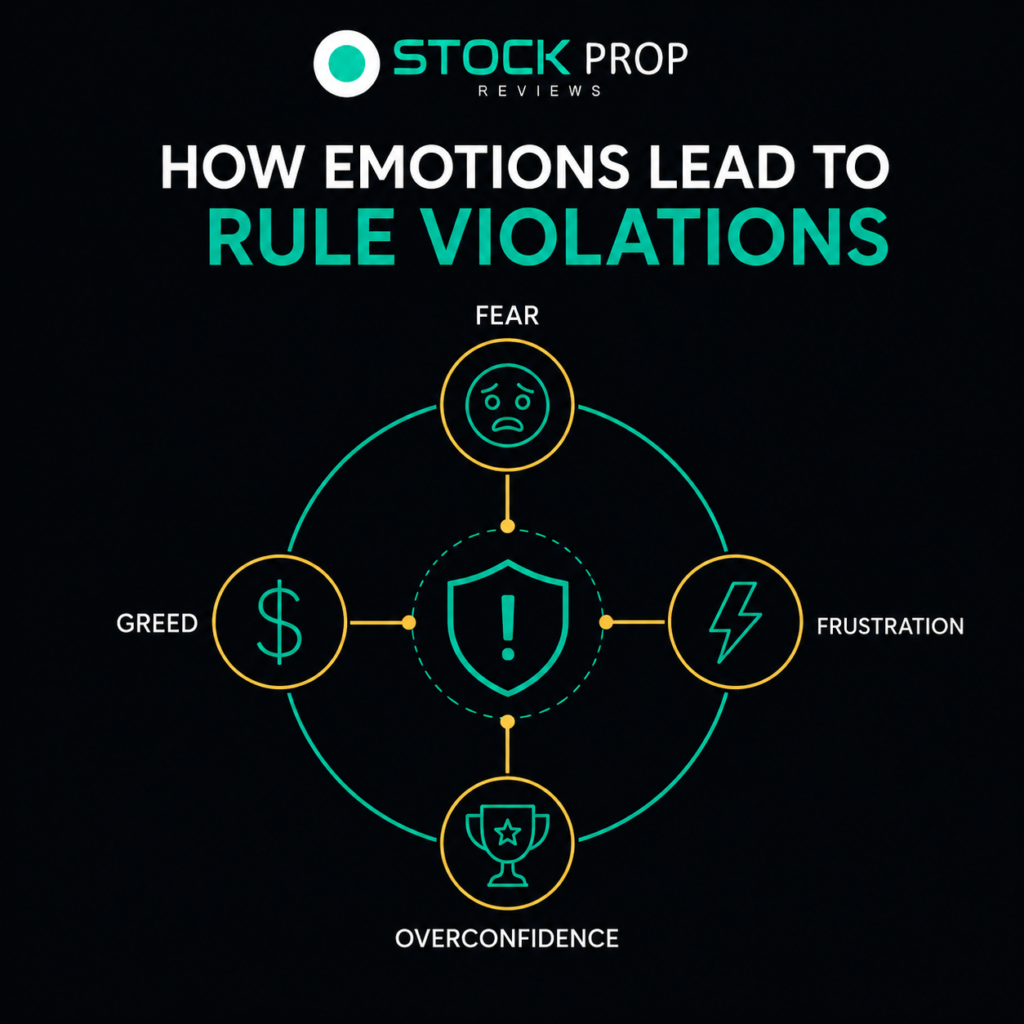
Fear encourages traders to exit winning trades too early.
Greed encourages them to increase position sizes after a few profitable days.
Frustration pushes them into revenge trading after losses.
Overconfidence makes them believe the rules no longer apply because they are “seeing the market clearly.”
None of these emotions automatically lead to a rule violation.
The problem is that each one makes the next poor decision easier.
Professional traders are not emotionless. They simply build routines that reduce the influence of emotions before placing a trade.
A Realistic Example
Imagine two traders who both have funded accounts.
The first trader earns 12% per month but trades near the maximum drawdown limit frequently. Each trading day feels like an effort to recover.
The second trader only makes 6% in the same time frame but never risks more than a small percentage of the account on any one trade.
The first trader is more successful than many novice traders think.
Most prop firms would prefer to allocate capital to the second trader because their risk profile is predictable.
It is easier to build consistency at scale than to build occasional excellence.
This is why disciplined traders tend to stay funded longer than traders who go for big returns.
Practical Ways to Avoid a Prop Firm Rule Violation
Avoiding rule breaches is usually less about finding a better strategy and more about removing unnecessary decisions.
Before every trading session, know exactly how much you can lose without approaching the firm’s limits. If you reach your personal loss limit for the day, stop trading even if the firm’s maximum has not yet been reached. Giving yourself a buffer reduces the chance of an accidental breach.
It also helps to review scheduled economic announcements before opening positions. News restrictions vary between firms, and assuming the rules are identical can become an expensive mistake.
Finally, resist the temptation to increase position size simply because the previous trade was profitable or because you want to recover from a loss. Position sizing should follow your trading plan, not your emotions.
These habits sound simple, but they are often what separates traders who remain funded from those who repeatedly start new evaluations.
Is Every Strict Rule Unfair?
Not necessarily.
Some traders view strict rules as obstacles, while others see them as a framework that encourages discipline.
The real issue is transparency.
A firm should explain its rules clearly before asking traders to purchase an evaluation. If important restrictions are difficult to find or written in confusing language, traders are more likely to make avoidable mistakes.
That is one reason many experienced traders look beyond challenge fees when comparing firms. Clear communication can be worth far more than a discounted evaluation.
TradeThePool is one example of a regulated stock prop firm that publishes its risk framework and trading conditions clearly. Readers can get up to 10% discount when purchasing through our TradeThePool link. The value is not the discount alone but the ability to understand the rules before risking money.
Before Choosing a Prop Firm
Comparisons between firms should not be restricted to profit splits or valuation prices.
Read independent prop firm reviews to see how the rules are implemented in real life by different companies. Comparing drawdown models is also worth doing as two firms with the same maximum loss percentage may calculate that limit differently.
Finally, read opinion pieces that discuss whether some evaluation models are really useful for traders or just add unwarranted pressure. Those articles tend to highlight issues that marketing pages overlook.
The Bottom Line
Every trader eventually experiences losing trades. That is part of trading.
A prop firm rule violation is different because it is usually preventable.
The traders who receive payouts consistently are rarely the ones making the biggest returns every week. More often, they are the traders who understand the rules, respect them, and avoid turning one emotional decision into a failed account.
Learning to trade well is important.
Learning to stay funded is what ultimately determines whether trading becomes a sustainable source of income.
If you are comparing firms, consider those that explain their rules openly rather than expecting traders to discover important restrictions after they have paid for an evaluation. TradeThePool follows this approach as a regulated stock prop firm, and readers can get up to 10% discount when purchasing through our TradeThePool link.
FAQs
Can a funded account violate a prop firm rule?
Yes. If you seriously break the rules, e.g., you exceed your maximum drawdown or trade in prohibited conditions, many firms will close your account immediately, even if you are profitable.
The most common prop firm rule violation?
The most common violations are daily drawdowns, because traders underestimate floating losses or increase risk after losing trades.
Can a Profitable Trader Blow Their Account?
You know it. Profit doesn’t negate a rule breach. The trader may violate the firm’s risk policies, but the account still might be closed or the payout denied.
How can you reduce the chances of breaking the rules for beginners?
If you know the firm limits prior to each day of trading, keep a consistent position size, and stop for the day before reaching the maximum allowable loss, you can greatly reduce the risk of a violation.
Are prop firm rules the same for all companies?
No. The drawdown calculation, news trading policy, payout requirements and holding rules will differ from firm to firm. Make sure to check out the firm’s own rulebook and do not think all evaluations are created equal.