Consistency rules can reduce real profitability even if they are designed to promote discipline.
The problem is not that these rules prevent traders from making a profit. The issue is that they can sometimes affect how traders manage winning trades, qualify for payouts and take on risk. Sometimes traders make decisions to satisfy the rule, not to maximise opportunities in the market.
Consistency rules can stop newer traders from trading recklessly. For seasoned traders, especially those who live for a few big winning days, the same rules can feel more like a profit restriction than a risk-management tool.
It is an important distinction to know before purchasing any prop firm challenge.
What Is a Consistency Rule?
A consistency rule is a restriction designed to prevent traders from generating a large percentage of their profits from a single trading day.
Most prop firms use some variation of the rule.
For example:
- Total profit: $10,000
- Largest winning day: $5,000
If the firm has a 40% consistency rule, the trader would fail because 50% of total profits came from one day.
The goal is to encourage steady trading performance and discourage excessive risk-taking.
From a risk-management perspective, the logic is understandable. Firms want evidence that profits are repeatable rather than the result of one oversized trade.
The issue is that profitable trading is rarely perfectly consistent.
Why Consistency Rules Exist
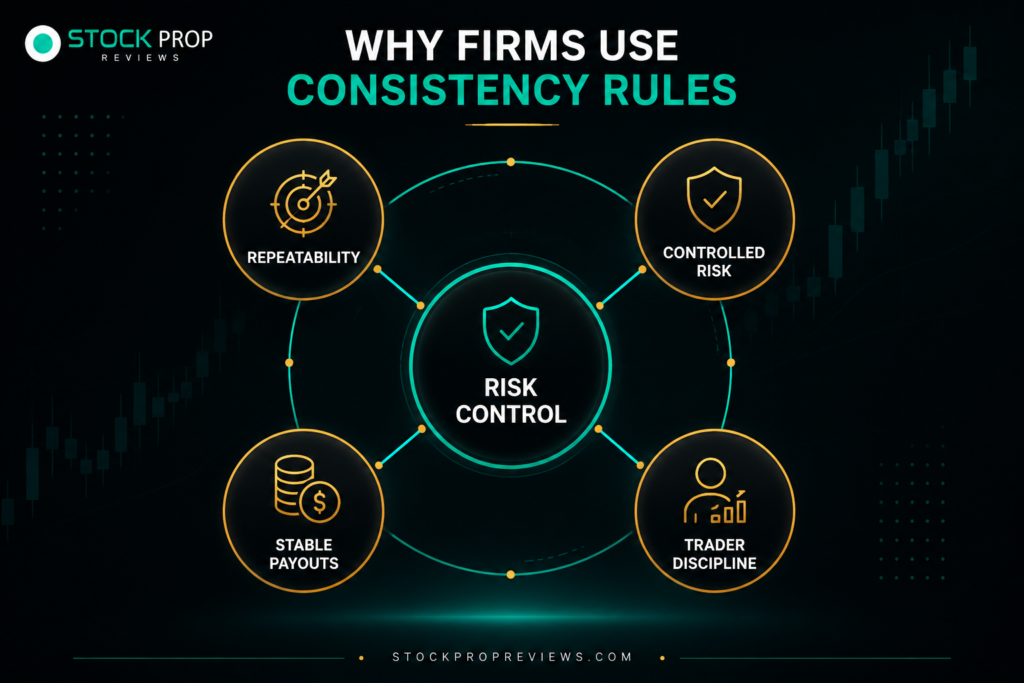
Most prop firms didn’t put in consistency rules to make trading harder. They were seeing the same pattern over and over and they brought them out.
A trader would get funded after one odd big trade and then not be able to repeat. A single winning day does not necessarily mean a repeatable trading process from the firm’s point of view.
That’s why there are consistency rules. Firms like to see profits generated over a number of trading sessions, rather than from one outsized move.
On paper, the concept sounds reasonable.
The problem is that markets rarely behave in a consistent manner.
Some weeks offer several strong opportunities. Other weeks offer almost none. A trader may spend days waiting patiently for a setup and then make most of their monthly profit during a single session. That does not necessarily mean they are taking excessive risk. It may simply mean they are trading selectively.
This is where the conflict begins.
The Problem Most Traders Discover Too Late
One thing is clear after reading through dozens of prop firm rulebooks. Consistency rules are usually marketed by firms as a risk-management feature. Traders often see them as a profit-management feature.
It makes a difference.
There’s a drawdown rule that limits your loss. Because it directly controls risk most traders accept.
One of the consistency rules deals with the distribution of profits. You can be well within drawdown limits, trade perfectly according to your plan and have problems because one trading day was too large a part of your total profit.
That changes the psychology of trading.
Instead of focusing entirely on finding the best opportunities, traders start thinking about percentages, payout calculations, and whether a winning day might create compliance problems later.
Over time, that can affect decision-making in ways that are rarely discussed in marketing material.
A Real Trading Scenario
Imagine a futures trader who specialises in high-volatility market openings.
For most of the month, conditions are average. The trader takes a handful of setups and generates modest gains. Then a major economic release creates exceptional volatility. The trader executes well, follows position-sizing rules, and finishes the day with a profit that represents nearly half of the month’s gains.
From a trading perspective, this is exactly what should happen. The trader recognised an opportunity, managed risk correctly, and capitalised on favourable market conditions.
Under certain consistency models, however, that same performance can create complications.
The account is profitable.
Risk limits were respected.
Yet the trader may need to continue trading simply to reduce the percentage contribution of that winning day.
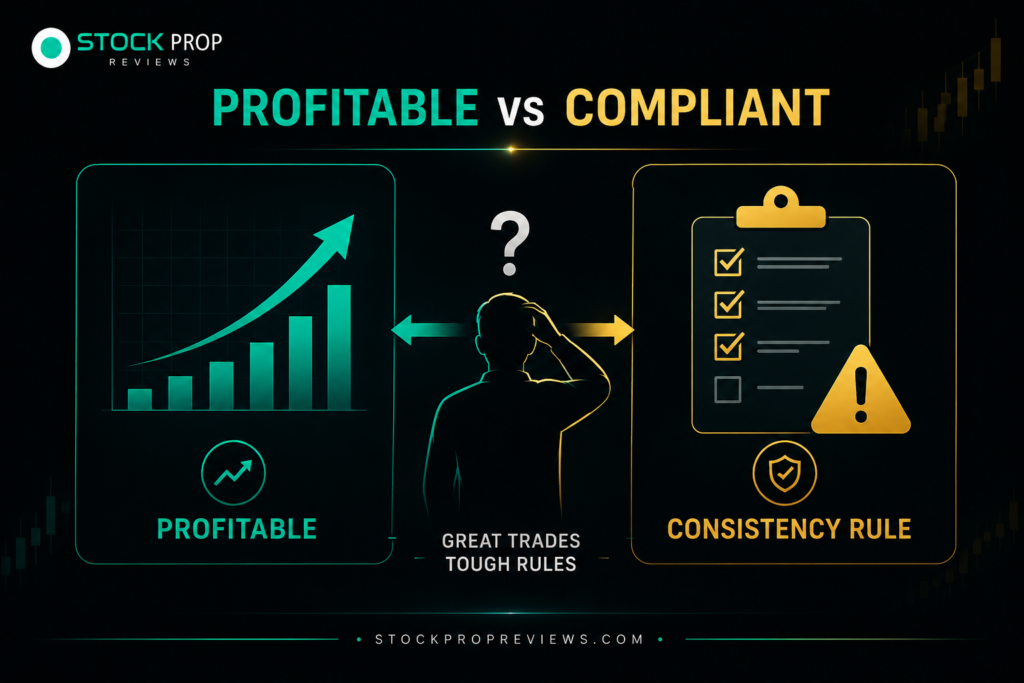
This is the point where many traders begin trading the firm’s rulebook instead of trading the market.
When Consistency Rules Actually Help
Critics tend to reject consistency rules altogether, but that is too simple.
These requirements can be very helpful for some traders.
Discipline is something newer traders tend to struggle with. Many try to make up losses with oversized positions or try to pass evaluations with aggressive risk; A consistency requirement can discourage that behaviour by making it harder to rely on one lucky trade.
The rule can also lead traders to think in terms of process rather than short term results.
A trader who consistently makes small gains while managing risk is usually developing habits that support long-term survival.
That’s the best argument you can make for consistency rules.
The problem is that not all traders making uneven profits are trading recklessly.
When Consistency Rules Become a Problem
Usually the dealers most affected are those whose profits naturally come in clusters.
Swing traders can wait days for a set up. The payoff when it does happen can be enormous. News traders are in the same boat. Limited activity over weeks can create a single event with tremendous opportunity.
This is what momentum traders have sometimes felt. Market conditions can be quiet for long periods of time before a strong directional move is made.
In all these cases, concentration of profit is normal.
The rule of consistency is not, per se, a bad sign of risk management. Or maybe it is pointing out the inherent features of the strategy itself.
That distinction is often lost when companies talk about the benefits of consistency requirements.
The Difference Between Risk Control and Profit Control
This is the part of the discussion that many competitors miss.
A trader can be profitable, disciplined, and fully compliant with risk limits while still struggling with a consistency rule.
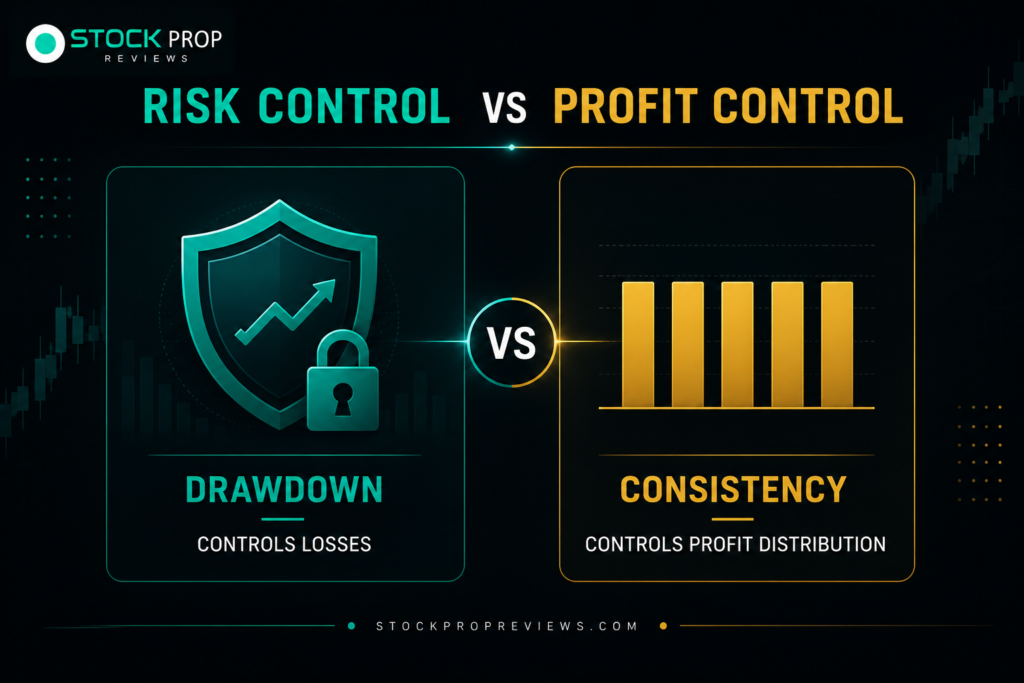
That is because drawdown rules and consistency rules measure different things.
A drawdown limit answers a straightforward question: how much risk is the trader taking?
A consistency rule answers a different question: how evenly are profits distributed?
Those questions are related, but they are not the same.
Professional trading results are rarely smooth. Many experienced traders can point to a handful of trading days that contributed a significant percentage of their annual returns.
If risk was controlled throughout those trades, should concentrated profits be viewed as a problem?
Reasonable people can disagree on the answer.
What matters for traders is understanding that consistency rules often influence profitability in ways that drawdown limits do not.
Comparing Common Consistency Models
| Rule Type | Impact on Profitability | Most Affected Traders |
| Evaluation-only consistency rule | Moderate | Challenge participants |
| Payout consistency rule | High | Funded traders |
| Daily profit cap model | High | Momentum and news traders |
| Balance-based consistency calculation | Moderate | Swing traders |
| No consistency rule | Low | Most trading styles |
Not every consistency model is equally restrictive. Some firms apply the rule only during evaluations, while others continue using it after funding when traders begin requesting payouts.
That difference deserves careful attention before purchasing a challenge.
Should Traders Avoid Firms With Consistency Rules?
Not necessarily.
The better question is whether the rule fits your strategy.
A high-frequency scalper who produces relatively stable daily returns may barely notice the restriction. A swing trader who depends on occasional large winners may find the same rule frustrating.
Before choosing a prop firm, it is worth comparing the entire rule structure rather than focusing solely on account size, pricing, or profit splits.
Many traders spend hours searching for the cheapest challenge and only discover payout restrictions after becoming profitable.
That is usually the wrong order.
Reading detailed prop firm reviews, comparing rule structures, and understanding payout conditions often provides more value than saving a few dollars on an evaluation fee.
For traders looking at stock-focused opportunities, TradeThePool is often mentioned because of its transparent risk framework and regulated structure. Readers can get up to 10% discount when purchasing through our TradeThePool link, but the decision should still come down to whether the rules match the trader’s strategy.
Final Thoughts
The consistency rule is designed to reduce risk for prop firms, but the effect it has on traders is a bit more nuanced than what most marketing pages want you to believe.
They can promote discipline, prevent gambling behaviour and allow firms to identify traders with repeatable processes. At the same time, they can modify trade management, defer payments and cut down the value of outstanding trading days.
The bottom line is simple. A consistency rule does more than just affect compliance. It has bottom line implications.
Before you buy any challenge, learn not only how much profit you can make, but how the firm expects to generate that profit. That little detail is often what makes or breaks a trading style in the firm’s model.
FAQs
Are consistency rules bad for profit?
And they can. Many traders modify their position sizes, their trade management or the timing of their payouts to remain compliant. This can lead to a reduction in the overall returns.
Why do prop firms have rules of consistency?
Most firms use them to find traders who make money from repeatable processes rather than one big winning trade.
Are rules for consistency bad for swing traders?
They can be difficult because swing traders often make a majority of their money on a handful of trades.
Do all prop firms check for consistency?
Nope. Some firms use consistency requirements in their assessments while others emphasise risk controls and drawdown limits.
What to check before buying a challenge for traders?
See how the consistency rule is calculated, if it impacts payouts and if it matches your trading style.