Traders who look for prop firms without a consistency rule usually want to avoid rules about how they can make money. To put it simply, these companies don’t need you to spread your profits out over several days. You can pass or withdraw after just one or two good trading sessions.
That sounds good, especially if your plan depends on timing more than frequency.
This model works for traders who:
- Take selective, high-conviction setups
- Trade volatility events or breakouts
- Accept long periods of inactivity
It does not suit:
- Beginners still figuring out risk
- Traders who increase size after wins
- Anyone relying on luck rather than repeatable setups
This is the main point that most articles miss. Getting rid of the rule about consistency doesn’t make trading easier. It just changes where the pressure is.
Why consistency rules exist in the first place
A consistency rule is designed to filter out unstable performance. For example, if one day produces 70 percent of your total profit, some firms flag that as unreliable.
When that rule is removed, firms still need protection. So instead of controlling how you make profits, they tighten how much you can lose.
This is where traders get caught off guard.
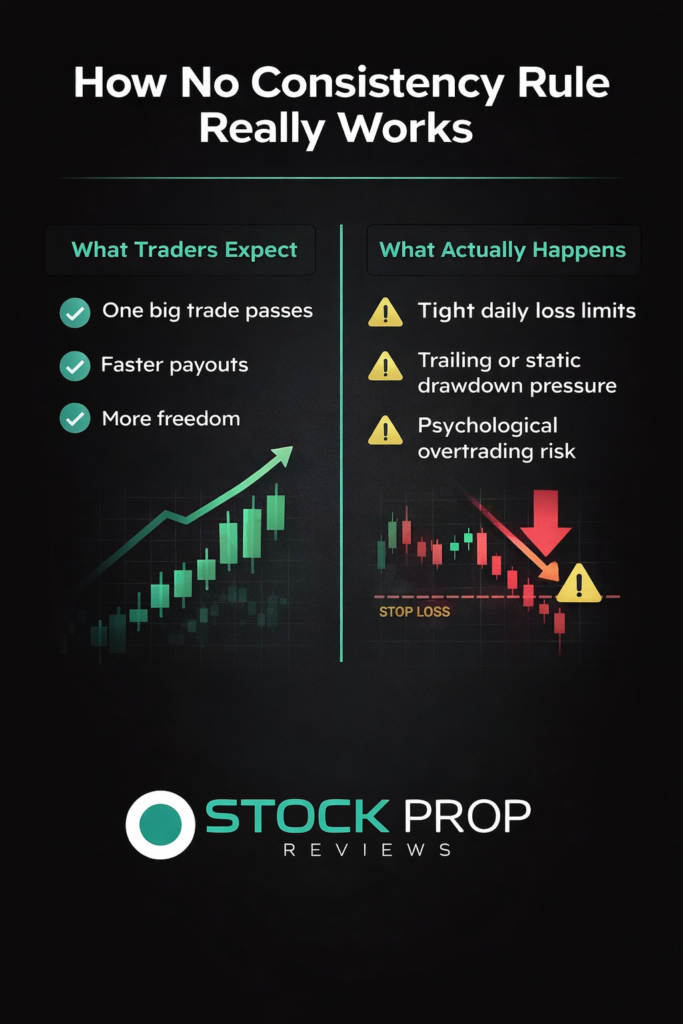
What changes when there is no consistency rule
Most articles by competitors talk about freedom. The truth is more useful.
If there isn’t a consistency rule, you usually get:
- More freedom in how profits are shared
- Faster evaluation passes if the time is right
But you also have to deal with:
- Tighter daily loss limits
- Drawdown structures that are more aggressive
- More mental pressure to win big again
The last point is the most important one in real trading. A single successful trade can lead to overconfidence rather than consistency. .
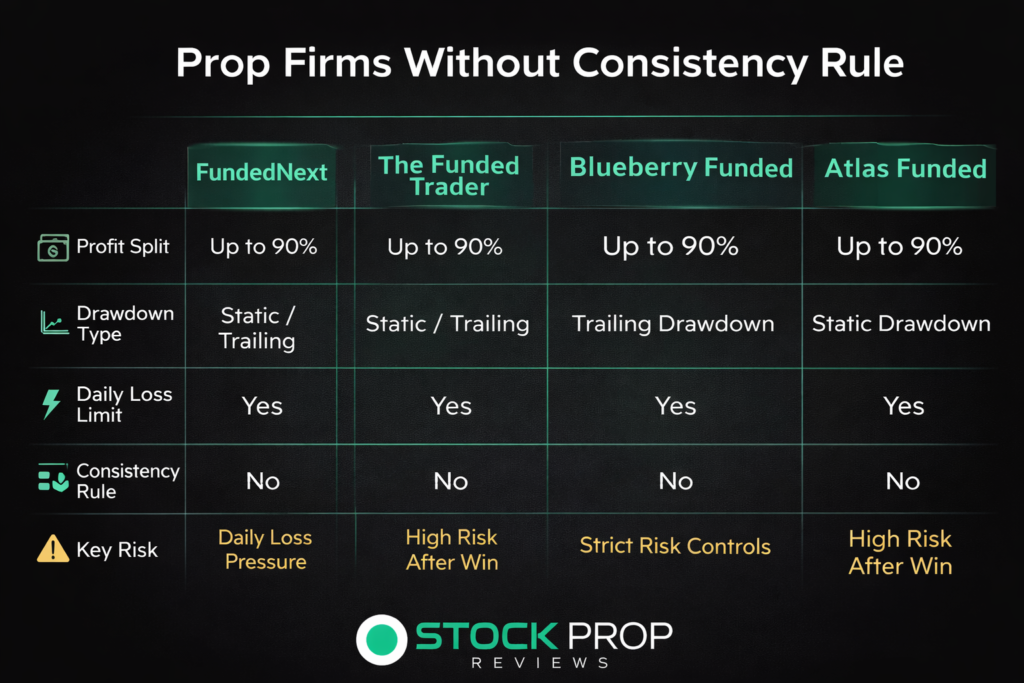
Comparison of top prop firms without consistency rule
| Firm | Model | Profit Split | Drawdown | Consistency Rule | Key Limitation |
| FundedNext | Evaluation + Instant | Up to 90% | Static / Trailing | No | Daily loss pressure |
| The Funded Trader | Evaluation | Up to 90% | Trailing | No | Drawdown moves fast |
| Blueberry Funded | Evaluation | Up to 90% | Static | No | Strict risk limits |
| Atlas Funded | Evaluation | Up to 90% | Trailing | No | Behaviour monitoring |
FundedNext review
Quick verdict
Flexible structure but harder than it looks in practice.
Rules overview
| Metric | Details |
| Profit split | Up to 90% |
| Drawdown | Static or trailing |
| Daily loss | Yes |
| Consistency rule | Not applied |
What it feels like in real trading
During a news session, a trader makes a big move in gold and hits their profit target in one trade. That is okay. There is nothing stopping that.
The issue comes up in the next step. The trader tries to do the same thing again, which raises the risk a little bit, and they reach their daily loss limit in just a few minutes.
This kind of pattern happens a lot. The first win sets a false standard.
What competitors don’t explain
The absence of a consistency rule increases emotional pressure. Traders feel they need another “big trade” instead of returning to normal risk.
Who should avoid it
If your position sizing changes after a win, this model will expose that quickly.
Alternatives
Even though it may feel limiting at first, a company with a mild consistency cap often has better long-term behaviour.
The Funded Trader review
Quick verdict
Trailing drawdown replaces the consistency filter, which is a popular choice.
Rules overview
| Metric | Details |
| Profit split | Up to 90% |
| Drawdown | Trailing |
| Daily loss | Yes |
| Consistency rule | Not applied |
Real scenario
A scalper reaches their profit goal in one session. That works. But the trailing drawdown keeps the equity level higher. A normal loss turns into a breach the next day.
A lot of accounts fail here.
What competitors miss
The trailing drawdown is like an indirect rule for consistency. It makes things stable even when the profits aren’t shared evenly.
Common mistake
Traders think that having fewer rules means they have more freedom. In reality, the risk framework is less forgiving. .
Who should avoid
Anyone who doesn’t like trailing drawdown should think about it again. It punishes performance that is inconsistent. .
Blueberry Funded review
Quick verdict
More balanced than most things in this group.
Rules overview
| Metric | Details |
| Profit split | Up to 90% |
| Drawdown | Static |
| Daily loss | Yes |
| Consistency rule | Not applied |
Real scenario
A swing trader builds profit over two or three trades. There is no pressure to distribute gains evenly, and the static drawdown gives breathing room after a winning streak.
What stands out
Static drawdown changes the experience completely. After a strong trade, your risk buffer does not tighten the way it does in trailing models.
Risk that still exists
If you overexpose during one event, not having a rule about consistency won’t help you. Loss limits still apply.
Who should avoid
Traders who stack positions that are related to each other often don’t realise how much risk they are taking on. That becomes a problem here.
Atlas Funded review
Quick verdict
Flexible on paper, stricter in practice.
Rules overview
| Metric | Details |
| Profit split | Up to 90% |
| Drawdown | Trailing |
| Daily loss | Yes |
| Consistency rule | Not applied |
Real scenario
A trader quickly moves through the market with one big position. Later, inconsistent sizing patterns start to set off internal checks.
What competitors don’t say
Some companies still keep an eye on behaviour, even though there isn’t a formal rule. Changes in risk or strategy that happen quickly can cause problems during payouts.
Who should avoid
If your trading style changes frequently, this environment becomes difficult to manage.
Strategy fit analysis
This structure helps some strategies, but only when they are in charge.
Breakout and news traders usually do well because their edge comes from timing, not how often they trade. They are used to waiting and then making a choice.
People who trade on their own time and are patient also fit. They can wait out bad conditions and not have to make trades.
On the other hand, scalpers who don’t have a clear edge have a hard time. They get different results, but there isn’t a clear reason for it. The hardest part is for beginners. They often see flexibility as a chance, which makes them trade too much.
The truth traders overlook
Taking away the consistency rule doesn’t make things easier. It takes away one filter that you can see and adds filters that are less obvious.
The real test is now mental:
- Can you go back to normal risk after a big win?
- Can you stop yourself from going after another big trade?
- Can you deal with inactivity without forcing setups?
Most of the time, these points are what cause failures, not the rules themselves.
Common mistakes traders make
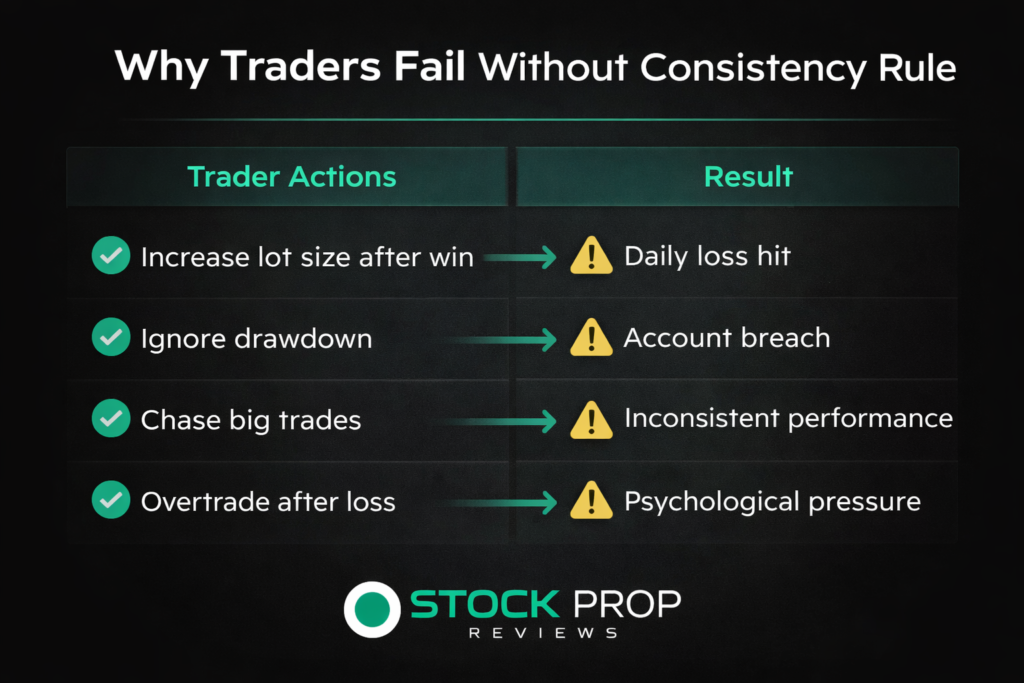
One of the most common patterns is to raise the lot size after a trade that made money. The reasoning seems sound at the time, but it quickly breaks the account when daily loss limits are reached.
Ignoring the structure of the drawdown is another problem. Traders only care about making money quickly and forget about what happens to the account after they do.
People also tend to use these models as a shortcut. Traders try to fit results into a few trades instead of building up consistency over time. That usually ends the same way.
Where TradeThePool fits
Most of the companies we’ve talked about so far focus on forex-style flexibility, but TradeThePool is a regulated stock prop firm that works differently. The rules are easier to understand, and the risk is more organised.
For traders who have trouble with overtrading or sizing inconsistently, that structure can be a benefit instead of a problem.
When readers buy through our TradeThePool link, they can save up to 10%.
This isn’t about making things easier. It is about having fewer grey areas in how risk is handled.
Alternatives worth considering
Some traders do better when they only follow some of the rules. These let profits vary, but they stop huge spikes in one day.
You could also look into static drawdown companies. They make it easier to deal with the stress that comes after a winning trade.
Prop firms that focus on stocks create a very different environment, where controlled execution is more important than quick evaluation passes.
Final perspective
Most traders searching for prop firms without consistency rule are trying to remove friction. The reality is that friction does not disappear. It just moves.
Instead of being tested on profit distribution, you are tested on discipline after success.
That is a harder test for most traders.
FAQs
Are prop firms that don’t have a consistency rule easier?
They may be easier to pass, but harder to keep going. The risk structure still needs discipline.
Is it possible to pass a trade evaluation?
Yes, but most traders fail to keep their accounts after that trade.
Is trailing drawdown a problem in this case?
It often becomes the biggest problem, especially after a good day.
Which kind of trader gets the most out of it?
Traders who make a few high-quality trades instead of a lot of them.
Should beginners pick this model?
Usually not. It quickly shows where risk control is weak.