Passing a prop firm challenge is like proof that you’ve got trading figured out.
It’s the moment when things seem to fall into place for many traders. The strategy works, the risk management works, the profit target is hit. Then the funded account comes in and within weeks the same trader starts making mistakes that never showed in the evaluation.
That’s one of the more common prop-trading patterns.
The simulated versus funded trading argument gets bogged down in technical arguments, but it is not so simple. The charts are identical. They have the same setup. Often the execution environment is nearly identical.
It’s the trader that changes.
This article is for traders who are about to go from an evaluation account to a funded account and for traders that have already been disappointed by a drop in performance after getting funded. It is not for traders looking for a quick way to pass challenges or a way around risk rules.
Knowing why the transition is hard can save you months of frustration and possibly several lost accounts.
The Misunderstood Difference Between Simulated and Funded Trading
In theory, simulated trading and funded trading can look very similar.
Trading opens, risk management and a trading plan. The market doesn’t care whether you are trading a challenge account or a funded account.
That’s why many traders assume that success in one environment should automatically translate into success in the other environment.
The problem is that simulation takes away repercussions.
In a serious evaluation, there is even a psychological safety net. If the account fails, the trader can usually reset, buy another challenge or just start again. It is frustrating, but rarely disastrous, to experience it.
Having a funded account changes the mindset. Now there is something worth risking. And suddenly every decision is impacted by future payouts, scaling opportunities and credibility with the firm.
That additional pressure influences behaviour more than most traders expect.
Quick Verdict
Passing a challenge demonstrates that a trader can perform well under a specific set of conditions.
Keeping a funded account requires something different. It requires the ability to repeat that performance while dealing with fear, expectations, and the temptation to change what was already working.
The traders who last the longest are usually not the traders who passed the challenge fastest. They are the traders who continue behaving exactly as they did before funding.
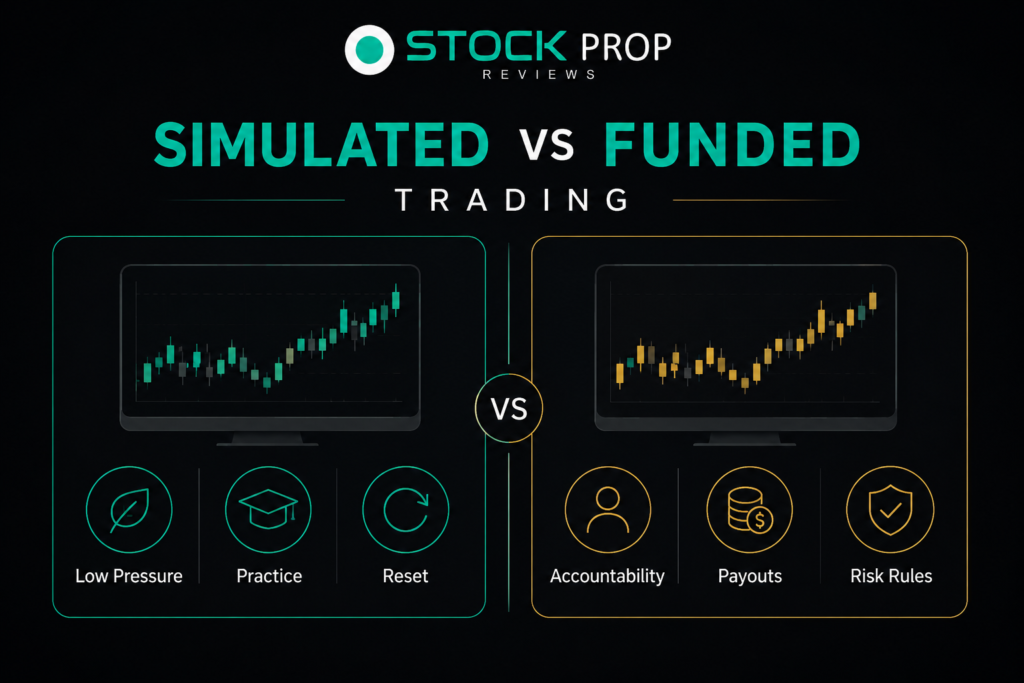
Simulated vs Funded Trading Comparison
| Area | Simulated Trading | Funded Trading |
| Emotional pressure | Relatively limited | Significantly higher |
| Focus | Passing a target | Preserving consistency |
| Consequences of mistakes | Usually temporary | Can result in account loss |
| Relationship with money | Indirect | Direct |
| Decision making | Often more objective | More emotional |
| Long-term discipline | Helpful | Essential |
Looking at the table, none of the differences involve charts, indicators, or market conditions.
That alone should tell traders where the real challenge exists.
Where Most Traders Go Wrong
One mistake competitors often make is treating funded-account struggles as a risk-management problem alone.
Risk management is important, but it is usually not the root cause.
The root cause is often a change in behaviour.
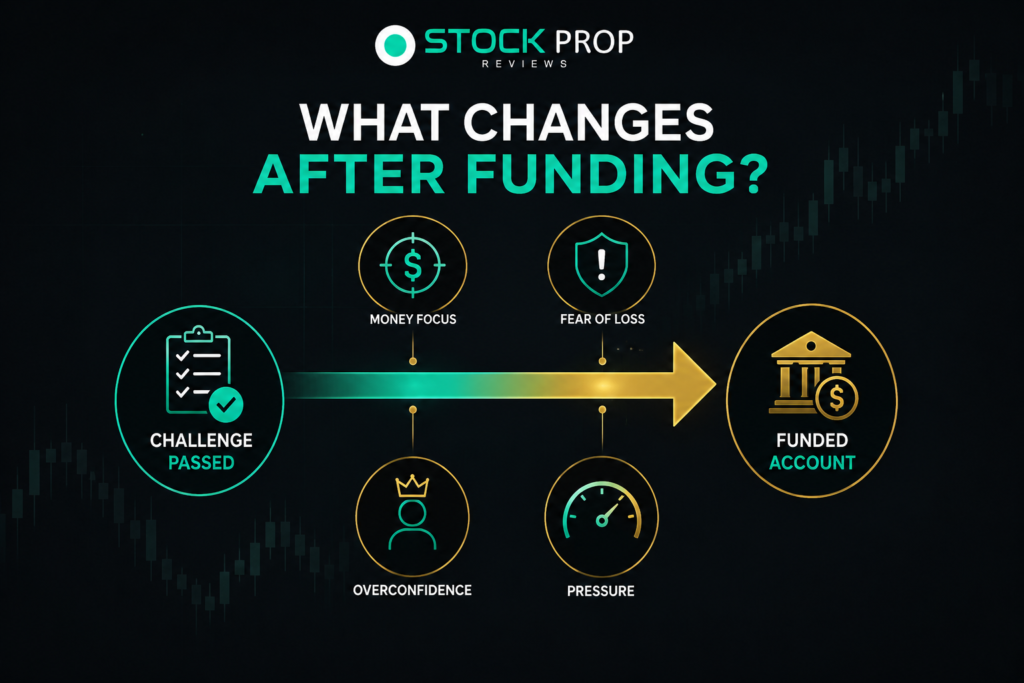
A trader passes a challenge risking half a percent per trade. Once funded, that same trader starts calculating what each winning trade could pay. The focus slowly shifts away from execution and toward income.
The strategy has not changed.
The trader’s priorities have.
I’ve seen traders become far more aggressive after funding because they feel confident. I’ve also seen traders become so cautious that they stop taking perfectly valid setups.
Both outcomes come from the same source: emotional attachment to the account.
The Challenge Creates a False Sense of Readiness
This is something many prop firms do not talk about enough.
A challenge measures whether you can meet specific objectives over a relatively short period. It does not necessarily measure whether you can remain profitable over six months or a year.
Those are completely different tests.
A trader might pass an evaluation during a favourable market cycle where their strategy performs exceptionally well. Another trader might pass after a handful of unusually strong trades.
Neither outcome guarantees long-term consistency.
The funded stage is often the first time traders discover whether their edge is genuinely repeatable.
That can be an uncomfortable realization.
The Payout Trap Nobody Warns New Traders About
When traders imagine getting funded, they naturally think about payouts.
There is nothing wrong with that. After all, making money is the reason most people enter trading.
The problem appears when payouts become the primary focus.
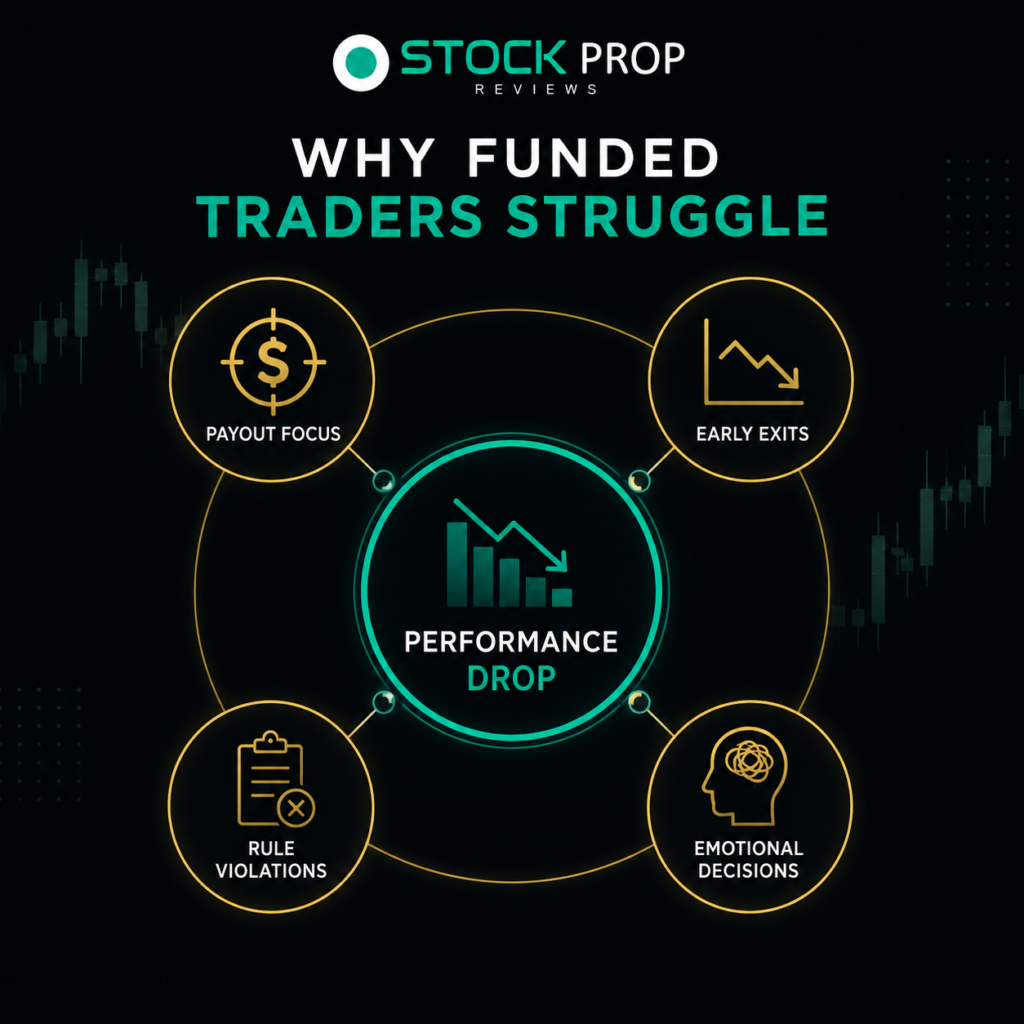
A trader who previously looked for quality setups begins looking at trades through a different lens. Every potential winner represents money that could be withdrawn. Every losing trade feels like money disappearing from their pocket.
The result is subtle but powerful.
Winners get closed too early.
Losers become harder to accept.
Risk decisions become emotional rather than systematic.
Ironically, the stronger the desire for a payout, the more likely it becomes that performance deteriorates.
Why Discipline Often Disappears After Funding
A lot of traders stop following the rules that got them funded, one of the weirdest things about prop trading.
You would expect the reverse.
A trader spends weeks proving they can manage risk, wait for setups, and be patient. Then the money starts pouring in and all of a sudden they are upping position size, trading more often, or throwing the routine out the window.
“The logic usually sounds good on first impression.” “I have a bigger account now.” “I need to capitalize this opportunity.”
“I shall make up for the loss before long.
Unfortunately, these thoughts often come right before an account violation.
The market doesn’t reward excitement. It rewards consistency.
What Competitors Often Miss
Most articles discussing simulated and funded trading stop at psychology.
Psychology matters, but there is another layer worth discussing.
Many challenge structures unintentionally encourage behaviour that becomes harmful later.
A trader chasing a profit target may feel pressure to be more aggressive than normal. Reaching the target quickly is rewarded. Taking longer often feels inefficient.
Once funded, however, survival becomes more important than speed.
The habits developed during the evaluation can suddenly become liabilities.
This explains why some traders pass challenges repeatedly yet struggle to maintain funded accounts.
They learned how to pass an evaluation.
They never learned how to protect a funded account.
A Real Trading Example
Imagine two traders who both succeed in the same challenge.
For the first trader, funding is just another part of doing business. There is always risk. Position sizing is the same. The day to day is the same.
It is a big milestone for the second trader in terms of funding. The account feels more valuable, so the position size increases right away. Losses are more annoying because they postpone possible payments.
Three weeks later the first trader is still trading.
The second trader probably had a much rougher ride.
It’s not much difference in strategy quality.
It has everything to do with the way they responded to funding.
Who Typically Performs Best in Funded Accounts?
The traders who survive longest are often surprisingly boring.
They rarely chase trades.
They are comfortable sitting out difficult market conditions.
They do not become overly excited during winning streaks.
Most importantly, they understand that preserving capital matters more than producing spectacular returns.
This is one reason why many experienced traders outperform naturally aggressive traders over the long run.
Consistency compounds.
Emotion usually does not.
Should Every Trader Pursue Funding?
Not necessarily.
Funded trading can be an excellent opportunity, but it exposes weaknesses quickly.
Traders who constantly change strategies, struggle with discipline, or depend on trading income immediately may find the environment more stressful than expected.
In some cases, spending additional time trading a personal account or refining a process in simulation can be more valuable than rushing into another challenge.
There is no prize for getting funded before you are ready.
Choosing the Right Firm Matters Too
Although trader behaviour is the biggest factor, firm structure still matters.
Different firms have different approaches to drawdown limits, consistency requirements, payout schedules, and risk policies.
That is why traders should spend time reviewing detailed firm analyses before committing capital. Reading a thorough FTMO review, a FundedNext review, or a comparison of leading prop firms can help clarify whether a firm’s rules align with a trader’s style.
For traders interested in equities rather than forex or futures, TradeThePool is often worth examining because of its focus on stock trading and relatively transparent risk framework.
Readers can get up to 10% discount when purchasing through our TradeThePool link.
That should not be viewed as a reason to join on its own. The quality of a firm’s rules and whether they suit your trading approach matter far more than any discount.
The Reality Behind Simulated vs Funded Trading
The biggest misconception in prop trading is that passing a challenge proves a trader is ready for long-term funded success.
Sometimes it does.
Often it does not.
Simulation tests whether a strategy can work. Funding tests whether a trader can continue executing that strategy when money, expectations, and pressure become part of the equation.
That distinction explains why so many traders celebrate receiving a funded account and then struggle shortly afterward.
The challenge was never the finish line.
For most traders, it was simply the beginning of a different test.
FAQs
Why do traders perform worse after getting funded?
The leading cause is increased emotional pressure. Traders begin to consider payouts, account preservation or getting back their losses and stop following their trading plan.
Is simulated trading easier than funded trading?
From a psychological perspective, yes. The market remains the same, but the consequences attached to decisions become much more significant.
Does passing a challenge prove a trader is profitable?
Not always. Passing a challenge demonstrates competence over a specific period, but long-term profitability requires consistency across different market conditions.
Should I change my strategy after getting funded?
In most cases, no. Many funded traders struggle because they abandon the process that helped them pass the evaluation.
What is the biggest difference between simulated vs funded trading?
The largest difference is psychological pressure. The presence of real payouts and account consequences often changes trader behaviour more than the market itself.