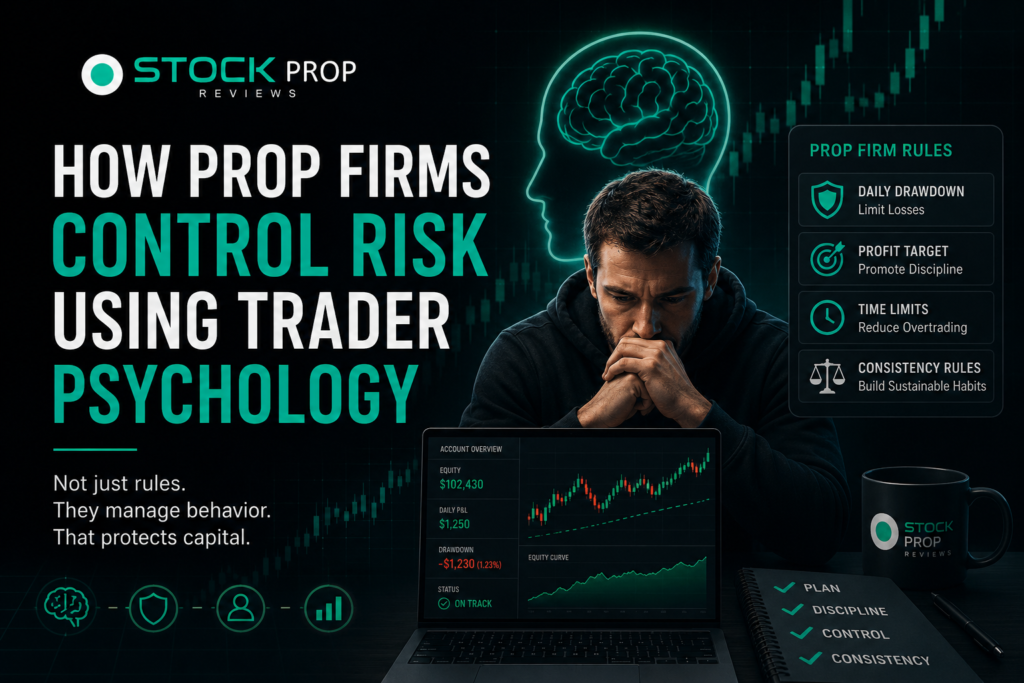
Most traders believe prop firms care about managing risk with drawdown rules and account limitations.
That’s just the tip of the iceberg.
Behind the scenes most firms are managing trader behaviour as much as market exposure. Most of the rules of evaluation are based on expected emotional responses. Daily drawdown limits to aim for revenge trade. Profit targets lead to pressure. Gambling is discouraged through consistency rules.
Here the psychology of prop firm traders is involved.
The problem is not only to find good entries. It’s about keeping rational when the weight of the money starts to creep into decision making.
This article is for the beginning traders and the funded traders who are trying to figure out why so many evaluations fail, despite the strategy itself looking solid.
This is not for traders looking for shortcuts, fast pass tricks or social media style motivation.
What Prop Firms Actually Measure
Many traders think prop firms just want to make money.
And in fact, firms do care about how those profits are made.
A trader who breaks discipline, even if making 8%, is generally considered a bigger long-term risk than one who makes slower but controlled returns.
That is why most firms monitor patterns such as:
| Area | What Firms Watch | Why It Matters |
| Daily losses | Emotional recovery attempts | Prevents account blowups |
| Position size changes | Revenge trading behavior | Detects unstable decision-making |
| Trade frequency | Overtrading patterns | Reduces emotional fatigue |
| News exposure | Gambling-style execution | Limits volatility risk |
| Consistency | Risk stability | Measures long-term survivability |
A lot of traders misunderstand this point.
They think evaluations are mostly technical.
Most of the time, the real pressure comes from psychological instability.
Prop Firm Trader Psychology Explained
Prop firm trader psychology is the behaviour of traders under structured pressure.
The decision-making is changed by the environment.
A trader who appears calm on a personal demo account might act completely differently when there is a profit target, drawdown limit and countdown timer on every trade.
This is why some traders pass the technical analysis tests with ease but keep failing the funded evaluations again and again.
The problem isn’t always the quality of strategy.
Usually it’s emotional control.
Loss is personal. Traders start to force setups. Risk rises after frustration. Discipline slowly evaporates.
Prop firms know this happens.
That is the case with a lot of rules.
The Psychological Pressure Inside Evaluations
Most competitors talk about discipline in broad terms.
Very few explain how evaluation models actively create emotional pressure.
That pressure changes execution.
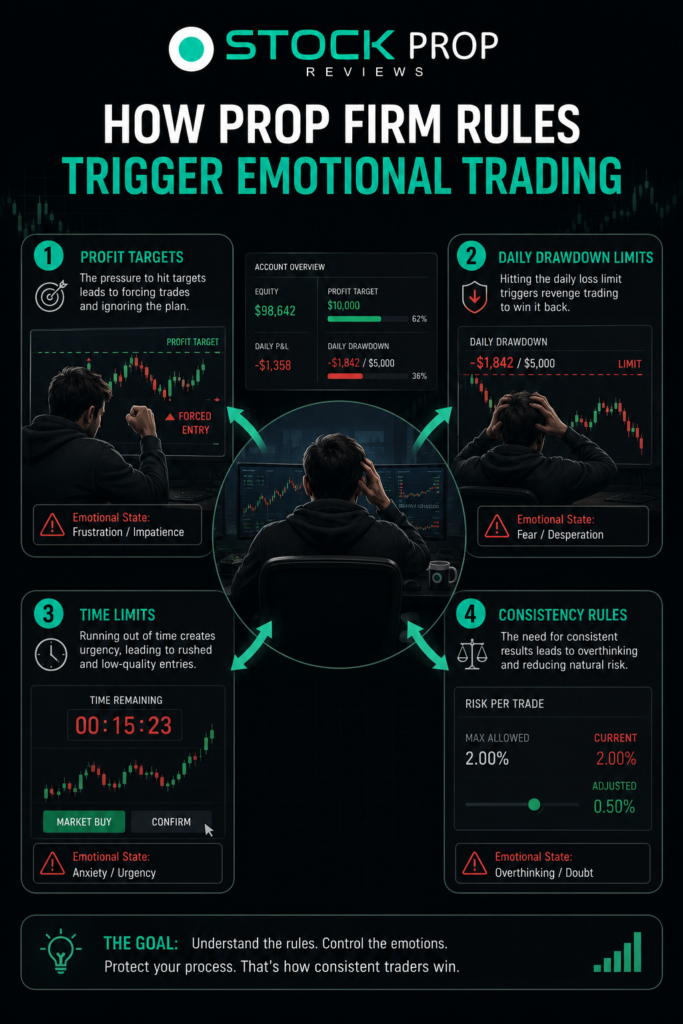
Profit Targets Change Trader Behavior
A trader who normally waits patiently for quality setups suddenly feels urgency.
Instead of taking two strong trades weekly, they may start entering random setups daily trying to hit a target faster.
The strategy itself did not fail.
The pressure changed the trader.
This is one reason aggressive challenge models often produce inconsistent performance.
The bigger the target pressure becomes, the harder it is for many traders to remain selective.
Daily Drawdown Limits Trigger Emotional Trading
One of the most common prop firm failures happens after a trader takes a normal loss.
At first, the risk remains controlled.
Then frustration appears.
The trader wants the loss back immediately.
Lot size increases. Trade quality drops. Another loss follows.
This usually becomes the point where the account collapses.
Ironically, many traders do not fail because of bad market analysis.
They fail because they stop following their normal process after losing.
Time Limits Create Forced Setups
Older models of prop firms were very deadline driven.
That structure penalised traders for over-trading.
With the challenge clock ticking down, many traders took on positions they normally wouldn’t.
Some firms later ditched time limits, partly because rushed traders tend to make worse decisions.
But even with infinite runtime models aren’t always perfect.
Traders get sloppy when there is no urgency.
Why Most Traders Blow Funded Accounts
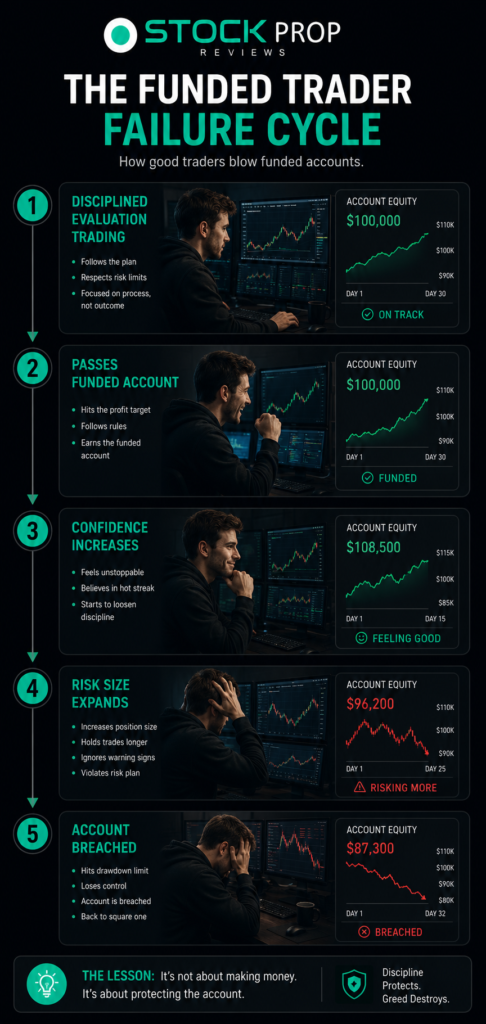
A surprising number of traders lose funded accounts after passing evaluations.
This usually happens because confidence changes risk behavior.
A trader may pass using disciplined 0.5% risk.
Once funded, they suddenly start risking 2% or 3% per trade trying to scale faster.
The account disappears within weeks.
Prop firms see this pattern constantly.
Passing an evaluation does not automatically mean someone is emotionally prepared to manage larger capital.
There is also another issue many traders ignore.
Some people trade differently once payouts become possible.
Pressure increases.
Fear of losing profits creates hesitation. Traders close winners early, move stops emotionally, or avoid valid setups entirely.
Again, the market is not always the problem.
Human behavior is.
The Data Prop Firms Monitor Quietly
Most modern companies monitor a lot more than just profit and loss.
They study the behaviour of execution .
Including but not limited to:
- Sudden jumps in position size
- Trading following big losses
- inconsistent strategy
- Very brief holding periods
- Exposure to high-risk news
- Related positions
For instance, if a trader normally risks small amounts, but suddenly doubles up after two losing trades, that sets up a psychological red flag.
The same is true for traders who are calm for weeks and then open several impulsive positions in one session.
Unstable behaviour matters on the part of the firm, because emotional traders become unpredictable sources of risk.
Most firms would prefer to work with a slower trader who gets through the day than someone who produces the occasional explosive return before booking a big loss.
What Competitors Usually Do Not Explain
Many articles discuss mindset and discipline in a motivational way.
The reality inside prop trading is less glamorous.
Prop firms have already seen thousands of traders fail through nearly identical behavioral patterns.
That experience shapes the rules.
The Evaluation Is Partly a Behavioral Filter
But a prop challenge tests more than just market understanding.
It also tests for:
- Patience
- Risk Management
- Emotional Security
- Consistency
- Ability to adhere to restrictions
This move can be tough for retail traders as personal accounts offer more freedom.
Prop environments can be very punishing of emotional flexibility very quickly.
Traders Often Destroy Good Systems Themselves
Many traders blame the strategy after it fails.
Sometimes the strategy was okay.
The execution was changed.
A trader begins:
- Coming sooner than expected
- Trailing stop loss
- Higher leverage
- Looking for volatility
- Disrespect for session discipline
These small changes gradually wear away the edge.
The problem is that traders are often not aware of the change until the account is already approaching breach levels.
Real Scenarios Firms See Every Day
The Revenge Trade Spiral
Trader loses 2 trades in London session.
Instead of retreating they elected to claw back losses amid New York volatility.
Risk is twofold.
The market made a quick move and hit the daily limit.
This is the most frequent fund account failure.
The Overconfident Payout Trader
A trader finally receives their first payout.
Confidence jumps immediately.
Discipline disappears gradually.
The trader starts forcing setups, increasing size, and trading outside their normal sessions.
Within a month, the account is gone.
A lot of firms quietly see payouts as dangerous periods because trader psychology changes after early success.
The Strategy Hopper
One week down for a trader and he throws the whole system away.
They move from breakout trading to scalping.
Then change again after a few days.
This inconsistency creates unstable risk exposure as the trader is not using tested execution patterns anymore.
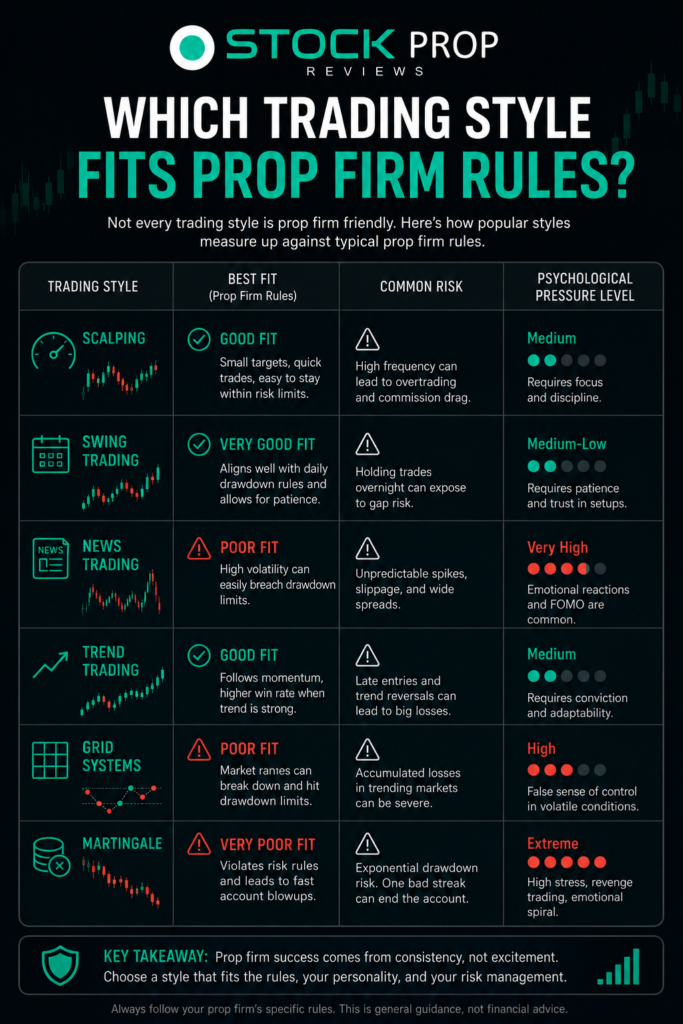
Why Some Trading Styles Struggle in Prop Firms
Not every profitable strategy fits well inside funded-account structures.
That is something newer traders often overlook.
| Trading Style | Common Issue Inside Prop Firms |
| Aggressive scalping | Emotional fatigue and execution pressure |
| News trading | Volatility restrictions |
| Swing trading | Overnight holding limitations |
| Martingale systems | Rapid drawdown breaches |
| Grid strategies | Hidden exposure risk |
| Slow trend trading | Longer evaluation periods |
A strategy can work well on a personal account and still struggle under prop firm restrictions.
That does not automatically mean the strategy is bad.
Sometimes the structure itself is simply a poor fit.
The Psychology Behind Consistency Rules
Consistency rules frustrate many traders because they limit the ability to push through one oversized trade quickly.
But companies tend to see inconsistent profits as emotional behaviour.
For example, a trader making most of their profit from one huge position may appear far riskier than someone producing smaller controlled gains steadily.
In general, companies like predictability.
The big emotional swings in the execution almost never scale safely in time.
That is why many firms also restrict scaling opportunities for traders who have unstable patterns in risk.
How Experienced Traders Adapt
The traders who last longest inside funded environments usually stop treating evaluations like competitions.
They focus more on survival.
Most experienced funded traders eventually simplify their process.
Risk becomes smaller.
Trade frequency drops.
Session discipline becomes stricter.
Many successful traders also stop trading after reaching predefined limits.
For example:
- Two consecutive losses
- One emotional mistake
- A specific drawdown amount
This prevents psychological deterioration during difficult sessions.
That approach may look boring from the outside.
But it is often what keeps accounts alive long term.
Who Should Avoid Most Prop Firm Challenges
Not all traders are successful in prop firms.
Traders who have not learned to master their emotions often perform worse under evaluation pressure.
Traders who are always:
- Trade Revenge
- Emotionally expand
- Rely on recovery systems
- Disregard stop losses
- Chase Fast Challenge Pass
For many novices, building up consistency on personal capital first might actually cost money.
Challenge sales drive revenue and many times the industry doesn’t say this publicly.
TradeThePool and Risk Transparency
Some traders prefer firms with more structured risk expectations instead of highly aggressive challenge marketing.
TradeThePool is often discussed for this reason because it operates as a regulated stock prop firm with relatively transparent rule structures.
Readers can get up to 10% discount when purchasing through our TradeThePool link.
That does not guarantee profitability.
But clearer expectations can help traders understand the environment before risking evaluation fees.
The Bigger Truth About Prop Firm Trader Psychology
Most failed evaluations are not caused by one terrible trade.
Usually the account breaks down through emotional escalation.
Small mistakes turn into larger ones.
Discipline slowly disappears after stress increases.
This is the part many competitors avoid discussing clearly.
Prop firms are not only evaluating whether someone can make money.
They are evaluating whether someone can stay controlled while pressure increases.
That distinction matters.
A trader who cannot handle emotional pressure inside a structured evaluation will usually struggle even more with larger capital later.
The strongest funded traders are rarely the most aggressive.
Most of the time, they are simply the most stable.
That sounds less exciting on social media.
Inside prop trading, though, stability is usually what survives.
For traders comparing funding models, it also helps to review different evaluation structures carefully. Many traders researching psychology-related risk models also read our breakdown of trailing versus static drawdown systems, several prop firm reviews focused on hidden restrictions, and our truth article on why funded traders often lose accounts after their first payouts.
FAQs
Why is psychology important for prop firms?
Emotional trading is inconsistent risk exposure. Companies are looking for traders who can stay disciplined through losses, volatility and pressure.
What is the most common reason traders fail the evaluation?
One of the main reasons is revenge trading. Traders often up their risk emotionally after losses trying to make up for them fast.
Why do some traders pass challenges and then fail funded accounts?
Many traders become overconfident when they pass. They increase risk, overtrade, or drop the discipline that made them successful in the first place.
Are prop firm rules intentionally made so traders lose?
Some challenge formats are very high pressure, but many of the rules are mainly there to protect the capital of the firms from erratic trading behaviour.
Who is most likely to struggle in prop firms?
The most difficult to evaluate are the structured rules for traders that use martingale systems, emotional scalping systems or don’t manage their risk consistently.