Most traders believe that risk management at a prop firm is easy. Adhere to the daily drawdown limit, observe the maximum loss rule and don’t over-leverage your positions. If those boxes are ticked, things should be okay.
Actually that’s only part of the story.
All prop firms have to manage their own risk, not just the risk of the individual traders. Traders are looking at their account dashboard. But firms are looking at something much bigger. They’re looking at trader positioning, where exposure is and what could happen if hundreds of accounts get on the wrong side of the same trade.
This is what matters in prop firm risk exposure.
This article is for traders preparing for evaluations, managing funded accounts or just trying to understand why firms tighten restrictions sometimes even when published rules have not changed. If you’re looking for ways to get around risk controls, this is probably not the article you want.
What Is Prop Firm Risk Exposure?
Prop firm risk exposure is the overall risk a firm has at any given moment because of its traders.
Many traders believe the risk stops at the account level. The firm has a different view.
Suppose you run a firm with 5,000 active traders. Even if every trader is technically following the rules, if a large percentage of the traders are holding similar positions ahead of a major news release, the firm’s exposure can become significant.
This is the reason why risk management at a prop firm is often more complicated than the drawdown numbers traders see on the surface.
Why Firms Care About More Than Your Drawdown
A common misunderstanding among newer traders is that prop firms only care about whether you hit your daily loss limit.
That would be an easy system to manage, but it would also be dangerous.
Consider two funded traders. Both are risking 1% per trade.
The first trader has been risking 1% consistently for six months, trades a small basket of markets, and follows the same process every day.
The second trader usually risks 0.5% but suddenly starts risking 3% after receiving a payout.
On paper, neither trader has broken a rule.
From a risk manager’s perspective, however, they look very different.
The first trader appears stable. The second trader may be showing early signs of overconfidence, which is one of the most common reasons funded traders lose accounts.
This is one area many public discussions miss. Risk departments are not just measuring losses. They are measuring the probability of future losses.
The Exposure Traders Never See
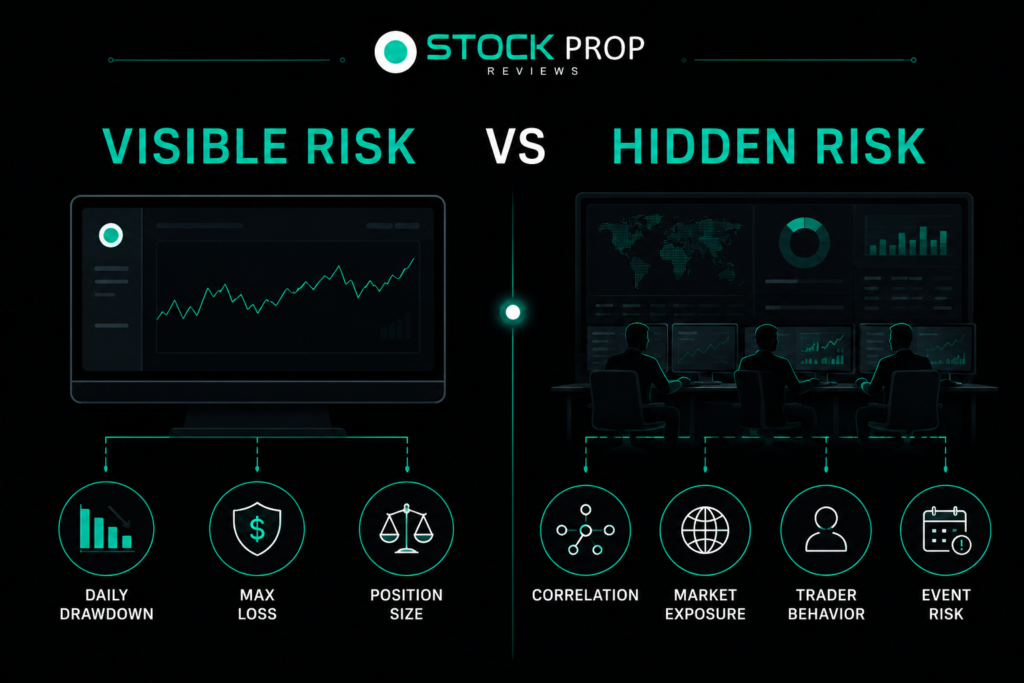
Most firms monitor several layers of risk simultaneously.
The obvious layer is account risk. This includes daily drawdown, maximum drawdown, position sizing, and leverage.
The less obvious layer is firm-wide exposure.
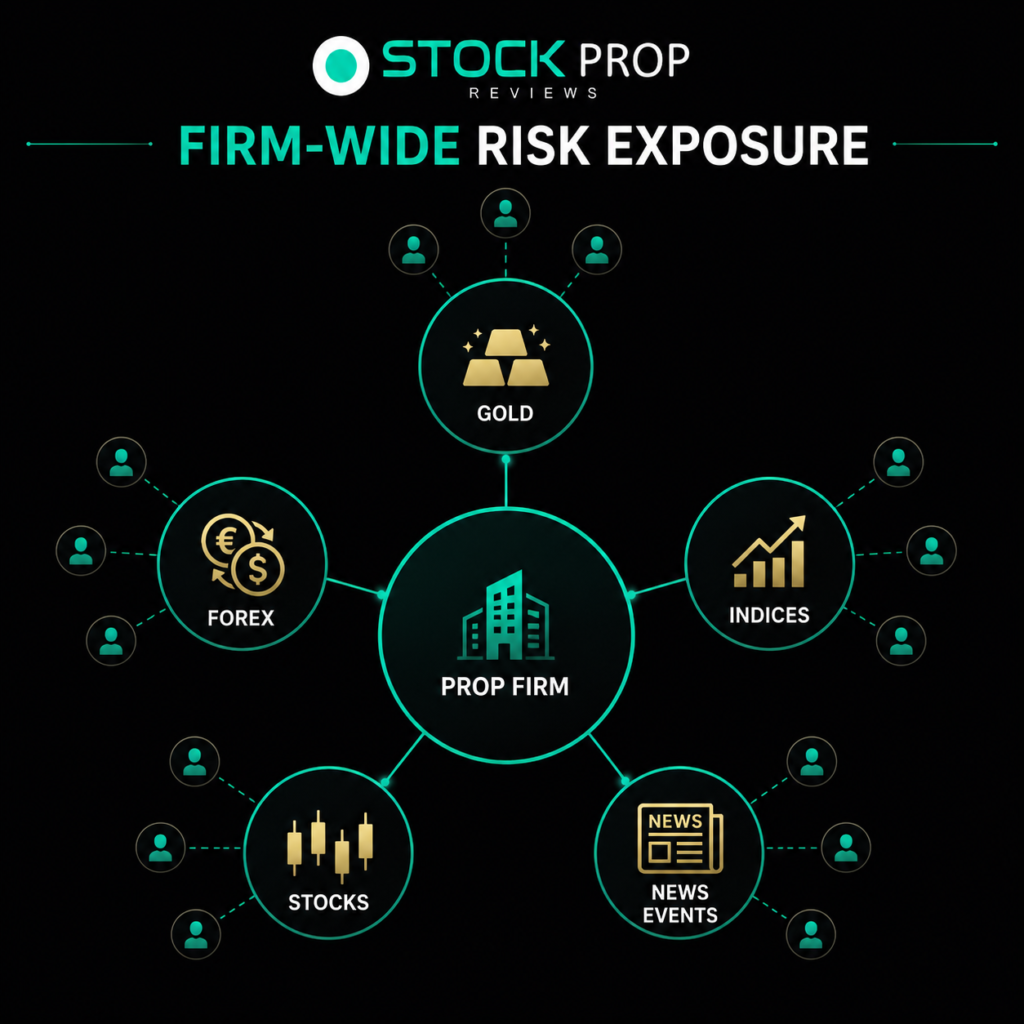
For example, suppose hundreds of traders are long gold because the same technical setup is being shared across trading communities. Individually, each trader may have acceptable risk. Collectively, the firm may be carrying a very large directional bet.
That concentration becomes a problem if the market moves sharply against those positions.
The trader only sees their own account. The firm sees the entire book.
That difference in perspective explains many decisions traders find confusing.
Correlation Risk Is Often Ignored
One of the biggest blind spots among retail traders is correlation.
Many traders believe they are spreading risk because they have positions in several markets. In reality, those positions may all be expressing the same idea.
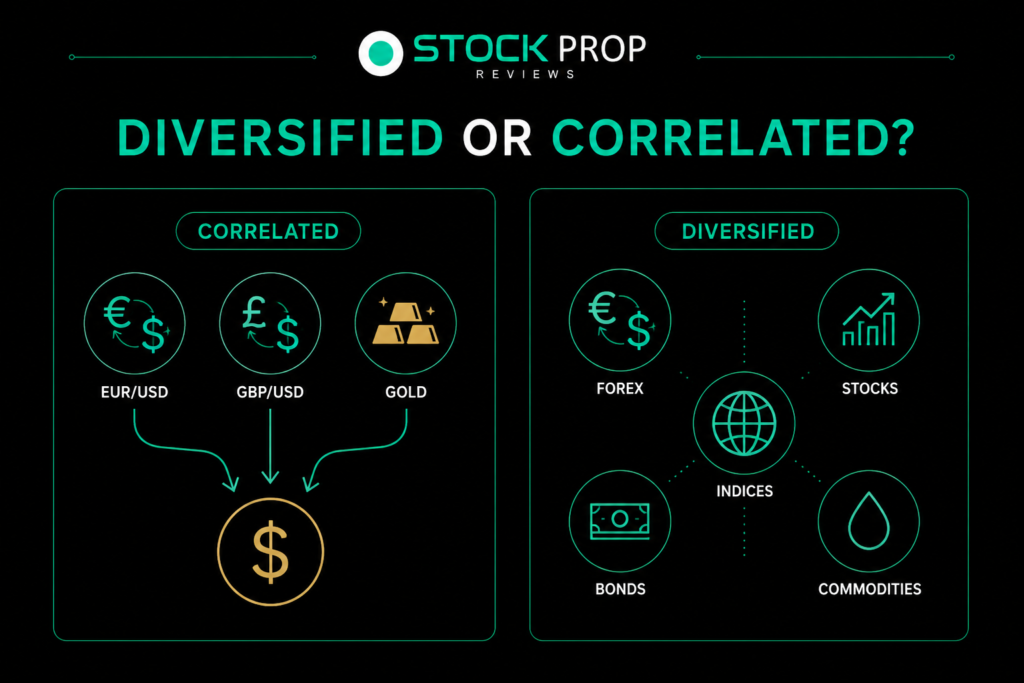
A trader who is long EUR/USD, GBP/USD, and gold may think they are diversified. During certain market conditions, all three trades can move together because they are heavily influenced by the U.S. dollar.
The account may show three separate trades.
The risk department may see one oversized directional position.
This matters because firms are not only looking at what you trade. They are looking at how those positions behave together.
Why News Events Change Everything
Anyone who has traded through a major economic announcement has seen how quickly conditions can change.
Spreads widen. Liquidity disappears. Stops may not be filled exactly where expected.
From a trader’s perspective, a setup might look attractive.
From a firm’s perspective, the same setup may introduce a level of uncertainty that cannot be measured using normal market conditions.
That is why some firms impose restrictions around events such as inflation reports, interest rate decisions, or major employment data.
These policies are often viewed as obstacles by traders. In reality, they are usually designed to control exposure during periods when historical risk models become less reliable.
How Traders Accidentally Increase Their Risk Profile
One of the most interesting things about funded trading is that traders very rarely lose accounts because they do not understand the rules.
The rules are well known to most.
The problem is the post-success time.
A trader goes through an evaluation, gets funded, and starts to build confidence. Confidence itself is not a bad thing. The problem comes when confidence turns into bigger position size, more trades or looser execution.
Often the change comes slowly.
A trader who risked 0.5% per trade in the challenge now risking 1%.
Then 2%.
Then doubles down after losing trade, because they think they can get it back fast.
The account may survive weeks of this behaviour. Eventually the market will catch up.
This pattern is followed by many funded account failures. They’re not due to a lack of strategy. This is due to a change in risk behaviour.
What Most Competitors Don’t Explain
Most articles on prop firm risk management focus on how traders should manage risk.
That is important, but it only tells half the story.
The other half is understanding how firms manage their own exposure.
A prop firm’s risk team is constantly asking questions such as:
- Are too many traders positioned in the same direction?
- Has trader behaviour changed recently?
- Are market conditions becoming more volatile?
- Is exposure concentrated in a specific asset class?
These concerns exist even when individual traders are fully compliant.
Once you understand that distinction, many prop firm policies start to make more sense.
Should Traders Be Concerned About Hidden Risk Monitoring?
Not necessarily.
In most cases, hidden risk monitoring is not intended to trap traders. It’s there because companies have to protect their business model.
The traders that last the longest in funded programs are typically the traders that think outside the published rules. They know it is not because a rule book says so, but because consistency lessens risk for the trader and firm.
That kind of thinking is often what separates traders who stay funded for months or years from those who keep starting over.
TradeThePool and Risk Transparency
One reason some traders prefer stock-focused firms such as TradeThePool is the emphasis on clearly defined risk parameters and transparent rule structures.
As a regulated stock prop firm, TradeThePool provides traders with visibility into risk requirements and account management expectations. Readers can get up to 10% discount when purchasing through our TradeThePool link.
That does not guarantee success. The responsibility for managing exposure still rests with the trader.
FAQs
What is a prop firm’s risk exposure?
This is the total risk that a prop firm takes on from its trader pool, including open positions, market concentration, behavioural patterns and potential losses.
If all the rules are followed can a trader be high risk?
Sure. Sudden changes in position sizing, highly correlated trades or strange trading behaviour can lead to an increased perceived risk even if no formal rule has been broken.
Why does correlation matter to firms?
Because several positions can practically become one big market bet. Diversification at the account level can result in concentration risk at the firm level.
Are all prop firms calculating risk exposure in the same way?
No Each firm has their own models, limits and risk procedures. Most, however, look at more than just simple drawdown rules when judging funded traders.
Here are ways traders can address concerns about hidden risk.
From a firm’s perspective, the best ways to stay a low risk trader are usually consistent position sizing, controlled risk per trade, avoiding excessive correlation and stable trading behaviour.