Some prop firms are tightening up and others like to be flexible, so some can be more strict and others more flexible depending on what account model you are following, which strategies and rules you follow. Some firms provide wider evaluation options, management of greater trading options, and other ways to cash out. However, drawdown limits, consistency rules, and banned trading rules still represent large conditions.
Why are these prop firm rule changes important? A program with a flexible-looking advertisement might have rules that restrict a trader’s ability to pass an evaluation or payout.
This trend analysis is for beginner, intermediate, and seasoned traders considering prop trading programs. It is not for traders seeking guaranteed funding or unlimited trading. It’s not the flexibility of the firm based on one attractive feature; the question should be if the firm’s rules match with the strategy or not.
Quick Verdict: Are Prop Firms Getting Stricter?
So there you have it, my friends, a two-way street! Some programs are more laid-back in their evaluation format, overnight positions, news trading, and account selection. Others limit losses, payout terms, and certain trading activities.
Three developments explain the current trend:
- More account choices: Forex, futures, or stock traders can compare ratings and programs.
- Detailed risk controls: Most programs still feature maximum drawdown, daily loss limits, and payout eligibility.
- Strategy-specific flexibility: A firm may allow news trading but still impose strict drawdown limits or consistency requirements.
There is no common rulebook for the industry. Every company has its own terms, and rules may differ for different types of accounts. Therefore, traders should always check the terms of the program they are about to purchase.
Why Prop Firm Rule Changes Are Happening
Firms compete in differentiating their programs. Traders consider evaluation rules, challenge fees, payout frequency, profit splits, and restrictions when choosing an account. Firms have an incentive to offer options that will appeal to various trading styles.
But they also want to maintain some cost, risk, and potential abuse of their schemes. This means of balancing between exciting traders but still controlling the trading of accounts.
Competition is creating more choices
Some companies offer one-step assessments, two-step challenges, and instant funding-type programs. These will suit traders with different experience and risk levels.
For example, a trader with an established strategy might be seeking a short evaluation. A new trader may prefer a structured challenge that gives a clear path to consistency.
However, fewer evaluation phases do not mean an easier account. Even if an evaluation standard does not exist in a program, it could include stricter loss allowance, higher fees as well as additional payout criteria.
Risk management remains important
Restrictions on maximum drawdown and trading behavior may help to define the requirements on program behavior. Some companies also prohibit certain forms of account correlation, technical exploitations, or trading styles that are in violation of their conditions.
Such rules are not in themselves unreasonable. The important questions are whether the rules are clear and consistently applied and whether they are in tune with the account being offered.
A company can be strict on risk controls and flexible on other matters. Traders should not view strictness and flexibility as opposing features but both.
Where Prop Firms Are Becoming More Flexible
Flexibility usually appears in particular parts of a programme, not across every rule.
Evaluation formats and funding options
Varied evaluation structures can allow traders to have more control over the way they enter a program. One step challenge for traders who want less, two-step evaluations may benefit from a more structured route.
Instant funding accounts might avoid the usual evaluation step but feature other fees, loss limits, or payout policies. However, rather than focusing on the speed of account availability, traders might be better off looking at all of the requirements.
News trading and overnight positions
There are also differences in policy for trading news. Some allow trading around economic announcements and some don’t or limit entry or exit in a certain window. Overnight and weekend holding regulations can vary also.
For example, imagine a forex trader trading near a central bank announcement. One platform may permit the trade, while another may not allow new entries or liquidation of positions for a time.
These differences may impact a strategy directly. Traders will need to look for suitable instruments, announcement windows, holding conditions, and order management restrictions. You may already have a position and have a right to do something about that position, but it doesn’t mean you can simply open or close that position.
Different trading styles and markets
Others are scalping, swing trading, or limited to certain times. Others limit holding periods, position size, or execution methods.
For example, a scalper may be more concerned with execution conditions and news restrictions, whereas a swing trader may be more concerned with holding overnight and over-weekend exposure. And the same goes for futures traders (e.g., futures contract limits and drawdown calculations).
It’s not about the firms being flexible in general. But whether your account in particular allows for the trading behavior your strategy requires.
Where Prop Firms Remain Strict
The conditions that matter most are not always the ones highlighted in advertisements. Traders should pay close attention to loss limits, payout eligibility, and the definitions used in prohibited-strategy policies.
Drawdown limits can still cause account breaches
Drawdown is the amount by which an account can decline before it reaches a limit. The limit can be measured off the starting balance, off the balance at the end of each day, or off a high-water mark that ascends with account growth.
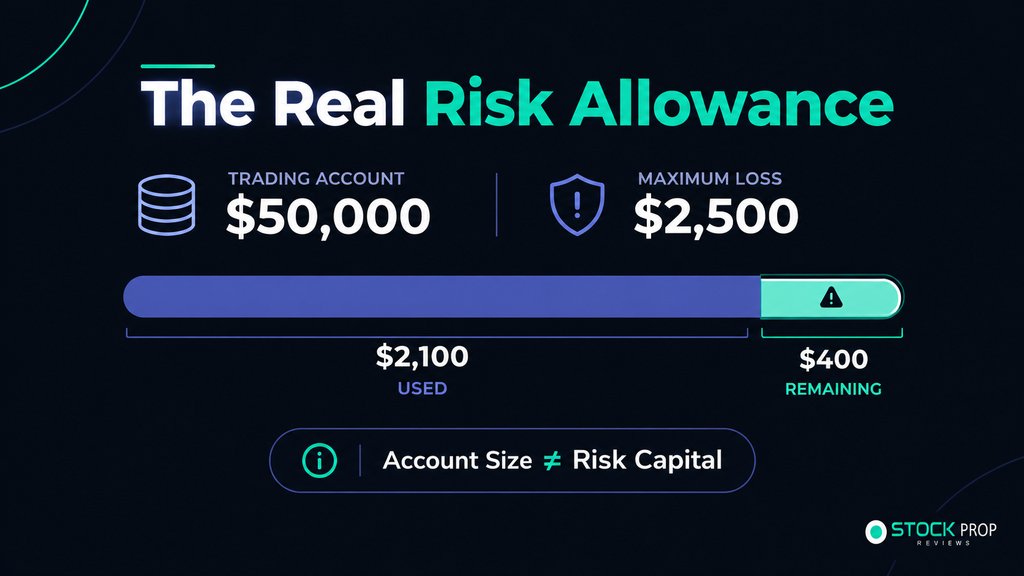
For example, if you have a $50,000 account with a max loss of $2,500, you could incur a $2,500 loss before it is filled. If you lose $2,100, you are just 400 away from blowing your allowance.
A trader might have close to $48,000 in the account and believe he or she has the room to take one more large position. In reality, there is practically no margin for loss. Even a minor move against you (plus commissions or other costs if applicable) could be a violation.
This is why traders need to know if the drawdown is fixed or trailing, if it includes floating losses, and how the daily limits are reset.
Payout conditions can be more complex than expected
Profit splits explain how eligible profits can be split but not when you can withdraw.
Minimum trading days, consistency rules, payout schedule, or other eligibility requirements may be applied to traders depending on the program. Some programs also have rules on first vs. subsequent withdrawals.
For example, a trader may have a profit of $2,000, but a large part of that profit may be in one session. Under a consistency rule, the trader may have to meet other requirements before being paid out.
Consistency requirements are not by nature unfair, but the formula is important. Traders need to ask: what definition of profits is included, is the condition that gets reset between payout cycles, and what aspects of the program does it apply to?
Prohibited trading practices need clear definitions
Companies may limit the ranges, types of copy trading or as a consequence of technical abuse or abusive trading patterns. Policies vary.
Terms such as toxic trading and gambling behavior are open to interpretation unless examples are given. If a strategy is potentially gray, traders should request written clarification and reach any agreement in writing.
An explicit rulebook exists with limited room for wiggle, so don’t assume a strategy must be allowed just because it’s common practice elsewhere.
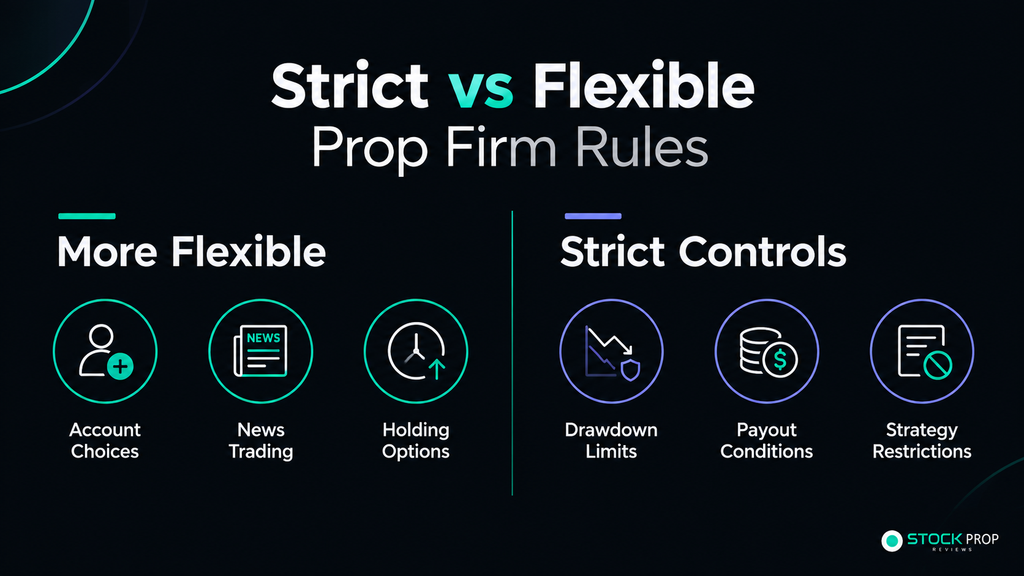
Strict vs Flexible Prop Firm Rules
The table below summarises the main areas traders should compare. These are general examples, not claims that every firm has changed its rules in the same direction.
| Rule area | Potential flexibility | Restrictions to check |
| Evaluation | One-step or two-step options | Targets and deadlines |
| Drawdown | Different risk models | Daily and maximum-loss limits |
| News trading | Permission to trade selected events | Entry and exit windows |
| Holding positions | Overnight or swing-trading options | Weekend and instrument restrictions |
| Payouts | Different withdrawal schedules | Consistency and eligibility conditions |
| Profit split | Alternative split structures | Conditions attached to higher splits |
A programme can be flexible in one category and strict in another. A high profit split does not compensate for a rule that makes your strategy impractical, and fewer evaluation stages do not necessarily mean a lower chance of failure.
What Competitor Comparisons Often Miss
Traders can compare flexible prop firm rules to find programs, but lists of features rarely discuss how rules interrelate in live trading.
First, drawdown rules have to be considered in combination. If one would impose a one-trade limit and strict daily loss limit, it is questionable how much room one really has left for flexibility in a very loose total loss limit.
Second, the severity of the consequences of a violation. Violators may receive at least a warning or restriction or termination of an account or ability to be paid, depending upon contract. These penalties should be known by a trader ahead of time.
Third, it could be the account-specific restrictions. For instance, standard evaluation may differ locally for limits on a funded stage and the firm’s instant funding account. The most liberal program may not be indicative of the firm’s other trades.
Third, third-party reviews can quickly become out-of-date. A program may have been compared fairly some months ago, but it may not be so valid a comparison of that program today.
Also of interest to StockPropReviews readers may be our prop firm reviews, as well as our prop firm comparison and situation marketing vs. reality at the prop firm. As always, check the actual conditions with the firm.
How Traders Fail When Rules Change
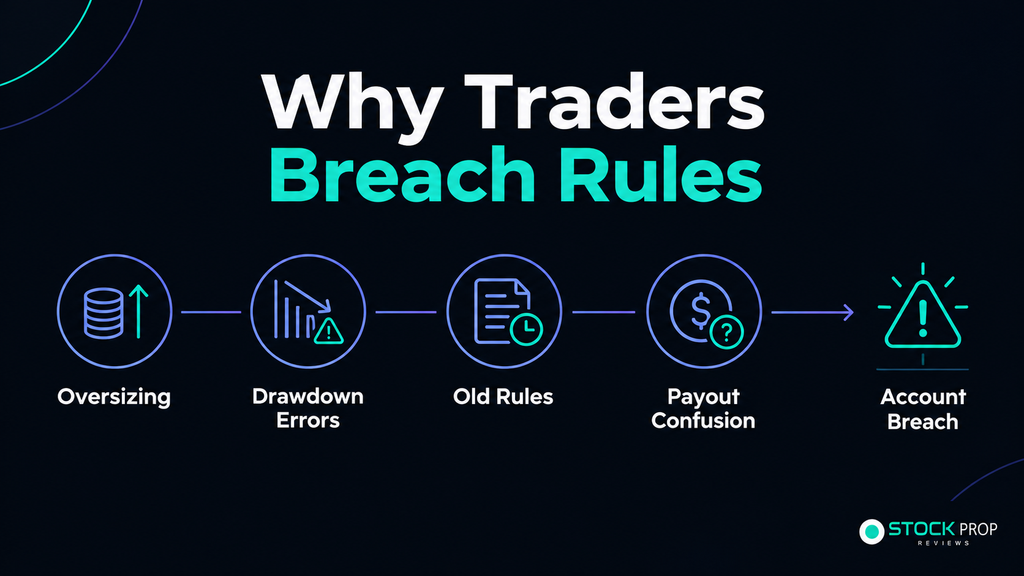
A common mistake is believing that a flexible program allows you to increase risk. By choosing a shorter evaluation period, a trader may be tempted to increase position sizes and deviate from a proven strategy in an effort to make money quickly in the direction of his profit target. This leads to a breach of drawdown before the trader even gets to know whether the strategy is profitable.
Another error is using obsolete data. In the previous program, something may have been allowed, but it is no longer allowed in the upgraded program. Traders who don’t read the policies have exposed themselves to unnecessary problems.
Misinterpretation of payouts is another issue. You become eligible for a withdrawal at a profit target, but other terms also apply.
Before trading, create a simple rule sheet to minimize these risks. Write in your maximum daily loss, your maximum drawdown, your instruments policy, your news policy, and your holding and payout rules. If the firm announces a change, refer to the formal documentation.
How to Choose a Prop Firm When Rules Keep Changing
Don’t concern yourself with fees or profit-split arrangements before you find out whether the account of your choosing is suitable to your strategy.
For scalpers, execution conditions, news trading restrictions, and opening position limits will be of interest. – Weekend and overnight rules for swing traders should also be kept in mind. Futures traders: Contract limits and trailing thresholds.
Know how much you can lose. Look ahead that you can be paid out, that your plan is permitted, and the (total) cost of chasing either (plus a reset or a subscription fee) of entering an account.
Also read the terms at sign-up. If there are changes in company policies, be sure to ask if this applies to existing accounts or only new purchases. .
Should stock traders consider TradeThePool?
If you also trade stocks alongside futures options and currencies, check out stock-specific programs as well. If looking for a stocks-specific program, research the trading rules, risk limits and evaluation requirements of the TradeThePool proprietary stocks trading program.
Check the terms and check the claims of regulation yourself. Just because a trading program is registered or claims to be professional does not mean it is a regulated proprietary trading program.
Readers can get up to 10% discount when purchasing through our TradeThePool link. The discount may reduce the initial cost, but it does not guarantee a successful evaluation or payout.
Will Prop Firms Become More Flexible by 2030?
The direction of the market is still unclear, but there are three things we should be looking out for.
First, companies could continue to offer model-specialized accounts for specific instruments and trading styles. Second, traders may require more explanation on drawdown calculations, who is owed payment and forbidden strategies. Third, firms may adjust terms in response to changing competition and operating costs.
Such changes are not proof that the industry is becoming more uniformly fair or stringent. The real question is whether traders can learn the rules before they pay, implement them in reality and know what they need to do to get paid.
FAQs
1. Will Prop Firms Become More Strict in 2026?
Some programs have hard loss limits and payout expectations, while others offer more flexible evaluation or trading grants. There isn’t a universally applicable rule, so check the terms of your account.
2. What are the first prop firm rules traders should check?
First, check daily drawdown, max drawdown, and floating loss treatment. 2. Look at payout eligibility, consistency rules, news rules, and trading practices allowed.
3. Do loose rules make passing a challenge easier?
Not when it comes down to it. A certain strategy may be more prone to changing the trading permissions slightly, but that doesn’t mean a lower profit target or higher loss allowance.
4. Can prop firm rules be changed after purchase?
It is contingent upon the firm and what’s being changed. Be aware of announcements, keep copies of the relevant rules, and ask about the effect of changes on existing accounts.
5. How do you avoid violating rules unknowingly as a trader?
Be sure to check the rulebook for that account and calculate how much of your drawdown allowance you have remaining. If you’re unsure what is and is not allowed with your strategy, obtain a written confirmation. Don’t depend on outdated reviews or sales materials offered.
Final Assessment
Prop firms are tightening and loosening their trading conditions and risk controls. While more accounts and more trading permissions may be beneficial to traders, the particulars of risk controls and payout conditions will still make or break a program for a strategy.
“Best” does not always equal the smallest set of rules or most lucrative profit split promo. It’s the one offering clarity on its terms, has limits suitable for your style of trading, and spells out its costs and risks ahead of your capital at stake.
If a firm has changed in some way or another, do not assume the change is for better or worse but take a changed set of rules as an opportunity to check the details. Decide in light of your own approach, risk tolerance, and ability to stick with the terms of the program.