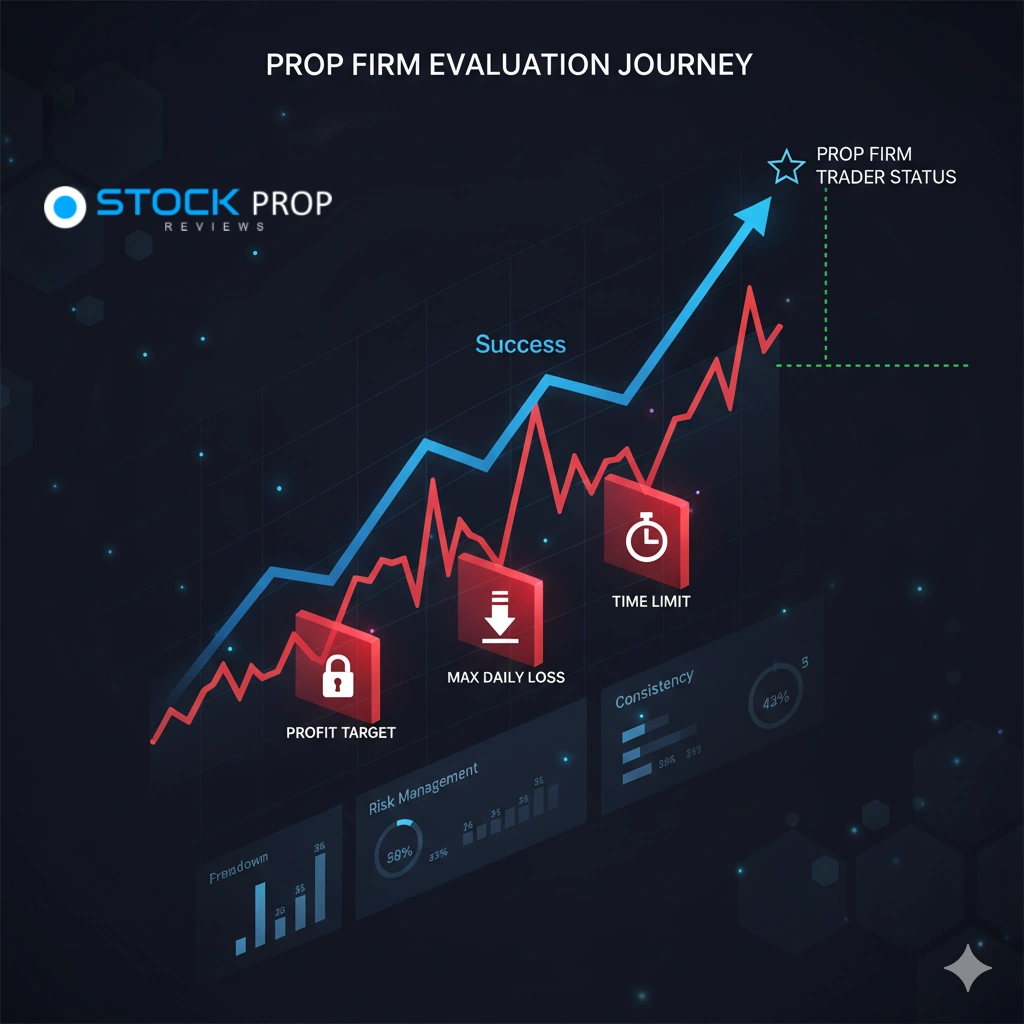
The desire to become a funded trader is the modern gold rush for those passionate about the financial markets. Imagine having access to significant capital—$\$50,000$, $\$100,000$, or even more—without risking your personal savings. This is the compelling promise of the proprietary trading (prop) firm evaluation process. Yet, the path is littered with broken trading plans and failed attempts. Prop trading evaluation process aren’t designed to be easy; they are the ultimate test of a trader’s discipline, risk management, and psychological fortitude. They act as a sophisticated filter, seeking out the rare individuals who treat trading as a professional business, not a gamble.
To navigate this challenge successfully, you need to move beyond simply having a profitable strategy. You need a comprehensive, systematic preparation plan. This article will serve as your blueprint, covering every relevant aspect needed to conquer the evaluation and secure your funded status.
Understanding the Prop Trading Evaluation Process
Before you place your first simulated trade, you must deeply understand the rules—not just to follow them, but to build your strategy around them. The evaluation is a game of adherence, where the rules are more critical than the returns.
The Core Constraints (Your Survival Lines)
Prop firm rules are universally focused on capital preservation. Failing these metrics usually results in an instant termination of the evaluation.
- Maximum Daily Loss (MDL): This is arguably the most critical rule. It’s the maximum amount your account can lose on any single trading day, often calculated based on your starting balance or equity at the start of the day. Your strategy must prioritize staying within this limit above all else. A typical limit might be 5% of the initial capital.
- Maximum Drawdown (MaxDD): This is the total amount the account equity can fall from its highest point. This metric tests your ability to recover from a losing streak and manage risk over a prolonged period. A typical limit is often 8–12%.
- Profit Target: The amount of profit you must achieve, usually expressed as a percentage of the initial account balance (e.g., 8–10%). This is the goal, but it must be pursued conservatively.
- Minimum/Maximum Trading Days: Some firms require a minimum number of days to prove consistency, while others impose a time limit to encourage a reasonable pace.
Understanding these metrics means knowing exactly how much “breathing room” you truly have. If your maximum overall drawdown is 10%, you should design a trading system that aims to lose no more than 6–7% before you stop and reassess, giving yourself an essential safety buffer.
The Trader’s Mindset: Psychological Fortitude
The evaluation process is a high-pressure environment that ruthlessly exposes any psychological weakness. Your edge isn’t just in your chart patterns; it’s in your mental toughness.
Discipline Above All Else
Discipline is the cornerstone of success. A profitable trader with no discipline will fail the evaluation; a moderately profitable trader with iron discipline will pass.
- Patience is Your Friend: The evaluation is not a race. You must be patient enough to wait only for your highest-probability setups. Overtrading out of boredom or a desire to “get ahead” quickly is the fastest way to breach the Daily Loss Limit.
- Accepting Losses: Treat losses not as personal failures, but as a normal, budgeted cost of doing business. If a trade hits your pre-defined Stop Loss, accept it immediately. The moment you deviate and move that stop, you are trading emotionally, and you are setting yourself up to breach the MaxDD.
- Emotional Detachment: You must treat the evaluation as a professional simulation, not a personal bank account. This psychological detachment allows you to make rational decisions when the market moves against you, preventing the disastrous spiral of revenge trading.
Your Trading Blueprint: Strategy and Risk Mastery
Your strategy is the vehicle, but risk management is the fuel and the brakes. A prop firm evaluation tests your ability to drive safely, not just speedily.
Robust Strategy for Consistency
Your system must be optimized for consistency, not massive single-trade returns.
- Favorable R:R (Risk-to-Reward): Your system should target at least a 1:2 or 1:3 R:R ratio. This means for every dollar you risk, you aim to gain two or three dollars. This mathematical edge is vital because it allows you to be profitable even if you only win 40% of the time, providing a buffer against inevitable losing streaks.
- Backtesting and Forward Testing: Before the evaluation, your strategy must be meticulously backtested across various market conditions (ranging, trending, volatile). Crucially, it must then be forward-tested for weeks on a demo account to prove it works in real-time, under your personal execution.
- Defined Entry and Exit: Eliminate ambiguity. Know exactly what conditions trigger a trade (entry) and precisely where you will exit if you’re wrong (Stop Loss) or right (Take Profit).
The Golden Rule of Position Sizing
This is the non-negotiable step that determines whether you pass or fail.
Never risk more than 1% of your account capital on a single trade.
For a $\$100,000$ evaluation with an 5% Daily Loss Limit $(\$5,000)$:
- If you risk $2\%$ per trade, you only need three consecutive losers to wipe out over half your daily allowance.
- If you risk $\mathbf{1\%}$ per trade, you can sustain five consecutive losers before hitting the limit.
By strictly adhering to a $0.5\%$ to $1\%$ risk per trade, you maximize the number of chances you have and minimize the psychological pressure of any single loss. Small, repeatable wins, combined with aggressive loss-cutting, is the funded trader’s formula.
The Practice Ground: Simulating Success
Would a pilot jump into a new aircraft without hours of simulator time? No. You must treat a demo account as a high-fidelity simulation of the funded environment.
The Mock Evaluation Challenge
Set up a demo account with the exact starting balance and rules of your chosen prop firm. Then, commit to a “Mock Evaluation” for 30 days.
- Enforce Rules: If you hit the Daily Loss Limit on the demo, stop trading immediately for the rest of the day, just as the prop firm would. If you breach the MaxDD, consider the challenge failed, review your journal, and start over.
- Trade Like It’s Real Money: This is the hardest part. You must mentally attach the same gravity and seriousness to the demo account as you would to a live, funded account.
Meticulous Journaling
A trading journal is your most powerful self-correction tool. You must record, at a minimum:
| Data Point | Purpose |
| Setup/Conditions | Did the trade meet all system rules? (Crucial for consistency check) |
| Risk Metrics | Size, Max Risk (in $\$$ and %), R:R ratio. |
| Emotional State | How did you feel before, during, and after the trade? (Identifies emotional triggers) |
| Result | Win/Loss amount, time held. |
| Lesson Learned | What could have been better, even on a winning trade? |
Review your journal daily. If you find you broke your rule 60% of the time but still made a profit, you’re not consistent, and you will eventually fail the evaluation when variance turns against you.
Navigating the Evaluation: Execution Tactics
Once you purchase the prop trading evaluation process, the clock is ticking, and the pressure is real. Here’s how to execute with precision:
- Start Slow, Finish Strong: The first week is about establishing consistency and avoiding the Daily Loss Limit. Don’t try to make $50\%$ of the profit target in the first few days. Focus on small, controlled wins. The psychological benefit of a strong, rule-adhering start far outweighs any rushed profits.
- Prioritize Rule Adherence Over Profit: Every decision must pass the “Rule Check” first. If you pass the 30-day evaluation with $8.1\%$ profit and zero rule breaches, you win. If you make $20\%$ profit but breach the Daily Loss Limit once, you lose. The choice is clear.
- Use the Time Limit to Your Advantage: If the evaluation is 60 days long and you hit $5\%$ profit in 15 days, you have 45 days of cushion. Slow down. Trade smaller sizes or even take breaks. Protect your gains and let time satisfy the minimum trading day requirement, rather than risking the excellent position you’ve built.
- Know When to Walk Away: If you suffer two consecutive losses, or if you hit $75\%$ of your Daily Loss Limit, shut down your trading platform immediately. Stepping away is a form of risk management. Trading while frustrated, desperate, or angry guarantees a poor outcome.
Post-Evaluation: What Comes Next?
The evaluation phase is a finite challenge. Whether you pass or fail, the learning continues.
If You Pass: The Real Test Begins
Congratulations! You’ve proven your ability to manage risk. However, the funded account is the real test. Many traders who pass the evaluation fail their first funded account because they relax their discipline.
- Maintain the Discipline: Continue to treat the funded account with the same strict $1\%$ risk rules you used to pass the evaluation.
- Understand Scaling: Prop firms offer scaling plans, which reward consistent profitability by increasing your capital. Your focus must shift to consistency to access these larger accounts, increasing your eventual earning potential.
- Payout Structure: Be aware of the profit split and withdrawal process. Align your risk to ensure you can reach the minimum withdrawal threshold regularly.
If You Fail: Embrace the Setback
A failed evaluation is not a tragedy; it is tuition paid for a valuable lesson.
- Thorough Review: Go back to your trading journal. Identify the exact rule that was breached and the emotional trigger that caused the breach. Was it MaxDD? You likely risked too much per trade. Was it Daily Loss? You likely revenge-traded after an initial loss.
- Refine and Retest: Adjust your strategy or, more likely, your risk management plan. Trade on a demo account until you have proven you can consistently avoid the mistakes that led to the failure.
- Reset with Knowledge: If you choose to attempt a reset, you do so with a deeper, more expensive understanding of the challenge. This is the difference between a failed trader and one who is simply learning.
Conclusion: The Prop Firm Mandate
The journey to a funded trading account is highly demanding, but entirely achievable for the dedicated. Prop firm evaluations are essentially designed to ensure that you are a responsible custodian of capital.
The three pillars of passing any evaluation are clear: Unwavering Discipline, Meticulous Risk Management, and a Psychological Edge.
You must trade your plan, risk $1\%$ or less per trade, and prioritize avoiding the Daily Loss Limit above all else. Do not focus on the profit target; focus on perfect rule adherence. Before committing to a reset or moving to the funded stage, always re-evaluate your partner by checking the latest independent prop firm review data. If you perfect the process, the profits will follow, and the funded status will be yours. The funded account isn’t the finish line; it’s the professional tool you’ve earned through proving your character and commitment to treating trading as a serious, professional business.