The prop firm regulation has implications on the operations of proprietary trading firms, provision of risk, payouts, and service to their clients. Legal obligations, however, differ from prop firm to prop firm. For example, a company that conducts simulated trading challenges may have other rules to adhere to than a broker who enters real-money trades, or an investment firm that manages other people’s money.
This article covers regulation, and how it affects trading opportunities with new traders, experienced traders, forex traders, futures traders and funded traders. It does not constitute legal advice for any particular jurisdiction.
And brief: no kind of trading model and no client protection of a firm. These three things should always be an element of consideration when executing a trading evaluation funding.
Quick Verdict: Does Regulation Make Prop Trading Safer?
Regulation can be a way to offer consumer protection and the potential of information and recourse for those consumers if a company were under the right regulatory regime. This can include licensing, disclosures, financial controls, and formal complaint procedures depending on the activity and jurisdiction.
However, regulation is no guarantee of payouts, waivers of evaluation fees, or that all prop firms are safe. Rather, some have imitated trading products without protections, like regulated brokerage accounts.
| Area | Potential impact | What traders should check |
| Legal status | Licensing may be required for certain activities | Company identity and regulatory permissions |
| Drawdown rules | Applicable requirements may improve disclosures | Daily, trailing, and maximum loss limits |
| Profit splits | Contract terms determine reward eligibility | Calculation methods and deductions |
| Risk management | Firms may strengthen monitoring | Breach conditions and prohibited strategies |
| Customer protection | Certain legal safeguards may apply | Complaints process and jurisdiction |
These are possible effects, not universal legal obligations. Requirements depend on the firm’s activities, location, and customer arrangements.
What Does Prop Firm Regulation Mean?
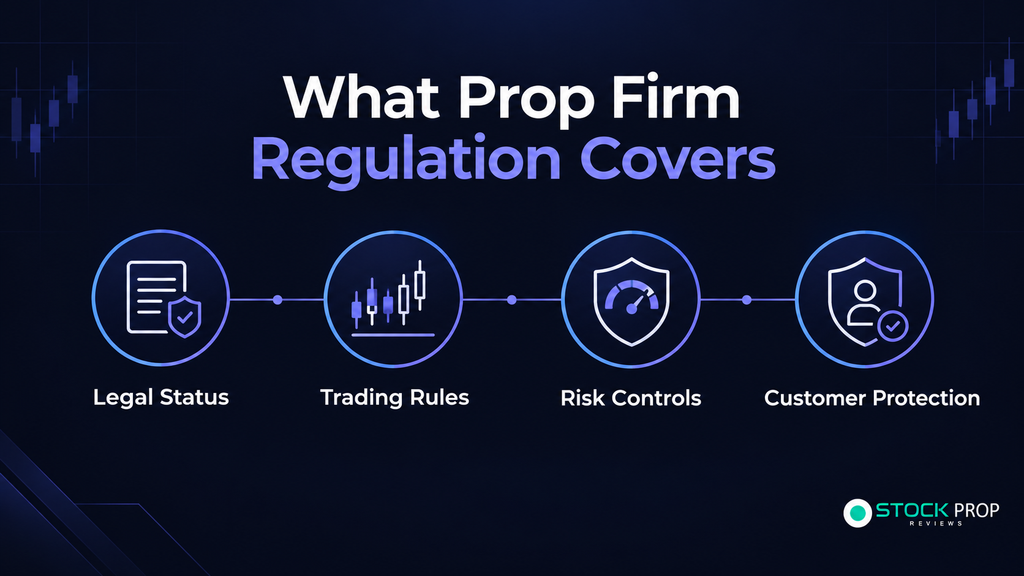
Proprietary (prop) firm regulation is the body of laws to be followed by a proprietary trading company. The regulations depend on the type of firm, the financial instruments it trades, and the jurisdiction in which it operates.
Classic prop firms trade with the firm’s own money. Publicly-facing prop firms may also sell assessments, simulation accounts, performance evaluations and rewards by contract.
They are not always equivalent to brokerage services.
For example, a provider running a simulated forex challenge may be regulated very differently than a broker that executes customer-order CFDs. If a firm is holding client money, there may be other requirements depending on that business model.
In March 2024 the Financial Services and Markets Authority (FSMA) of Belgium issued a consumer warning regarding paid challenge-based and simulated trading by prop trading schemes. The warning included financial risks of multiple attempts at the assessments and stressed dangers of reckless trading.
Lesson: Regulators can focus beyond how much the firm continues to refer to themselves as being a proprietary trader and check out the business model and the risks.
How Regulation Differs Across Prop Firm Models
Forex and CFD prop firms
Check what regulatory status the crypto-exchange platform is, because it will vary: is the crypto-exchange platform trading, acting as a broker, trading as principal, or simulating?
The UK’s Financial Conduct Authority (FCA) has a service for verifying whether a firm is authorized or licensed to provide the services it offers.
Because a prop firm is associated with a regulated broker does not mean that the prop firm is authorized. Traders should check the legal entity of a program and the scope of any claimed license.
Futures prop firms
Futures and other covered activities conducted by some businesses and persons in the United States may require registration with the Commodity Futures Trading Commission (“CFTC”) or the National Futures Association (“NFA”) and may be subject to their regulations.
Not all registrations applicable to a futures intermediary automatically apply to a provider of a simulated futures evaluation.
Refer to the NFA’s BASIC database for any registration and disciplinary information. They should also be aware of position limits, drawdown calculations, and contract limits.
Stock prop firms
Programs based on stock can include actual stock trading with company funds, simulated stock trading, or rewards for performance. Different arrangements may have different legal implications.
Traders need to know whether they are purchasing a program or contract to trade or a service involving regulated securities activity.
The regulatory status of a firm does not depend on the asset classes involved.
How Regulation Can Change the Prop Trading Industry
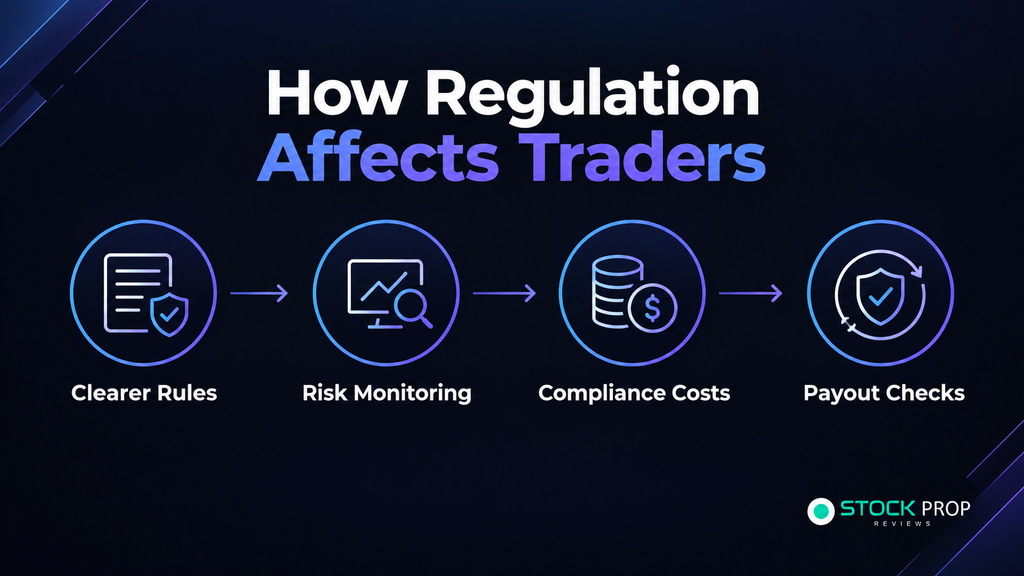
1. Greater transparency around trading rules
Some benefits of regulating applicable fees, payout requirements, and trading restrictions and eligibility criteria could include better disclosure of some of these things.
For example, consider a trader who purchases a $10,000 evaluation, reaches the profit target, but breaches the daily loss limit when a position moves against them.
If the firm clearly explains the method of calculating daily losses, the trader can evaluate the risk before purchasing. If the calculation is not clear or difficult to find, the trader might have trouble trying to determine whether the breach was correctly applied.
Clear rules are only as good as traders understanding them prior to payment and the firm’s consistent application of the same.
2. Stronger risk management
Firms may be able to tighten KYC, transaction monitoring, exposure limits, and the documenting of breaches to rules as legal structures and firm expectations evolve.
Such measures may lead to more consistency and may also lead to stricter eligibility testing or tighter monitoring of trading patterns.
If the program prevents a trader from using crazy entries or a correlated position, that trader could be restricted from such. The important question is whether the restriction was disclosed and agreed.
3. Higher operating costs
Compliance may involve legal advice, record-keeping, technology, reporting systems, and staff training. Such costs can be harder to bear for smaller firms.
Some providers may increase the charges for challenges, offer fewer programs, limit their use in some countries or exit some markets.
This is possible but by no means certain. However, the departure of untrustworthy operators can be beneficial to traders, but from this traders can be left with fewer options. More expensive doesn’t always mean better protection.
4. Changes to payouts and eligibility
Identity verification, sanctions screening, and payment provider requirements could dictate who can participate (and when and how rewards are later processed).
For instance, if a trader does not supply payment information that matches their verified identities, then a payment could be delayed, or a loss of eligibility could result. Or the trader may be from a restricted country or region the provider cannot service.
Such vetting isn’t always indicative of wrongdoing. Check eligibility on how to withdraw money (for their country of residence) and verification to withdraw money and before purchasing an evaluation portion.
What Competitors Often Miss About Prop Firm Regulation
Compliance is not the same as authorisation
A financial-services licence is not required for a company’s internal risk controls and identity checks. Such practices do not imply that a regulator licenses all of its business.
Similarly, a regulated affiliate does not guarantee that all services offered under the same brand are regulated as well.
Traders should check the legal entity, its listing in the register of the regulator, and which activities it is permitted to perform.
Simulated accounts are not cash deposits
Just because the paper account value lists $100,000 in the money account doesn’t mean the trader has that sort of cash in his pocket to withdraw. The trader can be instantly liable for fees related to the evaluation, resets, and other terms of contracts.
Rewards may be limited by program terms.
However, simulated trading is not illegal per se, although the size of the account being advertised might not be interpreted as the actual amount deposited, a brokerage account, or guaranteed capital.
Certification is not government regulation
Certification should have some voluntary industry norms on transparent rules, payout policies, and risk controls. However, a certification is not a substitute for a government license.
Traders should investigate the certifying organization, the specific company named, the scope of the assessment, and the dispute-settlement mechanism.
.
How Regulation Affects Real Trading Scenarios
Payout disputes:
A trader breaks a rule and is refused a withdrawal. The trader should have a copy of the trade logs, the contract, the version of the relevant rule and the company’s explanation. A regulatory license does not guarantee a good outcome.
Rule changes:
In purchasing a challenge, a trader has overnight gained a new holding limit for the firm. Whether such a change is legal depends on the rule, how the amendment is communicated at the time of the purchase, and then applicable law. Traders should keep copies of the rules as they existed at the time.
Country restrictions:
This may be due to legal restrictions, sanctions, or blocked payments preventing the provider from accepting people from your country. Just because you can access the site doesn’t mean you qualify. Traders should confirm residency and payout requirements prior to making payment.
These examples show why legal status matters, but also why traders must read the actual agreement.
How to Check a Prop Firm’s Regulatory Status
Use this checklist before purchasing an evaluation:
- Identify the legal entity. Find the operator’s name in the terms and conditions.
- Check the official regulator register. Confirm the company’s permissions cover the advertised activity.
- Understand the trading model. Determine whether trades are simulated, executed live, or handled through a separate broker.
- Review payment terms. Check evaluation fees, resets, refunds, payout eligibility, and account termination conditions.
- Verify certification claims. Confirm whether a claim relates to government authorisation or voluntary industry standards.
- Keep records. Save the rules, payment confirmation, trading history, and payout correspondence.
Ask a precise question: regulated by whom, under which legal entity, for which activity, and in which jurisdiction?
Common Mistakes Traders Make
One is confusing a very large marketed account with like funds within the firm for payout. Another is confusing photo KYC checks for regulation.
Traders also lose out in terms of drawdown mechanics. They’re going to find out their generous profit split is not so attractive the instant their strategy bumps into trailing drawdown rules. These limitations need to be known whether it is regulated.
Finally, rebuying challenges if you do not succeed can turn a trivial cost into an abominable money problem. Set a limit for how much you spend and don’t think of buying another as a sure way of getting your money back.
Alternatives to Consider
| Trading model | Best suited for | Main limitation |
| Evaluation-based prop firm | Traders comfortable with targets and loss limits | Evaluation and reset fees |
| Futures funding programme | Traders familiar with futures contracts | Contract and drawdown restrictions |
| Regulated brokerage account | Traders who want to trade through an appropriately authorised broker using their own funds | Personal capital is at risk |
These are different business models, not endorsements of specific providers.
Is TradeThePool Worth Considering?
TradeThePool may interest traders looking for stock-focused evaluation programmes with defined trading rules and risk limits. However, regulatory claims need to be precise.
Its published terms describe simulated trading activity and identify Five Percent Online Ltd. as the operator. The terms also distinguish the programme from regulated financial-institution or custodial services.
Traders should not assume TradeThePool is a government-regulated stock prop firm without independently verifying the relevant authorisation.
Readers can get up to 10% discount when purchasing through our TradeThePool link, subject to the applicable offer terms.
For further research, read our FTMO review, Funding Pips review, instant funding vs evaluation-based funding comparison, and hidden incentive problem in prop firms article. Link these partial anchors to the corresponding published StockPropReviews pages before publication.
FAQs
Are prop trading firms regulated?
Depending on the activities in the jurisdictions, some are regulated as financial services. Others offer mock assessments, which may be treated differently: Consider the real legal entity and its authorizations.
Does regulation guarantee prop firm payouts?
No. Regulation does not guarantee payments or eliminate disputes. Payout eligibility depends on the agreement and applicable law.
How can I check whether a prop firm is regulated?
Search the relevant regulator’s official register using the company’s legal name. Confirm that its authorisation covers the service being offered.
Will stricter regulation make prop trading more expensive?
It could. Compliance costs may lead some firms to increase fees, change programmes, or restrict access to certain markets. The effects will vary.
Is a certified prop firm the same as a regulated prop firm?
No. Certification is testing against standards; government approval is a different legal position. Check both independently.
Final Assessment
Prop firms’ regulation may change the liability, disclosure, clients’ eligibility, and dispute settlement. Its utility depends on the legal framework and the activities of a company.
For traders, key considerations include who operates the company, the status of its own trading program, rules for collecting fees and making payouts, and the protections available in their jurisdiction. Looking at these factors before purchasing an evaluation will not make it risk-free, but it will prevent the trader from making unnecessarily stupid moves in an industry where the claimed account size is only part of the story.