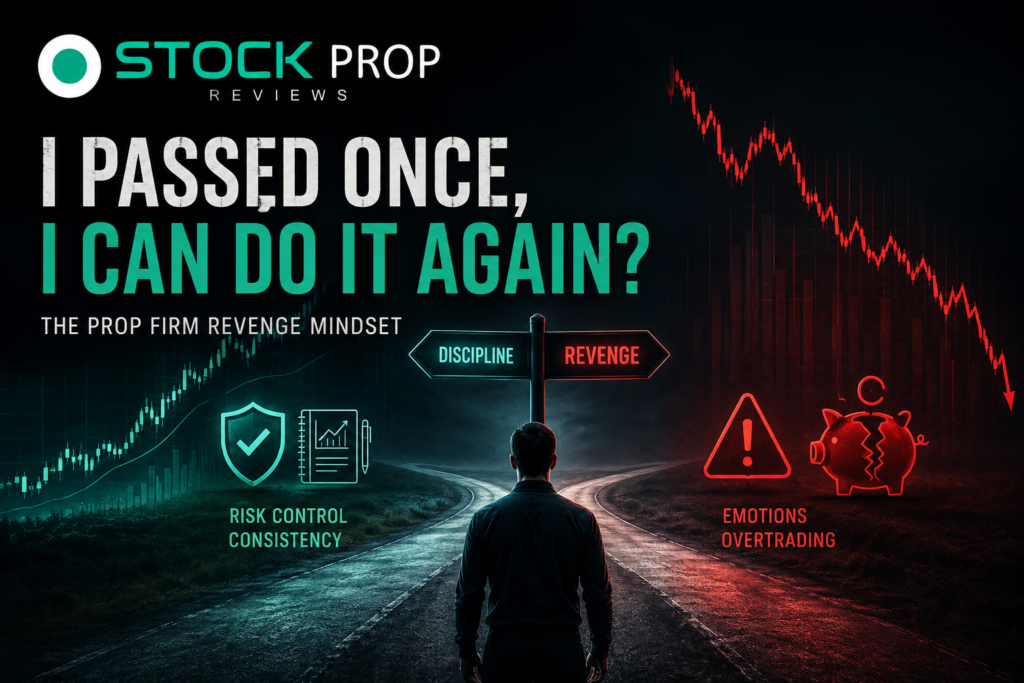
Passing a prop firm challenge is like proof that you have things figured out.
This is why losing a funded account can be such a shock.
What often follows is a dangerous line of thinking: I got away with it once, so I’ll do it again.
That sounds reasonable at face value. After all, you’ve proven you can hit the targets and play by the rules. But traders who have been around prop firms for a while now know that passing a challenge and maintaining a funded account are two very different skills.
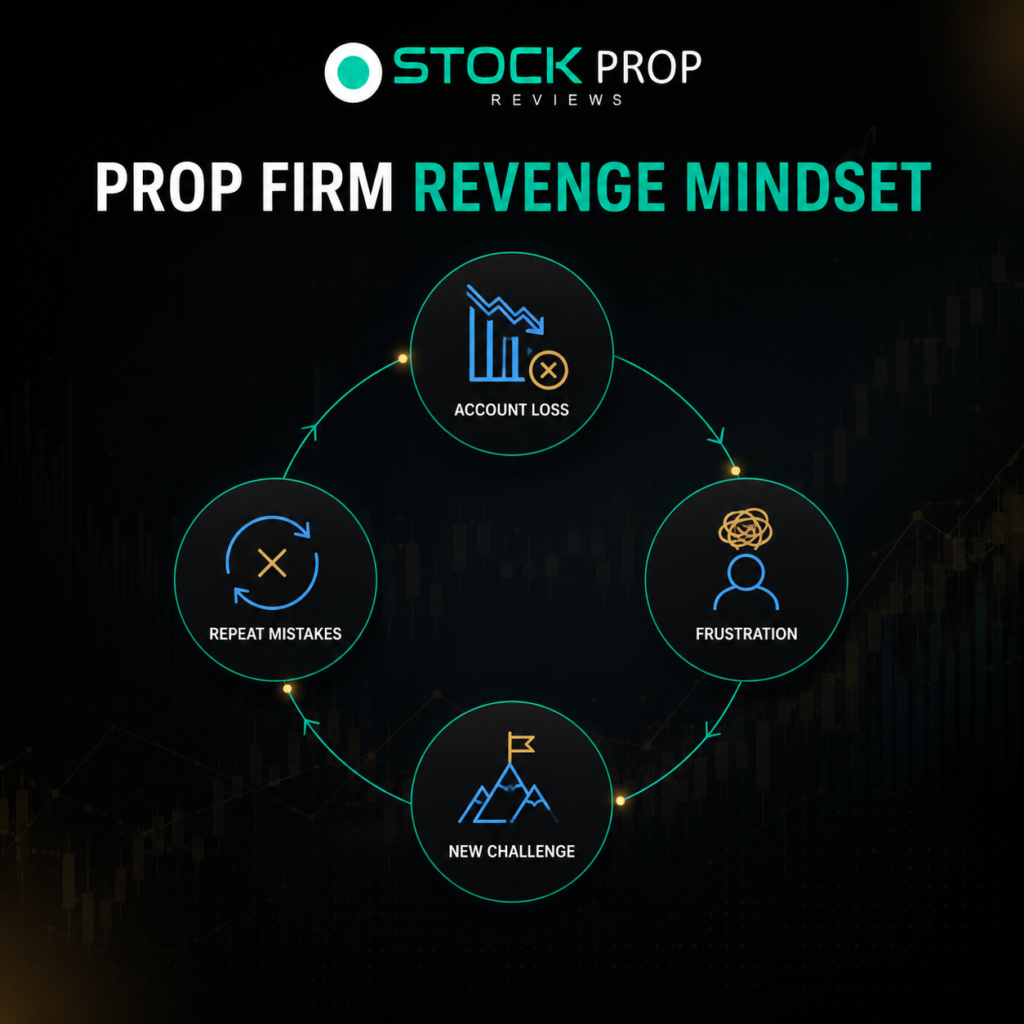
This is where the revenge mindset of the prop firm starts to kick in.
Many traders instead of looking very closely into why the account was lost, become focused on getting back to funded status as fast as they can. The objective shifts from making money to recovering losses. The irony is that this urgency is often what leads to another failure.
This article is for traders who have already passed at least one challenge and are thinking of trying again after losing funding. The lessons here may be useful for those still learning the basics of risk management, but the problem discussed is far more common among traders who have already enjoyed some success.
What Is the Prop Firm Revenge Mindset?
The prop firm revenge mindset occurs when a trader treats a failed funded account as something that must be immediately recovered.
Instead of objectively reviewing mistakes, the trader focuses on getting back to where they were as quickly as possible.
A common thought process looks like this:
- I already passed once.
- Losing the account was bad luck.
- I know exactly what to do.
- I’ll just buy another challenge.
- I’ll be funded again within a few weeks.
At first glance, this sounds reasonable.
The problem is that the emotional need to recover often replaces the discipline required to trade properly.
The trader is no longer focused on execution quality. They are focused on restoring their previous status.
Why Losing a Funded Account Feels Different
Most traders expect frustration when they fail a challenge.
What they don’t expect is how much worse it feels to lose an account after they’ve already been funded.
A failed challenge can be written off as part of the learning process. A lost funded account feels different because there is usually a sense that something valuable was already within reach.
Maybe there was a payout coming. Maybe the account had months of progress behind it. Maybe the trader had started to view themselves as someone who had finally “made it.”
When that disappears, the emotional response is often stronger than people expect.
That emotional reaction is where poor decisions tend to begin.
Passing a Challenge Doesn’t Mean What Most Traders Think It Means
One mistake I see repeatedly is traders treating a successful challenge as proof that they’ve permanently solved trading.
In reality, a challenge only proves that a trader met specific objectives during a particular period.
Sometimes that result comes from a genuinely robust trading process.
Sometimes it comes from a favorable market environment.
And sometimes, if we’re being honest, it comes from a hot streak that would be difficult to repeat consistently.
The uncomfortable truth is that many traders don’t know which category they belong to.
That uncertainty often stays hidden until the funded account is lost.
The Conversation Traders Have With Themselves
After an account breach, the internal dialogue is usually predictable.
The trader remembers passing the challenge.
They remember profitable weeks.
They remember payouts or near-payouts.
What they don’t spend enough time examining is the exact sequence of decisions that led to the account loss.
Instead, the focus becomes the next challenge.
I’ve spoken with traders who purchased another evaluation within hours of losing funding. In their minds, the solution was simple: get funded again and everything goes back to normal.
The problem is that nothing has actually been fixed.
The behavior that caused the failure is still there.
What Most Articles Miss About Repeat Challenge Attempts
There is a lot of content about passing challenges in the prop firm industry.
Not much is said about what happens when traders lose accounts.
And that’s where the more interesting story begins.
Most traders don’t blow up because they suddenly forgot how to trade.
They fail because their relationship with risk changes in nature.
Risk is usually managed in evaluations. Every mistake has consequences, traders know that.
Confidence comes with funding. Position sizes increase a little. Rules begin to seem less constraining. Suddenly a setup that could have been missed during challenge looks tradable.
None of the decisions seem important in itself.
Together they can completely overhaul account performance.
When an account is lost a trader will often blame a few bad trades, when the problem was a gradual shift in discipline.
The Difference Between Confidence and Revenge
It is good to have confidence.
It’s what every successful trader must have.
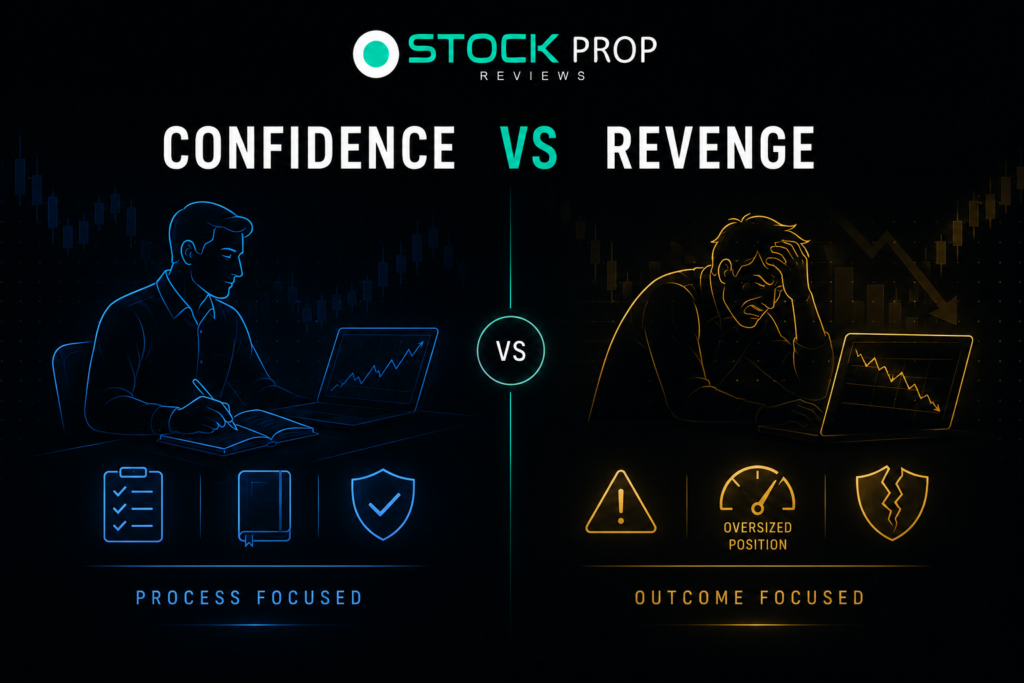
The trouble begins when confidence is tied to a need to recover.
The confident trader says:
“I made mistakes. I’ll find them and fix them.
Says a revenge-minded trader:
Need another funded account ASAP.
That difference, while small, changes decision making dramatically
One perspective is process-oriented.
The other is on results.
Markets punish traders who become obsessed with outcomes.
Why The Second Challenge Often Feels Harder
Many traders expect the second challenge to be easier because they have already done it once.
The opposite is often true.
The first challenge comes with excitement and possibility.
The second challenge comes with expectations.
Now there’s something to recover.
Now there’s pressure.
Every losing trade feels connected to the previous account loss. Every missed opportunity feels more significant than it should.
The challenge itself hasn’t changed.
The psychological baggage has.
A Better Response After Losing Funding
The best traders I’ve seen rarely jump into another evaluation.
Instead they spend time understanding what exactly happened.
The conclusion is sometimes surprising.
The problem was not strategy.”
The issue wasn’t the market.
The problem wasn’t the prop firm.
The problem was a series of small decisions which gradually increased risk exposure until a normal losing streak became an account-ending event.
That kind of insight is valuable because it gives traders something they can sink their teeth into.”
Another challenge without that review process is often just another attempt to repeat history.
Where Firm Selection Still Matters
Psychology is usually the biggest factor in repeat failures, but firm structure matters too.
Clear risk parameters and transparent rules make it easier to identify whether a problem comes from trading performance or from misunderstanding firm requirements.
This is one reason some traders explore regulated stock-focused firms such as TradeThePool. The rules are generally straightforward, which can make self-assessment easier after a losing period.
Readers can get up to 10% discount when purchasing through our TradeThePool link.
That shouldn’t be the reason to choose any firm. Understanding the rules and whether they fit your trading style matters far more than a discount.
The Real Lesson Most Traders Learn Too Late
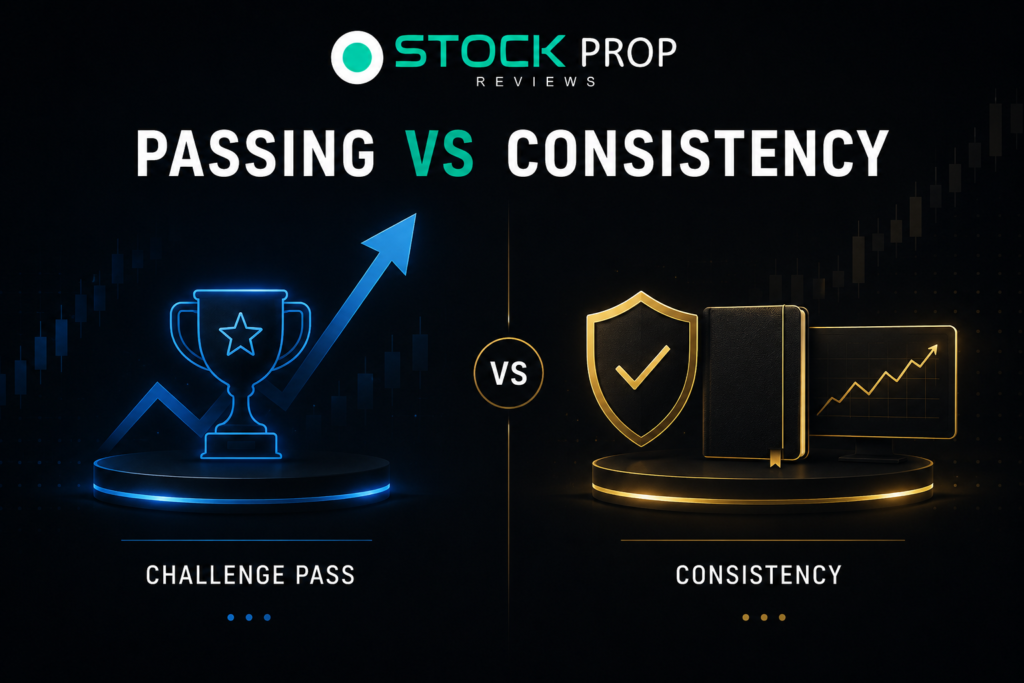
Passing a challenge once is evidence of capability.
It is not evidence of consistency.
Those are different things.
The traders who survive longest in the prop firm space are usually not the ones who passed the fastest. They’re the ones who treat every account, funded or not, with the same respect for risk.
Losing a funded account doesn’t automatically mean you’re a bad trader.
But assuming another challenge will be easy simply because you’ve done it before is one of the quickest ways to repeat the same mistake.
FAQs
What is the prop firm revenge mindset?
It is the urge to immediately recover a lost funded account by jumping into another challenge without fully reviewing what caused the failure.
Why do traders often fail after getting funded?
Many become less disciplined after funding. Risk increases, rules become easier to ignore, and emotional decisions start replacing structured execution.
Is passing a challenge proof of trading consistency?
Not necessarily. It proves you met specific objectives during a certain period. Long-term consistency requires much more than a successful evaluation.
Should traders take another challenge immediately after losing funding?
In most cases, reviewing the failed account first is a better decision. Understanding why the account was lost can prevent the same outcome from happening again.
Can traders recover after losing a funded account?
Yes. Many successful traders have lost funded accounts. The difference is that they use the experience to improve their process rather than rushing into another attempt.