
If you want to find the best prop firms for forex traders, you’re probably trying to figure out how to grow your business without putting your own money at risk.
If you’re a forex trader and want to get money without switching markets, this guide is for you. It looks at how these companies really work, not just what they say they do.
It is for people who trade:
- You can trade pairs like EURUSD, GBPJPY, and XAUUSD.
- Know what drawdown and risk mean
- Want to compare companies based on real-life situations
It is not for people who are just starting out or who expect to make money right away.
Most comparison articles list companies but don’t tell the whole story. Most of the time, traders don’t fail because of the company. They fail because their plan doesn’t work when the rules are strict. That’s what we’ll be talking about here.
What Forex Prop Firms Really Offer
A forex prop firm gives you access to a larger account, but under strict limits. These limits change how you trade.
Two things matter more than anything else:
- Drawdown structure
- Daily loss limits
Profit splits and payouts look attractive, but they are secondary if your strategy cannot survive the rules.
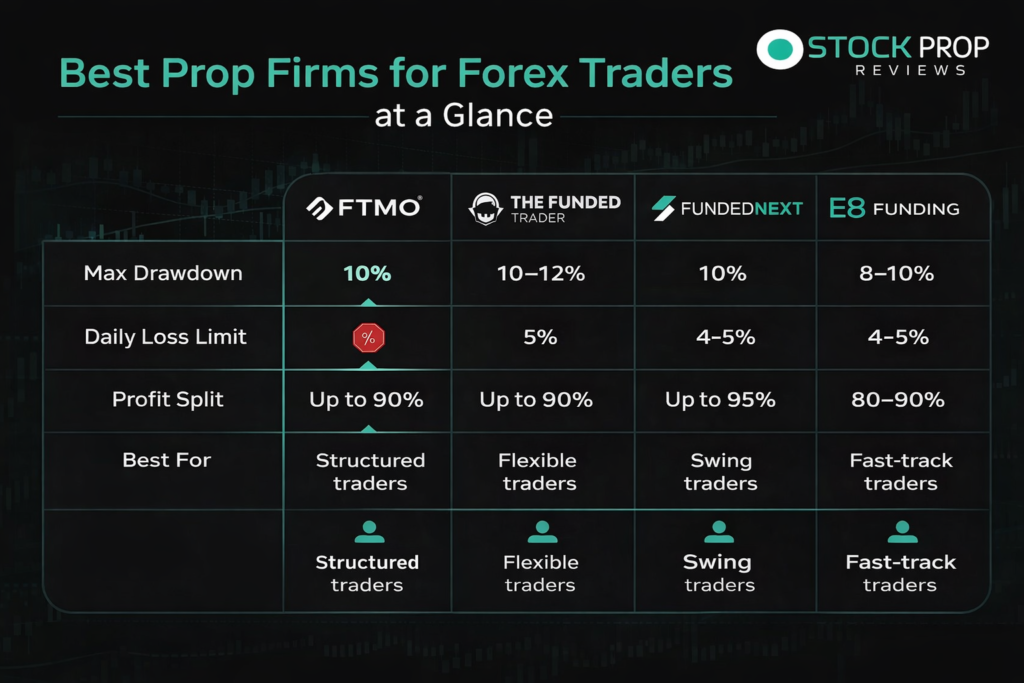
Comparison Table: Prop Firms for Forex Traders
| Firm | Model | Max Drawdown | Daily Loss | Profit Split | Best Fit |
| FTMO | Two-step | 10% | 5% | Up to 90% | Structured traders |
| The Funded Trader | Multi-model | 10–12% | 4–5% | Up to 90% | Flexible traders |
| FundedNext | Two-step / Express | 10% | 5% | Up to 95% | Swing traders |
| E8 Funding | One-step / Two-step | 8–10% | 4–5% | 80–90% | Fast-track traders |
This table looks simple, but the differences show up when you actually trade.
FTMO for Forex Traders
Quick take
FTMO is not the easiest firm, but it is one of the most consistent in how it operates. The rules are strict, but they are predictable.
How the rules affect trading
The 5 percent daily loss limit is where most traders struggle. It forces you to think in terms of damage control rather than opportunity.
A common situation:
You take two losing trades early in the session. You are down 3 percent. Now every decision becomes emotional. You either stop trading and miss setups, or push harder and risk breaching the limit.
This is where many accounts fail.
What is often overlooked
FTMO rewards traders who can slow down. If your edge depends on frequent trades or aggressive recovery, it becomes difficult to sustain.
Who should avoid it
This is not the place to try new things if you are still working on your strategy. The evaluation phase is not a place to test things.
Alternatives
The Funded Trader offers more flexibility. FundedNext gives slightly more breathing room for holding trades.
The Funded Trader for Flexible Forex Strategies
Quick take
TFT is better for traders who hold positions for longer periods of time, but it isn’t as easy as it seems.
How it plays out in real trading
More models mean more choices. Traders often change their strategy in the middle of a challenge. One day they scalp, and the next day they swing. That lack of consistency is what usually causes failure.
Another problem is how to do it. Forex scalpers, in particular, pay close attention to small changes in spreads and fills. In a prop environment, these details are more important than in a personal account.
What competitors miss
Flexibility does not fix discipline problems. It amplifies them.
Who should avoid it
This is not the place to try new things if you are still working on your strategy. The evaluation phase is not a place to test things.
Alternatives
FTMO for structure. E8 Funding if you want a faster evaluation path.
FundedNext for Swing Forex Traders
Quick take
FundedNext works better for traders who hold positions longer, but it is not as relaxed as it looks.
The real challenge
Drawdown spikes are often not taken seriously by swing traders. A strong setup can still go against you before it works.
For example:
You make a GBPUSD trade based on the structure of a longer time frame. The setup is good, but the price drops by 2 to 3 percent first. That alone could get you close to the daily loss limit.
So the problem isn’t analysis. It is being tolerant.
What matters here
You need to size positions smaller than you would on a personal account. Many traders fail because they do not adjust.
Who should avoid it
If you use wide stop losses or trades with a lot of confidence, the rules will not work with your method.
Alternatives
FTMO for tighter control. E8 for shorter holding periods.
E8 Funding for Fast Evaluations
Quick take
E8 is made to be fast. That draws in traders, but it also puts pressure on them.
What actually happens
Traders push harder to get through quickly. Risk goes up, discipline goes down, and decisions are made on the spot.
Some people pass the test in a few days, but then have trouble once they get the money because they can’t keep the same level of risk safely.
What is rarely explained
Fast models reward short-term performance, not long-term consistency.
Who should avoid it
If you do not already have strict risk rules, this model will expose that quickly.
Alternatives
FTMO for long-term consistency. The Funded Trader for more flexibility in approach.
Strategy Fit Matters More Than Firm Choice
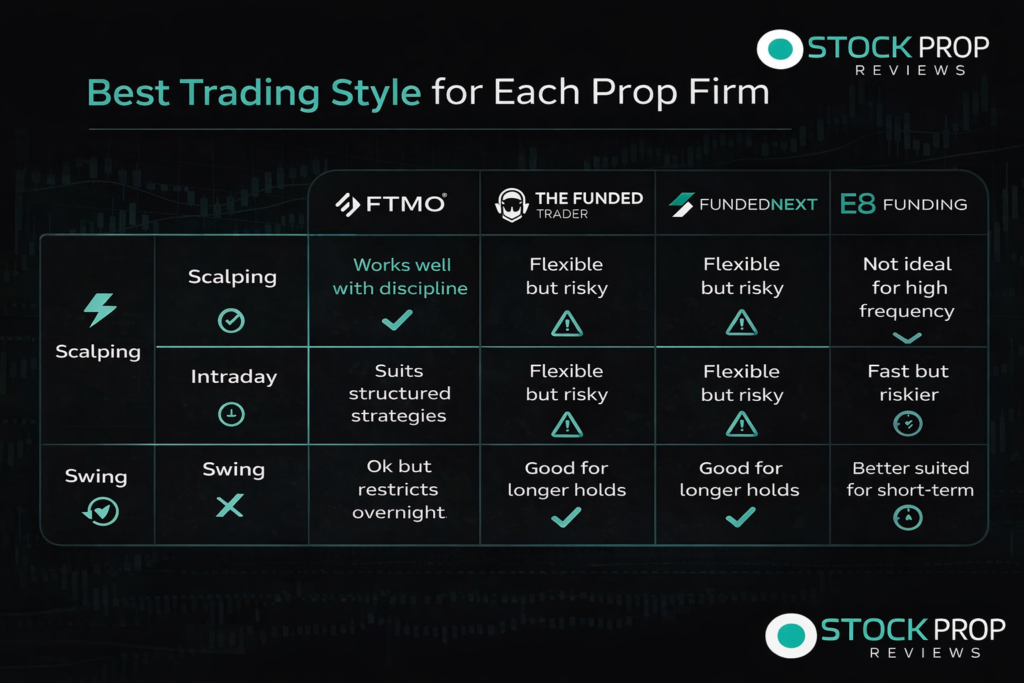
Scalping
Scalpers tend to look for flexible firms, but the real issue is execution and cost.
Even small spread differences can turn a profitable system into a losing one. Daily loss limits also reduce your ability to recover from a bad session.
The Funded Trader and E8 are common choices, but they still require strict control.
Intraday trading
This is where most traders sit. Firms like FTMO and FundedNext work well here because the rules align better with session-based trading.
The main risk is overtrading after losses.
Swing trading
Swing traders have a different issue. It is not how often it happens, but how much it changes.
Holding trades overnight can cause changes that can hit drawdown limits even when the setup is good
What Other Sites Do Not Explain Clearly
Most articles focus on features. Traders experience something different.
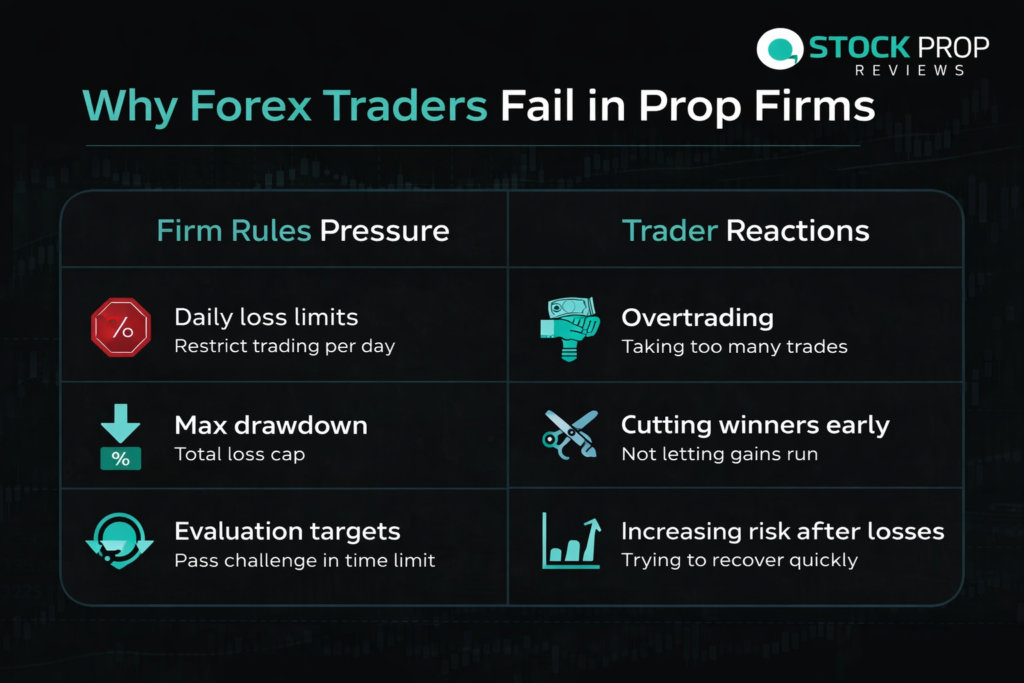
Drawdown is the real constraint
If you can’t stay within a 10% drawdown, a 90% profit split doesn’t matter.
Daily limits change behavior
Instead of following their system, traders start to protect their account. That makes people hesitate, leave early, and have to trade.
Passing is not the same as sustaining
Some traders get through tough times by taking on more risk for a short time. That method doesn’t work very often after the account is funded.
Common Mistakes Forex Traders Make
There is a pattern that keeps coming up.
Traders change things too much.
After a loss, they change the size of their positions. They make changes to entries. They change the time frames. They don’t stick to a plan; they just react to what happens.
Another problem is going after payouts. Traders often lose focus on execution when they start thinking about withdrawals. That change alone can make things less consistent.
A More Practical Way to Choose a Firm
Don’t ask which company is best; instead, ask
- if my plan can handle a daily loss limit of 5%.
- Is it possible for me to keep my losses to less than 10% over time?
- Do I trade enough to reach my goals without having to make trades?
If the answer is no, the problem is not with the company.
A Note on TradeThePool
This article is mostly about forex, but it’s also important to know how structure is different in different prop models.
TradeThePool is a regulated stock prop firm with clear rules and risk limits that are easy to see. Some traders find it easier to deal with this than with forex CFD environments.
When readers buy through our TradeThePool link, they can save up to 10%.
This isn’t about changing markets. It’s about knowing that how clear the rules are is often more important than the asset you trade.
Best Choices Based on Trading Style
FTMO is usually the safest choice if you like things to be organised and consistent.
The Funded Trader can work if you want to be able to change things up and are sure of your system.
FundedNext is a better fit if you trade over longer timeframes, but you need to change your risk.
E8 is faster, but it has a higher failure rate, so it’s not the best choice if you want speed.
Final Perspective
There is no one best prop firm for forex traders.
Every company has its own set of pressures and its own way of doing things. The most important thing is not to look for the easiest problem. It is about finding a structure that works with how you already trade.
If your system needs freedom, strict rules will break it.
Strict rules can help if your system relies on discipline.
This is something that most traders learn after failing one or two times. Before you start, it’s better to know what it is.
FAQs
What is the best prop firm for forex traders?
People often like FTMO better because of how it is set up, but the best choice for you depends on how you trade and how much risk you are willing to take.
Do you trust forex prop firms?
Some are, but not all of them are. It’s more important to know about payout history and rule transparency than to believe marketing claims.
Can beginners do well with prop firms?
It could happen, but it’s not likely. Most beginners have a hard time with managing risk and being consistent.
What is the main reason traders fail?
The main reasons are inconsistent risk and making emotional decisions when the market is going down.
Is it better to split the profits more?
Not all the time. You might not get to the point where profit split matters if the rules are too strict.