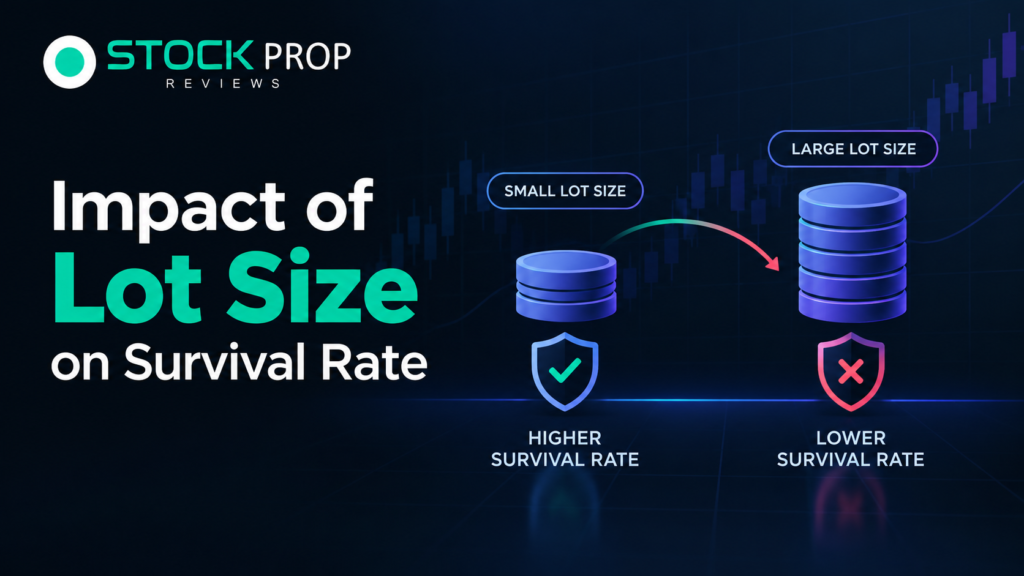
Lot size risk is one of the easiest things in trading to calculate and one of the easiest to get wrong . A larger position means that each price change has a greater effect on your account. If the stop loss is the same, increasing the lot size increases the dollar loss almost in direct proportion.
This is even more important in a prop firm account. A trader may have a $100,000 account on paper but the real risk budget could be only a fraction of that due to daily loss and max drawdown rules.
This article is for forex traders, funded traders and beginners wanting to learn about position sizing and account survival. There is not a universal number so the point is not to find a “correct” lot size for each account but to devise a method that suits you. The right size is determined by account equity, stop distance, pip value, risk tolerance and the firm’s drawdown rules.
What is lot size risk?
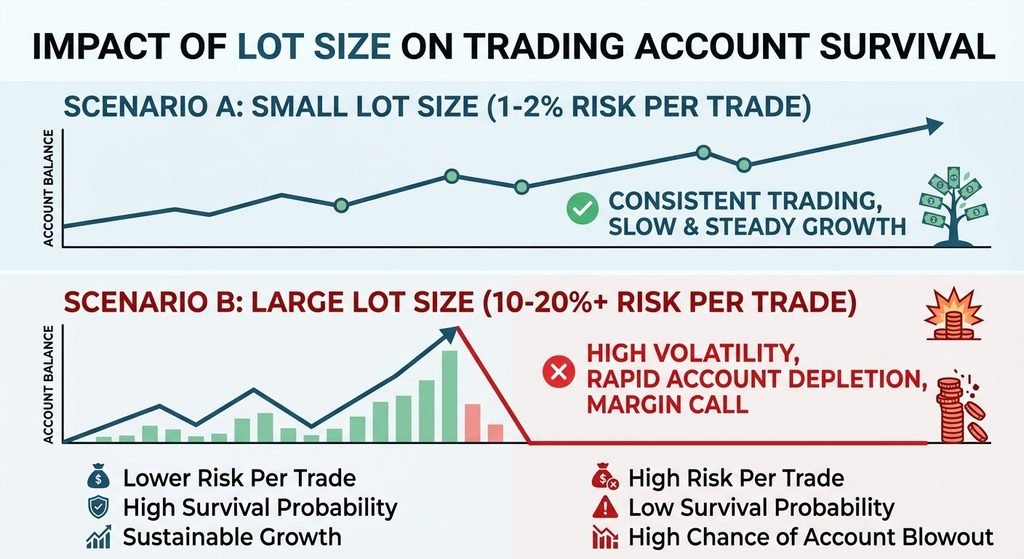
Lot size risk is the financial exposure created by the size of a trading position.
In forex, a standard lot normally represents 100,000 units of the base currency. A mini lot represents 10,000 units and a micro lot represents 1,000 units. For major currency pairs such as EUR/USD, one standard lot is commonly around $10 per pip, although the exact pip value varies by instrument and exchange rate.
The important point is not the label itself. It is how much money the position can gain or lose when price moves.
For example, if a trader uses a 50-pip stop:
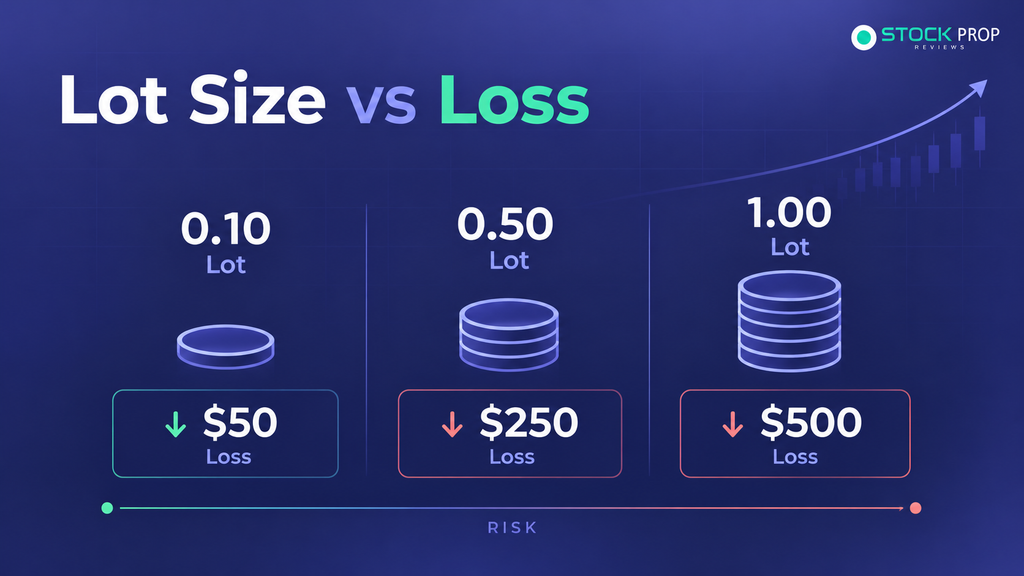
| Position | Approx. pip value on EUR/USD | Loss at 50-pip stop |
| 0.01 lot | $0.10 | $5 |
| 0.10 lot | $1 | $50 |
| 0.50 lot | $5 | $250 |
| 1.00 lot | $10 | $500 |
These numbers are simplified examples . The actual pip values depend on the currency pair and the account currency.
The basic relationship is simple, double the lot size with the same distance to your stop and the potential loss will roughly double.
Why lot size matters more than many traders realise
A common mistake is to think about lot size in isolation.
A trader might say, “I only use 1 lot.”
That statement does not tell us much about the actual risk.
One lot with a 10-pip stop is very different from one lot with a 100-pip stop.
For example:
1 lot × 10 pips × $10 per pip = approximately $100 risk
But:
1 lot × 100 pips × $10 per pip = approximately $1,000 risk
The lot size stayed identical. The risk did not.
This is why professional position sizing starts with the amount the trader is prepared to lose and the technically appropriate stop location. The position size is calculated afterward. CMC Markets uses the same basic relationship in its position-sizing guidance: account risk divided by stop distance and pip value determines the appropriate position size.
The basic lot size risk formula
A commonly used formula is:
Lot Size = Account Risk ÷ (Stop Loss in Pips × Pip Value)
Suppose a trader has a $10,000 account and chooses to risk 1%.
Maximum planned loss:
$10,000 × 1% = $100
If the stop loss is 50 pips and one standard lot is worth approximately $10 per pip:
$100 ÷ (50 × $10) = 0.20 lots
The trader would therefore use approximately 0.20 lots.
If the same setup required a 100-pip stop, the position would need to be approximately half as large:
$100 ÷ (100 × $10) = 0.10 lots
The wider stop does not automatically mean more risk. The problem occurs when traders widen the stop while keeping the original position size.
The survival difference between 0.5% and 5% risk
The effect of position size becomes much clearer when looking at losing streaks.
Imagine two traders who each start with $10,000.
Trader A risks 0.5% per trade.
Trader B risks 5% per trade.
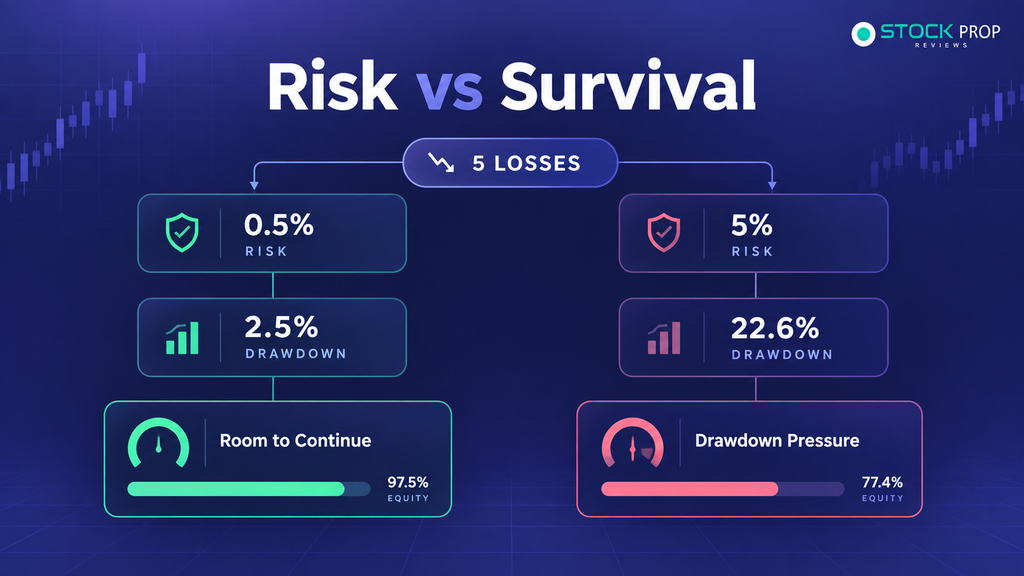
After five consecutive losses, assuming percentage-based compounding:
| Risk per trade | Approx. balance after 5 losses | Approx. drawdown |
| 0.5% | $9,751 | 2.49% |
| 1% | $9,510 | 4.90% |
| 2% | $9,039 | 9.61% |
| 5% | $7,738 | 22.62% |
The difference is not caused by the strategy.
Both traders experienced exactly the same five losing trades.
The difference came from position sizing.
This is the part many basic lot-size guides do not explain. Lot size does not merely determine the outcome of the next trade. It determines how much room remains for the trades that come afterward.
How oversized lots turn a normal losing streak into an account problem
Losing streaks are normal in trading.
Even a strategy with a positive expectancy can produce several losses in succession. The exact sequence depends on the strategy’s win rate, reward-to-risk distribution and market conditions.
The problem starts when the trader’s position size is too large for the account’s drawdown capacity.
Consider a funded trader with a maximum allowable drawdown of 10%.
If the trader risks 2% on every trade, five consecutive full losses would leave roughly 9.6% of the account depleted.
There is very little room left for execution costs, slippage, correlated positions or another losing trade.
Now consider a trader risking 0.5%.
Ten consecutive losses would reduce the account by approximately 4.9%.
Neither scenario guarantees survival. A strategy can experience a longer losing sequence, and a stop loss does not guarantee the exact execution price during a fast market.
But the second risk model leaves considerably more room for normal variance.
This is why fixed-percentage position sizing is widely used as a risk-control framework. CMC Markets describes the approach as adjusting position size so that the loss at the stop represents a small, predefined percentage of account value.
What competitors often miss about prop firm accounts
Most lot-size guides focus on personal forex accounts.
Prop traders have another problem: the advertised account size is not necessarily the amount they can afford to lose.
A $100,000 evaluation with a 10% maximum drawdown does not give the trader $100,000 of practical risk capacity.
The relevant risk budget is closer to the $10,000 drawdown allowance.
If the account also has a daily loss limit, the trader needs to consider that smaller constraint as well.
This changes the position-sizing calculation.
A trader should ask:
- How much can I lose before violating the daily limit?
- How much can I lose before violating the maximum drawdown?
- How many consecutive losses does my strategy normally produce?
- What happens if several open trades are correlated?
- Does the firm’s drawdown use balance, equity, static levels or trailing calculations?
FundingPips, for example, distinguishes balance from equity and explains that floating profit and loss affects the account’s real-time equity. It also identifies daily and maximum loss limits as core parts of its risk structure.
That distinction matters when several large positions are open simultaneously.
Lot size and the psychology of trading
The mathematical risk is only half the problem.
Large positions change behaviour.
A trader who normally accepts a $50 loss may react very differently when a position starts showing a $500 floating loss.
This can lead to several familiar decisions:
Moving the stop: The trader does not want to accept the planned loss.
Closing too early: A normal temporary drawdown becomes psychologically uncomfortable.
Adding to the position: The trader believes a larger position will recover the loss faster.
Revenge trading: The next position is increased to recover the previous loss.
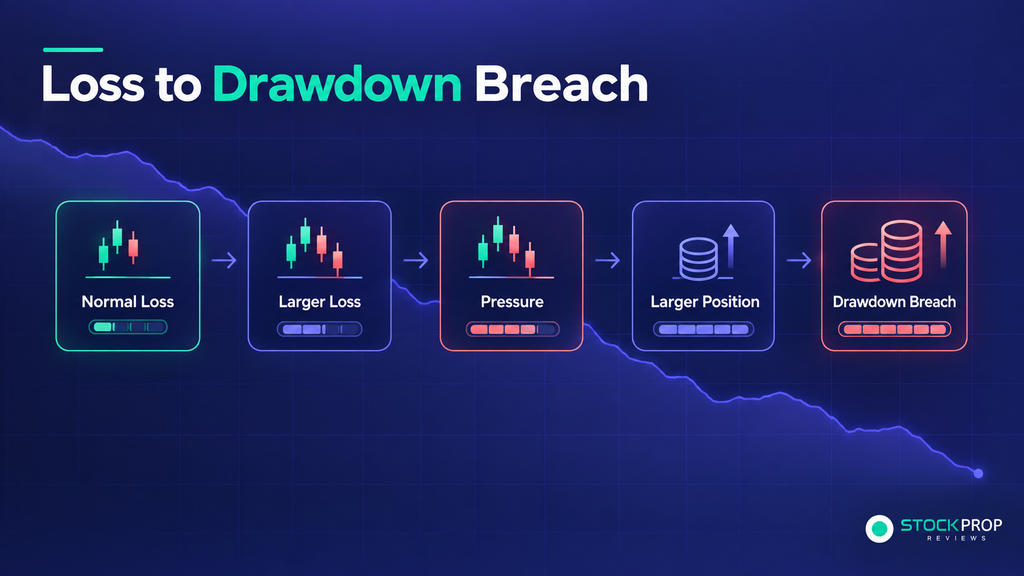
The sequence can look like this:
Oversized position → Larger loss → Emotional pressure → Larger next position → Drawdown acceleration
The original strategy may not have been the problem. The risk model changed the trader’s behaviour.
This is particularly important after a losing trade. Increasing lot size because the next setup “looks better” does not recover the previous loss mathematically without increasing future risk.
Why using the same lot size on every trade is flawed
Using a fixed lot size can make risk inconsistent.
Suppose a trader always uses 0.50 lots.
Trade A has a 20-pip stop.
Trade B has a 60-pip stop.
Trade B has three times the stop distance, so its potential loss is roughly three times larger, assuming the same pip value.
The trader may believe they are following a consistent position-sizing plan because the lot size never changes.
They are not.
The consistent variable should normally be the risk budget, not the lot number.
A wider technical stop generally requires a smaller position if the trader wants to maintain the same monetary risk.
A narrower stop may allow a larger position, but that does not mean the setup is automatically safer. Tight stops can be more vulnerable to normal market noise.
Common lot size mistakes
Choosing the lot size before the stop
This reverses the normal process.
The trader decides, “I want to trade 1 lot,” and then searches for a stop that makes the position fit the account.
The stop should normally be determined by the trade setup first. Position size should then be calculated from the acceptable risk.
Increasing size after losses
This is one of the fastest ways to destroy the original risk plan.
A five-trade losing streak does not make the sixth trade more likely to win. Increasing size simply makes the next outcome more financially important.
Ignoring multiple open trades
Three positions risking 1% each are not necessarily three independent 1% risks.
EUR/USD, GBP/USD and AUD/USD can all have meaningful exposure to the US dollar. CMC Markets specifically notes that correlated positions can create concentrated exposure even when each individual trade appears acceptable.
Treating leverage as risk
Leverage determines how much exposure can be controlled with a given amount of margin. It does not tell you how much you should risk.
A trader can use high leverage and still risk only 0.5% if position size and stop distance are controlled.
The reverse is also true. A trader can use relatively low leverage and still take excessive risk by opening a position that is too large for the account.
A practical survival framework for funded traders
Before placing a trade, calculate four numbers:
Account equity
Use the figure that the firm’s rules actually use for its loss calculations.
Maximum planned loss
For example, 0.5% of current equity.
Stop distance
Use the technically valid stop, rather than moving the stop to justify a preferred lot size.
Position size
Calculate the lot size that keeps the planned loss within the predetermined risk budget.
Then add a fifth check: total open exposure.
If several positions are related, treating each one as an isolated risk can produce a much larger effective exposure.
This approach is more useful than memorising a table that says a $10,000 account should trade a particular lot size.
How lot size affects survival rate
There is no single survival rate for a given lot size.
Survival depends on the interaction between position size, strategy expectancy, win/loss distribution, drawdown rules, trading frequency, execution and trader behaviour.
However, the mathematical relationship is clear: larger risk per trade means a losing sequence consumes the account’s drawdown budget faster.
That makes lot size one of the most important variables a trader can control.
The objective is not to use the smallest possible position. It is to use a position that is consistent with the strategy and leaves enough capital for the strategy’s normal losing periods.
This is also why a backtest needs to be tested against the actual prop firm’s risk structure. Our analysis of backtesting prop firms covers the difference between a strategy’s historical drawdown and the tighter constraints imposed by an evaluation account.
What this means for different traders
Beginners: Know the relationship between position size, stop distance and monetary risk before upping size.
Funded traders: The real risk budget is the firm’s drawdown allowance, not the headline account size. Get used to it.
Scalpers: Pay particular attention to spread, slippage and the number of simultaneous positions. A large position can make small execution differences meaningful.
Swing traders: Wider stops generally require smaller positions if percentage risk is to remain constant.
High-frequency or highly active traders: Total daily exposure matters as much as individual trade risk.
Traders who regularly increase position size after losses should address that behaviour before increasing account size.
Where TradeThePool fits
TradeThePool is a stock-focused proprietary trading firm rather than a forex lot-size model. Its current program documentation describes risk requirements around stock trading, buying power and account rules.
One important distinction is worth making for accuracy: TradeThePool should not currently be described as a regulated stock prop firm. Its own terms state that Five Percent Online Ltd operates as a proprietary trading firm and is not a financial institution or entity under the purview of financial regulatory authorities. The company also says its evaluation environment is simulated.
What traders can assess instead is its published rule structure and risk framework. Our TradeThePool review covers its current account rules, drawdown structure and trading conditions in more detail.
Readers can get up to 10% discount when purchasing through our TradeThePool link.
The bigger lesson about lot size risk
Lot size is not a strategy.
It is a risk-control variable.
A good entry can still become a bad trade if the position is oversized. A profitable strategy can still fail a prop evaluation if the risk per trade is too large for the firm’s drawdown limits.
The practical sequence is simple:
Find the setup → determine the valid stop → define acceptable account risk → calculate position size → check total exposure → place the trade.
Not:
Choose a large lot → find a stop that fits → hope the trade works.
Our prop firm comparison also looks at how drawdown structures, account rules and trading conditions can change the practical risk available to a trader.
And for traders who want to understand the behavioural side, our analysis of prop firm consistency rules examines how risk limits can influence trading decisions beyond the numbers.
The most important question is therefore not “What lot size should I trade?”
It is:
“How much of my available drawdown can this position consume if the trade is wrong?”
That question puts lot size into the context that matters most: survival.
FAQs
Does a bigger lot size always mean higher risk?
Yes, when other variables remain the same. Increasing lot size increases the monetary effect of each price movement. However, total trade risk also depends on stop distance, pip value and the instrument being traded.
Should I use the same lot size on every trade?
Not necessarily. If stop distances vary, keeping the same lot size can create very different levels of risk. Position size should generally be adjusted so the potential loss remains within the trader’s predefined risk limit.
What lot size is safest for a funded account?
There is no universal safe lot size. The appropriate size depends on the account’s equity, stop distance, instrument, daily loss limit, maximum drawdown and strategy. A position that is reasonable for one account can be excessive for another.
Is 1% risk per trade enough to survive?
It can provide considerably more room for losing streaks than larger risk levels, but it does not guarantee survival. A strategy can experience an unusually long losing sequence, and prop firm rules may impose additional constraints.
Does leverage determine how much I should risk?
No. Leverage affects the amount of market exposure available relative to margin. Your actual risk should be determined by position size, stop distance and the amount of account equity you are prepared to lose.