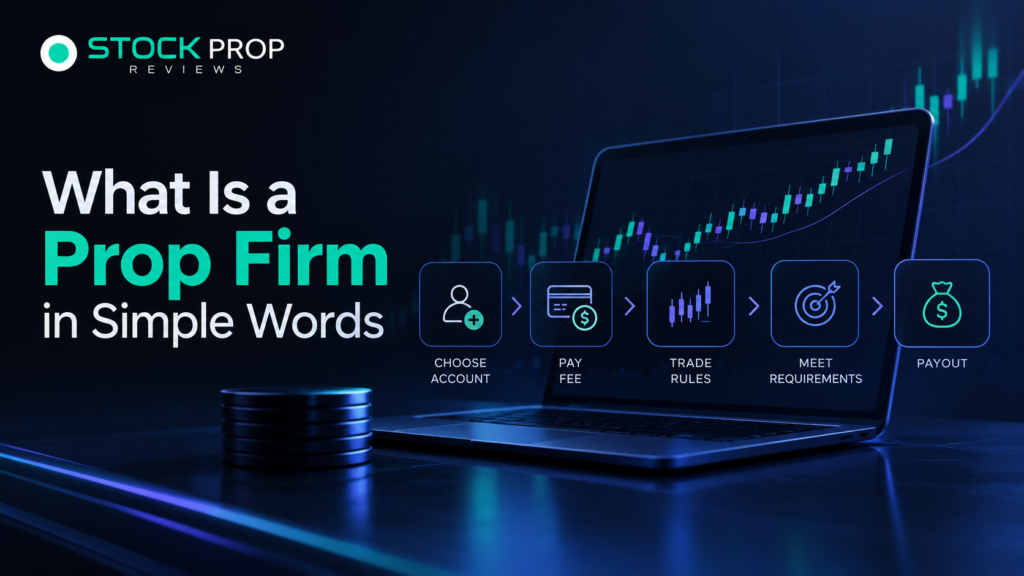
A prop firm is a company that offers traders access to a bigger trading account under certain risk rules. You don’t have to pay the full amount of trading capital yourself, but rather you pay for an evaluation or account, and then you have to follow rules like maximum drawdown, daily loss, and position-size limits.
This is for beginners trying to understand how proprietary trading works before they pay for an account. It is not for traders looking for a guaranteed income method or shortcut to consistent profitability.
What Is a Prop Firm?
A proprietary trading firm, commonly called a prop firm, is a company that provides traders with access to trading capital or a simulated account under a defined set of rules.
The basic idea sounds simple:
Trader pays for access or evaluation → trader follows risk rules → trader meets the firm’s conditions → trader may become eligible for payouts or a funded arrangement.
However, the exact structure varies significantly between firms.
Some firms focus on forex and CFDs. Others specialize in futures or stocks. Some use simulated trading environments, while others have different arrangements for allocating or copying trading activity. This distinction matters because the phrase “funded account” does not always mean that the trader is directly trading a company’s cash in a live brokerage account.
For a beginner, the most important question is therefore not simply, “How much capital does the firm give me?”
It is:
What are the rules, how is drawdown calculated, and what happens when I make a loss?
How Does a Prop Firm Work?
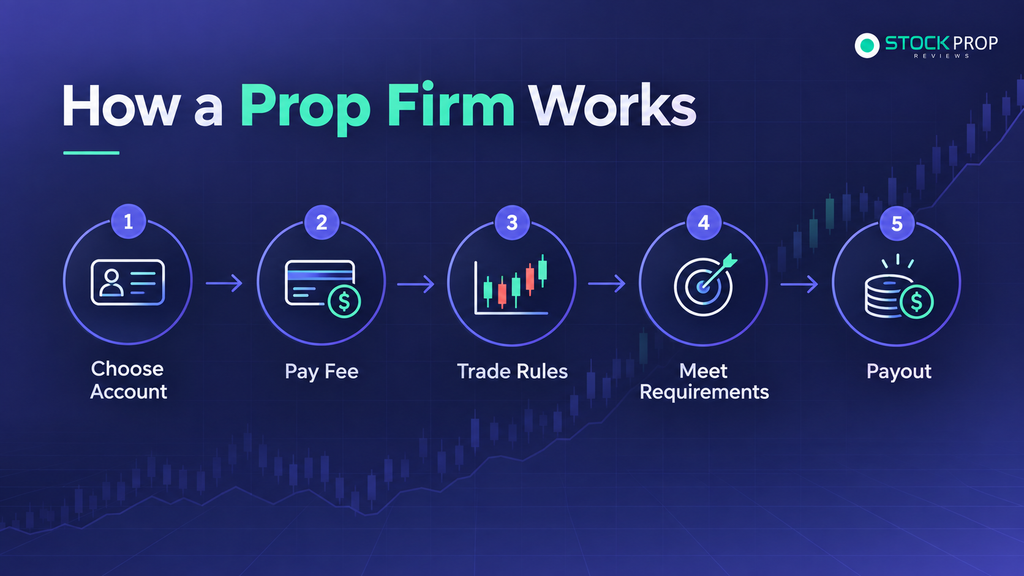
Most retail prop firm programs follow a variation of this process.
1. Choose an account
A trader selects an account size, such as $10,000, $50,000, or $100,000.
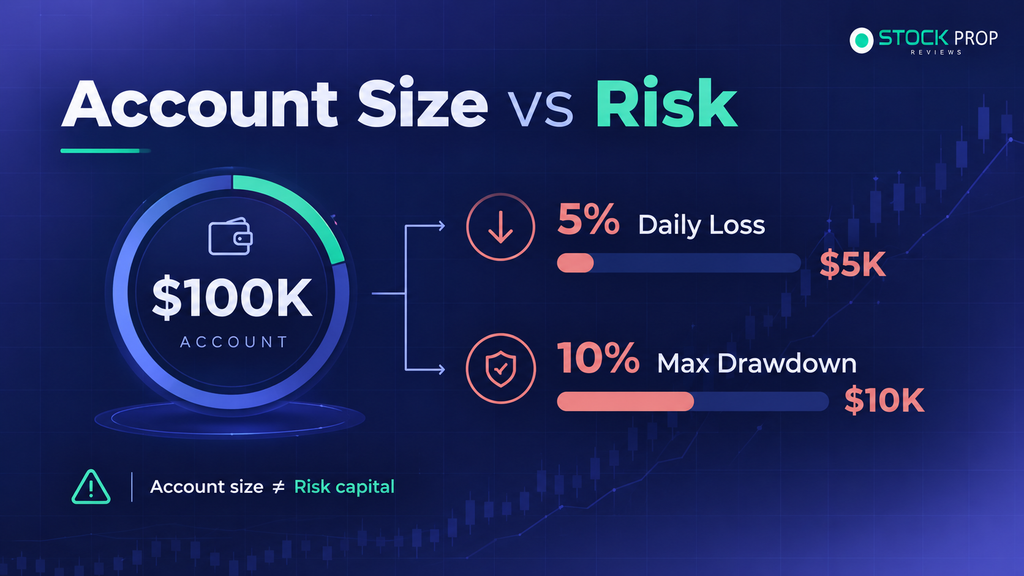
The advertised account size can be misleading if viewed as money available to lose. A $100,000 account with a 10% maximum drawdown does not give you $100,000 of practical risk capital. Your allowable loss might be only $10,000, depending on the firm’s rules.
2. Pay the required fee
Many evaluation-based firms charge a fee to access an assessment or trading account.
The fee should be treated as a cost of attempting the program, not as an investment that guarantees access to capital.
3. Trade under specific rules
The firm may impose conditions covering:
- Maximum loss per day;
- Total maximum drawdown
- Target profit
- Minimum trading days
- Position Size
- Trader News
- Overnight / Weekend Holding
- Copy Trading.
- Discipline Algorithmic trading
- Max. Allocation
Breaking one of these rules can result in the account being closed even if the trader was profitable overall.
4. Meet the firm’s requirements
If the trader reaches the required objective without violating the rules, the next stage depends on the program.
Some programs move the trader to another account or stage. Others provide access to a funded or simulated funded environment.
5. Request payouts when eligible
Once the trader has fulfilled the firm’s payout requirements, profits can be shared according to the firm’s stated profit-sharing agreement.
The minimum withdrawal amount, timing and conditions vary by company, as does the exact process for payout.
A Simple Prop Firm Example
Imagine a trader purchases a $100,000 evaluation.
The firm sets:
| Rule | Example |
| Account size | $100,000 |
| Profit target | 8% |
| Daily loss limit | 5% |
| Maximum drawdown | 10% |
| Profit target in dollars | $8,000 |
| Maximum drawdown in dollars | $10,000 |
The trader does not simply have $100,000 available to lose.
If the account reaches the maximum permitted drawdown, the account can fail.
This is why drawdown is often more important than the headline account size.
A trader risking 2% on every trade could theoretically experience five consecutive losses and lose roughly 10% before considering compounding, fees, slippage, or other effects.
A trader risking 0.25% per trade has considerably more room for a normal losing streak.
The mathematics of the risk model can therefore matter more than the advertised account balance.
Prop Firm vs Trading Your Own Money
The biggest difference is where the trading capital comes from and what restrictions apply.
| Factor | Prop Firm | Personal Trading Account |
| Starting capital | Depends on program | Your own deposit |
| Risk rules | Usually strict | Set by you or broker |
| Drawdown rules | Firm-defined | Usually no external prop-firm limit |
| Profit sharing | Often applies | You generally keep trading profits, subject to costs/taxes |
| Evaluation | May be required | Usually not |
| Trading restrictions | Can be extensive | Depends on broker and market |
| Account failure | Rule breach can terminate account | Loss reduces your own capital |
Neither structure automatically makes a trader profitable.
A personal account gives more control, but you are risking your own money. A prop program may reduce the amount of personal trading capital required, but it replaces some of that freedom with contractual and risk-management restrictions.
What Beginners Often Get Wrong About Prop Firms
The most common misunderstanding is treating the account size as if it were the trader’s available cash.
A “$100K funded account” sounds very different from a $5,000 personal account. But if the prop firm’s effective drawdown is $5,000 or $10,000, the practical risk budget is much smaller than the headline number suggests.
Another misunderstanding is assuming that passing an evaluation proves a trader has a sustainable strategy.
It does not.
A trader can pass by taking unusually high risk during a favorable market period. That does not necessarily mean the strategy will survive months of changing volatility.
The reverse can also happen. A profitable strategy may fail an evaluation because its normal drawdown temporarily exceeds the firm’s limit.
This distinction is particularly important for swing traders, discretionary traders, and strategies that require wider stops.
How Traders Actually Fail Prop Firm Accounts
Most account failures do not require a complicated trading mistake.
Consider a trader risking 1% per trade.
After four consecutive losses, approximately 4% of the account’s initial value has been lost before considering compounding. If the trader becomes frustrated and increases the next position to 3%, one additional loss can create a much larger drawdown.
The problem has now changed from a normal losing streak to a risk-management problem.
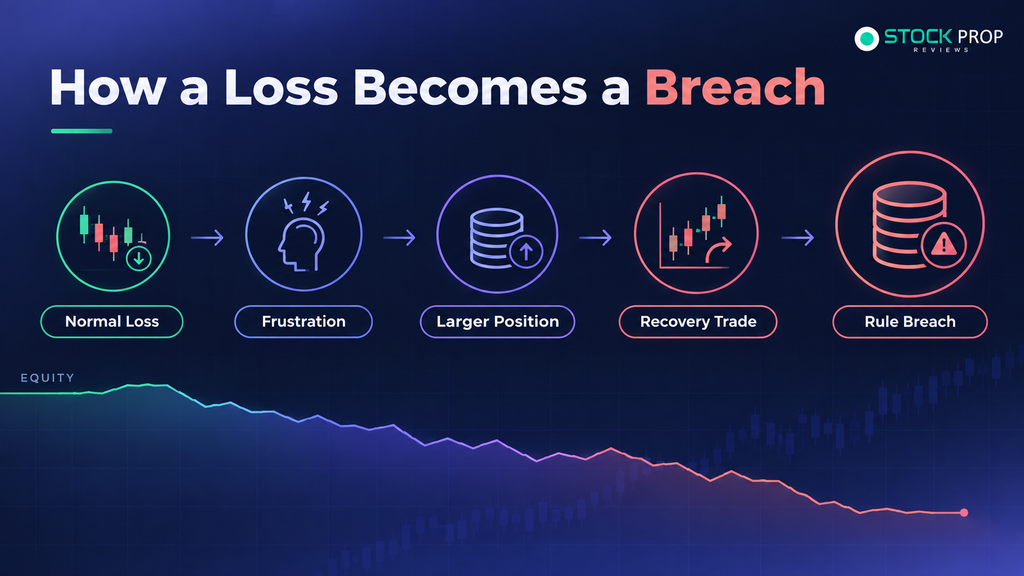
A common sequence looks like this:
Normal Loss → Frustration → Larger Position → Recovery Trade → Drawdown Pressure → Rule Breach
The first loss is not necessarily the problem.
The position-size increase after the loss often creates the larger problem.
Other common failure points include trading during prohibited news events, holding positions overnight when the rules prohibit it, misunderstanding trailing drawdown, and assuming that a stop-loss always guarantees the exact intended loss.
Market gaps and slippage can affect actual execution.
The Drawdown Rule You Need to Understand
Before choosing a prop firm, find out exactly how drawdown works.
There is a major difference between:
Static drawdown: the loss limit remains based on a fixed starting balance or level.
Trailing drawdown: the level of permitted loss is allowed to move up as the account reaches new highs in equity or balance.
Let’s say, for example, that a trader has a $100,000 account and a $5,000 trailing drawdown.
If the account grows to $103,000 the trailing threshold can be different depending on how the firm calculates it. Therefore a later loss can trigger a breach even if the trader is still above the original $100,000 balance.
The exact calculation is different for each firm, so traders should check the official rules rather than just the headline balance in their account.
This is one of the things that prop firm articles for beginners tend to over simplify.
What Competitor Guides Often Don’t Explain
Many basic explanations describe a prop firm as a simple way to “trade with more money.”
That description misses the central issue.
Prop trading is primarily a risk-management exercise.
A strategy can be profitable in a normal brokerage account but unsuitable for a particular prop program.
Imagine a swing strategy that normally risks 1.5% per position and occasionally holds trades through major economic announcements.
That strategy may work under one firm’s conditions but become impractical under another firm’s daily loss, news, or overnight rules.
The question is therefore not:
“Is this strategy profitable?”
The better question is:
“Can this strategy remain profitable while obeying this firm’s specific risk model?”
That is the strategy-fit test beginners should perform before purchasing an evaluation.
Prop Firm Profit Splits Explained
A profit split determines how trading profits are divided between the trader and the firm.
For example, if a program specifies an 80/20 split and the trader has $2,000 of eligible profit, the trader’s share would be $1,600 before any other applicable conditions or deductions.
The percentage alone should not determine your decision.
You also need to check:
- When profits become eligible for withdrawal
- Minimum payout requirements
- Consistency conditions
- Maximum payout restrictions
- Scaling rules
- Any fees associated with withdrawals
- Whether the profit split changes at different stages
A high advertised profit split does not automatically mean a better economic arrangement if other restrictions make payouts difficult to achieve.
Who Should Avoid Prop Firms?
Prop firms may be a poor fit for traders who need complete control over their trading conditions.
For example, a trader may want to hold positions indefinitely, trade through major news releases, use aggressive position sizing, or tolerate large temporary drawdowns.
Those approaches can conflict with many prop programs.
A prop firm may also be unsuitable for someone who does not yet have a tested trading process.
If a trader is still changing indicators every few days, moving stop losses because of emotions, or increasing size after losses, adding a strict external rule set may not solve the underlying problem.
It can make the consequences of poor discipline more immediate.
What Should Beginners Check Before Buying?
Start with the rules rather than the marketing page.
Look at the maximum daily loss and overall drawdown first. Then determine exactly how those numbers are calculated.
After that, check the firm’s trading restrictions and payout conditions.
A useful pre-purchase checklist is:
- How do you calculate daily loss?
- Maximum drawdown is trailing.
- Equity or closed balance? Which one counts?
- Are overnight positions allowed?
- Are weekend jobs permitted?
- Can I trade on big news events?
- Allow expert advisors or automated systems?
- Are there any consistency requirements ?
- What conditions are the payout?
- What happens when a rule is broken?
The answers should come from the firm’s current rules, not from a social-media post or an affiliate review.
Prop Firm Reviews and Comparisons
Once you understand the basic model, individual reviews become much easier to evaluate.
For example, our TradeThe Pool review focuses on how its stock-focused structure and trading rules affect actual strategy selection. Readers comparing different approaches can also look at our prop firm comparison content rather than judging firms solely by account size or profit split.
If you are a trader looking to trade stocks, TradeThePool is a regulated stock prop firm with defined rules and risk parameters for trading. As with any prop program, traders should still read the current terms and see if the restrictions fit their own strategy.
Readers can get up to 10% discount when buying through our TradeThePool link.
For a wider view, our articles about the reality of prop firms also explain why passing an evaluation and consistently getting payouts are two different challenges.
What About Alternatives?
There are several types of prop programs, so “alternative” should mean a different structure rather than simply another company.
Forex and CFD prop firms can suit traders whose strategies depend on currency pairs, metals, indices, or CFDs.
Futures prop firms are built around futures markets and can have different margin, drawdown, and trading hour structures
Stock-focused prop firms may be more relevant to traders who favor individual equities and stock-market setups.
The right category depends on the instruments your strategy actually trades.
A forex scalper should not automatically choose a stock prop program simply because its advertised account size looks attractive. Likewise, a stock trader should not choose a futures program without understanding the differences in market structure and risk rules.
FAQs
What is a prop firm in simple words?
A prop firm is a company that allows traders to trade under the firm’s rules and potentially receive a share of eligible profits. Depending on the program, the trading environment may be simulated or involve another form of capital allocation.
Do prop firms give you real money to trade?
Not especially. The phrase “funded account” may have various meanings. Some retail programs have simulated trading environments, but others have different capital allocation structures. Always check the firm’s paperwork.
Do you have to pay to join a prop firm?
Many retail prop firms charge an evaluation or account fee. The amount and refund conditions vary between companies.
Can beginners make money with a prop firm?
A beginner can potentially earn payouts, but a prop firm does not make an unprofitable strategy profitable. Traders still need a repeatable strategy, appropriate position sizing, and the ability to follow the firm’s rules.
What is the biggest risk of a prop firm?
For many traders, the biggest practical risk is misunderstanding the drawdown and account rules. A strategy can be profitable overall but still fail if its normal losses or trading behavior conflict with the firm’s risk limits.
Final Takeaway
A prop firm is not just a firm that gives traders a big account.
It is a trading arrangement based on access to capital, risk limits and certain conditions.
The account size tells only part of the story. Far more important for the actual ability of a trader to successfully operate the account are the drawdown calculation, daily loss limits, trading restrictions, payout rules and compatibility with the strategy.
For a beginner, the safest bet is to learn the rules first, and then the advertised account size.