
The best forex sessions for prop firm traders are typically the periods when liquidity, volatility and strategy conditions line up, but there is no one session that produces the best results for every trader. For many intraday forex strategies the London session, or more specifically the London-New York overlap, is the most active. That doesn’t necessarily make them the safest or most profitable windows.
This analysis is for forex day traders, scalpers and funded traders who want to know when the conditions for their strategy are strongest. This is not for traders looking for a session guaranteed to be profitable, nor a simple shortcut based on time of day.
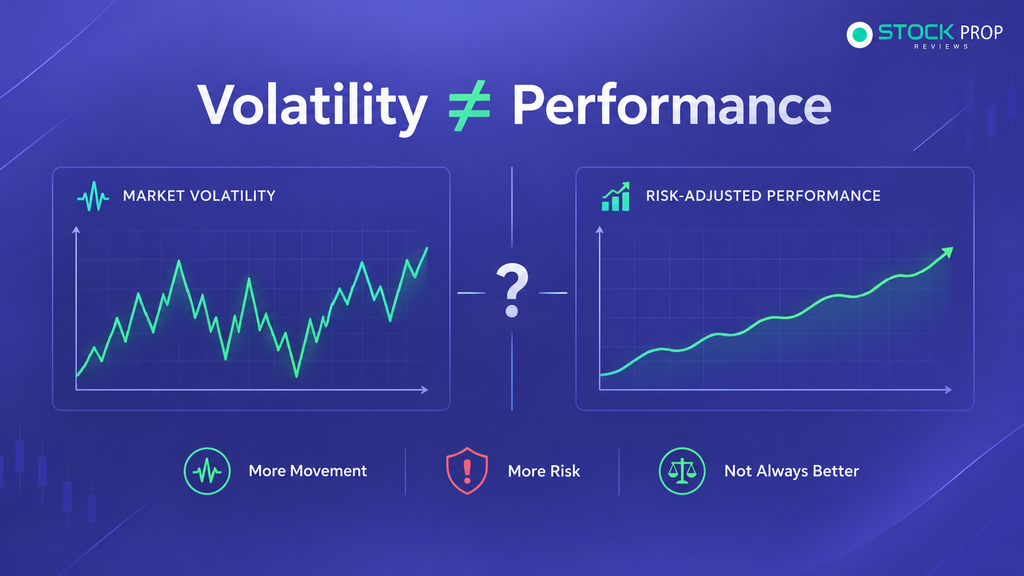
That’s the easy part to overlook. More movement in a session doesn’t necessarily mean better trading results. More volatility in a prop account equals a faster drawdown.
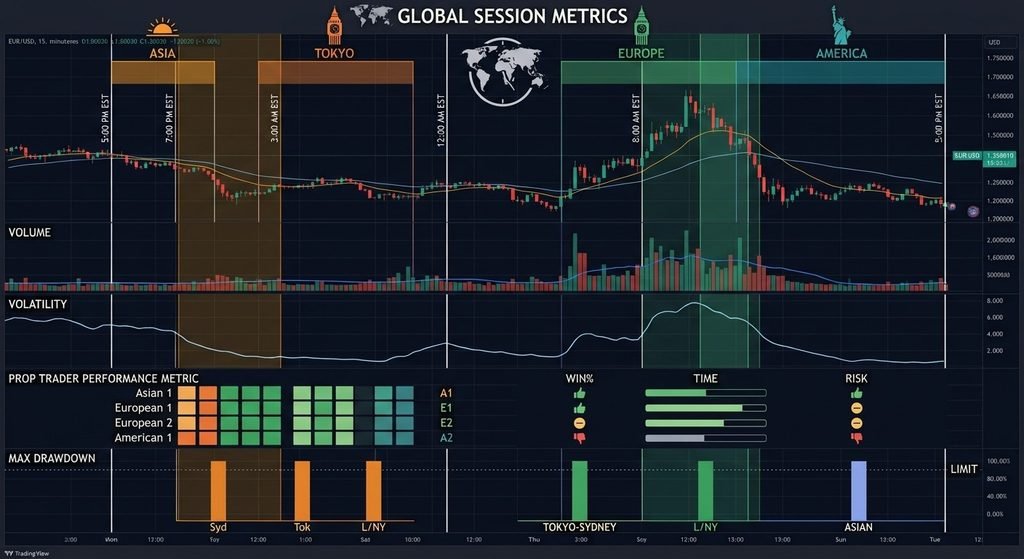
What Makes a Trading Session “Best”?
A trading session is simply a period when a major financial centre is active. Forex operates around the clock during the trading week, but activity changes as Tokyo, London and New York participants enter and leave the market.
The practical differences come from three variables:
- Liquidity
- Volatility
- News and market catalysts
The London-New York overlap is commonly associated with high activity because European and U.S. participants are active at the same time. ACY’s session analysis similarly identifies the overlap as a particularly active period for major FX pairs, gold and U.S. indices.
But prop traders need a fourth variable: drawdown exposure.
A 50-pip move may be useful to a trader whose setup needs momentum. The same move can be dangerous for a trader entering late with a tight stop.
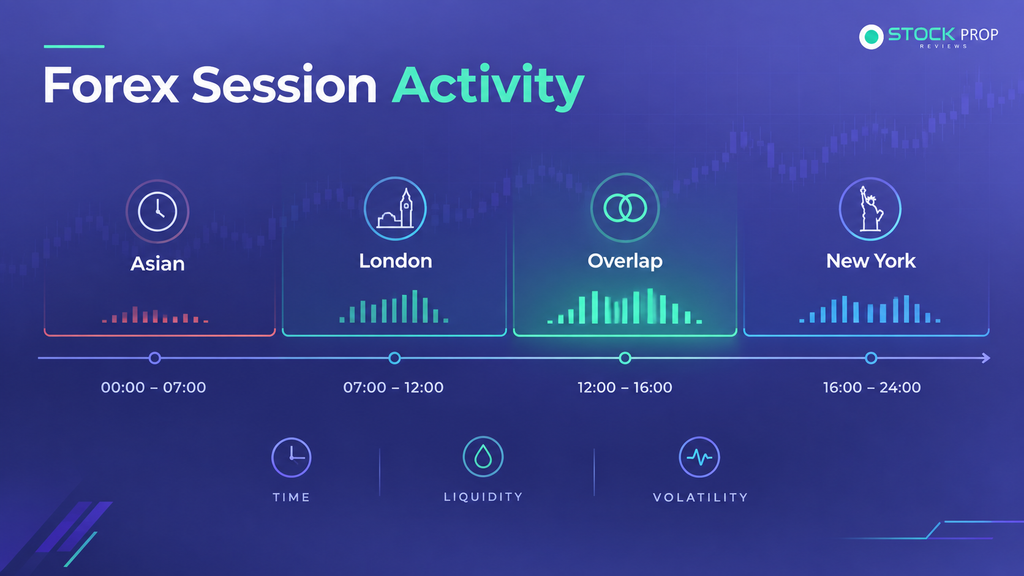
London Session vs New York Session vs Asian Session
| Session | Typical Character | Stronger Markets | Main Prop-Trading Risk |
| Asian | Lower volatility, more ranges | JPY, AUD, NZD pairs | False breakouts and limited movement |
| London | Increasing liquidity and directional moves | EUR, GBP, CHF pairs | Opening volatility and false breaks |
| London-New York overlap | High liquidity and volatility | EUR/USD, GBP/USD, USD/JPY, gold | News spikes and rapid drawdown |
| New York | Strong USD and U.S. market influence | USD pairs, gold, indices | U.S. data and market-open volatility |
These are general market characteristics, not performance guarantees. The exact conditions change with economic data, central-bank decisions, holidays and broader market sentiment.
London Session: Strong Conditions for Structured Intraday Trading
London is often one of the most useful sessions for European currency pairs.
As European traders enter the market, liquidity generally increases. Overnight ranges can be tested, breakouts can develop, and previously quiet pairs can begin moving.
For a trader using a London breakout strategy, this can create a clear sequence:
Asian range → London liquidity expansion → breakout → retest → continuation
But this is also where many beginners make mistakes.
They see the first large candle and assume the breakout is confirmed.
A more realistic scenario is:
A trader identifies the Asian high and low. London opens and pushes above the Asian high. The trader buys immediately. Price reverses back into the range and hits the stop.
The market then breaks higher later.
The problem was not necessarily the session. It was entering the first move without accounting for a possible liquidity sweep.
This matters even more in a prop account because repeated attempts around the same level can turn one reasonable setup into several small losses.
London-New York Overlap: High Opportunity, High Risk
The London-New York overlap receives the most attention when traders discuss the best forex sessions.
There is a logical reason. Two major financial centres are active simultaneously, while U.S. economic releases often occur during the New York morning. ACY identifies the overlap as a particularly volatile period and highlights EUR/USD, GBP/USD, gold and U.S. indices among the markets that can become active.
This makes the overlap attractive to momentum and breakout traders.
It also makes it dangerous.
Suppose a funded trader risks 1% per trade and normally trades three times during a quiet session. During the overlap, the trader sees several large candles and starts entering more frequently.
The first trade loses 1%.
The second loses 1%.
The third trade is increased to 1.5% because the trader expects the next move to compensate.
A normal losing sequence has now become a serious drawdown problem.
The volatility that created the original opportunity also accelerated the losses.
That is the part many session guides understate.
New York Session: Particularly Relevant for USD and Gold Traders
New York becomes especially important for traders focused on USD pairs, gold and U.S. indices.
The U.S. economic calendar can produce sudden changes in price around releases such as CPI, employment data and Federal Reserve decisions. The U.S. equity open can also create a separate volatility window for indices.
For a trader specializing in EUR/USD, this can be useful because the pair has both European and U.S. participation.
For a gold trader, the same period can produce much larger candles.
That difference matters.
A strategy tested on EUR/USD should not automatically be assumed to work on XAU/USD simply because both are active during New York.
Gold can move substantially faster, and a stop distance that is reasonable on a major currency pair may be inadequate for gold.
Asian Session: Not Automatically a Bad Session
Asian trading is often referred to as a quiet or low-volatility period. That is a useful description in general, but it can be misleading when traders try to make it a rule.
Lower average volatility can be an advantage for certain strategies.
Range traders, for example, may prefer a market that spends more time inside defined boundaries.
A trader might identify support and resistance during the Asian session and trade mean-reversion setups rather than expecting a large trend.
The problem occurs when a trader uses a London breakout strategy during Asia simply because they are available to trade.
The strategy and market conditions do not match.
That is why session selection should follow the strategy rather than personal preference alone.
The Prop Firm Difference: Volatility Is Not the Same as Performance
This is where standard forex session guides leave an important gap.
A conventional trading guide asks:
When does the market move the most?
A prop trader should ask:
When does my strategy produce its best risk-adjusted results without putting the account too close to its drawdown limits?
Those are different questions.
Consider two traders.
Trader A risks 0.25% per position and has a breakout system that performs well during high-volume periods.
Trader B risks 1% per trade and has a mean-reversion system designed for quieter conditions.
The London-New York overlap could provide excellent conditions for Trader A while being a poor environment for Trader B.
Calling one session universally “best” ignores the strategy.
Our analysis of prop firm risk management makes the same broader point: a strategy must be evaluated against the actual drawdown structure rather than just its theoretical profitability.
What Competitors Don’t Explain About Session Performance
FundedNext’s discussion of trading cycles focuses on performance periods, loss limits, trading activity and consistency. That is useful context, but it does not answer the more practical question of whether a trader’s preferred market hours are compatible with their risk model.
ACY’s session guide goes further into market timing and identifies the London-New York overlap as a major activity window. However, even that type of session analysis should not be interpreted as proof that every trader will perform better during those hours.
The missing variable is usually individual strategy expectancy by session.
If your trading journal shows:
- London: 48 trades, 0.31R average expectancy
- New York: 52 trades, 0.08R average expectancy
- Asian: 35 trades, -0.12R average expectancy
then your personal data says considerably more about your strategy than a generic session ranking.
That is the data a prop trader should collect.
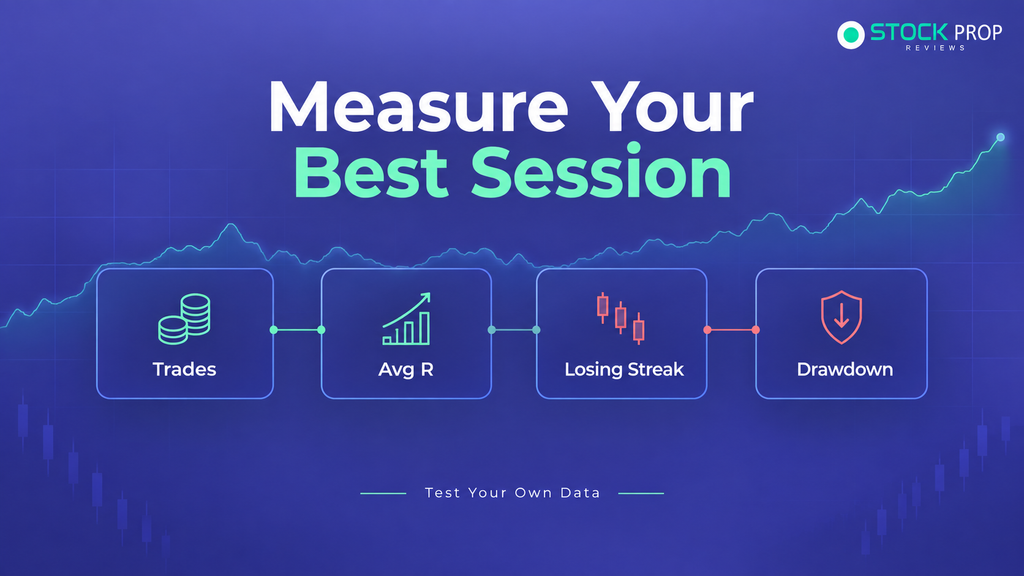
How to Measure Your Best Trading Session
Instead of copying a session recommendation, divide your historical trades into time blocks.
Record at least:
| Metric | Why It Matters |
| Number of trades | Prevents conclusions from tiny samples |
| Win rate | Shows directional accuracy |
| Average R | Measures outcome relative to risk |
| Maximum losing streak | Helps assess drawdown pressure |
| Average trade duration | Identifies scalping vs intraday behavior |
| News exposure | Separates normal volatility from event risk |
| Maximum intraday drawdown | Connects results to prop rules |
Do this over a meaningful sample rather than five or ten trades.
A session with a 70% win rate from ten trades may look impressive, but it is not strong evidence. A lower win rate over 100 or more trades can be more useful if the average R and drawdown profile are stable.
Common Trader Mistakes
Trading the Most Volatile Session by Default
High volatility creates opportunity, but it also increases slippage, stop-outs and emotional pressure.
A scalper may benefit from movement, while a trader using wider stops may find the same environment difficult.
Increasing Risk During the Overlap
This is particularly dangerous.
A trader sees larger candles and assumes the opportunity is larger, so position size increases.
The correct approach is the opposite: position size should generally be calculated from the stop distance and predetermined account risk.
Treating News as a Trading Session
CPI, NFP and central-bank announcements can completely change normal market behavior.
A trader who performs well between 9:00 and 11:00 may not perform equally well during a major release at 8:30.
The clock alone does not describe market conditions.
Forcing Trades Because the Session Is Active
This is one of the most common psychological problems.
The trader decides that London is the “best” session and feels obligated to trade it every day.
If there is no valid setup, nothing has been gained by being active.
Session Selection and Funded Account Survival
The best session for a funded trader is usually the one where the trader can repeat the same process without excessive drawdown.
This sounds less exciting than simply identifying the most volatile four hours, but it is more relevant to account survival.
For example, imagine a trader whose strategy normally experiences four consecutive losses during a poor market regime.
At 0.25% risk per trade, that sequence costs approximately 1%.
At 1% risk per trade, it costs approximately 4%.
The market session did not change the mathematics. Position sizing did.
This is why traders should compare their normal losing streak with the firm’s daily and maximum drawdown limits before deciding how aggressively to trade a particular session.
Our FTMO review explains the impact of fixed daily and maximum drawdown rules on real trading behavior while the FundedNext review shows how different account structures can alter the fit of your strategy.
For a broader comparison, our prop firm comparison breaks down how drawdown models, targets and restrictions change the practical trading environment.
Which Session Fits Which Strategy?
There is no universal winner, but the characteristics can be matched to different approaches.
| Trading Style | Session Characteristics to Test | What to Watch |
| London breakout | London open | False breaks and stop placement |
| Momentum trading | London-New York overlap | News spikes and rapid reversals |
| U.S. index trading | New York open | Opening volatility |
| Gold scalping | London-New York / New York | Spread, slippage and news |
| Asian range trading | Asian session | Range breaks and low liquidity |
| Swing trading | Session less important | News, overnight and weekend rules |
The important word is test.
A session should earn its place in your trading schedule through your own results.
TradeThePool and Session-Based Trading
TradeThePool is relevant to a different type of trader because its programs focus on U.S. stocks and ETFs rather than forex. Its published program information provides detailed trading conditions and risk requirements, so equity traders can assess the rules against their own trading style.
One accuracy point matters here: TradeThePool should not be described as a regulated stock prop firm. Its own disclosures do not support that characterization. It is more accurate to describe it as a stock-focused prop firm with published rules and risk information.
That distinction is important because rule transparency and regulatory status are not the same thing.
Readers can get up to 10% discount when purchasing through our TradeThePool link.
For a trader who primarily trades U.S. equities, the relevant question is not whether its model is better than a forex prop firm. It is whether the stock market, trading hours, holding rules and risk framework fit the strategy.
The Data Traders Should Actually Track
If you want to determine your personal best trading session, track performance for at least several weeks and preferably a larger sample.
Separate results by:
Asian: 00:00-07:00 UTC
London: 07:00-12:00 UTC
New York: 12:00-17:00 UTC
Overlap: The hours where London and New York are simultaneously active
Exact clock times should be adjusted for daylight-saving changes and the market’s relevant local time.
Then compare expectancy, drawdown, losing streaks and execution quality.
A useful final metric is:
Session expectancy = average R gained or lost per trade
A session generating fewer trades but higher positive expectancy may be more useful than a session producing dozens of trades with small or negative expectancy.
The Bottom Line for Prop Traders
The best forex sessions are not necessarily the sessions with the largest candles.
London and the London-New York overlap can provide strong liquidity and momentum for many intraday strategies. New York is particularly important for USD-related markets, gold and U.S. indices. The Asian session can be more suitable for range-based approaches and traders who deliberately work with lower volatility. These are market characteristics, not guarantees of profitability.
A prop trader is best tested by his own performance.
If your journal shows that your strategy has its best expectancy during the London – New York overlap and has controlled drawdown, that is meaningful evidence.
If the same session causes you to overtrade, chase news moves and approach your daily loss limit, higher volatility is not helping you.
Session timing is therefore a strategy filter, not a standalone trading edge.
The traders who survive the longest are not necessarily the ones who find the most active hours. They know when their particular setup will work, how much it usually loses and how that behavior fits into the true risk limits of the firm.
FAQs
What are the best forex sessions for prop traders?
For many intraday traders, London and the London-New York overlap offer strong liquidity and volatility. However, the best session depends on the strategy, currency pair, risk level and prop firm’s drawdown rules.
Is the London-New York overlap the best session for scalping?
It can offer good conditions for momentum and scalping strategies since market activity is usually higher. The same volatility can also cause an increase in stop-outs and drawdown, especially around the major economic releases.
Is the Asian session good for prop trading?
Yes, depending on the strategy. Range traders and traders specializing in JPY, AUD or NZD-related pairs may find the session useful. A strategy designed for high-volatility breakouts may perform differently.
Should I trade during every major session?
No. Being available during a session does not create an edge. Traders should use their historical results to determine which market hours produce acceptable expectancy and drawdown.
How do I find my best trading session?
Review your trades by time of day and compare expectancy, win rate, losing streak, drawdown, trade duration and news exposure. Use a sufficiently large sample before changing your trading schedule.
Does the best session matter more than the prop firm’s drawdown rules?
Not necessarily. A strong session can still be unsuitable if the strategy’s normal losing streak or intraday volatility is too large for the firm’s risk limits. The session and risk model need to be considered together.