
Yes, but the Funding Pips consistency rule depends on the reward cycle and account model you select. It’s not a one-size-fits-all rule that applies exactly the same to every FundingPips account.
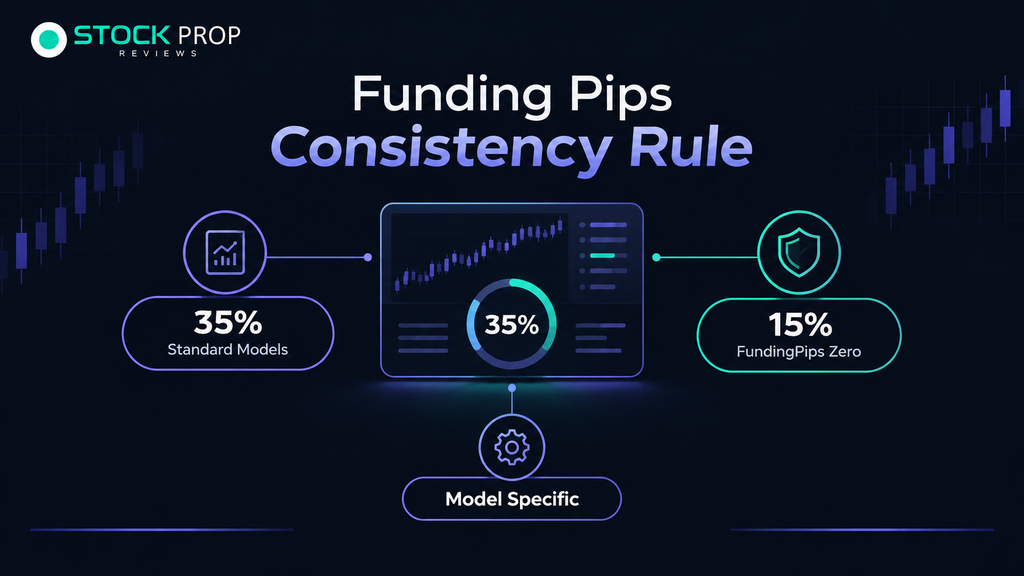
For some of the current models, having a consistency score of 35% can affect reward eligibility. This means that your biggest profitable trading day cannot account for more than 35% of your total profit. FundingPips Zero has a more rigorous 15% consistency threshold. But some bi-weekly rewards don’t use a consistency score at all.
This guide is for traders who are thinking about using FundingPips or are already running a Master Account and want to know how consistency affects rewards. This isn’t for traders who want a “one-size-fits-all” headline rule that can be applied to all FundingPips products.
The key difference is between passing an assessment and winning a reward. A trader can pass an evaluation and still have consistency requirements when asking for certain rewards.
Quick Verdict: Does FundingPips Have a Consistency Rule?
FundingPips currently uses several different rule structures.
The simplest answer is:
Yes, FundingPips has consistency requirements, but they are model and reward-cycle specific.
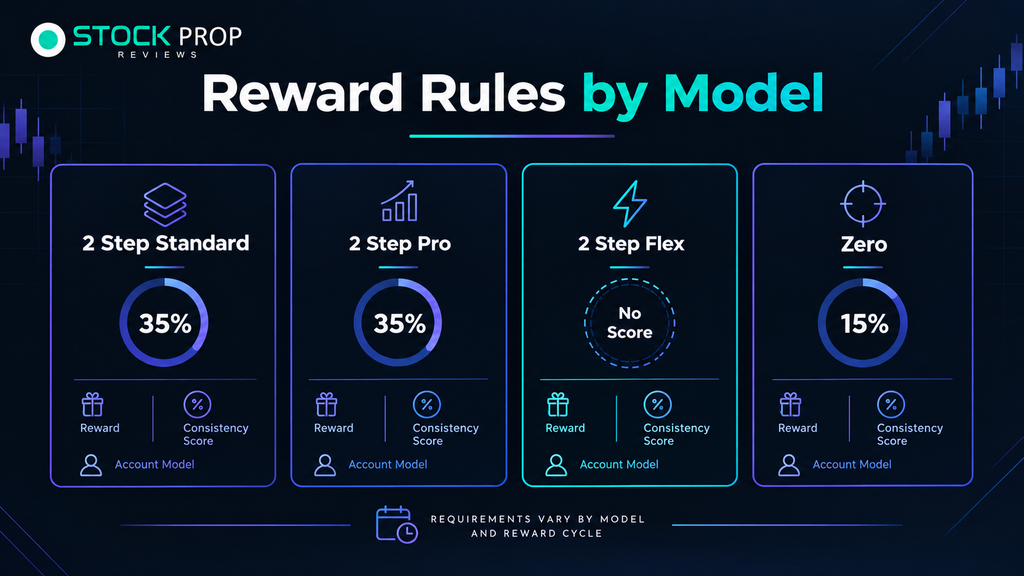
For example, the current 2 Step Standard model offers weekly, bi-weekly, monthly and on-demand reward structures. The 35% consistency score applies to the on-demand reward and the monthly 100% reward, while the weekly and bi-weekly structures have different conditions.
The 2 Step Flex model is different again. Its bi-weekly 85% and 95% options do not use a consistency score, while the monthly 100% option requires a 35% consistency score.
FundingPips Zero uses a 15% consistency score for reward requests.
So if someone simply says, “FundingPips has a 35% consistency rule,” that is incomplete.
What Is the Funding Pips Consistency Rule?
A consistency rule limits how much of your total profit can come from one exceptionally profitable trading day.
The basic formula is:
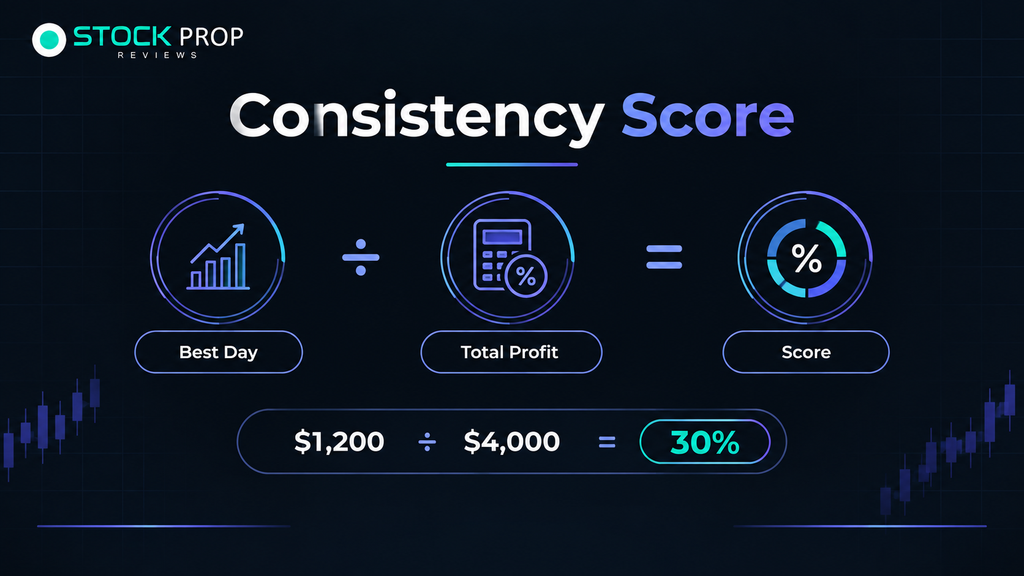
Consistency Score = Largest Winning Day ÷ Total Current Profit × 100
A lower percentage means your profits are spread more evenly across your trading days.
For example, suppose you have made $4,000 in total profit and your best trading day produced $1,200.
Your consistency score would be:
$1,200 ÷ $4,000 × 100 = 30%
That would satisfy a 35% requirement.
Now suppose your best day produced $2,000 while total profit was $4,000:
$2,000 ÷ $4,000 × 100 = 50%
You would be above a 35% threshold.
The important part is that this generally acts as a reward eligibility condition rather than an automatic evaluation failure. FundingPips describes the 35% score as a soft condition on applicable accounts.
That distinction matters.
A trader can hit the evaluation target with one large winning day without necessarily failing the evaluation because of the consistency score. The problem may appear later when requesting a reward under a cycle where the consistency requirement applies.
FundingPips Consistency Rule by Account Model
FundingPips now has several account architectures, so comparing the firm using one set of rules can be misleading.
| Model | Evaluation Target | Daily Loss | Max Overall Loss | Consistency / Reward Condition |
| 1 Step Flex | 12% | 3% | 12% static | 35% consistency not universal; concentration policy can add profitable-day requirement |
| 2 Step Standard | 8% / 5% | 5% | 10% static | 35% applies to selected reward cycles |
| 2 Step Pro | 6% / 6% | 3% | 6% static | 35% applies to Monthly 100% reward |
| 2 Step Flex | 10% / 6% | 4% | 12% static | No consistency score on bi-weekly options; 35% on Monthly 100% |
| FundingPips Zero | No evaluation | 3% | 5% trailing | 15% consistency for rewards |
These figures come from FundingPips’ current model comparison and individual model documentation. The exact rules attached to an existing account can differ depending on when it was created and which product was purchased.
This is one of the biggest areas where older FundingPips articles can cause confusion.
When Does the 35% Consistency Rule Apply?
The answer depends on your reward cycle.
2 Step Standard
The current 2 Step Standard model has a 35% consistency requirement for the on-demand reward and the monthly 100% reward.
For On Demand, FundingPips says the trader needs a 35% consistency score and at least 2% profit before requesting the reward.
The monthly 100% structure requires a 35% consistency score plus at least seven profitable days, with each profitable day producing at least 0.5% of the starting Master Account size. These conditions reset after a successfully processed reward.
The weekly 60% and bi-weekly 80% options have different eligibility mechanics.
2 Step Pro
The 2 Step Pro model has a 35% consistency requirement for its monthly 100% reward.
The weekly reward is structured differently, with an 80% split available seven calendar days after the first executed Master Account trade.
2 Step Flex
This is where the headline “FundingPips has a 35% consistency rule” becomes particularly misleading.
The current 2 Step Flex documentation says there is no consistency score on either bi-weekly split.
The 85% bi-weekly reward only requires the 14-day period, while the 95% option also requires three profitable days during the cycle.
The monthly 100% reward is different and requires a 35% consistency score plus seven profitable days at 0.5% or more of starting account size.
FundingPips Zero
FundingPips Zero has a stricter consistency requirement.
Its current rules state that your largest winning day cannot exceed 15% of total cumulative profit when requesting a reward.
That is substantially more demanding than a 35% threshold.
A Practical Example of How Traders Get Stuck
Imagine a trader has a $100,000 Master Account.
Over several days, the trader makes:
| Day | Profit |
| Day 1 | $300 |
| Day 2 | $400 |
| Day 3 | $350 |
| Day 4 | $2,000 |
| Day 5 | $450 |
Total profit is $3,500.
The largest winning day is $2,000.
The consistency score is:
$2,000 ÷ $3,500 × 100 = 57.1%
If this trader is using a reward cycle requiring a 35% consistency score, the account may be profitable but not yet eligible for that reward.
This is where inexperienced traders can become frustrated.
They think:
“I made the required profit. Why can’t I withdraw it?”
The answer is that the profit target and reward eligibility are separate calculations.
The trader may need to continue trading and build additional profit without allowing the original $2,000 winning day to become too large relative to total profit.
For the same $2,000 winning day to represent no more than 35% of total profit, total profit would need to reach approximately $5,714.
That does not mean the trader should blindly keep trading until reaching that figure. Continuing to trade simply to repair a consistency score introduces its own risk.
What Competitors Don’t Explain About Consistency
Most explanations stop after giving the formula.
The more important issue is what the rule does to trader behaviour.
A trader who makes 3% in one day may normally stop trading because the market has already delivered an unusually strong result.
But if that 3% makes up too much of total profit, the trader may feel forced to keep trading.
That creates a dangerous psychological shift.
The objective changes from:
Take good trades.
to:
Generate enough additional profit to make my previous win small enough.
That is not necessarily good risk management.
The trader can start forcing setups, increasing frequency or taking trades outside the original strategy.
This is why consistency rules should be treated as part of strategy selection rather than something to worry about after buying an account.
Our existing FundingPips rules guide goes deeper into how different FundingPips models change the practical risk profile.
Common Trader Mistakes
Making one oversized trade to pass quickly
A trader sees an 8%, 10% or 12% evaluation target and decides to make one large bet.
It can work.
But a large single-day or single-trade gain can create additional reward conditions depending on the model.
The current 1 Step Flex rules, for example, have a separate Profit Concentration Policy. If a single trade idea contributes more than 60% of the evaluation profit target, the resulting Master Account can require four profitable days before each reward request.
This is not exactly the same thing as a consistency score, but traders often confuse the two.
Confusing consistency with drawdown
Consistency controls the distribution of profits.
Drawdown controls the amount of loss you can take.
They solve different problems.
A trader can have excellent consistency and still breach a daily loss limit.
Likewise, a trader can remain comfortably inside the drawdown limits but have a reward blocked because too much of the profit came from one day.
Choosing a reward cycle based only on the profit split
A 100% reward split looks attractive on paper.
But the split is only one part of the structure.
A trader should also consider the consistency requirement, profitable-day requirements, reward timing and applicable risk rules.
Sometimes an 80% reward structure with simpler conditions may fit a trader better than a 100% structure that encourages additional trading.
Relying on old FundingPips reviews
FundingPips has changed its rule architecture considerably.
The current documentation covers different products, including 1 Step Flex, 2 Step Standard, 2 Step Pro, 2 Step Flex and Zero. FundingPips also maintains legacy rules for older accounts.
That means a statement that was accurate for an older account may not be accurate for a new purchase.
Before trading, check the rules attached to the actual account rather than relying on a generic article.
Who Is FundingPips Best For?
FundingPips can suit traders who already understand how to control position size, daily losses and profit volatility.
It is a better fit for traders who can produce relatively steady returns without feeling the need to hit a large profit target immediately.
It is less suitable for traders whose normal strategy depends on occasional oversized winners.
A trader who routinely makes most of the month’s profit in one or two sessions should pay close attention to reward-cycle requirements.
The same applies to traders who become more aggressive after a losing streak.
Our FundingPips review covers the broader issues around FundingPips, including how risk rules can affect traders who appear profitable on paper.
FundingPips Alternatives
There is no universal “better” prop firm. The right alternative depends on the strategy.
FTMO can be worth researching for traders who want another established multi-asset prop environment with its own clearly defined evaluation and risk framework.
TradeThePool is structurally different because it focuses on stocks and ETFs rather than the CFD-style environment associated with FundingPips. Its current program documentation lists more than 12,000 stocks and ETFs and publishes specific risk and trading conditions.
One important correction for traders in comparing firms: TradeThePool is not a regulated proprietary trading firm. To describe it as “regulated” would be misleading, considering that the current disclosures do not justify that characterization. It’s more akin to a stock-focused prop shop with published rules and risk parameters.
Readers can get up to 10% discount when purchasing through our TradeThePool link.
For a wider view of how different firms structure their rules, our prop firm comparison coverage can help put individual reward rules into context.
Should You Change Your Trading Strategy Because of the Consistency Rule?
Not necessarily.
The wrong response is to distort a profitable strategy simply to produce an artificially smooth equity curve.
The better approach is to choose a reward structure that fits the way you already trade.
If your strategy naturally produces many small and medium-sized winners, a consistency requirement may not be particularly difficult.
If your strategy depends on catching one or two large moves each month, a consistency-based reward structure deserves much more attention.
This is also where psychology matters.
A trader who knows a payout is blocked may feel pressure to manufacture additional trades. That can turn a simple administrative condition into a genuine trading risk.
Our article on the truth about prop firm payouts looks at the broader behavioural problem of changing trading decisions once withdrawals become the main objective.
Final Takeaway
So, does Funding Pips have a consistency rule?
Yes, but there is no single consistency rule that applies to every FundingPips account.
The current structure is more nuanced:
- Several reward cycles use a 35% consistency score.
- FundingPips Zero uses a 15% consistency requirement.
- Some bi-weekly reward options have no consistency score.
- Certain models also have separate profit concentration or profitable-day requirements.
- The rule can affect reward eligibility without necessarily failing the evaluation.
The biggest mistake is buying an account because the headline profit target or payout percentage looks attractive, then discovering that the reward conditions do not match your trading style.
Before purchasing or requesting a reward, check the exact model, reward cycle and rule set attached to your account.
That is more useful than asking whether FundingPips has “a consistency rule” in isolation.
FAQs
Does FundingPips have a 35% consistency rule?
Some current FundingPips reward structures do. The 35% requirement means your largest winning day cannot account for more than 35% of the applicable total profit. It does not apply universally to every model and reward cycle.
Can I pass FundingPips with one big winning day?
Potentially, yes. Some FundingPips models have separate profit concentration policies that can create additional reward requirements after an evaluation is passed. A large winning day therefore does not necessarily mean immediate evaluation failure, but it can affect what happens later.
Does the consistency rule apply to FundingPips bi-weekly rewards?
Not always. For example, the current 2 Step Flex documentation states that there is no consistency score on its bi-weekly 85% or 95% reward options. Other models have different requirements.
What is the FundingPips Zero consistency rule?
FundingPips Zero currently requires the largest winning day to be no more than 15% of total cumulative profit when requesting a reward.
Can a profitable FundingPips account have its reward blocked?
Yes. A trader can remain profitable and within the account’s drawdown limits but still fail to meet a consistency or other reward-eligibility condition. That is why profit targets, drawdown and reward rules should be treated as separate parts of the account structure.