The FTMO Inactivity Rule is not the same for all FTMO products. FTMO’s CFD-based Challenge and FTMO Account do not have a maximum time limit to achieve the trading objectives, but FTMO says it may reach out to traders when there has been no activity on the account for a number of weeks. FTMO offers an account freeze for planned longer breaks. FTMO Futures is more clear: “If there is no trading activity for 30 consecutive calendar days, the Sim-Funded Account will be closed.
For traders using low frequency strategies, taking long holidays or simply waiting for a very specific market setup, this distinction matters.
This guide is primarily for FTMO Challenge, FTMO Account and FTMO Futures traders that do not trade everyday. This is not for day traders who are already trading regularly and just want to know FTMO’s normal trading-period rules.
Quick verdict on FTMO inactivity
FTMO does not impose a simple “you must trade every X days” rule across its entire product range.
For the standard CFD offering, FTMO removed the old fixed evaluation time limits. Traders can take as much time as they need to reach the applicable objectives, provided they continue to comply with the account rules. FTMO says that if an account is accidentally left unused for several weeks, it may contact the trader, while a freeze can be requested for planned longer inactivity.
FTMO Futures are different. Its current Forbidden Trading Practices page states that Sim-Funded Accounts require ongoing trading activity and that an account with no recorded trading activity for 30 consecutive calendar days will be closed. The same page states that there is no inactivity rule on Live Funded Accounts.
So the practical answer is:
FTMO CFD: no stated fixed 30-day inactivity closure rule, but prolonged inactivity can trigger contact and a freeze may be appropriate.
FTMO Futures Sim-Funded: 30 consecutive calendar days without trading activity can result in closure.
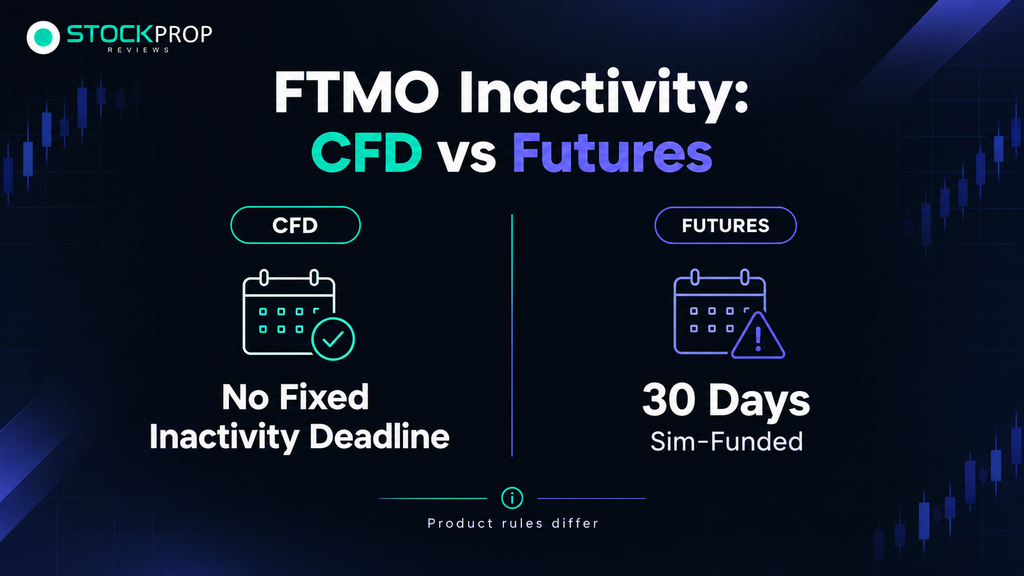
FTMO inactivity rules by account type
| FTMO product | Maximum time to complete objectives | Inactivity concern | Practical takeaway |
| FTMO CFD Challenge | No maximum trading period | Prolonged inactivity may result in contact from FTMO | Do not confuse unlimited evaluation time with unlimited account inactivity |
| FTMO CFD Verification | No maximum trading period | Same general inactivity consideration | A trader can take their time, but should communicate planned long breaks |
| FTMO CFD FTMO Account | No fixed performance deadline | FTMO may contact traders after several weeks of inactivity | Request a freeze if you know you will be away |
| FTMO Futures Evaluation | No maximum time limit while subscription remains active | Different from the Sim-Funded inactivity requirement | Subscription and inactivity are separate issues |
| FTMO Futures Sim-Funded | No maximum time to meet applicable requirements | 30 consecutive calendar days without trading activity can close the account | Low-frequency traders need to monitor the inactivity clock |
| FTMO Futures Live Funded | Depends on the applicable live arrangement | FTMO says there is no inactivity rule on Live Funded Accounts | Do not automatically apply Sim-Funded rules to Live Funded accounts |
FTMO Futures also have other important restrictions that are unrelated to inactivity. For example, Futures positions and resting orders cannot remain open past the permitted trading day, with the platform automatically liquidating or cancelling them at the session close.
What does the FTMO inactivity rule actually mean?
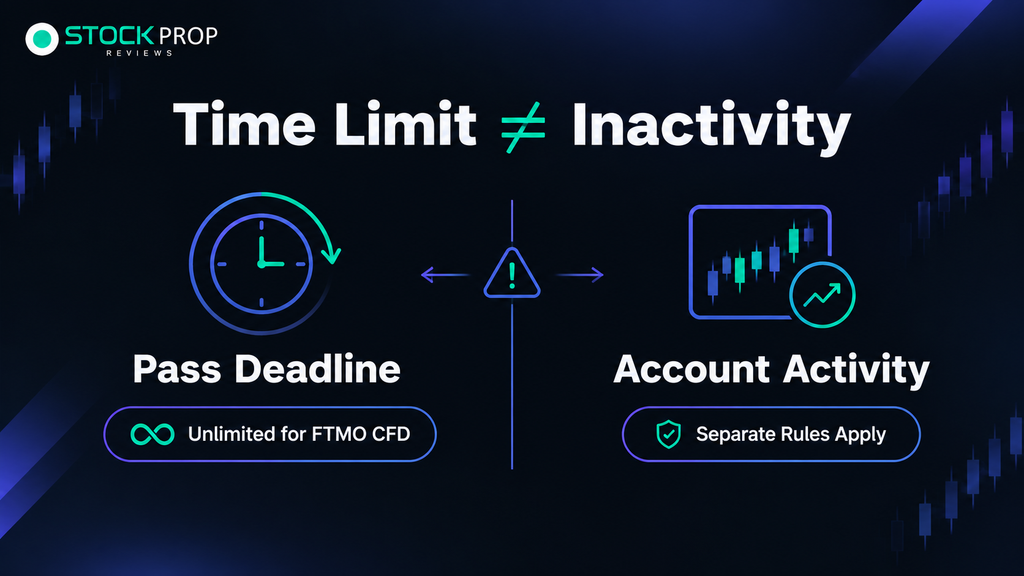
The biggest misunderstanding is treating an unlimited trading period as permission to leave an account untouched indefinitely.
Those are two different concepts.
An unlimited trading period answers the question:
How long do I have to reach the trading objectives?
An inactivity rule answers:
How long can the account remain unused without trading activity?
FTMO removed the former fixed 30- and 60-day evaluation deadlines for its CFD Challenge and Verification. The firm’s explanation was that traders should not feel pressured to increase position size simply to hit a profit target within a fixed period.
That is useful for conservative traders, but it does not mean that every account can simply sit unused forever.
For Futures, the distinction is even more important because FTMO explicitly defines the 30-day inactivity threshold for Sim-Funded Accounts.
A practical example of FTMO inactivity
Consider a trader using a swing strategy on an FTMO CFD account.
They normally wait for major weekly market structures and may only take two or three trades in a month. They pass several weeks without finding a valid setup.
That does not automatically mean the trader has failed the Challenge.
The trader still has an unlimited period to meet the applicable objectives. However, FTMO says it may contact traders when an account has been inactive for several weeks. A planned longer break can also be handled through the account freeze option.
Now consider a Futures Sim-Funded trader.
The trader stops trading for a month because of travel. If there is no recorded trading activity for 30 consecutive calendar days, the account can be closed under FTMO Futures’ current rules.
The difference is significant.
A trader who assumes that “FTMO has no time limit” applies equally to inactivity across all products could make the wrong decision.
How traders actually get caught by inactivity rules
The most common problem is not usually someone deliberately trying to avoid trading. It is misunderstanding what the rule covers.
Confusing no time limit with no inactivity requirement
A trader reads that FTMO has no maximum time limit and assumes the account can remain dormant indefinitely.
That is too broad.
The no-time-limit policy concerns the time available to meet the relevant trading objectives. FTMO Futures separately imposes an ongoing activity requirement on Sim-Funded Accounts.
Taking a long holiday without checking the product
A trader might be comfortable leaving a CFD account alone while travelling. A Futures Sim-Funded trader should be much more careful because the 30-day threshold is explicit.
If you know you will not trade for an extended period, check the current terms for your exact account before leaving it dormant.
Assuming opening the platform counts as trading
Again, this is a perilous assumption.
Futures rules specifically pertain to recording trading activity. Simply logging into a dashboard, viewing some charts or opening up the platform does not count as making a trade unless FTMO specifically states so.
Don’t try to fake activity just to reset a clock. Trading tokens that are not part of your strategy means taking on more risk than the inactivity itself.
Taking low-frequency trading too far
There is a difference between being a patient trader and having no active trading plan.
A genuine swing trader might wait for a setup. A trader who repeatedly buys challenges but never trades them is operating differently.
FTMO’s own explanation makes this distinction. Its unlimited trading period is designed to give genuine traders more flexibility, not to support accounts that are simply left unused indefinitely.
What competitors often fail to explain
Many prop-firm articles reduce inactivity to a single number.
That is convenient for SEO, but it is not very useful for a trader.
The first question should always be:
Which FTMO product are you using?
The second question is:
Are you talking about an evaluation deadline or an account inactivity requirement?
Those questions produce different answers.
FTMO’s CFD offering currently has no maximum time limit for completing the Challenge and Verification. Its Futures Evaluation also has no maximum time limit while the subscription remains active.
But FTMO Futures Sim-Funded has a clearly stated 30-calendar-day inactivity closure rule.
That is the detail traders should look for before relying on an article that simply says “FTMO has no time limit.”
Does inactivity affect FTMO drawdown?
A drawdown violation is not just inactivity.
A trader is not usually ruined just because the account balance stays the same.
Drawdown rules are different risk requirements.
For example, FTMO’s current CFD material talks about a Maximum Loss and a Daily Loss, whereas its current promotional rules state a 10% Maximum Loss and a 3% Maximum Daily Loss for the relevant setup. The exact rules can vary by product and account setup, so traders should look at their own Trading Objectives rather than some generic percentage in some old article.
Another reason not to confuse inactivity with performance rules.
A trader can do nothing and still stay within loss limits. In contrast, a trader might trade every day and blow up the account in one session by violating a loss rule.
Can swing traders use FTMO?
Yes, but the strategy has to fit the specific FTMO product and its trading restrictions.
For CFD traders, FTMO’s unlimited trading period can be useful for a patient approach because there is less pressure to force trades simply to satisfy a deadline. FTMO itself notes that removing the fixed evaluation period can reduce pressure on conservative traders.
However, holding leveraged positions for extended periods can introduce other costs and risks, including swaps. FTMO specifically warns that negative swaps can become significant when positions are held for several days.
Futures traders face a different situation. FTMO Futures does not allow positions to remain open past the permitted market close, so it is not suitable for a strategy that depends on carrying futures positions overnight.
If you are researching how this fits into a broader prop-firm decision, our FTMO review and prop firm comparison can help put the inactivity rule alongside the other rules that affect strategy fit.
Who should be careful with FTMO?
FTMO’s inactivity rules are most relevant to traders who regularly take long breaks between trades.
This includes:
- Very selective swing traders
- Traders who only trade major market events
- Traders who take extended holidays
- Traders who trade only a few times per month
- Futures traders who may leave a Sim-Funded account unused for several weeks
It is less of a concern for active intraday traders who regularly execute their normal strategy.
The bigger issue for low-frequency traders is not whether FTMO allows their strategy. It is whether the account’s operational rules match the way they actually trade.
That distinction is worth checking before paying for an evaluation.
Who may want an alternative?
If your trading style depends heavily on holding positions overnight, compare the specific product rules rather than choosing a firm based on its brand name.
Futures traders should also examine market-close requirements, because FTMO Futures requires positions and resting orders to be closed or cancelled at the end of the permitted trading session.
Stock traders may prefer a specialist stock prop model. TradeThePool is one option worth researching because its published program terms focus on stock trading, defined risk parameters and activity requirements. Its terms also make clear that the evaluation environment is simulated, so traders should read the current rules rather than assume the program works like a traditional regulated brokerage account.
For readers comparing stock prop firms, TradeThePool rules are worth reviewing alongside the actual funding conditions, activity requirements and risk parameters.
Readers can get up to 10% discount when purchasing through our TradeThePool link.
Another useful comparison is whether a firm’s rules fit your strategy before looking at the headline account size. Our prop firm rules comparison is a better starting point for that decision than simply comparing advertised funding amounts.
Common FTMO inactivity mistakes
A few simple mistakes can turn a manageable rule into an avoidable problem.
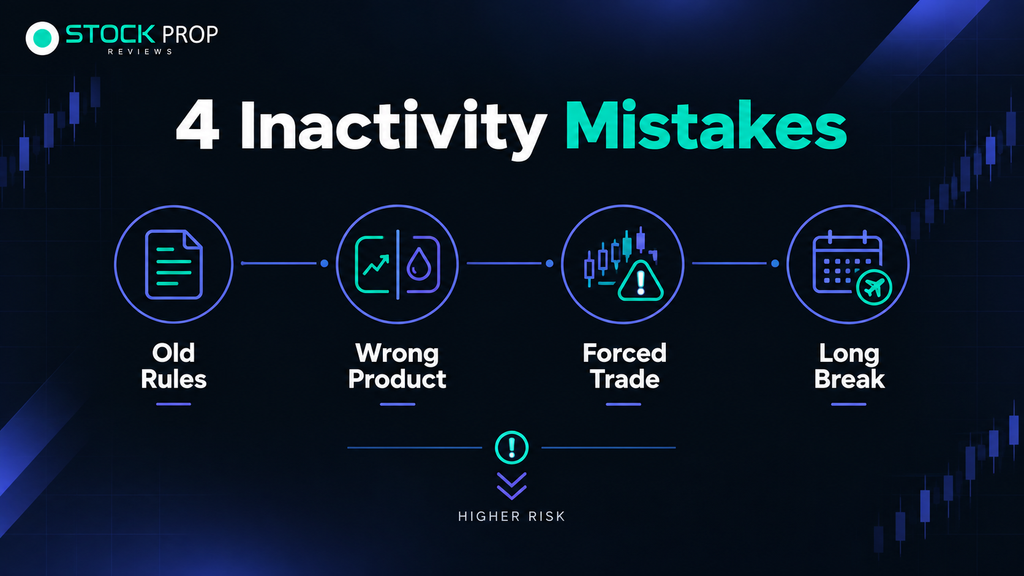
Mistake 1: Using an old FTMO article as the current rulebook.
Prop-firm rules change. FTMO’s own historical material shows how significantly its evaluation time limits changed when the unlimited trading period was introduced.
Mistake 2: Applying CFD rules to Futures.
The 30-day Sim-Funded inactivity rule is specifically stated on FTMO Futures’ current Forbidden Trading Practices page.
Mistake 3: Trading simply to avoid inactivity.
A low-quality trade can create unnecessary market risk. If a trade does not meet your setup criteria, forcing it just because of an inactivity clock defeats the purpose of disciplined trading.
Mistake 4: Ignoring planned breaks.
If you know you will be away for an extended period, check whether your account supports a freeze or whether your product has a specific inactivity threshold.
Mistake 5: Checking only the inactivity rule.
Overnight restrictions, drawdown, daily loss limits, consistency requirements and prohibited strategies can have a much greater effect on your results.
Our FTMO truth and rules analysis covers why traders should assess the complete rule set rather than focusing on one attractive feature.
FTMO inactivity rule: the trader’s checklist
Before leaving an FTMO account unused, check these five points:
- Product: CFD or Futures?
- Account stage: Evaluation, Sim-Funded or Live Funded?
- Last trading activity: When was the last actual trade?
- Planned break: How long will you be away?
- Current terms: Has FTMO changed the rules since you opened the account?
For FTMO Futures Sim-Funded accounts, the critical number is 30 consecutive calendar days without recorded trading activity.
For FTMO’s CFD products, do not interpret the unlimited trading period as a promise that an account can remain dormant forever. FTMO has stated that it may contact traders after several weeks of inactivity and that a freeze can be requested for longer planned breaks.
FAQs
Does FTMO have a 30-day inactivity rule?
Not across every FTMO product. The current FTMO Futures rules state that Sim-Funded Accounts with no trading activity for 30 consecutive calendar days will be closed. FTMO’s CFD material does not describe the same fixed 30-day closure rule.
Does FTMO have a maximum time to pass?
For the current CFD Challenge, there is no maximum trading period. FTMO Futures Evaluation also has no maximum time limit while the subscription remains active. Other minimum-day or consistency requirements may still apply depending on the product.
Can I take a break from my FTMO account?
For CFD accounts, FTMO says traders can request a freeze, particularly for planned longer inactivity such as a holiday. Futures traders should check the specific account stage because the 30-day inactivity requirement applies to Sim-Funded Accounts.
Does logging into FTMO reset the inactivity period?
Do not assume that logging in, checking charts or opening the platform counts as trading activity. The Futures rule refers to recorded trading activity. If you need certainty about a particular action, confirm it with FTMO before relying on it.
Is FTMO suitable for low-frequency traders?
It can be, particularly where the strategy benefits from an unlimited evaluation period. However, low-frequency traders need to consider inactivity, holding restrictions, swaps and the other rules of the exact FTMO product they intend to use. Futures traders face the additional 30-day Sim-Funded inactivity requirement.
The article is deliberately careful about the CFD versus Futures distinction, because that is the main point many competing explanations miss.