The problem about prop firms for traders in Iran is that they are not as easy to find as you might expect just by looking at a country list. Iranian traders can find companies that seem to be available, but eligibility can change due to sanctions, KYC, payment processors, broker relationships, and internal compliance policies.
This guide is for traders in Iran looking at a forex, CFD, stock or futures prop firm. This isn’t for traders looking for a surefire way around country restrictions. Using false residency info, someone else’s identity, or a VPN to hide your location can lead to account and payout issues.
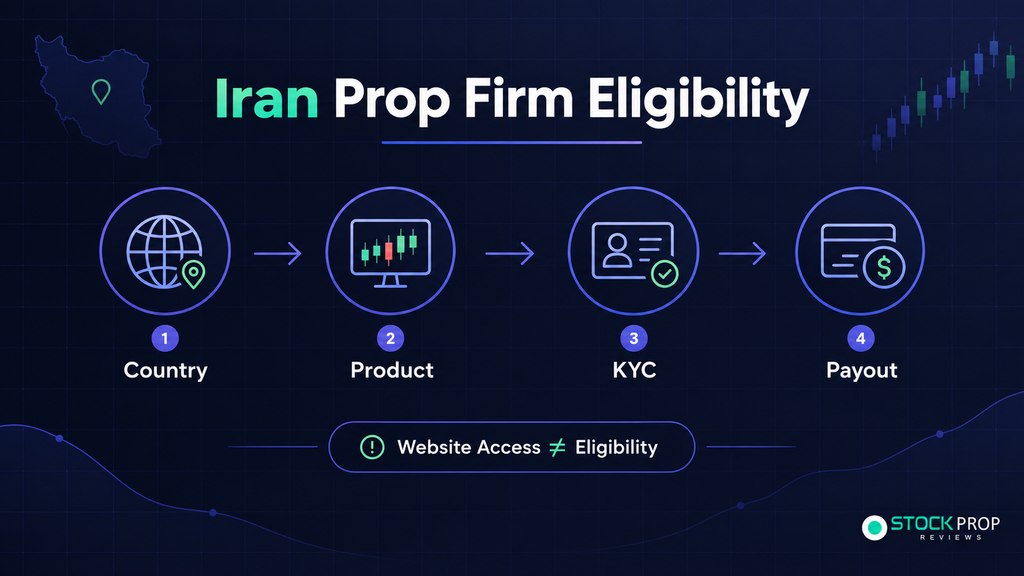
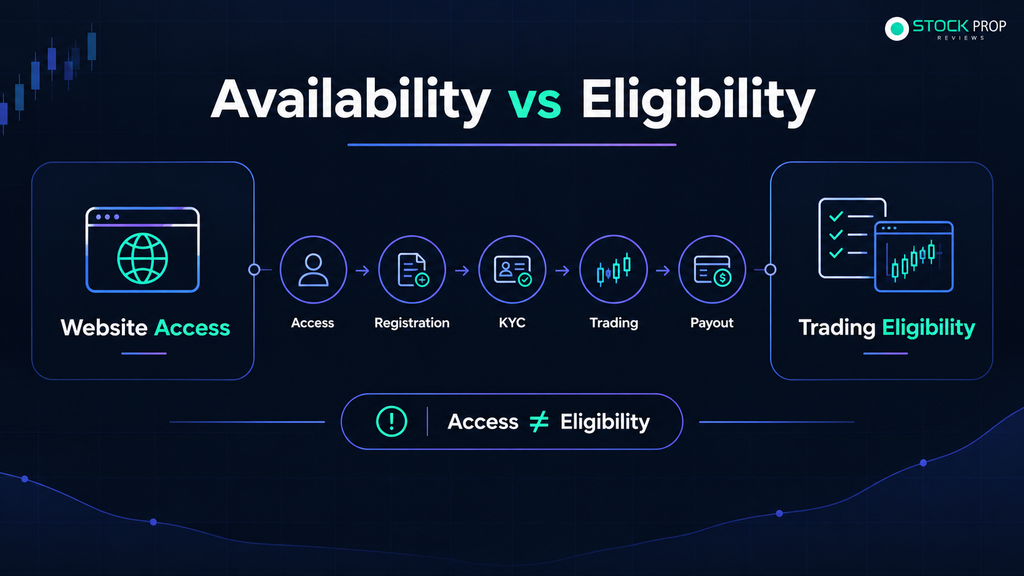
The important point is, access to the website does not automatically mean you are eligible to trade. A trader could be able to load a firm’s website but not be able to buy an account, perform KYC or receive a pay out.
Are Prop Firms Available to Traders in Iran?
Yes, some prop firms will accept traders located in Iran but availability depends on the firm’s current country restrictions, product type, KYC requirements and payout arrangements. Prop Firm Match has now added 37 forex prop firms to its Iran restrictions page showing that country access is a major problem for Iranian traders.
The important thing is that the third-country list should not be taken as the final word. Policies may change and a firm might have different restrictions on forex, CFD, futures or other trading programs.
Traders should check the firm’s current official terms before paying for a challenge to check whether Iranian residents can register, complete KYC, trade the specific program and receive payouts. Just having access to a website does not make a trader fully eligible.
Why Iran Restrictions Are Complicated
Country eligibility can involve several different questions:
| Check | What it means |
| Website access | You can visit the firm’s website |
| Registration | You can create an account |
| Challenge purchase | You can actually buy the program |
| Trading access | You can receive login credentials and trade |
| KYC | Your identity and residency can be verified |
| Payout eligibility | You can legally receive performance rewards |
| Payment method | You have a supported way to pay and withdraw |
A firm can pass one of these checks and fail another.
This is one of the biggest gaps in many country-based prop firm lists. They often answer the question “Does this firm appear available?” without explaining what happens after registration.
The FundedNext Example Shows Why Verification Matters
FundedNext is a useful example of why traders should check the exact product and current terms.
Its current CFD help-center article lists countries restricted from FundedNext CFDs, and Iran is not included in that particular list.
However, FundedNext’s current Trust and Security page says that FundedNext Ltd. does not offer services to residents of Iran, while its Futures documentation explicitly lists Iran among countries restricted from purchasing Futures accounts.
There is therefore an important distinction between CFD and Futures products, and the firm’s public pages are not perfectly consistent.
FundedNext also states that Iranian traders can use TC Pay for Performance Reward withdrawals, while Iran is excluded from bank-transfer withdrawals.
For an Iranian trader, this illustrates the real question to ask:
“Am I eligible for this exact product, under the current terms, and can I complete KYC and receive the payout?”
That is much more useful than simply asking whether the firm’s website works from Iran.
Prop Firms That May Restrict Traders in Iran
Several well-known prop firms are currently listed as restricting traders from Iran by third-party country databases. Prop Firm Match, for example, lists 37 forex prop firms under its Iran restrictions page and includes names such as Funding Pips, E8 Markets, BrightFunded and The5ers.
These lists should be treated as a reference point rather than final proof of eligibility. Country policies can change, and restrictions may differ between products, account types, residency status and payout methods.
Iranian traders can opt for a more secure option by checking the current official terms of the firm and making sure they qualify by contacting the support team before paying for a challenge. Being on an ‘available’ list for a firm does not automatically mean a trader will be able to finish KYC or get paid out.
The practical rule is simple: do not purchase a prop firm challenge based only on an aggregator’s country list. Verify the current policy, KYC requirements and payout options first.
What Iranian Traders Should Check Before Buying
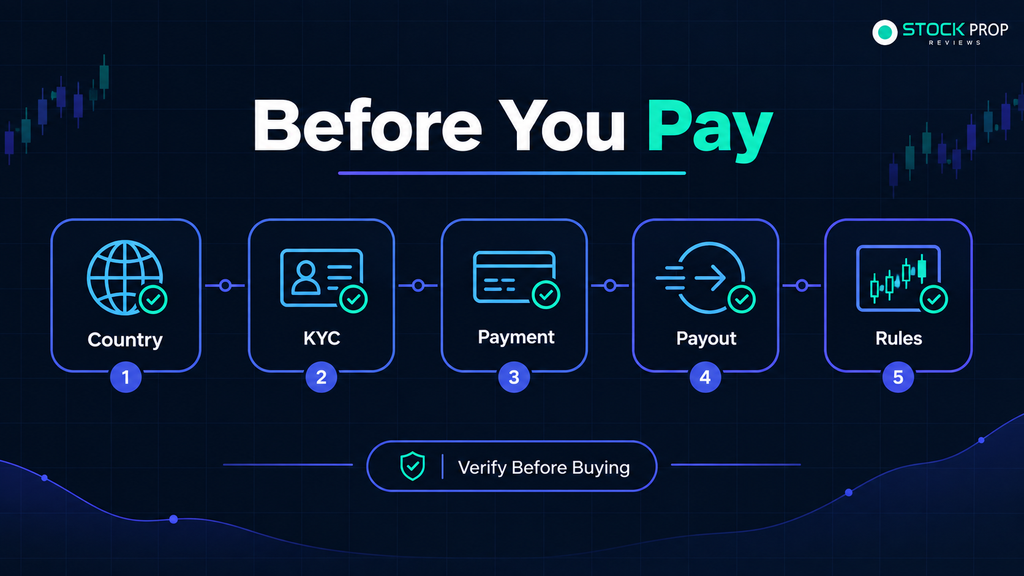
A proper eligibility check should happen before paying the challenge fee, not after passing it.
1. Check residency restrictions
Some firms distinguish between nationality and residency.
An Iranian citizen living legally in another country may be treated differently from a trader physically residing in Iran. Conversely, having another passport does not necessarily remove restrictions based on residence.
Do not assume that nationality alone determines eligibility.
2. Check the exact product
A firm’s CFD program, Futures program and stock program may have different eligibility rules.
FundedNext is a clear current example. Its Futures restrictions explicitly include Iran, while its CFD restriction documentation presents a different list.
Always check the specific program you intend to purchase.
3. Check KYC requirements
Passing the challenge is not the same thing as passing verification.
A trader could make the required profit, stay within the drawdown limit and then encounter a problem during identity or residency verification.
That is why the KYC stage should be considered part of the trading process, not an administrative detail at the end.
4. Check payment options
Iranian traders can face more difficulty paying challenge fees than traders in countries with unrestricted international card and banking access.
Crypto, regional payment processors and other supported methods may be available at some firms, but availability can change.
More importantly, a payment method being technically available does not automatically mean the resulting account is eligible.
5. Check the payout route
This is where many country lists provide too little information.
Before purchasing, confirm:
- Available Payment Methods
- Iran payments?
- Required KYC Documents
- Withdrawal from below
- processing instructions
- If the provider of the payout itself serves Iranian residents
A challenge is not particularly useful if you can pay the fee but cannot reliably receive an eligible payout.
How Traders Actually Get Into Trouble
Country restrictions are only one part of the risk.
Consider a trader who finds an apparently available firm through a comparison website. They purchase a $100,000 evaluation, pass it using 1% risk per trade, and then reach the funded stage.
The trader may believe the difficult part is finished.
Then KYC identifies Iran as the trader’s actual residence and the firm applies a country restriction.
The trading performance does not necessarily solve the eligibility problem.
Another common mistake is assuming that a VPN solves the issue.
It does not.
FundedNext, for example, explicitly warns that attempts to bypass jurisdictional restrictions using VPNs, proxies, third-party identities or inaccurate declarations can lead to account termination.
The sensible approach is to disclose your actual circumstances and obtain confirmation before paying.
Common Trader Mistakes in Iran
Confusing website access with eligibility
A website loading from Iran tells you very little about whether you can complete KYC and receive rewards.
Trusting an old availability list
A list published six months ago can become outdated after a firm changes its broker, payment processor or compliance policy.
Choosing based only on profit split
A 90% or 95% advertised split is irrelevant if the firm cannot legally or operationally pay you in your jurisdiction.
Ignoring payout restrictions
Payment and payout are separate questions. A firm may accept one method for purchasing an evaluation but use a completely different provider for rewards.
Using someone else’s documents
This creates a much bigger problem than simply being rejected. KYC information should accurately represent the person trading the account.
How to Compare Available Prop Firms in Iran
Rather than looking for one “best” firm, Iranian traders should compare firms against their own requirements.
| Factor | What to verify |
| Country eligibility | Is Iran currently accepted? |
| Residency | Does the firm restrict residents, nationals, or both? |
| Product | CFD, forex, futures or stocks? |
| KYC | What documents are required? |
| Payment | Can you legally purchase the challenge? |
| Payout | Can Iranian residents receive rewards? |
| Drawdown | Static, trailing or daily? |
| Profit split | How is the trader’s share calculated? |
| Trading rules | News, overnight, weekend, EA and copy trading restrictions |
| Platform | MT5, cTrader, Match-Trader or another platform |
| Support | Can the firm confirm Iranian eligibility in writing? |
This approach is more reliable than selecting a firm from a ranked country list.
Strategy Fit Matters More Than the Country List
An Iranian scalper and an Iranian swing trader can have completely different requirements.
A scalper should pay particular attention to execution, spread conditions, minimum trade duration, news restrictions and platform stability.
A swing trader needs to investigate overnight and weekend holding rules, swap conditions and whether positions can remain open during major market events.
A news trader should specifically check whether high-impact news trading is permitted.
A trader using automated systems needs to check EA, VPS and copy-trading rules before purchasing.
This is where a general country list falls short. Availability is only the first filter. Rule compatibility is the second.
What About Stock Prop Firms?
Iranian traders interested in equities should treat stock prop firms separately from forex and CFD firms.
TradeThe Pool, for example, focuses on stock trading rather than forex or futures. Its current program offers day-trading and swing-trading paths with buying-power levels up to $200,000.
However, it would be inaccurate to describe TradeThe Pool as a regulated broker. Its own website states that Five Percent Online Ltd. operates it as a proprietary trading firm and that it is not a financial institution or other regulated financial business. Trading in its hub is simulated.
For traders comparing stock-focused firms, the attraction is the different market structure and clearly stated trading rules rather than a claim of regulatory status.
Readers can get up to 10% discount when purchasing through our TradeThePool link.
What Competitors Often Miss
One of the biggest problems with many articles about prop firms available in Iran is that they treat country eligibility as a simple yes-or-no label.
In practice, eligibility involves several separate checks:
Firm policy → Product → KYC → Payout
A trader needs all four to work before the account is genuinely usable.
Third-party databases can also produce different results. Prop Firm Match currently lists a substantial number of firms as restricting traders from Iran, but country policies can change and may differ between specific products or account types.
This does not automatically mean that one source is wrong. The information may have been collected at different times, or a database may use a different definition of “available.” It may also fail to distinguish between trading products such as CFDs, forex and futures.
The practical solution for Iranian traders is to check the current policy with the prop firm directly. Before paying for a challenge, make sure you can register, complete KYC, trade the specific program, and get paid out.
Practical Checklist Before You Pay
Before purchasing any prop challenge from Iran, confirm these points:
- Now Iran is accepted for the same program.
- Your actual home can pass KYC.
- This payment method is available to you.
- The payout method is available to Iranian residents.
- The firm’s trading rules fit your strategy.
- The firm’s current terms do not contain another relevant jurisdictional restriction.
- Customer support confirms eligibility if the website is unclear.
Save the firm’s response and current terms before purchasing. Country restrictions can change, and having a dated record of the firm’s answer can be useful if the policy changes later.
Related Prop Firm Research
For traders comparing individual firms, our FTMO review and Funding Pips review provide a more detailed look at rules and trading conditions. A broader prop firm comparison can help when you are choosing between different challenge structures.
For the behavioral side of funded trading, our analysis of traders failed prop firms also explains why passing an evaluation and surviving a funded account are two different challenges.
These distinctions matter because a country-eligible account can still be a poor fit for a trader whose strategy conflicts with its drawdown or consistency rules.
FAQs
Can Iranian traders use prop firms?
Some prop shops or products will allow Iranians, but availability varies and third party lists can be different. Current eligibility subject to change. Check with the firm before purchase.
Funding Pips and The5ers in Iran – Can it be Done?
Funding Pips and The5ers are both flagged as restricted for Iran in third party country databases. However, country restrictions can change, and eligibility may depend on the specific program, residency status, KYC requirements and payout arrangements.
Are Iranian traders able to use a prop firm with VPN restrictions?
A firm’s terms may be violated by the use of a VPN to mask a restricted residency or location. FundedNext clearly states that any attempts to bypass jurisdictional restrictions are strictly prohibited and such attempts may lead to termination.
Is FundedNext available for traders in Iran?
The answer will depend on the product and what the firm has documented at that time. FundedNext’s CFD restriction list does not currently name Iran, while its Futures documentation does restrict Iran. Its public trust page includes a more general statement for Iran as well, so buyers should seek up-to-date product-specific confirmation prior to purchase.
What should Iranian traders check before choosing a prop firm?
Check four things first: country eligibility, KYC, payment method and payout method. Then compare drawdown, profit split, platform and trading rules against your strategy.