
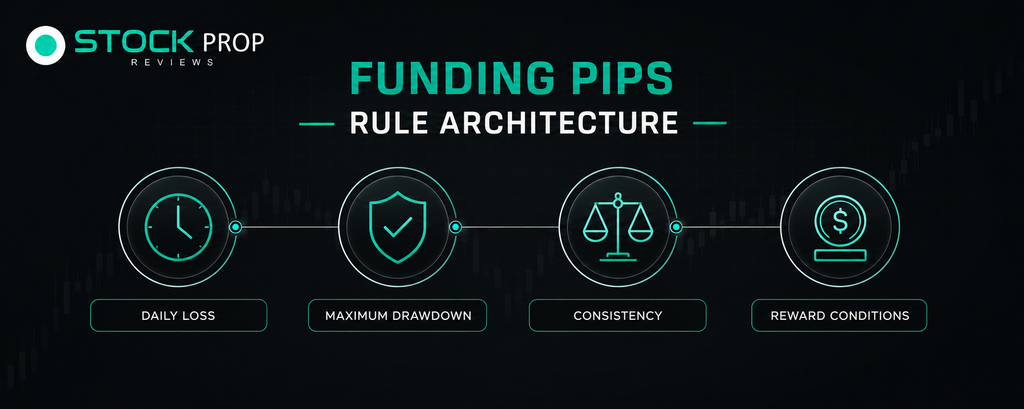
Funding Pips rules are not a one size fits all rule. The firm now uses various risk and reward structures in models such as 1 Step Flex, 2 Step Standard, 2 Step Pro, 2 Step Flex and Zero. That’s important, because a trader who knows one model might misinterpret another and violate an apparently innocuous condition.
This guide is for traders considering FundingPips or already trading one of its accounts and want to understand how the rules work in practice. It’s not for traders looking for a quick “maximum loss and profit target” summary. The key things to know are how daily loss is calculated, how floating P&L is handled, when consistency rules apply, and how reward conditions can change the way you should manage a funded account.
Funding Pips rules at a glance
FundingPips refers to its programs as simulated trading environments, not traditional brokerage accounts. The firm says traders don’t put their own trading capital into the account and the evaluation environment simulates market conditions.
The current architecture is broadly:
| Model | Evaluation profit target | Daily loss | Maximum loss | Important reward feature |
| 1 Step Flex | 12% | 3% | 12% static | Reward conditions depend on selected cycle |
| 2 Step Standard | 8% / 5% | 5% | 10% static | 35% consistency applies to selected reward cycles |
| 2 Step Pro | 6% / 6% | 3% | 6% static | Weekly or monthly reward structures |
| 2 Step Flex | 10% / 6% | 4% | 12% static | 85%, 95% or 100% reward structures |
| Zero | No evaluation | 3% | 5% trailing | 15% consistency and other reward conditions |
These are figures based on FundingPips’ up-to-date rule documentation and responsible trade policy. Depending on when the account was created and which model it is, the rules may be different, so before making a broad comparison, traders should check the specific rule page linked to their account.
The biggest point is simple. FundingPips should be seen as a collection of rule architectures rather than a single challenge with a single set of standard restrictions.
How the Funding Pips daily loss rule works
Daily loss is one of the easiest rules to misunderstand.
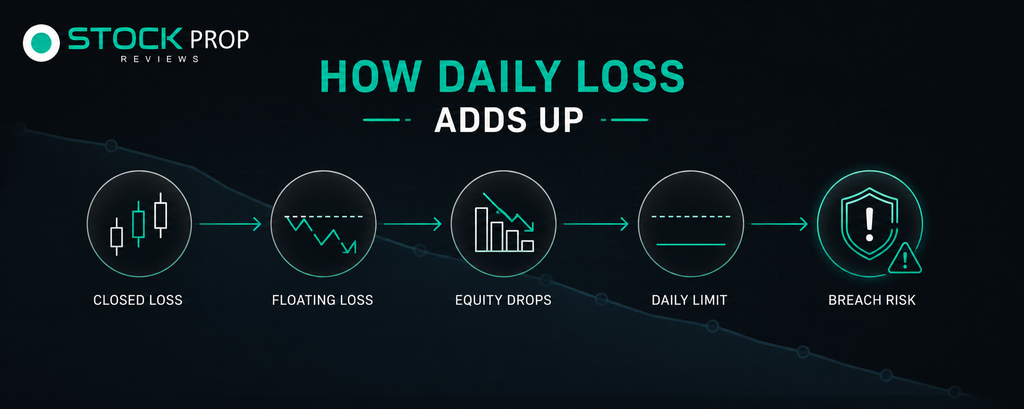
For the current 2 Step Standard model, the daily loss limit is 5% of the higher value between the opening balance and opening equity for that trading day. Both closed losses and floating losses count. The calculation resets at 00:00 platform time, currently UTC+3 according to the firm’s documentation.
Suppose a $100,000 account starts the day with:
- Balance: $102,000
- Equity: $104,000
The higher figure is $104,000.
Five percent of that is $5,200. Therefore, the equity cannot fall to or below $98,800 during that day.
This is where traders get caught. They may think, “I have only lost $3,000 today,” while an open position is carrying another $2,500 loss. The system looks at the relevant equity calculation, not simply the amount of closed losses shown in the history.
That distinction becomes particularly important around major news releases, market opens and positions held through volatile sessions.
Maximum drawdown is not the same as daily loss
FundingPips uses different maximum loss levels depending on the model.
For example, the current 2 Step Standard model has a 10% static maximum loss, while 2 Step Pro has a 6% static maximum loss. A static limit is based on the starting account size and does not trail upward as the account makes money.
On a $100,000 2 Step Standard account, the 10% maximum loss creates a $90,000 floor.
If the trader makes $8,000, the account may rise to $108,000, but the maximum-loss floor remains based on the original $100,000 starting size.
This is materially different from a trailing drawdown model.
For traders, static drawdown is generally easier to understand, but that does not make it easy to trade. A trader can still lose an account because of the daily limit long before reaching the overall loss floor.
The Funding Pips consistency rule is more complicated than it sounds
Consistency is one of the areas where competitor summaries often become too simplistic.
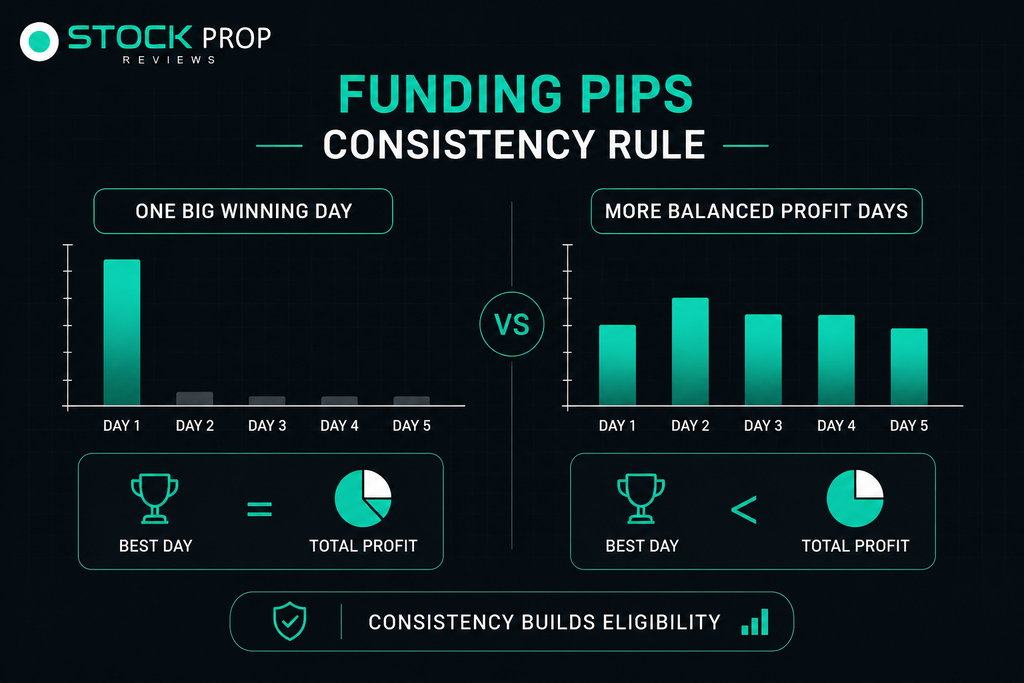
For the current 2 Step Standard model, FundingPips applies a 35% consistency score to the On Demand and Monthly reward cycles. A trader’s single best trading day cannot represent more than 35% of total profit for the relevant calculation. Weekly and Bi-Weekly reward cycles are not subject to that 35% requirement on this model.
Consider a trader who makes:
| Day | Profit |
| Monday | $1,500 |
| Tuesday | $500 |
| Wednesday | $400 |
| Thursday | $300 |
| Friday | $300 |
| Total | $3,000 |
The best day is $1,500.
That is 50% of total profit, so the trader would not satisfy a 35% consistency requirement.
The important part is that this does not necessarily mean the account is immediately breached. FundingPips describes the consistency condition as a reward-request restriction in the applicable cycles. The trader can continue trading and increase total profits until the best day represents a smaller percentage of overall profit.
That difference between a hard breach and a reward restriction is something traders frequently miss.
Reward percentages can change the practical risk
Headline profit splits can be misleading if you do not examine the conditions attached to them.
On the current 2 Step Standard model, FundingPips lists several reward cycles. The On Demand option offers a 90% split but requires a 35% consistency score and at least 2% profit. Weekly rewards have a 60% split, while Bi-Weekly rewards have an 80% split. A Monthly option introduced for Master Accounts purchased from August 15, 2026 offers a 100% split, but it comes with a 35% consistency requirement and at least seven profitable days with each day producing at least 0.5% profit of the starting account size.
That creates an important distinction between maximum advertised split and the conditions required to actually receive it.
A trader who produces most of the month’s profit on one strong day may be profitable but still fail to qualify for a reward under a consistency-based cycle.
Trade ideas and the 10-minute rule
FundingPips also has rules around how related positions can be treated as one trade idea.
For certain current models and account stages, multiple positions on the same instrument and direction can be combined. In addition, a new position opened in the same direction within 10 minutes of closing a losing trade can be treated as part of the same trade idea.
Imagine this sequence:
You lose $400 on EUR/USD.
Five minutes later, you enter again and lose another $300.
You enter a third time and lose $100.
A trader might see three separate trades in the platform history. The firm’s risk system may treat them as one trade idea for the relevant rule.
That matters for traders who use rapid re-entry after a stop loss. What feels like three independent setups can look like one extended risk event under the firm’s rule architecture.
Why traders actually fail FundingPips
Most rule breaches do not begin with a trader deliberately trying to break the rules.
They usually start with ordinary trading losses.
A trader takes a normal $500 loss. The next setup looks attractive, so they increase size. Another loss follows. They then try to recover the account quickly.
The problem becomes mathematical.
If a trader normally risks 0.5% but suddenly risks 2%, four bad decisions can consume the same risk budget that would normally support many trades.
This is where daily loss rules become dangerous. A trader does not need to reach the maximum drawdown to lose an account. A sequence of larger-than-normal positions, combined with floating losses, can reach the daily threshold much faster than expected.
Gold traders should be especially careful. XAU/USD can move quickly enough that a position which appears comfortable during normal conditions can become a significant percentage of the daily loss allowance during a volatile session.
The rule most traders underestimate
The most underestimated rule is not necessarily the maximum drawdown.
It is the interaction between position sizing, floating P&L, daily reset timing and reward conditions.
Consider a trader who makes 5% in two days and assumes the hard part is finished.
If most of that profit came from one unusually large trading day, a consistency requirement can become relevant when the trader requests a reward.
At the same time, increasing position size because the account is profitable can create a much larger floating drawdown than the trader is accustomed to handling.
The account can therefore move from “doing very well” to “under pressure” without the trader having changed their strategy. They may simply have increased risk after seeing an early profit.
What competitors often leave out
Most FundingPips comparisons focus on profit targets, maximum loss and profit split.
Those numbers are useful, but they do not tell you how the account behaves during real trading.
The more important questions are:
Does floating P&L count? Yes, for the daily and maximum loss calculations described in the current rules.
Does the daily limit reset? Yes. The current 2 Step Standard documentation states that it resets at 00:00 platform time.
Can a profitable account still have a reward blocked? Yes, where a consistency requirement applies.
Can several trades be treated as one trade idea? Yes, under the applicable trade-idea rules.
Can inactivity matter? Yes. For example, the current 2 Step Standard and Pro documentation states that an account can breach inactivity requirements after 30 consecutive days without completed trades.
These details are more useful to a trader than simply knowing that a program has a “10% drawdown.”
FundingPips strategy fit
FundingPips can make sense for traders who already operate with controlled risk and understand the exact model they are purchasing.
It is a better fit for a trader who can keep position size relatively stable, tolerate normal losing streaks and avoid forcing trades to meet a reward target.
It is a weaker fit for traders who:
- Grow Bigger from Losses
- Expect one or two big winning days
- Trade Revenge Often
- Get right back in after losses
- “Hold large positions through volatile news”
- Select a reward cycle without knowing the terms
This is also why a strategy that performs well in a personal account may not automatically transfer well to a prop environment. The strategy has to survive the firm’s risk architecture, not just generate positive expectancy.
Our FTMO review and Apex Trader Funding review are useful comparisons if you are evaluating how different rule systems affect trading behaviour. A broader prop firm rules comparison can also help when the headline profit split starts influencing your decision more than the actual risk limits.
FundingPips vs alternatives
| Firm | Main strength | Key risk structure | Best for |
| FundingPips | Multiple models and reward structures | Model-specific daily/max loss and reward conditions | Traders who understand rule variations |
| FTMO | Relatively clear two-stage structure | 5% daily and 10% maximum loss on the current 2 Step model | Traders wanting a well-defined evaluation |
| The5ers | Multiple styles and longer-duration approaches | Depends heavily on the selected program | Traders wanting different risk architectures |
FTMO’s current 2 Step structure uses a 10% Challenge target, 5% Verification target, 5% Maximum Daily Loss and 10% Maximum Loss. Its maximum loss is static in the 2 Step model, while the daily limit is recalculated using the previous balance at the daily reset.
The5ers also offers several structures. Its current High Stakes program, for example, uses a 10% Phase 1 target on the New version, 5% Phase 2 target, 5% daily loss and 10% maximum loss, with unlimited time to complete the evaluation.
For a trader deciding between these firms, the best question is not “Which has the highest profit split?”
The better question is “Which rule set is closest to how I already trade?”
Who should avoid FundingPips?
A trader should probably avoid FundingPips if they need wide discretion around risk.
If your strategy routinely requires large positions, aggressive averaging, frequent rapid-fire re-entry or highly concentrated exposure, the account rules can become an operational constraint.
The same applies if you tend to trade differently after losing money. A prop account magnifies the consequences of that behaviour because the trader is operating inside a fixed risk boundary.
This is particularly important for beginners. Passing an evaluation is not evidence that a trader can manage a funded account. The funded stage introduces a different psychological problem: protecting a profitable account can become more important than producing the next trade.
A note on TradeThePool
For traders who are primarily interested in stocks rather than forex or CFD-style prop trading, TradeThePool is worth comparing because it is designed around U.S. stocks and ETFs and uses a different risk framework.
There is one important accuracy point, however. TradeThePool itself states that its online prop trading environment is not regulated and that its evaluation accounts are simulated. Its own disclosure says the broader online prop trading arena is not yet regulated.
So we would not describe TradeThePool as a regulated stock prop firm. It is more accurate to describe it as a stock-focused prop firm with transparent program terms and a simulated evaluation environment. Its current program terms emphasize flexibility while still requiring traders to operate within defined risk parameters.
For readers who want to compare a stock-focused alternative, readers can get up to 10% discount when purchasing through our TradeThePool link.
The psychology behind rule breaches
The final issue is behavioural.
A trader who risks 0.5% per setup can survive a normal losing streak. The same trader may destroy an account if they decide to risk 2% after three losses because they feel they are “due” for a winner.
The rule did not cause the failure.
The trader changed the risk model.
That is why the most useful way to read FundingPips rules is as a risk budget. Your daily loss limit, maximum loss limit, trade-idea restrictions and reward requirements all define how much freedom your strategy actually has.
If your normal strategy needs more freedom than those boundaries provide, the problem is not that you need to trade harder. You need a different account structure or a different risk model.
That is the same issue discussed in our [truth about prop firm consistency rules] analysis. Consistency rules are not simply administrative requirements. They can change the optimal way to manage a trading account.
FAQs
What is the maximum daily loss at FundingPips?
It depends on the model. Current examples include 5% for 2 Step Standard, 3% for 2 Step Pro, 4% for 2 Step Flex and 3% for 1 Step Flex. FundingPips calculates the daily limit using the applicable account-day baseline and includes floating P&L.
Does FundingPips use a consistency rule?
Yes, but it depends on the model and reward cycle. For the current 2 Step Standard model, the 35% consistency score applies to On Demand and Monthly rewards, while Weekly and Bi-Weekly cycles are not subject to that rule.
Can floating losses cause a FundingPips breach?
Yes. FundingPips states that both floating and closed P&L are included in the applicable daily and maximum loss calculations.
Can FundingPips treat multiple trades as one trade idea?
Yes. Under applicable current rules, multiple positions can be grouped as one trade idea, and a new position opened within 10 minutes of closing a losing trade in the same direction can also be grouped into the same idea.
Is FundingPips suitable for aggressive traders?
Generally, it is a poor fit if your strategy depends on aggressive position sizing, rapid recovery after losses or concentrated exposure. The firm has several models, but every model imposes defined risk boundaries that can punish inconsistent sizing.
The practical lesson from Funding Pips rules is simple: Don’t choose the model based on its advertised profit split alone. Choose it by how well your normal risk, holding style, position sizing and trading frequency can fit comfortably within the entire rule architecture.