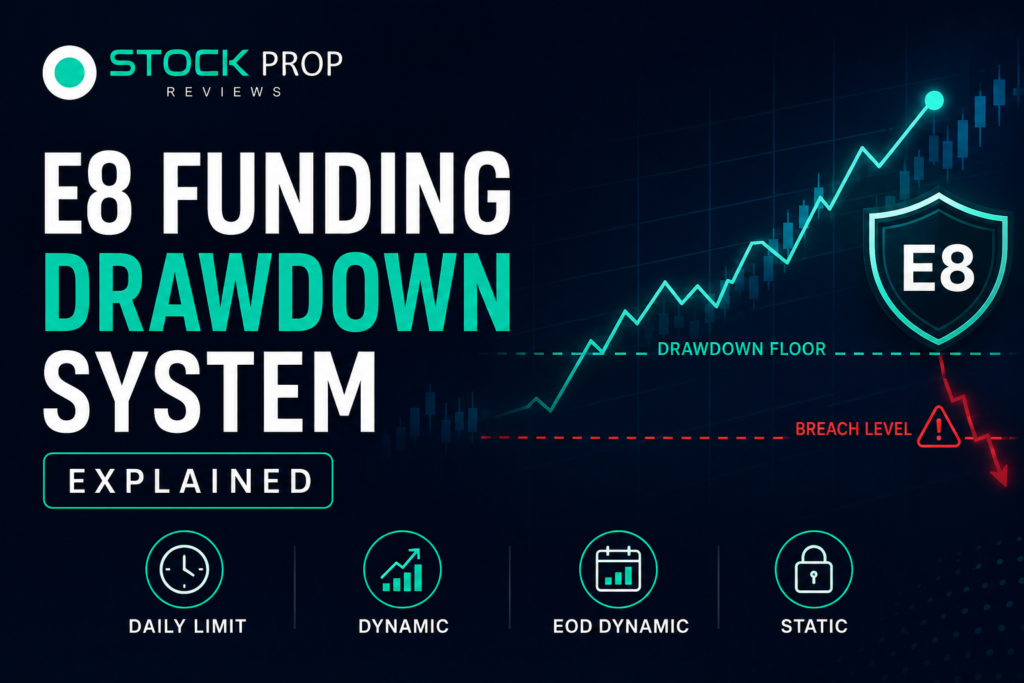
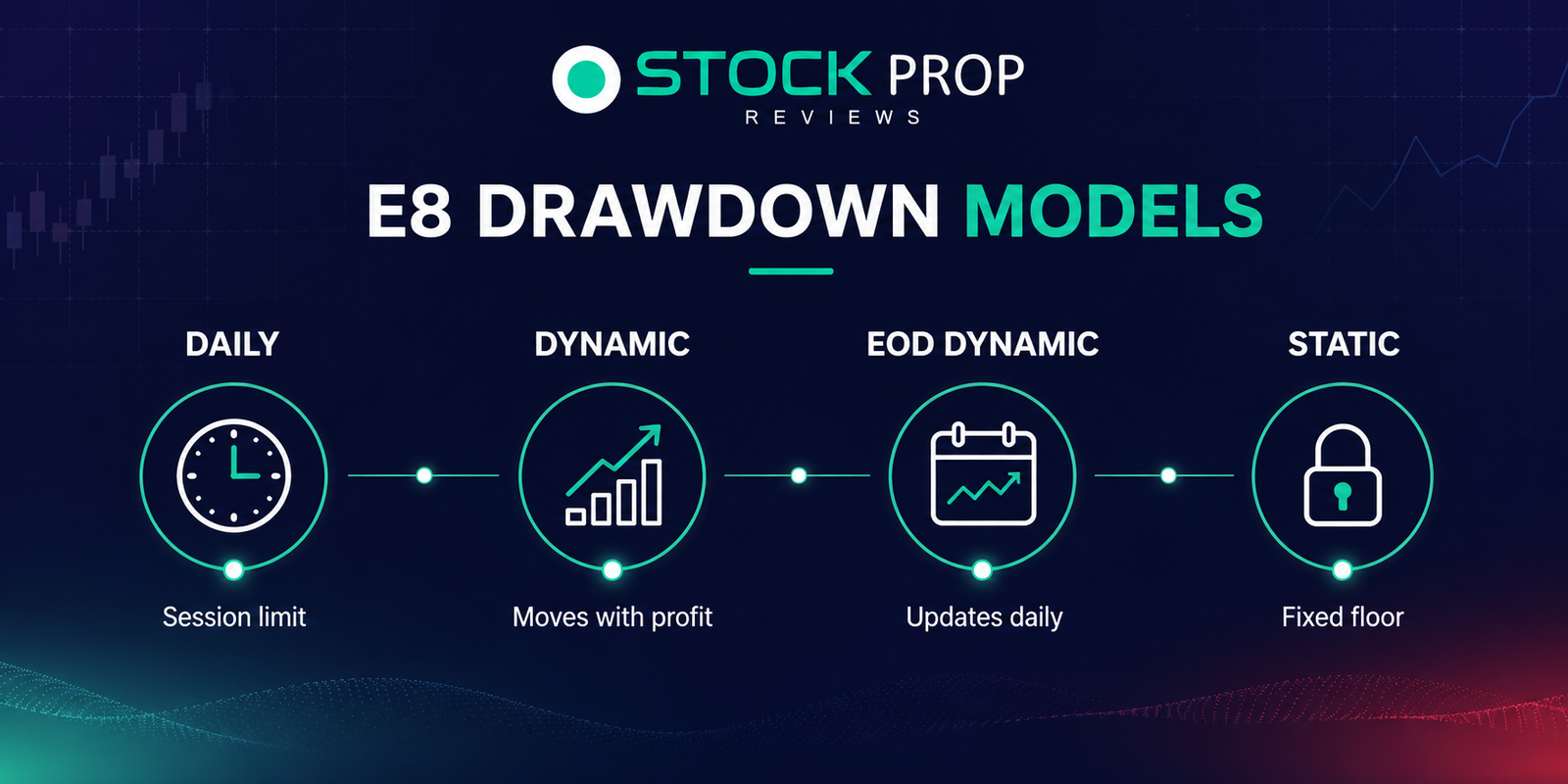
E8 Funding drawdown is not one single rule. The firm currently uses different drawdown systems depending on whether you choose E8 One, E8 Signature, E8 Pro, E8 Zero, or another account configuration. Some models use daily drawdown, some use dynamic or end-of-day dynamic drawdown, while E8 Pro uses static drawdown.
That difference matters because a trader can be profitable overall and still lose an account by misunderstanding how the loss level moves.
This guide is for beginner and intermediate traders comparing E8 Funding models or preparing to trade one. It is not for traders looking for a way around risk rules. The important question is whether the drawdown structure fits your normal losing streak, position size and trading style.
E8 Funding drawdown: quick verdict
The E8 drawdown system is more flexible than a simple fixed-loss model because different products offer different risk structures. The problem is that this flexibility also creates room for confusion.
For example, E8 One currently combines a 3% daily drawdown with a 4% dynamic drawdown on its preset account structure. E8 Signature uses EOD Dynamic Drawdown, where the loss level changes based on your highest end-of-day balance rather than every intraday equity high. E8 Pro uses static drawdown.
So there is no single answer to the question, “What is the E8 Funding drawdown?”
You have to identify the exact E8 product first.
For a trader, that is the first thing competitors often fail to make obvious.
E8 Funding drawdown rules at a glance
| E8 model | Main drawdown | How it works | Key issue |
| E8 One | 3% daily + 4% dynamic | Daily limit is based on starting balance; dynamic limit rises with closed profits | Both limits need to be monitored |
| E8 Signature | EOD Dynamic Drawdown | Loss level changes from the highest end-of-day balance | Intraday gains do not immediately raise the floor |
| E8 Pro | Static Drawdown | Fixed from initial balance until first payout | First payout changes the loss level |
| E8 Zero | Product-specific EOD/dynamic structure | Rules depend on Zero version | Challenge and performance mechanics can differ |
| E8 One Perpetual | 3% daily + 4% dynamic | Daily limit plus moving overall floor | Requires careful control after profitable periods |
E8’s current product overview confirms that these models are not interchangeable. E8 One and Signature use dynamic or EOD dynamic structures, while E8 Pro uses static drawdown.
The percentages can also be customized on some E8 products, so traders should check the actual parameters selected at checkout rather than relying on an old review.
What is the E8 Funding drawdown?
E8 Funding drawdown is the amount of loss you are allowed before your account reaches its defined loss level.
The important part is how E8 calculates that loss level.
A static drawdown stays fixed relative to the initial balance until a specified event changes it.
A dynamic drawdown can rise when you lock in additional profits.
An EOD Dynamic Drawdown updates using your highest end-of-day balance. Intraday equity increases do not immediately move the loss level.
These differences can completely change how a strategy feels in live trading.
How E8 dynamic drawdown works
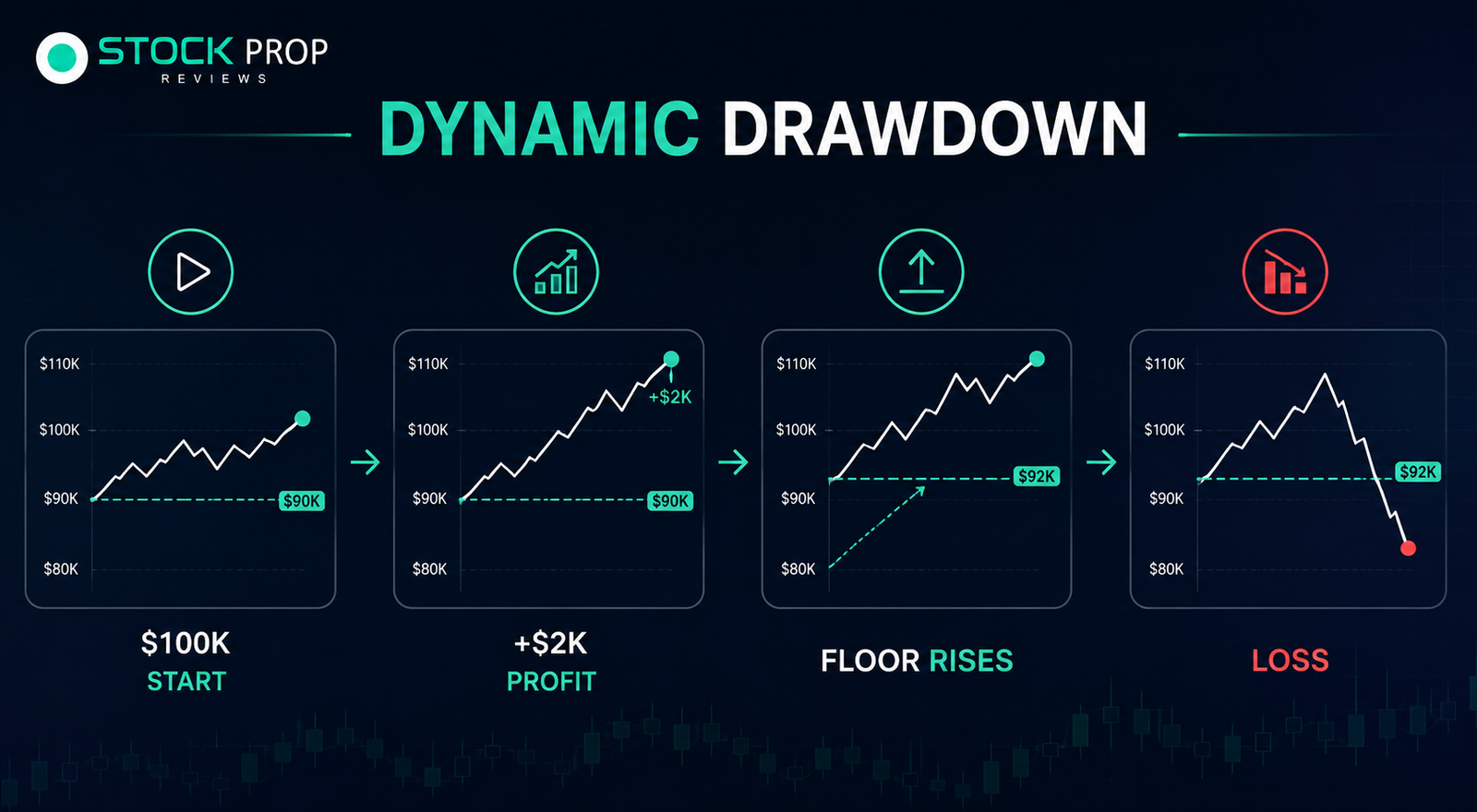
E8 One’s current dynamic drawdown is based on the highest closed balance. If you close profits, the loss level can move upward. Once the drawdown reaches the initial balance level, it becomes static.
Consider a simplified $100,000 example with a 6% dynamic drawdown.
Your initial loss level would be:
$100,000 – $6,000 = $94,000
You then close a $2,000 profit.
Your balance becomes $102,000, and the loss level rises to $96,000.
If you subsequently lose $3,000, your balance falls to $99,000. The loss level does not fall with you. It remains at $96,000.
This is where traders get caught.
They look at the $99,000 balance and think they are still $5,000 above the original $94,000 floor. That is irrelevant. Their actual floor has already moved to $96,000.
E8’s own example shows the same principle: the drawdown rises with closed profits but does not move lower after a loss.
EOD Dynamic Drawdown is different
E8 Signature uses an end-of-day version of dynamic drawdown.
This is an important distinction.
With EOD Dynamic Drawdown, your intraday equity high does not immediately raise the loss level. The calculation is based on the highest balance achieved at the end of the trading day.
Suppose you begin with $100,000 and the drawdown is $3,000.
Your initial loss level is $97,000.
During the day, you take a trade that pushes your floating equity to $103,000. You eventually close the trade for only $1,000 profit.
Your end-of-day balance is $101,000.
The next loss level is therefore calculated from the closed end-of-day balance, not the temporary $103,000 equity peak.
This can be considerably more forgiving for traders whose strategies naturally experience intraday fluctuations.
It does not mean the account is safe from losses. It simply means the drawdown calculation is not chasing every temporary equity high.
The part traders usually misunderstand
The biggest misconception is thinking that “dynamic” means the loss limit moves every time the account moves.
That is not necessarily true.
E8 currently distinguishes between dynamic drawdown and EOD dynamic drawdown.
Dynamic drawdown can react to closed profits.
EOD Dynamic Drawdown uses the highest end-of-day balance.
This distinction matters for swing traders, intraday traders and anyone holding positions through volatile sessions.
Another important point is that E8 says an account can be permanently closed when equity or balance reaches or falls below the applicable loss level. The fact that positions are automatically closed after a violation does not undo the breach if the account happens to finish above the limit.
That is why relying on the final account balance can be dangerous.
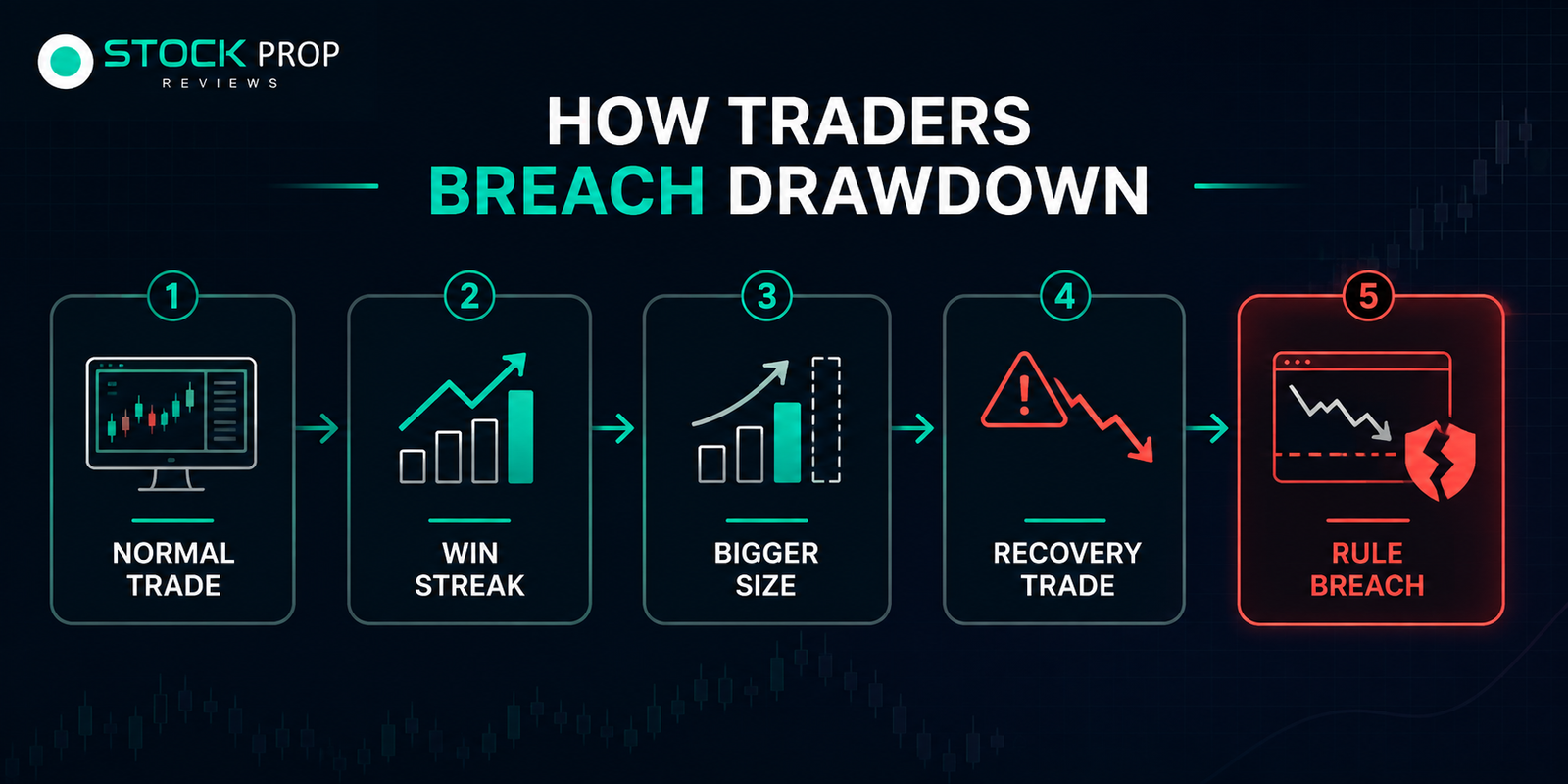
A real trading scenario
Imagine a trader starts with $100,000.
They risk $500 per trade and normally take four trades per day.
The first three trades produce:
+$600
+$700
-$400
The trader is still comfortably profitable.
Then a fourth setup appears. Because confidence is high, they increase the position and risk $1,500.
The trade reverses.
Instead of accepting the loss, the trader takes another $1,500 position to recover.
The second trade loses as well.
Nothing about the original strategy necessarily caused the account failure. The problem was the change in risk after winning trades.
This is one of the more realistic ways traders run into prop firm drawdown limits.
The account does not usually disappear because someone forgot what 4% means. It disappears because normal trading discipline changes when the trader gets close to a loss threshold.
Our analysis of daily loss limits looks at this problem in more detail.
E8 Pro static drawdown
E8 Pro takes a different approach.
Its current rules describe static drawdown as a fixed loss level calculated from the initial balance. For example, an $8,000 drawdown on a $100,000 account creates a $92,000 loss level.
That floor does not move simply because the account becomes profitable.
There is, however, an important payout-related change.
After the first payout, E8 says the loss level moves to the initial balance and remains there.
Using the same $100,000 account, a trader could initially have:
Initial balance: $100,000
Static drawdown: $8,000
Initial loss level: $92,000
After the first payout, the loss level can move to:
$100,000
That makes the post-payout period particularly important.
A trader who treats the entire accumulated profit as a freely available trading room can underestimate the new risk structure.
E8 drawdown and payouts
Drawdown cannot be separated from payouts.
For E8 Signature, the current payout documentation includes a drawdown buffer equal to the EOD Dynamic Drawdown. E8 also applies payout caps depending on account size and payout cycle.
E8 One has a different payout mechanism. The firm explains that a payout does not simply reset the dynamic drawdown. Traders may need to leave sufficient room between the account balance and the loss level.
E8 Pro also uses a specific payout mechanism where 50% of profits becomes the payout portion and 50% remains in the account as a buffer, with the trader’s selected payout percentage then applied to the payout portion.
This is why comparing firms solely by their advertised profit split can be misleading.
A 90% split does not tell you how much capital remains exposed to the drawdown after you request money.
What competitors don’t explain well
Many E8 Funding explanations focus on the percentage.
That is not enough.
The more useful question is:
How far can my account fall after I have already made money?
A trader who makes $5,000 and then gives back $4,000 is not necessarily in the same position under every E8 model.
Under a static model, the original floor can remain unchanged until the payout-related event.
Under a dynamic model, the floor may already have moved upward because profits were closed.
Under an EOD model, the timing of those closed profits matters.
This is why two traders with identical returns can experience very different levels of risk depending on the account structure.
Our FTMO risk framework provides a useful comparison because FTMO and E8 approach drawdown differently.
Common E8 Funding drawdown mistakes
The first mistake is treating the initial drawdown number as your permanent risk budget.
It may not be.
If your loss level has moved upward, the original percentage is no longer the number you should be watching.
The second mistake is using the maximum possible drawdown as your normal trading risk.
A 4% hard limit does not mean you should risk 4% in one day. A trader who uses most of the available drawdown on a single session leaves almost no room for ordinary variance.
The third mistake is ignoring floating losses.
E8’s rules state that equity or balance reaching the loss level can trigger a violation. A trader does not necessarily get protection simply because a losing position has not yet been closed.
The fourth mistake is increasing size after a winning streak.
This is particularly dangerous under dynamic models because the trader may already have a higher loss floor.
The fifth mistake is treating a payout as a reset.
Depending on the product, the payout can interact directly with the drawdown or create a buffer requirement.
Who should avoid E8 Funding?
E8 is probably a poor fit for traders who frequently increase position size after wins or losses.
It is also unsuitable for someone who does not regularly monitor the account’s current loss level.
High-variance strategies deserve particular caution. A strategy can have a positive long-term expectancy while still producing losing streaks that are uncomfortable under a prop firm’s fixed or moving limits.
Traders who rely heavily on large recovery trades should also think twice.
The account structure rewards staying alive. It does not give you permission to use the maximum drawdown as a recovery budget.
E8 drawdown strategy fit
| Trader type | E8 fit | Why |
| Conservative day trader | Good | Can keep risk well below hard limits |
| Disciplined swing trader | Depends on model | EOD structure may be easier for some strategies |
| High-risk scalper | Weak | Frequent entries can accumulate losses quickly |
| News trader | Depends on product | News restrictions vary by account |
| Recovery/martingale trader | Poor | Large size increases breach risk |
| Systematic trader | Good if tested | Historical drawdown can be compared with E8 limits |
A trader should ideally calculate their own historical maximum losing streak before choosing an account.
If your strategy routinely experiences a 3% drawdown before recovering, a model with a 3% daily limit is not giving you much operating room.
That does not mean the strategy is bad. It means the strategy and account rules are mismatched.
E8 Funding versus alternatives
There is no universal winner because drawdown needs to match the strategy.
FTMO is worth comparing if you want a more established evaluation framework with clearly defined daily and overall risk rules. Our FTMO review covers the broader conditions.
The5ers can make more sense for traders interested in longer-term scaling rather than simply passing a challenge as quickly as possible.
TradeThePool is a different beast, as it deals with stocks in the US, not forex or futures. The program information is published making its risk parameters relatively easy to examine but traders should not mistake clear rules for regulatory status. TradeThePool’s own disclosures do not support characterization as a regulated financial institution or regulated prop company.
For readers interested in a stock-focused alternative, the firm can still be considered on the basis of its documented rules and risk transparency. Readers can get up to 10% discount when purchasing through our TradeThePool link.
Our prop firm comparison is useful when you want to compare the complete rule structure rather than just the headline account size.
The trader’s way to manage E8 drawdown
The simplest approach is not to trade up to the firm’s maximum.
If your E8 account has a 4% overall drawdown, you might build your strategy around a much smaller personal loss threshold.
For example, a trader could decide that:
- 0.5% is the normal maximum risk per trade
- 1% to 1.5% is the maximum planned daily loss
- Trading stops after several consecutive losses
- Position size is reduced during unusual volatility
The exact numbers depend on the strategy.
The principle is more important: your trading risk should be controlled by your strategy, not by how much drawdown E8 allows you to lose.
This distinction is also relevant when looking at why funded traders fail. The hard rule is usually the final point of failure. The behavioral mistake often happens much earlier.
FAQs
What is the E8 Funding drawdown?
E8 Funding drawdown is the maximum loss allowed under the specific E8 account model. Depending on the product, it can be daily, dynamic, EOD dynamic or static.
Is E8 drawdown trailing?
Not every E8 account uses the same system. E8 One uses dynamic drawdown, E8 Signature uses EOD Dynamic Drawdown, while E8 Pro uses static drawdown.
Does E8 dynamic drawdown move with floating profit?
For E8’s dynamic drawdown the loss level is set on realized profits and not unrealized equity gains. EOD Dynamic Drawdown also uses the highest EOD balance rather than an intraday equity high.
Can E8 lock drawdown?
Yup. Some E8 models will stop the drawdown at the initial balance when enough closed profits are achieved. The exact mechanics vary by product, and E8 Zero can behave differently in its challenge stage.
What is the biggest E8 drawdown mistake?
The biggest mistake is treating the original drawdown percentage as your current available risk after the loss level has moved. Traders need to monitor the actual loss level shown for their account rather than relying on the initial calculation.
Final trader perspective
E8 Funding’s drawdown system is not inherently difficult, but it requires more attention than a simple fixed-loss rule.
The most important distinction is between daily, dynamic, EOD dynamic and static drawdown. Once you understand which model applies to your account, the risk becomes much easier to plan.
The bigger issue is behavioral.
A trader who risks 0.5% consistently can have plenty of room under a 4% drawdown. A trader who risks 2% after every loss can reach the same limit surprisingly quickly.
That is the real E8 drawdown lesson.
Do not ask how much E8 allows you to lose. Ask how much your strategy can realistically lose while still behaving normally.
That number is far more useful when deciding whether an E8 account actually fits you.