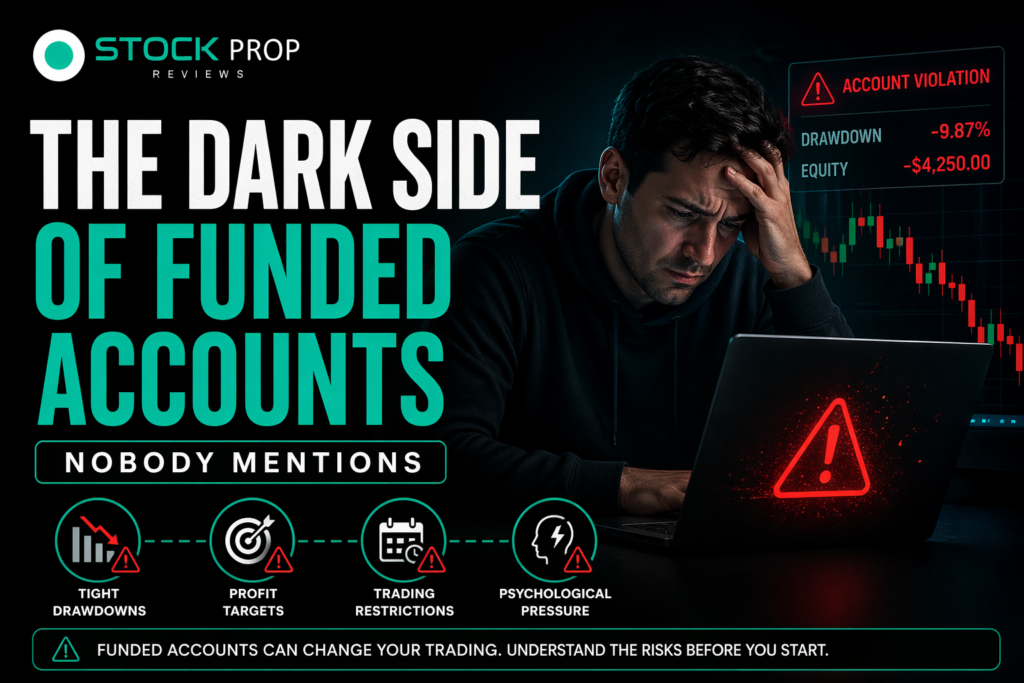
It’s not scams or fake promises that are bad about funded accounts. It’s about how the model works when you start trading in it.
This is more important than any payout percentage or scaling plan if you are just starting out or want to become a funded trader. If you are already making money consistently on your own account, you may still have problems here that have nothing to do with your edge.
This article is not for traders who want to find quick ways to make money or get motivated. It’s for people who want to know why it seems possible to pass a challenge but not to stay funded.
What a Funded Account Really Is
At its most basic level, a funded account lets you trade with a company’s money after you pass a test. You get to keep some of the profits, and the company sets the rules for risk.
That’s the easy way to say it.
You are not just trading in the market. You are making decisions based on a set of rules that affect every choice you make. Those rules aren’t fair. They give rewards for some actions and punishments for others, and sometimes it’s not clear at first what they are.
Quick Verdict
Funded accounts can work, but most traders don’t need them.
They are best for traders who already have:
- A steady, low-risk plan
- The ability to wait for slow growth
- Control your feelings when you have to
They tend to break traders who:
- Need to be able to change plans to make one
- Use higher risk to make money
- Have a hard time dealing with stress after losses
The problem isn’t that traders don’t know how to do their jobs. This is because the structure often doesn’t match how profitable trading really is.
How the Rules Shape Outcomes
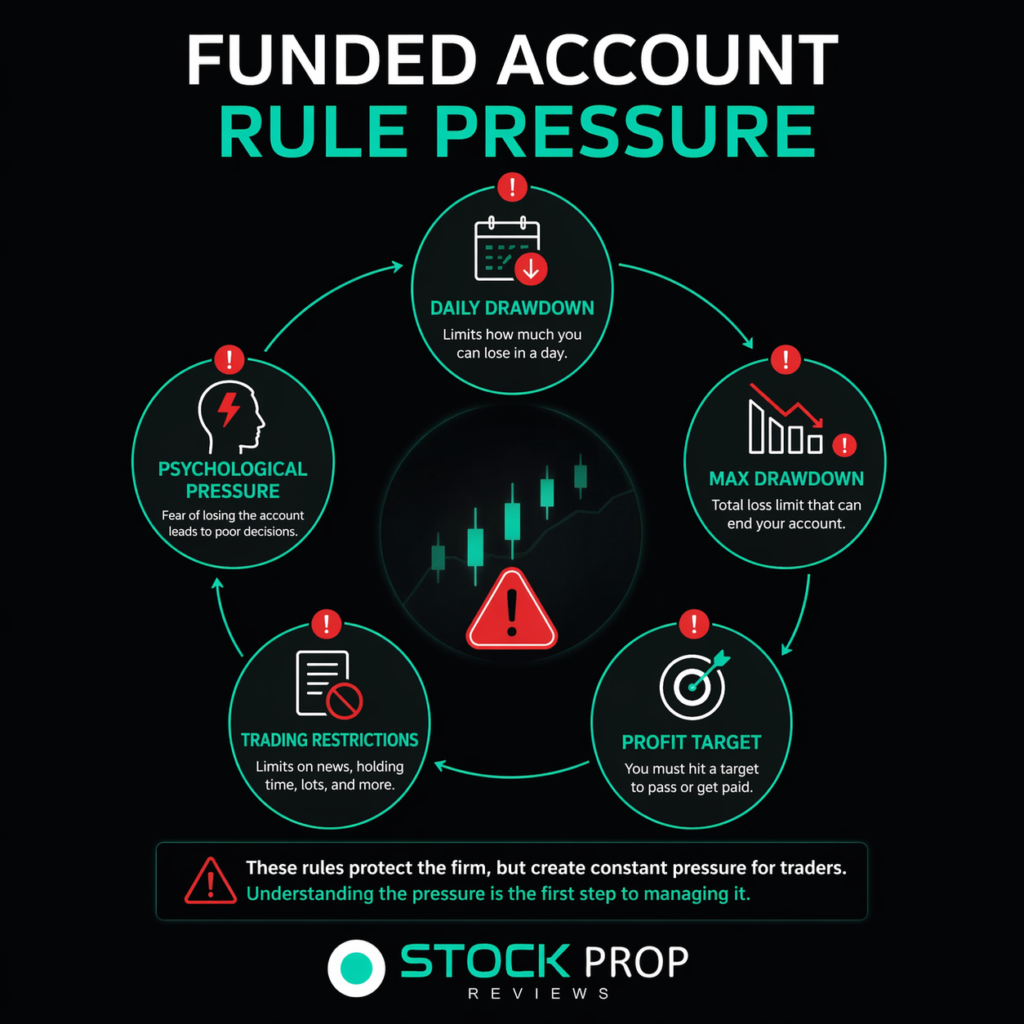
Below is a simplified view of the typical rule set.
| Rule | Common Level | What It Feels Like in Practice |
| Daily drawdown | Around 5% | You stop trading early even if setups appear |
| Max drawdown | Around 10% | One bad sequence ends the account |
| Profit target | 8–10% | You feel pushed to perform quickly |
| Restrictions | News, overnight | Some strategies become unusable |
| Profit split | 70–90% | Attractive, but only after survival |
Individually, these rules look reasonable. Together, they create tension.
You are asked to grow the account, but at the same time avoid normal fluctuations that come with growth.
Where the Dark Side Shows Up
The rush to hit targets
Most strategies that work long term are not designed to produce 10% quickly. They build slowly, with controlled risk.
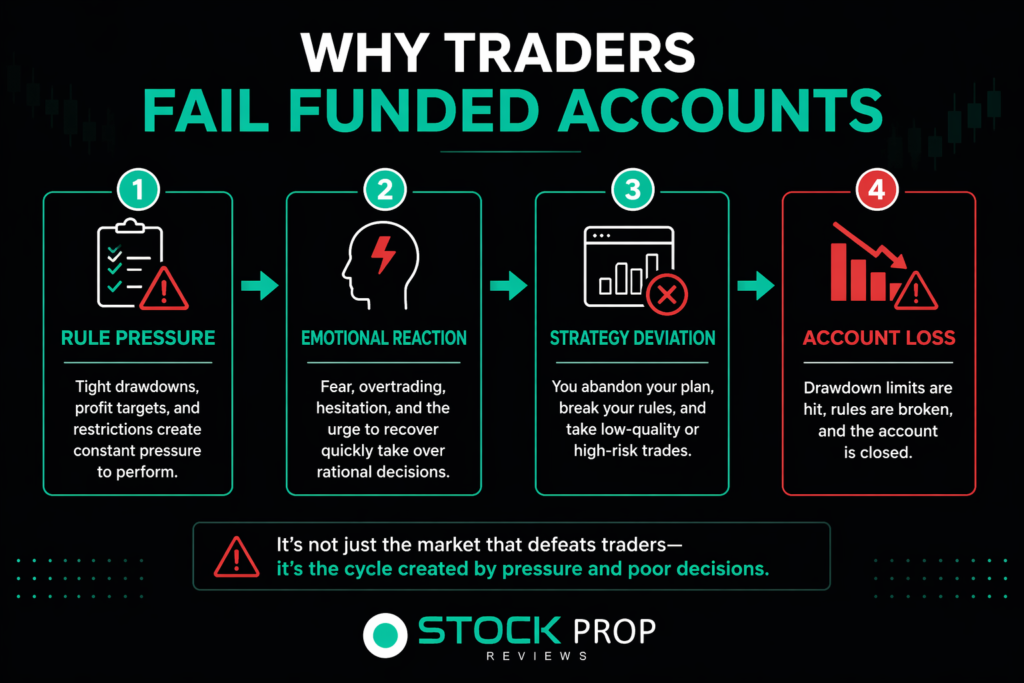
When a trader enters a challenge, that changes. The focus shifts from good execution to hitting a number within a timeframe. Even disciplined traders start taking trades they would normally skip.
It often starts small. A slightly larger position size. An extra trade in the day. Over time, that shift compounds.
Drawdown limits versus real trading
Every trader has times when they lose money. Even the best systems have times when nothing works.
You take that in and move on in a personal account. The same sequence can end everything in a funded account.
A trader who is willing to lose 1% on each trade can reach a 5% daily loss limit in a short amount of time. That happens a lot in trading, but the rule makes it final.
This is one of the biggest gaps. The rules assume that equity curves are smooth. That doesn’t happen in real trading.
The psychological shift
Most traders don’t realise how much their behaviour changes when there are strict rules.
You stop trading the market and start protecting the account. Winners get closed off early. People skip valid setups because they seem risky. The desire to get better quickly grows stronger after a loss.
This isn’t a lack of discipline. It is a normal reaction to stress.
Your strategy will become less consistent over time, even if it was stable before.
Passing is easier than staying funded
Many traders can pass a challenge once. Some pass multiple times. The real difficulty starts after funding.
The reason is simple. During the challenge, you can push harder, take more risk, and focus on a short-term goal. After funding, the same behavior leads to hitting drawdown limits.
So traders face a dilemma:
- Trade aggressively and lose the account
- Trade conservatively and struggle to grow
This is why consistency inside funded accounts is rare.
The business model most traders ignore
Prop firms earn a significant portion of their revenue from challenge and reset fees. That does not make them dishonest, but it explains why the filtering process is strict.
The system is built to:
- Attract many traders
- Filter out most of them
- Reward a small percentage who adapt well
Understanding this removes a lot of confusion. The difficulty is not accidental.
What Most Competitor Content Misses
If you look at popular articles or videos, the focus is usually on:
- Which firm pays fastest
- Which has the highest split
- Which challenge is easiest
People don’t often talk about how the rules work together.
For instance, a tight daily drawdown and a high profit target make people change how they act. On top of that, some strategies just stop working when there are trading limits.
Survivorship bias is another thing that is missing. You see traders posting payouts, not the bigger group that keeps trying challenges but never wins.
Real Scenarios Traders Recognize
A disciplined trader only risks small amounts of money on each trade and sticks to a plan. Results are steady on a personal level. When you’re facing a challenge, it seems like progress is too slow. They take a little more risk to speed things up. The account is gone after a losing streak.
An aggressive trader quickly passes by taking bigger positions. The same method hits drawdown limits after funding. The account is gone in a few days.
A careful trader protects their money and avoids losing it. They stay within the limits, but they can’t reach the goal. The challenge is over.
These cases are not uncommon. Those are normal results.
Common Mistakes That Make It Worse
Some mistakes happen because people don’t understand the model, not because they trade badly.
One of the hardest things is trying to change a strategy to fit the rules. Traders don’t ask if the strategy fits the environment; instead, they make changes that make their edge weaker.
Another is not paying attention to how drawdown works in terms of percentages. When limits are tight, small losses can add up faster than you think.
People also tend to focus more on payouts than on the process. After that change, choices are made quickly and aren’t always the same.
Who Should Think Twice Before Trying
Not everyone should use funded accounts.
If you’re still working on your strategy, the stress will probably make it harder, not easier.
If your strategy depends on making a lot of trades or getting things done quickly, restrictions and slippage can mess it up.
If you have trouble controlling your emotions after losing, strict limits will make it even harder.
In these situations, trading your own small account is often a better way to learn.
Strategy Fit Matters More Than Skill
A lot of traders miss this part.
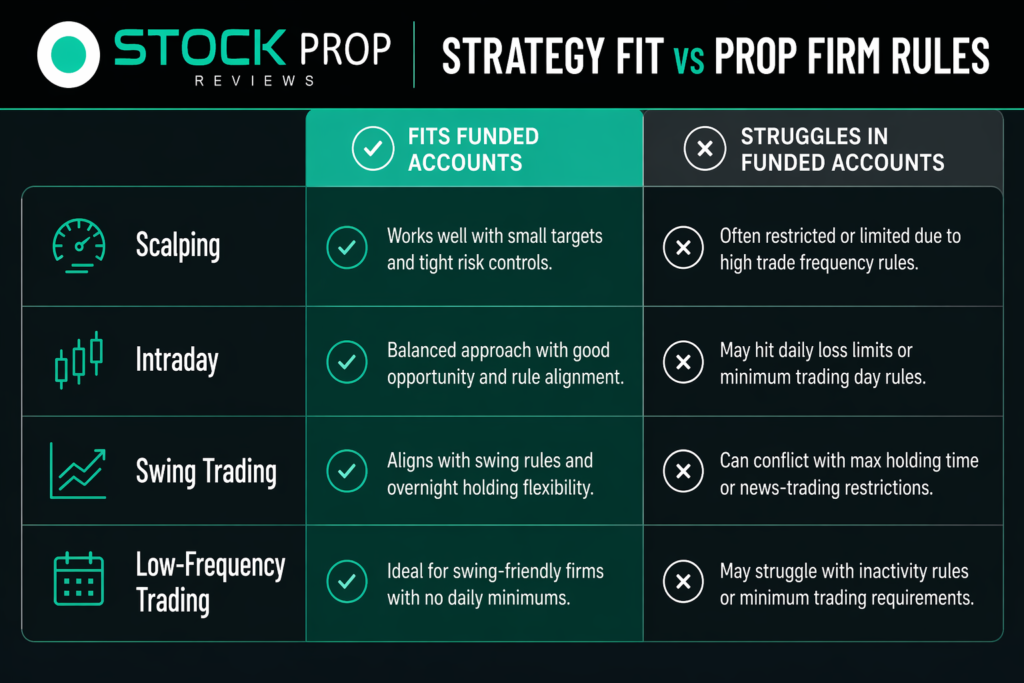
Even a good trader can fail over and over again if they use the wrong strategy for a prop firm. An average trader who follows the rules can last longer.
Controlled-risk, low-frequency methods tend to be more flexible. Styles that are high-risk or high-frequency have more trouble.
It’s not so much about making the right trades as it is about how your trading behaviour fits within the rules.
Alternatives Worth Considering
It takes longer to set up a personal account, but you have full control. You can take drawdowns, change your approach, and learn without the stress of losing access completely.
Some companies have more flexible rules, but those are still structured settings.
TradeThePool is an example of a regulated prop firm that focuses on stocks. The rules and execution are clearer there. It doesn’t get rid of risk, but it does make things less unclear in some places.
When you buy through our TradeThePool link, you can save up to 10%. The main benefit here is that things are clearer, not that it’s easier to make money.
Funded vs Personal Trading
| Aspect | Funded Accounts | Personal Accounts |
| Risk control | Strict and enforced | Flexible |
| Growth pressure | High | Self-paced |
| Strategy freedom | Limited | Full |
| Emotional load | Higher | Lower |
This comparison highlights the trade-off. Funded accounts offer access to capital, but they limit how you can use it.
A Balanced View
There is a reason why funded accounts are so popular. They let traders work with more money without putting their own money at risk up front.
That works for some people. Especially those who already trade with low risk and don’t depend on high returns.
But for a lot of people, the structure makes things harder than they were before. At first, the change is small, but after a few failed tries, it becomes clear.
The problem isn’t that funded trading is bad. It’s that what people expect isn’t always what happens. at funded trading is bad. It is that expectations are often misaligned with reality.
FAQs
Why do traders fail funded accounts even when they make money?
Because the rules change the way they trade. A flexible account’s profitability does not always carry over to a limited environment.
Is passing a test enough to get ahead?
No. It’s usually harder to stay funded than to pass, because you have to keep an eye on risk over time.
Is it important to have high profit splits?
Survival is more important than they are. A high split doesn’t mean anything if the account doesn’t last.
Can people who are new to trading start with funded accounts?
They can, but it’s not the best option. Instead of helping people learn, pressure usually makes it harder.
What do traders not think is the biggest risk?
The mix of profit targets and drawdown limits. When they work together, they put pressure on people to make bad choices.
After paying for a lot of challenges, most traders only get these points. Being able to see the structure clearly from the start can save you time and money.