The majority of traders who get paid from a prop firm aren’t doing anything special. They are doing a few basic things consistently. Especially when the account starts going against them.
That is the clearest pattern behind funded traders that make it. They think about making money second, and run the account first.
This case study is for traders looking to get a funded account or already trading one. It is not for someone hoping to make a quick fortune from a small account. You can’t cheat that. There’s no good way.
The first thing is to get one thing clear. There is no independent audit of the industry database that would include 100 random payout traders. The 100-trader framework here is a case-study synthesis of repeating behaviors seen in published examples of traders, payout discussions, and common prop-firm failure patterns. This is not to be interpreted as a statistical survey.
The main difference was risk
The most noticeable difference between traders who regularly get paid and those who repeatedly lose accounts is usually risk management.
A trader can have a profitable strategy and still fail a funded account if the position size is too large for the firm’s drawdown limits.
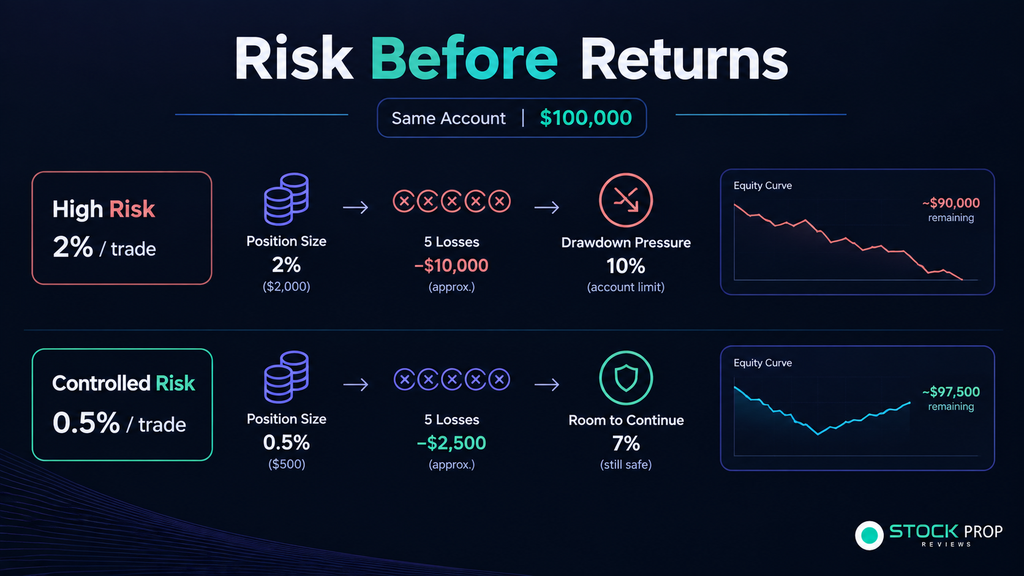
Consider a $100,000 account with a $10,000 maximum drawdown.
A trader risking $2,000 per trade does not have much room for a normal losing streak. Five full losses would theoretically consume the entire drawdown allowance.
Someone risking $500 per trade has considerably more room. That trader may take longer to reach the profit target, but a few losses do not immediately put the account in danger.
That difference becomes important when markets stop behaving as expected.
Successful funded traders generally understand that the account’s drawdown is not simply a number on the dashboard. It determines how much freedom their strategy actually has.
They did not increase risk after losing
This sounds obvious. In practice, it is one of the easiest rules to break.
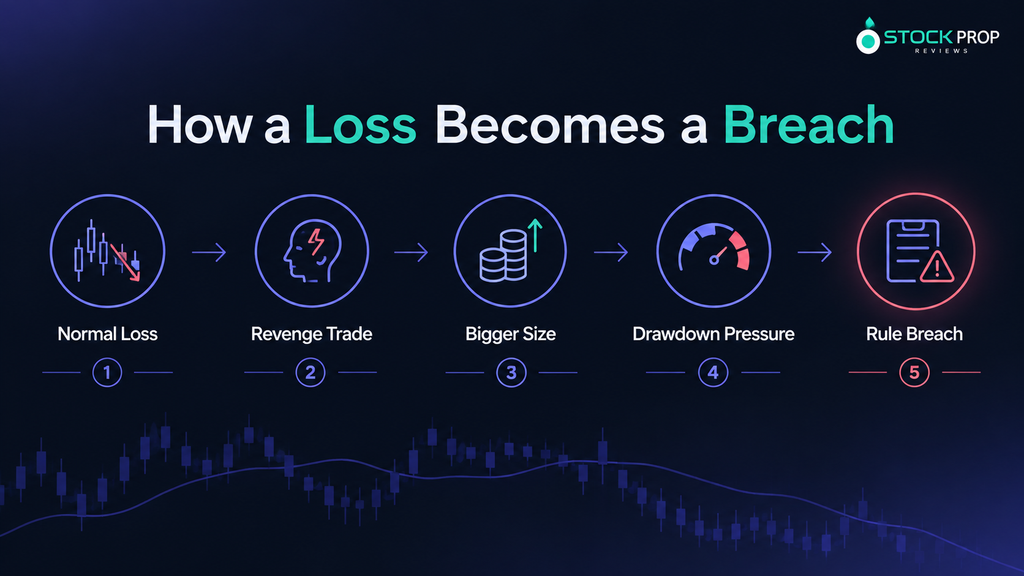
Imagine a trader loses $400 on Monday. The trader normally risks $400 per position but decides that Tuesday needs to be different. The next trade is doubled because the trader wants to recover Monday’s loss.
That trade loses too.
Now the trader is no longer following the original system. They are trading against the account’s drawdown.
This is where many funded accounts start going downhill. The first loss is normal trading variance. The larger second position is a decision. The third trade is often an attempt to repair the damage created by the second.
The account can go from a manageable loss to a serious drawdown surprisingly quickly.
Traders who survive long enough to collect multiple payouts tend to accept losing trades as part of the business. They do not need the next trade to repair the previous one.
Winning streaks can be just as dangerous
Losses get most of the attention, but a profitable streak can create another problem.
Suppose a trader normally risks 0.5% and has a very good week. The account is suddenly up 4%.
It is tempting to increase the position size. The trader feels more confident and has a larger cushion, so risking 1% seems reasonable.
Sometimes it works.
That is exactly why it becomes dangerous.
A winning streak does not prove that the next trade has a higher probability of success. The market has not signed a contract promising another five winners.
Several payout traders appear to handle this differently. Once their strategy is working, they are reluctant to change the risk model without a clear reason.
They treat profits as protection rather than permission to gamble more.
Passing an evaluation is not the same as earning a payout
This is one of the areas where prop-firm discussions often become misleading.
A trader can pass an evaluation with an aggressive approach and still struggle once the account reaches the funded stage.
The reason is simple. Different stages can have different conditions.
News restrictions, payout requirements, consistency rules, minimum trading days, drawdown calculations and other conditions can affect how a profitable strategy is actually traded.
FundingPips, for example, has different payout options with different profit splits and conditions. Its payout structure therefore needs to be considered alongside the advertised account and profit percentage.
The question a trader should ask before joining is not simply, “Can I pass this challenge?”
A better question is:
Can I trade my strategy normally and still meet the firm’s requirements for a payout?
That is a much harder question, but it is also the one that matters.
What the 100-trader pattern suggests
The traders who make it through to payouts generally have a fairly boring approach to account management.
They know their normal risk before opening a position. They know how much room remains before the daily and maximum drawdown limits become a problem. They also know when they should stop trading for the day.
That does not mean every payout trader uses the same percentage or the same strategy.
A scalper might take several small positions. A swing trader might take only a handful of trades in a week. A futures trader may manage risk differently again.
The common factor is that position size is usually connected to account risk rather than emotion.
| Situation | Higher-risk response | More sustainable response |
| First losing trade | Increase size | Keep normal risk |
| Several losses | Trade more often | Reduce activity or stop |
| Large winning day | Increase size | Protect the profit |
| Near drawdown limit | Try to recover quickly | Reduce exposure |
| Near payout | Chase a larger withdrawal | Protect eligible profit |
This is not particularly exciting trading.
It is effective precisely because it removes some of the decisions that cause accounts to fail.
Where traders usually go wrong
The most common failure is not a bad indicator.
It is a change in behaviour.
A trader might have spent three weeks following a system correctly. Then one trade loses more than expected. Instead of accepting it, the trader starts looking for another setup.
Then another.
Soon the trader has taken six trades instead of two.
The original strategy may have nothing to do with the final drawdown.
Revenge trading is especially damaging in a prop environment because the account has a hard limit. A personal brokerage account can theoretically survive a bad week if enough capital remains. A prop account may be terminated once a specific drawdown threshold is reached.
That makes emotional position sizing particularly expensive.
The drawdown calculation matters more than traders think
Two firms can advertise the same account size and maximum loss while creating very different trading conditions.
A static drawdown gives the trader a fixed reference point.
A trailing drawdown can move as the account reaches new highs.
An equity-based daily limit can also react to unrealised losses, depending on the firm’s rules.
These differences matter when choosing a strategy.
A trader with volatile positions overnight may find a static limit comfortable but a tight trailing model hard.
Likewise, a trader who habitually lets winning trades pull back hard may struggle with a rule that tracks account equity rather than closed balance.
This is why comparing firms purely by account size is not particularly useful.
The drawdown mechanism is often more important than the number printed on the front page.
Payout traders tend to understand their firm’s rules before paying
A surprisingly common mistake is to buy an evaluation and read the detailed rules afterwards.
That reverses the process.
Before purchasing an account, traders should know how the firm calculates drawdown, what happens around major news, whether positions can remain open overnight, how weekends are handled, whether there is a consistency requirement and what conditions apply to withdrawals.
The FundingPips payout structure is one example where the withdrawal option itself can affect the applicable profit split and requirements.
BrightFunded provides another example of why traders need to distinguish between evaluation conditions and funded-account conditions. Published reviews have highlighted differences in news-trading permissions between stages. That distinction could be important for a trader whose strategy depends on economic releases.
A rule that does not affect one trader may completely change another trader’s strategy.
The psychology changes after the first payout
Getting the first payout can create a new problem.
Before the payout, the trader is focused on proving that the account can make money.
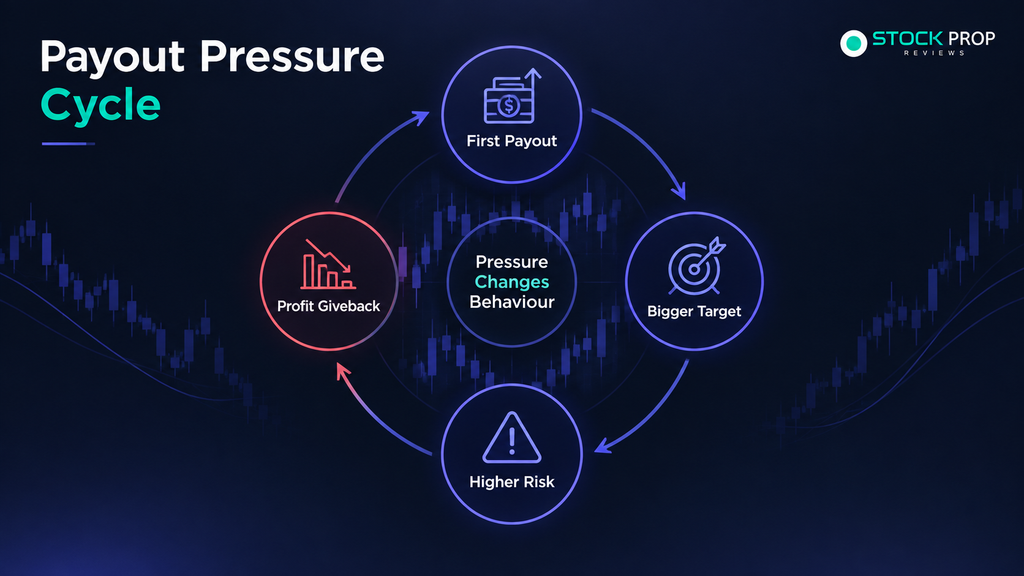
After the payout, the temptation may become proving how much more money the account can make.
That can lead to unnecessary risk.
For example, a trader withdraws $1,500 and then decides that the next payout should be $3,000. Nothing about the trading strategy has necessarily changed. Only the expectation has changed.
The trader starts holding positions longer, takes setups outside the normal trading plan or increases position size.
This is where a good month can turn into a bad one.
A payout should reduce financial pressure, not create a new performance target.
A simple example of why position size matters
Take two traders using exactly the same strategy.
Both have a 45% win rate. Both make 1.5R on an average winning trade. Both experience losing streaks.
The first trader risks 1.5% on each trade.
The second risks 0.5%.
Six consecutive losses would put the first trader around 9% down before accounting for compounding. The second would be around 3% down.
If the firm’s maximum drawdown is 10%, these traders are not operating in the same environment anymore.
The strategy is identical.
The difference is that one trader has almost exhausted the account’s room for normal variance while the other still has considerable room.
This is why a strategy’s expected return should never be considered without its expected drawdown.
What competitors often leave out
Most prop-firm articles are built around easy comparison points: account size, profit target, profit split and price.
Those numbers are useful, but they do not tell you whether the account is suitable for your trading style.
A trader who relies on news volatility needs to investigate news restrictions.
A swing trader needs to understand overnight and weekend rules.
A scalper needs to know whether the execution environment and trading restrictions fit rapid entries and exits.
A trader using a high-risk recovery method should question whether the firm’s drawdown structure makes that approach viable at all.
This is where a proper prop firm review is more useful than a simple list of account features.
The same applies when comparing several firms. A prop firm comparison should consider drawdown mechanics and strategy restrictions, not just profit splits.
There is also a broader truth about funded trading that gets overlooked: a trader does not automatically become more skilled because an account has been labelled “funded.” The risk framework still determines whether the trading process can survive.
Who should be careful with funded accounts?
Funded accounts are probably a poor fit for traders who routinely need large position sizes to make their strategies worthwhile.
They can also be problematic for traders who average down heavily, use martingale-style recovery, trade impulsively after losses or regularly ignore daily loss limits.
The problem is not necessarily that these traders cannot make money.
The problem is that their risk profile can conflict with the structure of a prop account.
A trader who is comfortable risking 5% of their own account on one trade may not be comfortable with a firm that allows only a 10% total drawdown.
The firm’s rules have to fit the strategy.
What about stock traders?
Stock traders and forex traders need to evaluate prop firms in different ways.
There are market hours, short-selling rules, buying power, overnight positions and the instruments available that can be more important than a headline profit split.
If you are interested in stocks, you should definitely check out TradeThePool. The company advertises itself as a regulated stock prop firm and posts its trading and risk requirements for traders to review before joining. The firm’s terms also distinguish between its simulated evaluation environment and a traditional brokerage account.
Readers can buy through our TradeThePool link for up to 10% discount.
The point is, TradeThePool is not automatically the right choice. It is that traders should select a company that suits their strategy rather than change strategy to fit an advertized account.
The biggest lesson from the payout traders
There is a tendency to search for the trade that successful funded traders are taking.
That is probably the wrong place to look.
The more useful question is what they do when a trade goes wrong.
Do they double the next position?
Do they keep trading after reaching their daily loss limit?
Do they change systems halfway through a losing week?
Do they give back a month’s profit because they want one unusually large payout?
Those decisions tell you much more about account survival than an entry indicator.
The traders who consistently reach payouts are not necessarily the traders with the highest monthly returns. They are often the traders who avoid the large mistakes that wipe out weeks of good trading.
That distinction matters.
A trader making 3% a month while protecting the account has a very different long-term outlook from someone making 15% one month and losing the entire account the next.
The goal of a funded account should therefore not be to extract the maximum possible profit from every trading day.
It should be to build a process that can survive enough trading days for the edge to matter.
FAQs
What do successful funded traders do differently?
They generally keep risk consistent, understand their firm’s drawdown rules, avoid emotional position sizing and protect profits once the account becomes eligible for a payout.
Do successful funded traders use a special strategy?
No. Successful payout traders use many different strategies. Scalping, swing trading, trend following and other approaches can work when the strategy fits the firm’s rules and the trader’s risk tolerance.
Why do traders pass challenges but fail funded accounts?
Some traders use excessive risk to reach the evaluation target quickly. That approach can produce a pass but may not be sustainable once the trader starts protecting a funded account and dealing with payout requirements.
Is a high profit split important?
It matters, but it should not be the first thing you compare. Drawdown rules, payout conditions and strategy restrictions can have a much larger effect on whether you actually receive money.
How much should a funded trader risk per trade?
There is no universal number. The appropriate risk depends on the strategy, drawdown limit, win rate and expected losing streak. The important principle is that the position size should leave enough room for normal losing periods without threatening the account.