If you’re researching an Equity Edge payout, there’s more to the story than the advertised 48-hour processing time. You also need to know when you can request money, what payment methods are currently supported. What the profit split is and what trading rules may cause a payout to be reduced or rejected.
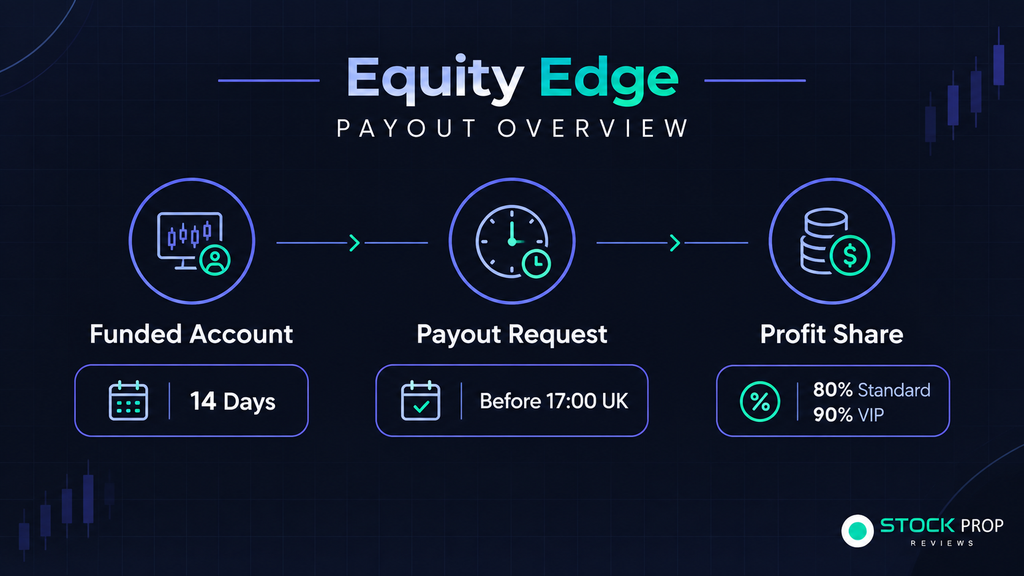
Currently, Equity Edge accepts bank wire transfer and cryptocurrency as methods of payment for profit-split. On the standard account, funded accounts will typically have a 14 day payout cycle with an 80% split of profits and if traders achieve VIP status they can request on-demand payouts with a 90% split. An instant account has a 14 day cycle and a 90% split.
This guide is for beginners and funded traders comparing payout structures before signing up for an account. It’s not for traders looking for instant income, guaranteed withdrawals or a prop firm that places very few restrictions on how profits are generated.
Quick Answer: How Does an Equity Edge Payout Work?
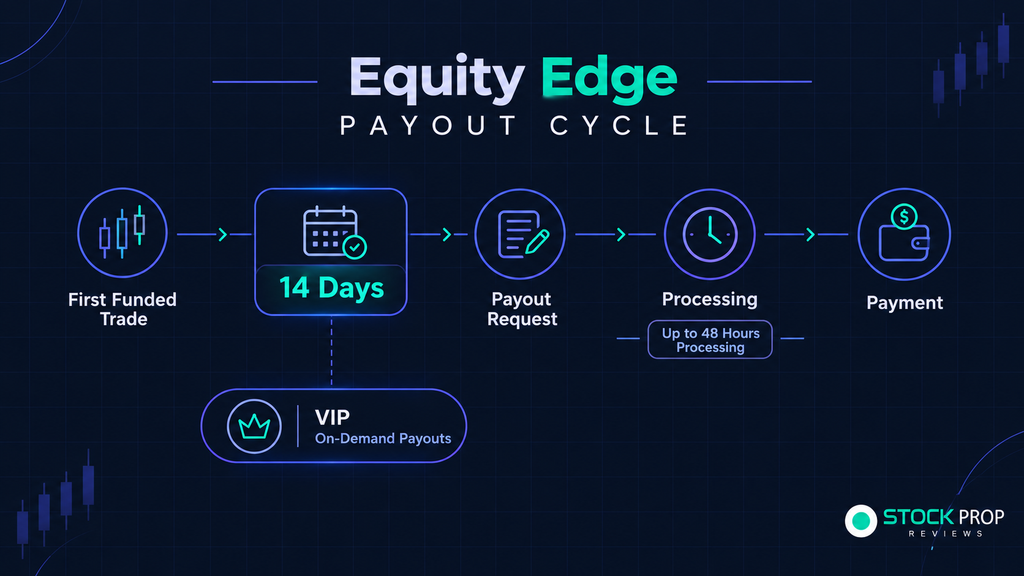
For standard Legacy, Swift and Flagship funded accounts, Equity Edge states that traders can request a payout every 14 calendar days after the first trade on the funded account. The standard profit split is 80%. Traders who reach VIP status become eligible for on-demand payouts and a 90% profit split.
Instant accounts have a separate structure. The current rules state that traders can request a payout every 14 calendar days after the first trade and receive 90% of eligible profits. A minimum payout amount of $125 applies, alongside the account’s payout-related rules.
The firm says payout requests should be submitted before 17:00 UK time. Requests made on Sunday begin processing on Monday, and Equity Edge states that payouts are processed within 48 hours, or two business days, when the applicable rules and terms have been met and the payment information is correct.
That’s a difference that counts. Stated conditions mean 48 hours is a processing commitment, not a guarantee that money will reach your bank or crypto wallet 48 hours after you hit the payout button.
Equity Edge Payout Methods
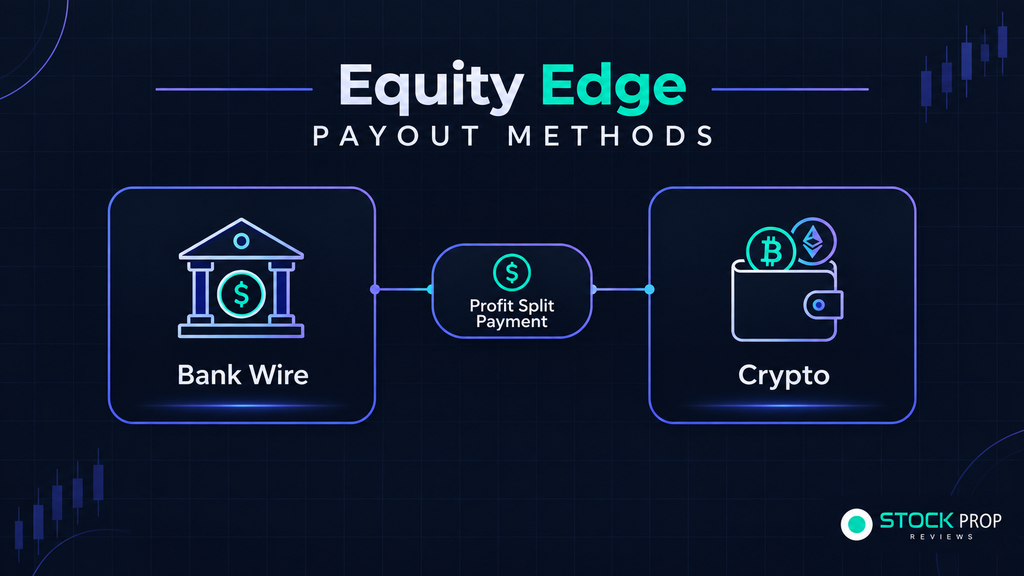
Equity Edge’s current official payment-method page lists two options for profit-split payments:
| Payout method | Currently listed | Important point |
| Bank wire transfer | Yes | Bank details must be correct |
| Cryptocurrency | Yes | Crypto is an alternative to bank payment |
| PayPal | Not confirmed on current official payment page | Some third-party articles list it, but traders should verify inside the dashboard before relying on it |
The distinction between a payment method and a processing window is easy to miss.
A bank transfer can be processed by the firm within its stated timeframe while the receiving bank takes additional time to credit the funds. Crypto transfers can also involve network confirmation and wallet-related issues.
Equity Edge specifically states that incorrect payment details can cause delays and that the trader is responsible for providing accurate information.
For that reason, traders should not treat the advertised 48-hour period as an unconditional bank-settlement guarantee.
How Often Can You Request an Equity Edge Payout?
The normal payout cycle is 14 calendar days.
For Legacy, Swift and Flagship funded accounts, the 14-day period begins following the initiation of the first trade on the funded account. Missing the payout date means waiting for another 14 calendar days according to Equity Edge’s payout documentation.
Instant accounts use the same 14-day concept, but the profit split is 90% rather than the standard 80% applicable to regular funded accounts.
There is an important difference at the higher trader levels. Equity Edge states that VIP status is reached after 16 payouts and a total profit share of 40%. VIP traders can then access on-demand payouts and a 90% profit split.
So a trader should not read “90% profit split” and assume every Equity Edge account has 90% payouts from the beginning.
Equity Edge Payout Rules
The payout structure makes more sense when viewed alongside the rules that determine whether your profits are eligible.
| Rule | Current requirement |
| Standard funded payout frequency | Every 14 calendar days |
| Standard funded profit split | 80% |
| VIP payout frequency | On demand |
| VIP profit split | 90% |
| Instant payout frequency | Every 14 calendar days |
| Instant profit split | 90% |
| Minimum payout | $125 |
| Instant safety buffer | 3% |
| Instant consistency score | 15% |
| Average trade duration | More than 2 minutes |
| Largest loss vs largest win | Largest single loss cannot exceed largest single win |
Equity Edge’s Instant-account rules state that the largest winning day cannot exceed 15% of total net profits for payout eligibility. If a trader has a $1,000 largest winning day, for example, the account would need approximately $6,667 in total net profit for that winning day to represent no more than 15%.
This is one of the most important details competitors can overlook.
A trader can be profitable overall and still not be ready for a payout because profits are too concentrated in one day.
The 3% Safety Buffer Matters
Instant accounts also use a 3% safety buffer.
Equity Edge explains that the first 3% of profits above the initial account balance acts as a buffer. The purpose is to leave enough drawdown room after a payout request because the account’s drawdown calculation can reset following the withdrawal process.
Consider a simplified $100,000 Instant account.
If the account reaches $105,000, it has generated $5,000 in gross profit. That does not automatically mean the entire $5,000 is available to withdraw.
The trader has to account for the safety buffer, minimum payout requirement, consistency condition and the applicable drawdown mechanics.
This is where payout headlines can be misleading. The headline profit is not necessarily the same as the amount that can safely be withdrawn.
Drawdown Can Affect Your Payout Decision
Equity Edge uses different drawdown structures across its account models.
For example, the current Instant rules show a 3% maximum daily loss and a 5% maximum total loss that trails the highest balance or equity. After a payout request, the maximum total loss resets back to the initial account balance and starts trailing again once the account reaches 5% profit from the initial balance.
The funded models also vary.
The current 1-Step Legacy funded account has a 4% daily loss limit and 6% trailing maximum loss. The 1-Step Swift funded account has a 3% daily loss limit and 5% trailing maximum loss. The 1-Step Flagship model uses a 4% daily loss limit and 6% trailing maximum loss. Two-Step models have different fixed maximum-loss structures.
This means traders should evaluate the payout and drawdown rules together.
Taking the maximum possible payout may leave a trader with less practical room to absorb the next losing sequence.
A Real Trading Example
Imagine a trader has a $100,000 account and has built a $4,000 profit.
The trader is tempted to withdraw as much as possible.
Instead of looking only at the 80% or 90% split, the trader should ask:
How much drawdown remains after the payout?
What happens to the drawdown calculation after the withdrawal?
Does the account still have enough room for the normal losing streak of the strategy?
Is the trader still compliant with the consistency requirement?
This is where many payout problems actually begin.
A trader may have made money but then withdraw too aggressively, return to the market with a smaller safety margin, increase position size to rebuild the account and eventually hit the drawdown limit.
The payout itself did not cause the loss. The problem was treating the withdrawal as separate from risk management.
What Competitors Often Do Not Explain
Many payout articles stop after listing the method, minimum and processing time.
The harder question is what happens between making a profit and actually being eligible to receive it.
Equity Edge has several conditions that can affect payout eligibility.
For Instant accounts, the consistency rule limits the largest winning day to 15% of total net profits. There is also the 3% safety buffer and a rule requiring the average duration of trades to exceed two minutes.
The two-minute rule applies to scalpers as well. Equity Edge says any profits made in two minutes are written off at pay out. If the deductions equal 25% or more of the requested profit share, the payout can be rejected and the profit share forfeited.
News trading also has restrictions on Instant accounts. Traders can hold positions during news, but opening or closing trades around specified high-impact events can result in profits being deducted. If restricted news-trading profits exceed 25% of the trader’s profit share, the payout can be rejected.
These are not minor details for a strategy built around rapid entries, news volatility or one large winning session.
Common Equity Edge Payout Mistakes
The first mistake is assuming the 90% split applies to every account. Standard funded accounts start at 80%, while VIP status provides the 90% on-demand structure. Instant accounts have a separate 90% payout split.
The second is confusing profit with withdrawable profit. A balance can show a substantial gain while consistency, buffer or other payout conditions still prevent the trader from withdrawing the amount expected.
The third is ignoring the clock. The 14-day cycle is based on calendar days, and missing the applicable payout day can push the next request back another 14 days.
The fourth is risking the account immediately before a payout. Some traders increase size because they feel they have already “earned” the withdrawal. A normal losing trade can then turn into a much larger problem.
Fifth, relying on third party summaries without checking the current rules. The difference around PayPal is a good example of the payment-method. The official current payment page has bank wire and cryptocurrency, but some third-party material has other methods. Traders should check the firm’s dashboard and current terms before deciding on a payout plan.
Who Should Avoid the Equity Edge?
Equity Edge may be a poor fit for traders whose strategy depends heavily on tick scalping or very short-duration trades because of the two-minute average duration rule.
It may also be unsuitable for traders whose results depend on one or two very large winning days. The 15% consistency rule on Instant accounts means that a large winning day can increase the amount of additional profit required before a payout becomes eligible.
News-dependent traders also need to understand the restrictions before choosing the account.
Beginners who have not yet demonstrated consistent risk control should be particularly cautious. A payout cycle does not turn an unstable strategy into a stable one.
Our TopStep review examines a similar issue from the futures side, where passing an evaluation and surviving the funded stage are two different challenges.
Equity Edge Payouts vs Other Prop Firm Structures
There is no single payout model that fits every trader.
FTMO, for example, currently allows reward requests from its standard program from the 14th day after the first trade, subject to its applicable conditions. It supports several withdrawal methods including bank transfer, Visa Direct or Mastercard Send, Skrill and cryptocurrency.
FTMO’s current futures product has a different structure, with payout requests every five qualifying days on Pro and every four qualifying days on Growth at the Sim-Funded stage.
That illustrates why traders should compare complete payout systems rather than simply searching for the highest advertised profit split.
Our prop firm comparison looks at the wider differences between drawdown structures, account types and payout models.
Strategy Fit: Who Does the Payout Structure Suit?
A trader using small, repeatable positions and relatively even daily returns may find a consistency-based payout model easier to manage.
A trader who regularly makes 30% or 40% of total monthly profit in one exceptional session has a different problem. Even if the strategy is profitable, a rule based on profit concentration can delay the payout.
Scalpers should keep a special eye on trade-duration restrictions.
News traders need to pay attention to event restrictions.
Traders with volatile equity curves should pay attention to the structure of drawdowns.
The practical lesson is simple: build your payout system around your strategy, not the other way around.
Our funded account survival analysis makes the same broader point. Passing an account and maintaining it long enough to receive repeated payouts are separate problems.
TradeThePool as an Alternative for Stock Traders
Traders who mainly trade equities can also look at a stock-focused prop model rather than comparing only forex and CFD firms.
TradeThePool is a stock prop trading provider with published risk rules and a stock-specific trading structure. However, one point needs to be stated accurately: it should not be described as a regulated prop firm. Its own material discusses the risks and regulatory limitations of the online prop-trading industry.
Its published material focuses on risk limits, buying power and stock-specific trading considerations.
Readers can get up to 10% discount when purchasing through our TradeThePool link.
The relevant question is whether its current rules fit your stock strategy, rather than whether a discount makes the account attractive.
The Bottom Line on Equity Edge Payouts
Equity Edge’s payout structure is more complicated than the headline “48-hour payouts” suggests.
The current structure provides standard funded traders with 14-day payout requests and an 80% profit split. VIP traders can qualify for on-demand payouts and a 90% split. Instant accounts use a 14-day payout cycle with a 90% split, subject to a $125 minimum payout and additional eligibility rules.
At the moment, the firm accepts bank wire and cryptocurrency as payment methods. The company says that, subject to its terms and conditions, approved requests received before 17:00 UK cut-off time will be processed within 48 hours.
But the bigger issue for traders is qualifying.
Consistency requirements, drawdown mechanics, the safety buffer, trade-duration rules and news restrictions all can affect whether profits are actually payable.
That’s why the best way to evaluate an Equity Edge payout isn’t by asking about how fast the firm says it processes payments. Can your trading style make it to payout day again and again without breaking any rules or leaving the account too open after.Ask yourself:
FAQs
How often can I request an Equity Edge payout?
Standard funded traders can request payouts every 14 calendar days after the first funded trade. VIP traders can access on-demand payouts. Instant accounts also use a 14-day payout cycle.
What is the Equity Edge profit split?
Standard Legacy, Swift and Flagship funded accounts start with an 80% profit split. VIP traders can receive a 90% split with on-demand payouts. Instant accounts currently have a 90% profit split.
What payout methods does Equity Edge use?
Equity Edge’s current official payment page lists bank wire transfer and cryptocurrency for profit-split payments.
How fast are Equity Edge payouts?
Equity Edge states that payout requests submitted before 17:00 UK time are processed within 48 hours, or two business days, provided the rules have been followed, payment information is correct and no additional information is required.
Can a profitable trader still have a payout rejected?
Yes. Profit alone does not guarantee payout eligibility. Depending on the account, traders may need to satisfy consistency, drawdown, trade-duration, news-trading and other rules. Instant accounts, for example, have a 15% consistency requirement and a two-minute average trade-duration rule.