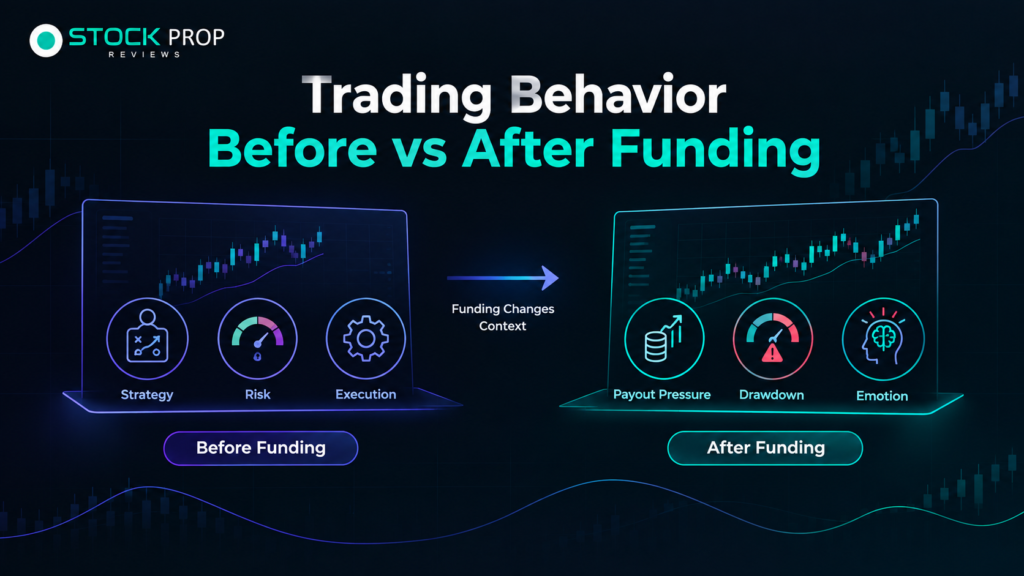
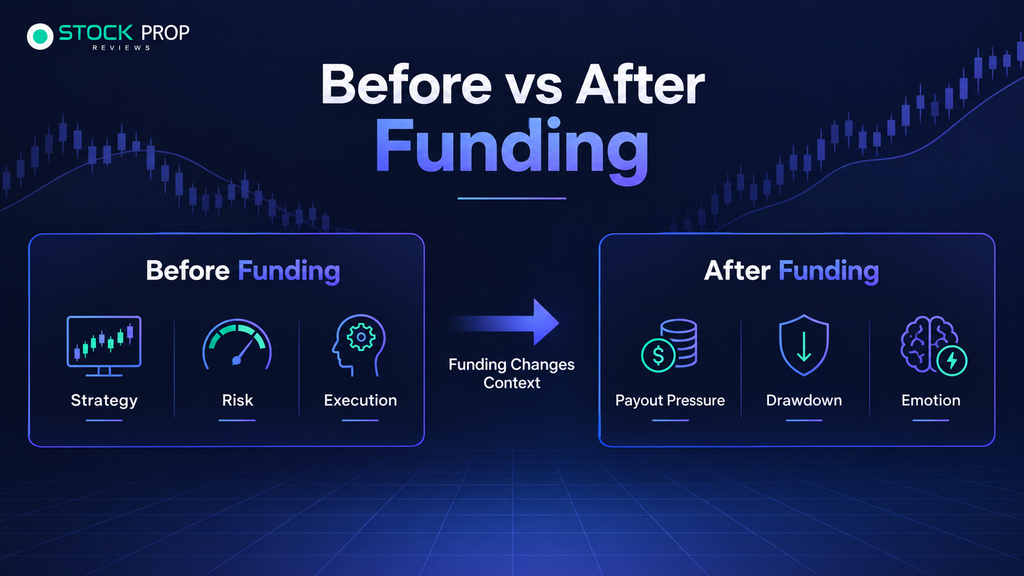
After transitioning from an evaluation or personal account to a funded account, a significant change in the behavior of a funded trader is possible. The strategy may be the same, but the psychological meaning of each transaction is changed.
A losing trade is usually a loss in a challenge, demo environment or personal account before funding. Once funded, that same loss can feel like a threat to income, payout, or account allocation. That change can affect position sizing, how often you trade, stop placement and your willingness to accept normal losses.
This study is for traders preparing for their first funded account and funded traders that want to understand why their execution changes when they get capital. It’s not for traders looking for a prop firm recommendation or a guaranteed psychological formula to avoid losses.
What Is Funded Trader Behavior?
Funded trader behavior refers to the decisions and risk-management habits traders display while operating under a proprietary firm’s rules and drawdown limits.
The important point is that funding does not automatically make a trader more disciplined.
The rules build structure and the trader becomes more disciplined. Another trader may become more anxious because each loss now appears to be linked to a future payout. Another trader may become overconfident after passing an evaluation and ramp up risk too quickly.
Behavior is therefore not determined by funding alone. It is shaped by the trader’s existing habits, account rules, perceived financial pressure and response to gains and losses.
Behavioral-finance research provides useful background here. Barber and Odean’s research on individual investors found evidence of overconfidence and excessive trading, as well as a tendency for investors to realize winning positions more readily than losing ones. Those findings do not specifically measure funded prop traders, but they help explain why changing financial circumstances can influence trading decisions.
Trading Before Funding: More Freedom, Less Pressure
Before funding, traders often have more psychological freedom.
During a challenge, the trader may think:
“I only need to make another 2%.”
That sounds harmless, but it can create its own problems.
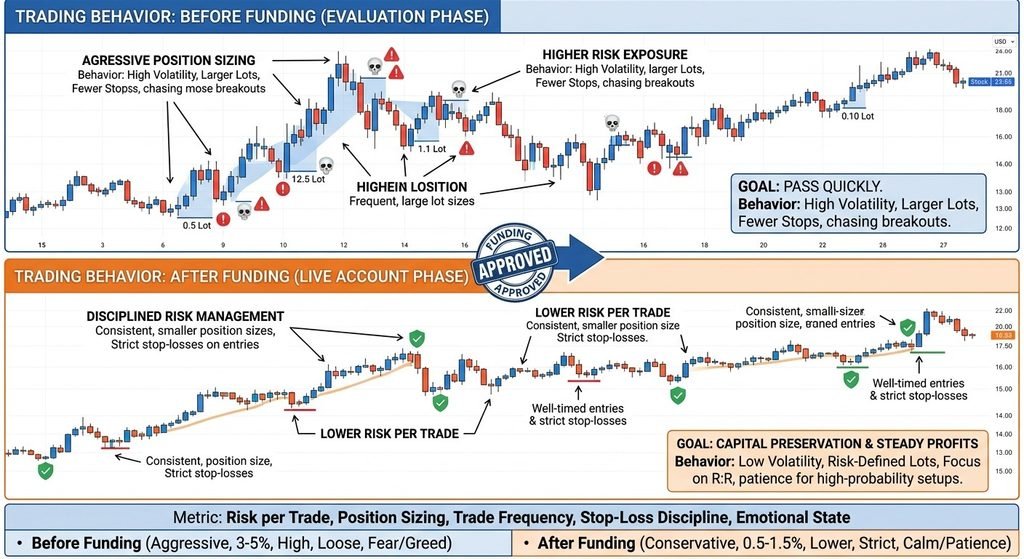
As the target approaches, the trader may increase the size of the position. After a few profitable trades, confidence can grow faster than the actual statistical evidence. You might normally risk .5% per trade, but all of a sudden you start risking 1% or 2% because the account seems to be going in the right direction.
The opposite can also happen.
After a losing streak, the trader may become excessively cautious and stop taking valid setups. The result is a cycle where the trader is no longer following the original strategy.
This is one reason a challenge should not be treated as a sprint.
A strategy that requires ten trades to produce a meaningful sample cannot suddenly become a two-trade strategy simply because the trader wants to reach the target faster.
The evaluation mindset
The evaluation stage often creates three competing objectives:
- Make enough profit to get by.
- Do not violate the firm’s risk policy.
- Be consistent enough for the strategy to work normally.
The problem is that traders frequently focus on the first objective while underestimating the second and third.
A trader may have a profitable strategy but still fail because position size becomes too large after a losing trade.
After Funding: The Same Trade Can Feel Different
Funding alters the risk profile.
Let’s say a trader risks 0.5% per trade.
5 losses in a row is about 2.5% of the account, not counting compounding, execution differences, or other costs.
Mathematically this sequence is not rare for many trading systems.
But psychologically, the fifth loss can feel very different from the first.
Before funding, the trader may think:
“That is part of the system.”
After funding, the trader may think:
“I have already lost money from my payout.”
That second interpretation can trigger behavior that was not present during testing.
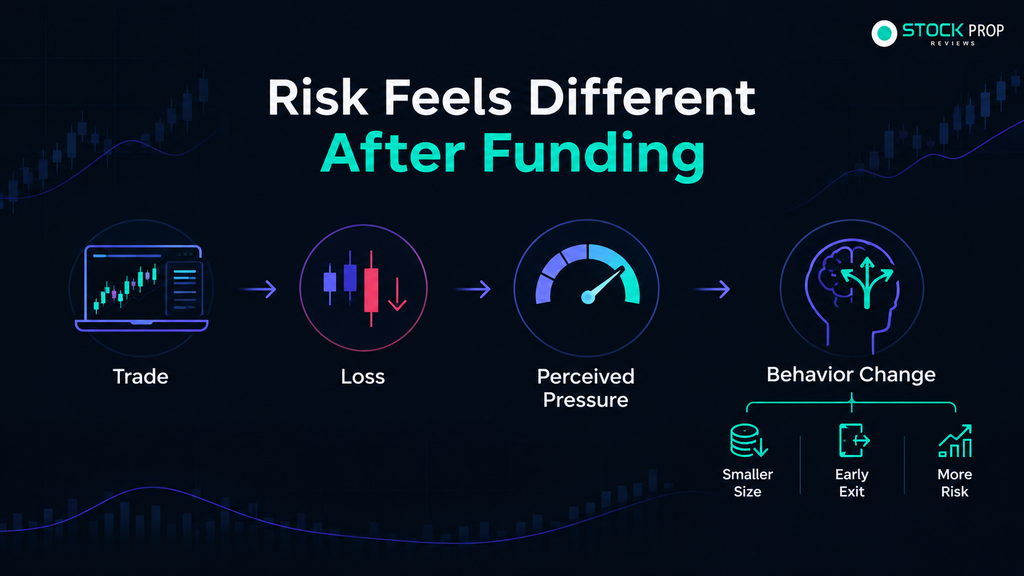
The trader might reduce position size dramatically, move a stop closer, close a trade early or skip the next valid setup.
Another trader may react in the opposite direction and attempt to recover the loss immediately.
Both reactions can damage the original trading process.
The Biggest Behavioral Shift: Risk Becomes Personal
The paradox of funded trading is that traders are using firm capital, but the psychological consequences can still feel personal.
A trader may technically risk none of their own trading capital on each position, yet the account represents something valuable:
- A potential payout
- A recurring income opportunity
- Proof that their strategy works
- A larger future allocation
- Money already spent on the evaluation
This can create what might be called perceived ownership of the account.
The trader starts protecting the account emotionally rather than managing it statistically.
That distinction matters.
A valid losing trade is not automatically a bad trade. A profitable trade is not automatically a good trade.
The quality of the decision should be judged against the trading plan, not solely against the result
Why Traders Start Overtrading After Funding
Overtrading is one of the clearest examples of behavioral change.
Suppose a trader normally takes two or three carefully selected setups each day. After receiving funding, the trader begins monitoring every small market movement because the account now feels like an opportunity that must be used.
More screen time creates more temptation.
A missed move becomes frustrating. The trader enters late. The trade loses. The trader then looks for another setup to compensate.
This is how a normal losing trade can become a behavioral problem.
The original loss may have been completely acceptable. The second trade may have been unnecessary.
The third trade may have been an attempt to recover the first two.
Eventually, the trader is no longer trading the strategy. They are trading the emotional state created by the previous trades.
Behavioral-finance literature commonly discusses overconfidence, loss aversion, emotional responses and other biases that can affect investment decisions. These concepts are relevant to prop trading, although they should not be treated as proof that every funded trader behaves in the same way.
The Payout Effect
The first payout can create another behavioral transition.
Before the first payout, the trader’s primary objective may be account survival.
After receiving money, the trader may begin thinking about how much can be made next month.
That sounds positive, but it can increase pressure.
Consider a trader who receives a $1,000 payout.
The next month, they decide they want $2,000.
The target has doubled, but the strategy has not necessarily become twice as profitable.
Instead of waiting for the same setups, the trader may:
- Increase position size
- Trade more frequently
- Hold positions longer than planned
- Take lower-quality setups
- Trade during unfamiliar market conditions
The account has not changed the strategy. The trader’s expectations have changed the strategy.
This is one of the less-discussed problems with funded trading.
What Happens After a Losing Week?
A losing week is where funded trader behavior becomes easier to observe.
A disciplined trader may review the trades and conclude that the losses were within the strategy’s expected distribution.
Another trader may interpret the same week as evidence that something is broken.
That interpretation can lead to unnecessary strategy changes.
For example, imagine a system historically produces four to six losing trades during difficult periods. The trader experiences five losses in a funded account and immediately changes indicators, entry criteria and stop placement.
The next few trades may then be based on an untested system.
The original strategy might have recovered naturally, but the trader abandoned it because the drawdown felt different inside the funded account.
This is why traders need to distinguish between strategy failure and normal variance.
What Competitor Psychology Articles Often Miss
Many articles about funded trading psychology correctly discuss fear, discipline and confidence. The missing part is usually the interaction between psychology and account mechanics.
A trader does not experience psychology in isolation.
The drawdown model matters.
A static drawdown can create a different experience from a trailing drawdown. Daily loss limits can create different behavior from a model where losses are measured differently. Consistency requirements can also influence when a trader chooses to take risk.
This means the question is not simply:
“Are you mentally strong enough to trade a funded account?”
A better question is:
“Does your normal trading behavior remain viable under this firm’s actual rules?”
That is a much more useful test.
For example, our FTMO review examines the firm’s current drawdown and trading restrictions, while our The5ers review looks at a different structure and scaling approach. Our broader prop firm comparison also shows why the headline profit split is only one part of the decision.
The distinction is important because traders sometimes blame psychology for a problem that is actually a poor strategy-rule fit.
Before vs After Funding
| Behavior | Before Funding | After Funding |
| Risk perception | Trading opportunity | Potential payout and account protection |
| Losing trade | Often easier to accept | Can feel financially significant |
| Position sizing | Based on strategy | Can increase or decrease emotionally |
| Trade frequency | Usually strategy-driven | Can rise because of payout pressure |
| Stop placement | Based on setup | May become tighter after losses |
| Profit taking | Based on system | Can become premature after a drawdown |
| Recovery behavior | Less urgent | Can become aggressive after losses |
| Main danger | Failing evaluation | Losing funded account or payout opportunity |
This table should not be interpreted as a universal rule. Some traders actually become more disciplined after funding because the rules force them to respect risk.
The important observation is that funding creates a new environment. The trader needs to prove that their behavior remains stable inside it.
The Most Common Behavioral Mistakes
Increasing risk after passing
Passing an evaluation can create a false sense that the trader has already proved everything.
But passing demonstrates performance over a particular period. It does not prove that larger position sizes are justified.
A trader who normally risks 0.5% and suddenly risks 1.5% has changed the statistical profile of the strategy.
Trying to protect every winning day
Some traders become so focused on protecting profits that they stop following their normal process.
After making 2% early in the week, they may reduce risk so dramatically that the remaining trades no longer resemble their tested strategy.
Protecting capital matters, but excessive protection can also create inconsistent execution.
Recovering losses quickly
This is one of the most dangerous transitions.
A trader loses 1%.
Instead of accepting the loss as part of the system, they decide to make back 1% immediately.
The next trade becomes emotionally connected to the previous one.
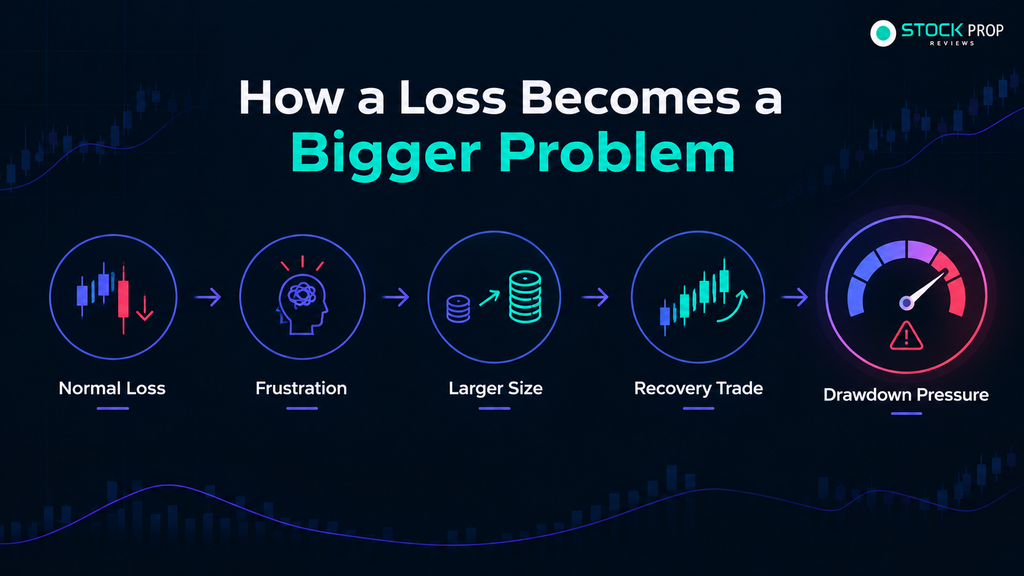
Now this is how position sizing can spiral:
Normal Loss -> Frustration -> Bigger Size -> Recovery Trade -> Drawdown Pressure
Maybe the first trade was normal. It is the behavioral response that generates the danger.
Changing strategy during drawdown
A drawdown is uncomfortable, but discomfort is not evidence that the strategy has stopped working.
Before changing a strategy, traders should examine sample size, market conditions, execution quality and historical drawdown.
Our analysis on [backtesting prop firms] covers why historical return alone is not enough when assessing whether a strategy can survive a prop firm’s risk framework.
How to Test Your Behavior Before Getting Funded
The best preparation is not simply passing another challenge.
Try to reproduce the funded environment before funding.
Use the same maximum daily loss you expect to face. Use the same position-sizing rules. Track every trade. Record whether you followed the plan, not just whether the trade won.
Most importantly, record what happens after a loss.
Ask:
Do I increase size?
Do I take another trade immediately?
Do I move my stop?
Do I skip the next setup?
Do I change my strategy?
These answers can tell you more about funded-account readiness than a short winning streak can.
A trader who can take five normal losses without changing the process has learned something valuable.
A trader who wins five trades but doubles risk after the fifth may have learned much less than the equity curve suggests.
Where TradeThePool Fits
Stock traders should take a look at TradeThePool separately, as its model is focused on equities and it publishes detailed information about its trading requirements and risk framework. The current program terms say that the trading strategy must be adapted to the firm’s defined rules and risk management requirements.
There is an important distinction, however: current TradeThePool disclosures do not support describing the company as a regulated stock prop firm. Its terms describe Five Percent Online Ltd. as the operator and distinguish its proprietary-trading service from regulated financial institutions.
The more useful point for traders is its published rule structure and risk transparency rather than a regulatory label. Readers can get up to 10% discount when purchasing through our TradeThePool link.
The Real Test of a Funded Trader
Funding does not create discipline.
It reveals how a trader behaves when discipline becomes financially and psychologically important.
The strongest test is not whether a trader can make 10% during a good month. It is whether they can continue executing the same process when they are down 2%, when a payout is close, when they have just had a winning streak, or when several valid setups fail in a row.
That is where funded trader behavior matters most.
A trader who treats every result as feedback can keep the process stable.
A trader who treats every result as a command to change risk can gradually move further away from the strategy that got them funded.
The difference is not always visible in a firm’s advertised profit target or profit split. It appears in the decisions made between those numbers.
FAQs
Does trading behavior really change after getting funded?
It can. Funding can increase perceived financial pressure, making traders more sensitive to losses, payouts and drawdown limits. However, the effect varies between traders.
Why do traders overtrade after getting funded?
A funded account can create pressure to generate income or reach a payout quickly. That pressure can cause traders to take setups they would normally reject or increase trade frequency after losses.
Should I reduce risk after becoming funded?
The strategy and the rules of the firm must set the risk, not emotion. If a trader changes risk after funding, they should understand how that impacts the strategy’s historical performance.
Why do traders increase position size after a losing trade?
Losses can create a desire to recover money quickly. If the trader responds by increasing position size, the next trade becomes larger precisely when decision-making may be less objective.
How can I prepare psychologically for a funded account?
Simulate the firm’s actual risk limits before funding. Track your response to losing streaks, winning streaks, missed trades and drawdown. The objective is to test whether your behavior remains consistent under pressure.