When people look at prop firms, most traders will consider things like profit targets, payout schedules, account sizes etc. Scaling restrictions are rarely given the same attention.
That’s false.
In many cases prop firm scaling restrictions are more important than the initial account size and these are what drive the long term earnings. A trader can have plenty of buying power but if position sizes are limited by scaling rules, the road to increasing income can be much slower than you expect.
The restrictions are important for funded and beginner traders to understand before signing up for any evaluation or funded program. Some scaling models may seem overly restrictive for experienced traders who have a solid risk management process in place.
This article is not about arguing the merits of scaling restrictions. Instead, it looks at why firms use them, where traders misunderstand them and what their practical impact looks like in real trading conditions.
What Are Prop Firm Scaling Restrictions?
Scaling restrictions are rules that determine how a trader can increase risk, position size, or account allocation over time.
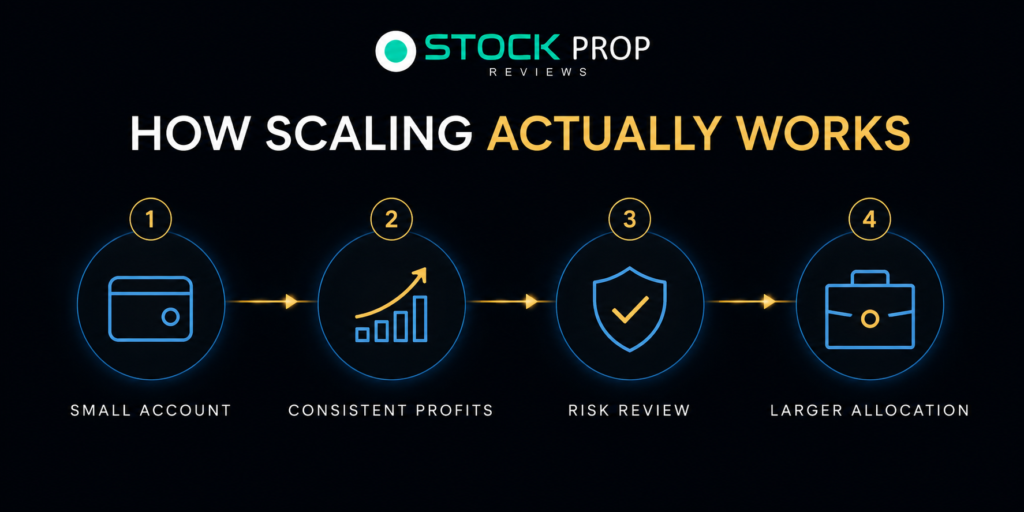
Most prop firms do not want traders dramatically increasing exposure after a short period of profitability. Instead, they require evidence that profits are being generated consistently and within acceptable risk parameters.
A trader may earn several payouts and still be required to follow the same position-sizing limits until certain milestones are met.
The underlying idea is simple. The firm wants to see whether profitability can be maintained over time rather than achieved during a brief hot streak.
That distinction is important because many traders perform well for a few weeks. Far fewer can maintain the same level of discipline for several months.
Why Prop Firms Care About Scaling
Many traders assume scaling restrictions exist solely to protect the firm’s capital.
That explanation is only partially true.
The bigger concern for most firms is what happens after a trader experiences success.
Passing an evaluation often requires disciplined execution. The problems tend to appear after funding. A trader who has spent weeks managing risk carefully may suddenly become more aggressive once real payouts become possible.
Most experienced traders have seen this happen firsthand.
A trader earns 8% or 10% in a strong month, feels confident, increases risk, and then gives back a large portion of those gains within a few sessions.
From the firm’s perspective, scaling restrictions are an attempt to slow that process down.
Whether traders like those restrictions is another discussion, but the reasoning behind them is not difficult to understand.
The Part Most Traders Miss
Many discussions about scaling focus almost entirely on account growth.
The conversation usually sounds something like this:
“If I reach a certain profit target, my account doubles.”
While technically true, that statement ignores a much more important factor.
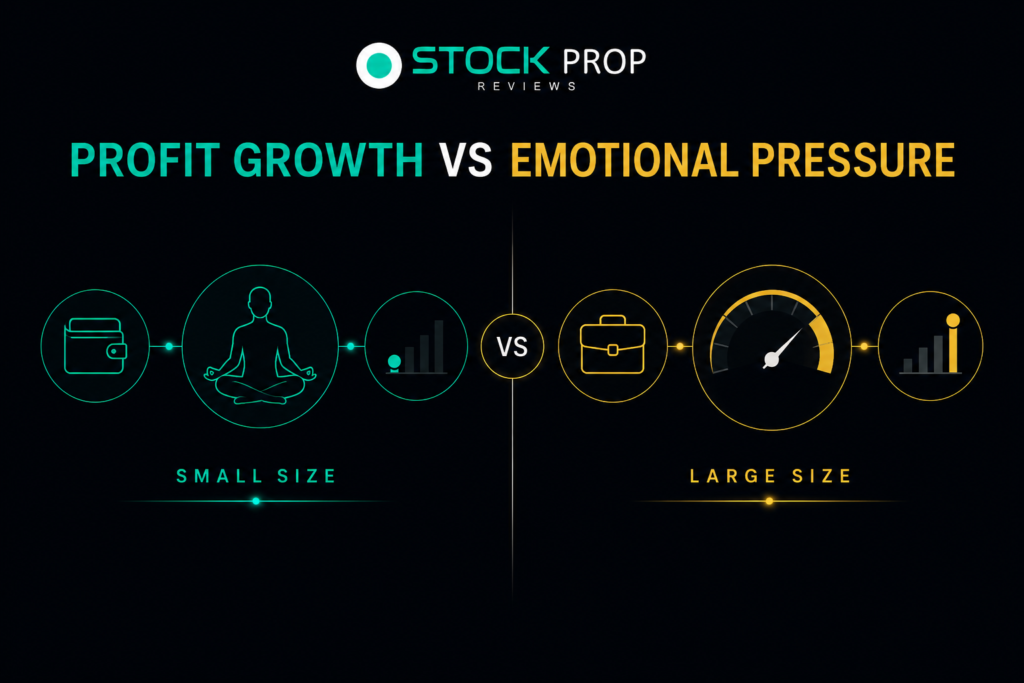
Larger accounts create larger emotional pressure.
A trader risking $50 per trade may feel completely comfortable following a plan. That same trader might behave very differently when each trade carries $500 or $1,000 of risk.
The strategy has not changed.
The market has not changed.
Only the emotional weight of decision-making has changed.
This is one reason some traders perform worse after receiving larger allocations. The challenge is no longer finding setups. The challenge becomes managing the psychological impact of larger numbers.
Many prop firms understand this reality better than traders do, which is one reason scaling tends to happen gradually.
Different Approaches to Scaling Restrictions
Not all firms handle scaling the same way.
Some firms focus on profitability. Others focus on consistency. A few combine multiple factors.
Profit-based scaling is the most common model. Traders reach specific profit milestones and become eligible for larger allocations. On paper, this approach seems straightforward. The difficulty arises when additional requirements are attached to those milestones.
A trader might generate the required profit but still fail to qualify because of inconsistent daily performance or excessive drawdowns.
Other firms place greater emphasis on risk management. Rather than rewarding profits alone, they evaluate how those profits were achieved.
A trader who earns 12% while maintaining tight risk controls may be viewed more favorably than a trader who earns the same return through aggressive position sizing.
There are also firms that require traders to maintain performance over a defined period before any scaling occurs. These programs can frustrate traders looking for rapid growth, but they tend to produce more stable results from the firm’s perspective.
How Scaling Restrictions Interact With Drawdown Rules
One of the biggest misunderstandings in prop trading is treating account size as the most important number.
Account size matters, but drawdown limits often matter more.
Consider two traders.
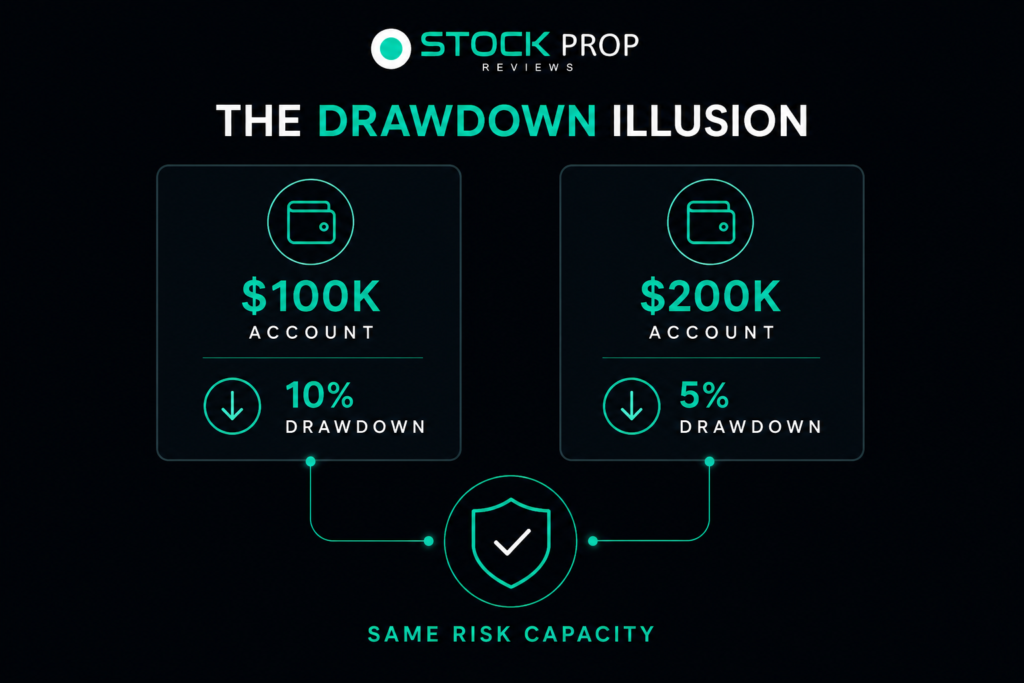
The first receives a $100,000 account with a 10% drawdown allowance.
The second receives a $200,000 account with a 5% drawdown allowance.
At first glance, the second account appears significantly better.
In reality, both traders have the same effective loss limit.
This is why evaluating scaling opportunities without looking at drawdown rules can lead to poor decisions.
Some firms promote aggressive scaling plans while simultaneously maintaining restrictive risk limits. The larger account sounds impressive, but the trader may not gain much additional flexibility.
When comparing firms, it is always worth looking beyond the headline account size.
Common Mistakes Traders Make
The first mistake is assuming scaling happens automatically.
Many traders reach a profit target and expect an immediate account increase. In practice, firms often require additional conditions to be met. These may include payout history, consistency requirements, minimum trading days, or internal reviews.
The second mistake is trying to force the scaling process.
This usually happens when traders become impatient. Instead of following their normal risk parameters, they increase position size in an effort to reach milestones faster.
Ironically, this behavior often delays growth because it leads to larger drawdowns and rule violations.
Another common issue is misunderstanding how much additional buying power is actually available after scaling.
Some firms increase account size while maintaining limitations on position exposure. Traders discover later that the practical benefits are smaller than expected.
None of these mistakes are complicated, yet they remain surprisingly common.
Are Scaling Restrictions Good or Bad?
The answer depends largely on the trader.
For newer traders, scaling restrictions can serve as a useful guardrail. They encourage patience and reduce the temptation to dramatically increase risk after a profitable period.
Many traders who initially dislike these restrictions later admit they probably prevented costly mistakes.
The argument against scaling restrictions is equally valid.
Experienced traders with established risk-management systems may see little value in being forced to wait for capital increases. They already understand position sizing and may prefer greater flexibility.
This is where personal trading style becomes important.
A trader focused on steady account growth may view restrictions as a reasonable trade-off.
A highly active trader looking to maximize capital efficiency may find the same rules frustrating.
Neither perspective is inherently wrong.
What Competitors Often Overlook
Most articles discussing scaling restrictions focus on the firm’s reasons for implementing them.
Very few discuss how traders actually experience them.
The reality is that scaling restrictions rarely feel restrictive during losing periods.
They become noticeable during winning periods.
When performance is strong, traders naturally want to increase size and capitalize on momentum. That is exactly when restrictions become most visible.
This creates a conflict between what the trader wants and what the firm wants.
The trader wants faster growth.
The firm wants evidence that the growth is sustainable.
Understanding this difference helps explain why scaling rules sometimes generate frustration despite being designed as risk controls.
Comparing Strict and Flexible Scaling Models
| Factor | Flexible Scaling | Strict Scaling |
| Account growth speed | Faster | Slower |
| Risk oversight | Lower | Higher |
| Trader freedom | Greater | More limited |
| Psychological adjustment | Harder | Easier |
| Capital protection | Lower | Higher |
Neither model is universally superior.
Flexible programs tend to appeal to experienced traders, while stricter programs often suit traders still developing consistency.
The important question is whether the firm’s approach matches your trading style rather than whether the rules appear generous.
Who Should Be Cautious About Strict Scaling Programs?
Traders who rely on high-frequency execution or aggressive position sizing should carefully review scaling policies before joining a firm.
Certain scalping strategies depend heavily on position size to generate meaningful returns. If growth in exposure is heavily restricted, the economics of the strategy may change.
By contrast, swing traders and lower-frequency traders are often less affected because their returns depend more on trade quality than rapid increases in size.
Understanding how your strategy generates profits is often more important than comparing account sizes.
A Note on Alternative Models
Not every prop firm is the same when it comes to growing.
Some companies are really focused on scaling milestones. Some others rely more on stable risk management from the beginning.
If you’re interested in stock trading, (not CFDs or forex), TradeThePool is often mentioned because of its transparent risk framework and regulated structure. The emphasis is on clear rules and risk control rather than pushing for fast account growth.
Readers can shop through our TradeThePool link and receive up to 10% off.
When comparing firms it can also be beneficial to read detailed funded account reviews, compare drawdown models between providers, and see if payout consistency meets your trading goals.
The Bottom Line
Scaling restrictions are often presented as either a major benefit or a major drawback. The truth sits somewhere in the middle.
They can protect traders from increasing risk too quickly. They can also slow down account growth for traders who already have a proven process.
What matters is not whether a firm offers scaling.
What matters is understanding exactly how that scaling works, how it interacts with drawdown limits, and whether it fits the way you trade.
Many traders spend hours comparing profit splits and challenge fees while barely reading the scaling section of the rulebook.
In practice, that overlooked section can have a bigger impact on long-term results than either of those factors.
FAQs
What are prop firm scaling restrictions?
They are rules that control how quickly traders can increase account size, buying power, or risk exposure after demonstrating profitable performance.
Do all prop firms use scaling restrictions?
No. Some firms offer fixed account structures, while others provide growth programs tied to performance milestones or consistency metrics.
Can scaling restrictions reduce profitability?
They can slow account growth, but they may also prevent traders from increasing risk too aggressively and violating firm rules.
Are scaling restrictions more important than profit splits?
In many cases, yes. A generous profit split may matter less if scaling restrictions significantly limit account growth.
Should beginners prefer firms with scaling restrictions?
For many beginners, gradual growth has advantages such as disciplined risk management and less temptation to overtrade after early success.