Most traders don’t fail prop firm evaluations because they can’t find good trades.They fail because of a misunderstanding of the risk rules attached to the account.
The trailing drawdown is a perfect example.
The idea looks simple on paper. As your account grows, so does your drawdown limit. In practice it creates a whole new risk landscape relative to a fixed drawdown. Many traders learn this the hard way – after they’ve already broken the rule.
If you have ever logged into your account to see that you are still in profit and asked yourself how you could have failed, a trailing drawdown was probably involved.
In this guide we will attempt to deconstruct the mathematics behind trailing drawdowns, show you how it is calculated and highlight some of the common mistakes traders make when trading with these rules.
Trailing Drawdown Explained
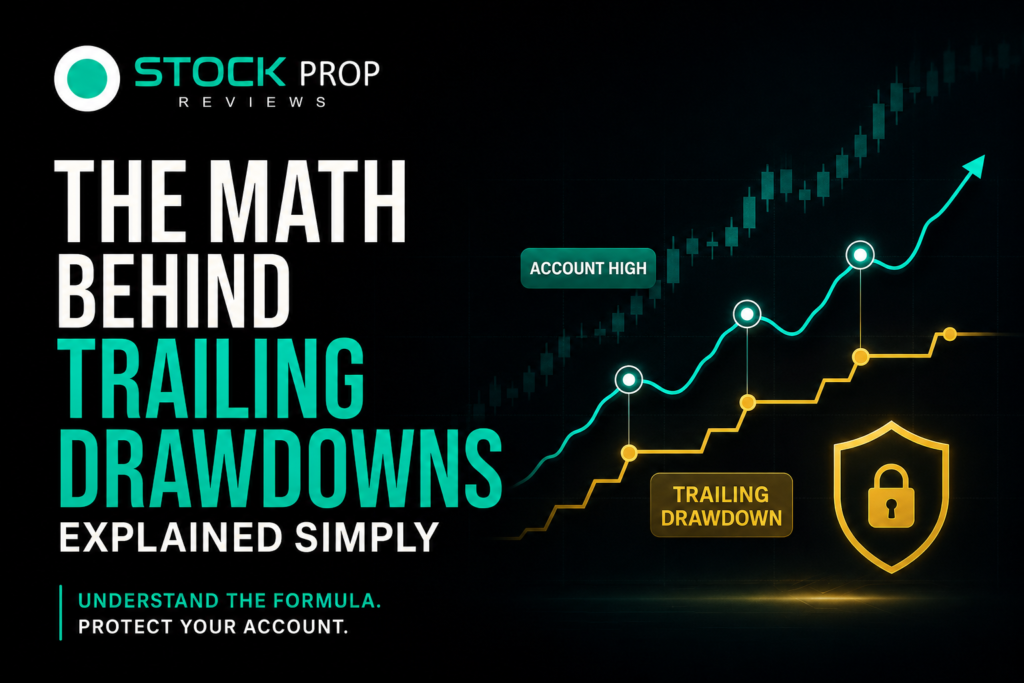
A trailing drawdown is a moving loss limit that rises as your account reaches new highs.
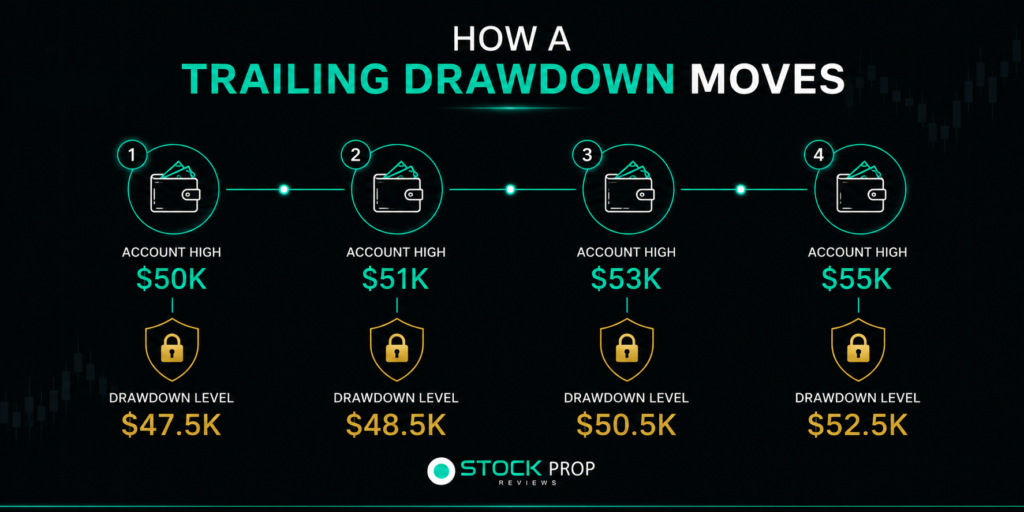
Let’s say a prop firm gives you a $50,000 account with a $2,500 trailing drawdown. Your initial loss limit sits at $47,500. If your account drops below that level, the account fails.
So far, that’s straightforward.
The important detail is that the drawdown level doesn’t stay there. If your account grows to $52,000, the loss limit rises as well. Instead of sitting at $47,500, it now moves to $49,500.
That change is where most of the confusion begins.
Many traders assume profits automatically give them more freedom. With a trailing drawdown, the opposite can happen. As the account grows, the floor beneath it rises too.
The Simple Math Most Traders Need
You don’t need to know any advanced maths to understand trailing drawdowns.
Normally the calculation is:
Highest Account Value – Drawdown Amount = Current Drawdown Threshold
For example:
- Starting balance: $50,000
- Trailing drawdown: $2,500
Initial threshold:
$50,000 − $2,500 = $47,500
Now imagine the account reaches $53,000.
New threshold:
$53,000 − $2,500 = $50,500
At that point, the original $47,500 limit doesn’t matter anymore. The company’s risk system now focuses on $50,500.
This is the detail many evaluation traders do not get. Your account may be growing, but your margin for error may not be growing at the same rate.
Why Profitable Traders Still Fail
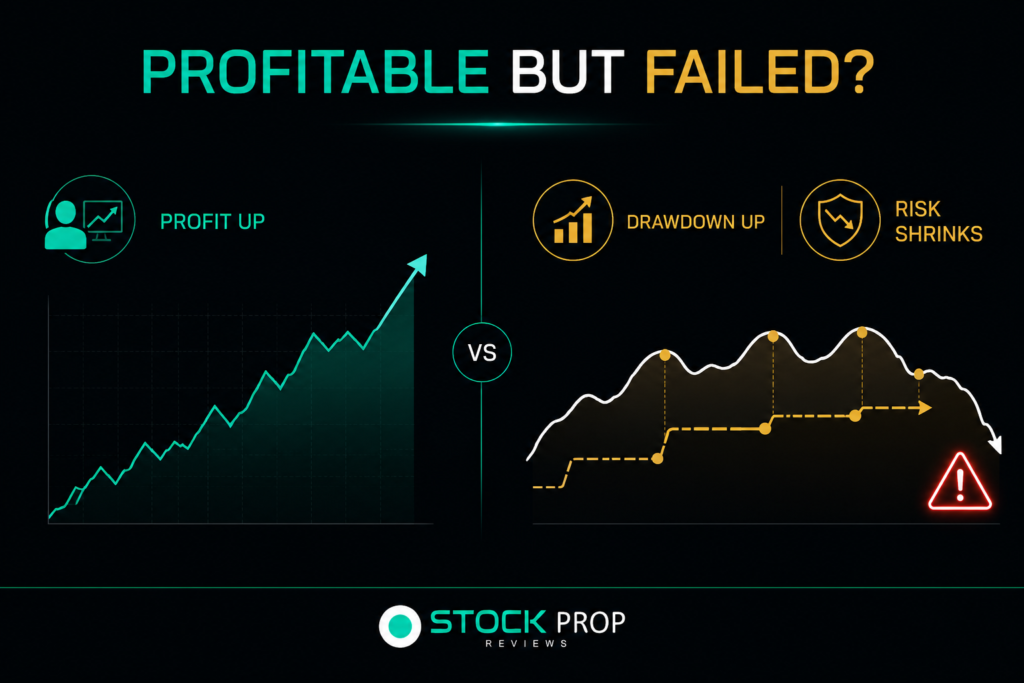
One of the biggest misconceptions about trailing drawdowns is that profitability automatically creates safety.
In reality, a trader can make money and still put themselves in a more vulnerable position.
Consider two traders.
The first trader makes $4,000 during the first week by trading aggressively. The second trader makes only $1,000 using conservative position sizing.
Most people would assume the first trader is in the stronger position.
Sometimes the opposite is true.
The aggressive trader has likely pushed the trailing threshold significantly higher. If volatility increases or a few trades go wrong, the account can quickly fall back toward the drawdown limit.
Meanwhile, the conservative trader often has more flexibility because account fluctuations remain smaller relative to the moving threshold.
This is one reason experienced funded traders often care more about account stability than rapid account growth.
What Most Prop Firm Articles Don’t Explain
Many articles explain how a trailing drawdown moves. Few explain how it changes trader behaviour.
The rule itself isn’t particularly complicated. The challenge comes from the psychological pressure it creates.
Once traders know the threshold moves upward, they often start managing trades differently.
Some take profits too quickly because they don’t want open profit to disappear.
Others become hesitant to take valid setups because they are focused on protecting recent gains.
A few start increasing position size after a winning streak because they believe they’ve built a cushion.
Ironically, that perceived cushion is often smaller than they think.
The most common account failures occur when traders stop following their strategy and start reacting to the drawdown rule.
Real-Time vs End-of-Day Trailing Drawdowns
Trailing drawdowns are not all created equal.
That difference is much more significant than most traders know.
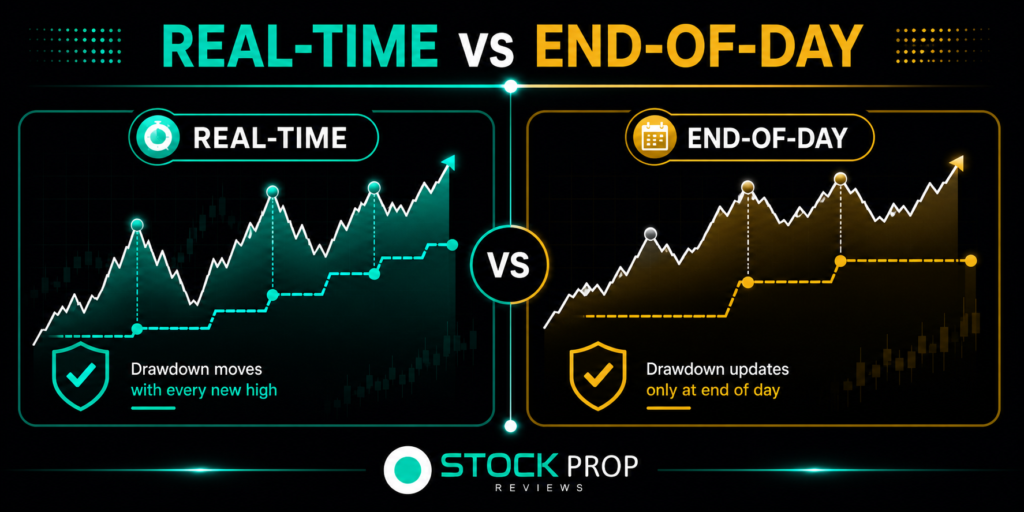
Real-time trailing drawdown can have an immediate impact on the calculation of unrealised profits. If a trade moves your account equity to a new high, the drawdown level can increase even before the trade is closed.
Let’s say your $50,000 account spikes to $52,000 while in an open trade. Then the drawdown level.
If the market goes against you and you close out with a small gain, often the higher drawdown threshold still applies.
This is frustrating for many traders because they never actually locked in the bigger profit.
End-of-day trailing drawdowns are easier to manage. This calculation is done at the close of a trading session and not on every twitch of the market.
That difference can be huge for active traders in survival in their accounts
The Relationship Between Risk and Trailing Drawdowns
Trailing drawdowns reward consistency more than aggression.
A trader risking 0.5% per trade may find the rule relatively manageable because account swings remain controlled.
A trader risking 3% to 5% per trade faces a very different challenge. Large fluctuations can cause the trailing threshold to rise rapidly, leaving little room for normal market noise.
This is why many traders who perform well on personal accounts struggle during prop evaluations.
The strategy itself may be profitable, but the account structure changes how risk must be managed.
The evaluation is not only testing trading skill. It’s testing whether the trader can operate within a specific risk framework.
Which Trading Styles Fit Best?
Trailing drawdowns generally favour traders who produce smooth equity curves.
Swing traders with moderate risk, trend-following traders, and disciplined day traders often adapt well because their performance tends to be more consistent.
Scalpers frequently face greater challenges. A strategy that generates many trades and constant equity fluctuations can interact poorly with a moving drawdown threshold.
News traders face similar issues. Large price swings can create temporary equity highs that later disappear, yet the drawdown level may continue to reflect those highs.
The result is often a shrinking margin for error.
That doesn’t mean these approaches cannot work. It simply means the trader must understand how the firm’s risk model interacts with the strategy.
Should Beginners Avoid Trailing Drawdowns?
Not necessarily.
The bigger issue is whether the trader understands the rule before taking the evaluation.
Many beginners spend hours studying entry models, indicators, and trade management while spending only a few minutes reading the firm’s risk rules.
That is usually backwards.
A trader can have an average strategy and still pass an evaluation through disciplined risk management.
A trader with an excellent strategy can fail repeatedly if they don’t understand how the drawdown is calculated.
Before purchasing any challenge, traders should know:
- Whether the drawdown is fixed or trailing.
- Whether it uses balance or equity.
- Whether it moves in real time or at the end of day.
- Whether it eventually stops trailing.
Those details often matter more than the advertised profit target.
Alternatives Traders May Prefer
Many experienced traders are looking for firms with fixed drawdowns, as this makes it easier to plan your risk framework.
A fixed drawdown is always in the same place as the account grows. Traders know where the limit is from the beginning.
Others like stock prop firms where the risk rules are built around consistency rather than aggressive evaluation targets.
TradeThePool is a regulated stock prop firm with clear risk parameters and simple account structures. TradeThePool link Readers get 10% discount on all products
The best choice is not so much about profit potential as it is whether the risk model fits your trading style.
The Bottom Line
Trailing draw downs aren’t designed to make traders fail. They are intended to protect capital.
The problem is many traders treat them as a fixed drawdown, and only realise the difference after they violate the rule.
Once you understand the calculation, the concept is far less scary.
The maths is simple. Trailing drawdowns are tough due to the effect they have on decision making. Traders tend to defend the moving threshold rather than follow their strategy.
And usually the traders that have the highest returns aren’t the ones who live the longest. They are the traders that know precisely where the line of risk is and size their position accordingly.
FAQs
What is a trailing drawdown?
A trailing drawdown is a moving loss limit that moves higher as the account reaches new highs. It tracks account growth and cuts down the amount of profit that can be given back.
Why do traders lose trailing drawdowns?
Most failures are due to traders not understanding how the threshold moves or to them increasing risk after a profitable period.
Is a fixed drawdown harder than a trailing drawdown?
Yes, for most traders. A fixed drawdown stays put, simplifying risk management and making it more predictable.
Do trailing drawdowns consider unrealised profits?
Some companies do. Real-time trailing drawdowns are typically based on account equity, so open profits may raise the threshold before the trades are closed.
Can a profitable trader lose a trailing drawdown?
Yes. The trader could still be profitable overall, but if the account equity drops below the required level, then the trader will have breached the moving drawdown threshold.