All traders say they understand drawdowns until they are in one.
On a backtest report, a losing streak looks manageable. But when it is happening on a live account though, it feels a lot different, especially if there is real money, a funded account, or a payout involved.
Drawdown anxiety trading is the emotional stress that builds up as losses start to accumulate. It can make traders question strategies that were working perfectly a week ago. It can lead to hesitation, overtrading or unnecessary risk when discipline is needed in execution.
This article is for traders who think differently when they are losing. This is especially relevant for beginners, funded traders, futures traders, or anyone trading with tight risk limits.
It’s not for traders who want to eliminate drawdowns completely. All profitable trading strategies have periods where they underperform. This is not about avoiding drawdowns, it is about avoiding bad decisions and making them worse.
What Is Drawdown Anxiety Trading?
Drawdown anxiety trading refers to the psychological stress traders experience when their account balance falls below a previous high.
The anxiety itself is not unusual. The real problem is what follows.
A trader who was executing confidently may suddenly hesitate before entering trades. Another may start changing stop-loss placements. Someone else might begin increasing position sizes in an attempt to recover losses faster.
None of these decisions are usually part of the original trading plan.
Drawdown anxiety is less about the losses themselves and more about how those losses change behaviour.
Why Drawdowns Feel Larger Than They Are
One of the biggest differences between newer and experienced traders is not strategy knowledge. It is perspective.
Most traders know that losing streaks are part of the game. The issue is that knowledge often disappears when losses arrive in real time.
Think of a trader who has tested his system over hundreds of trades. The data indicates that six or seven losses in a row are perfectly normal. But the confidence starts to fade when you get to the fifth loss.
The trader starts wondering whether market conditions have changed. Maybe the strategy no longer works. Maybe they have lost their edge.
In many cases, nothing has changed except the trader’s emotional response.
This is where decision-making starts to deteriorate.
How Drawdown Anxiety Changes Trading Decisions
The initial effects are usually not spectacular.
Most traders don’t throw out their entire strategy on a whim after a few losses. Instead, small changes begin to show.
It was an obvious choice, now it seems risky. A winning trade is closed early because the trader needs to be sure. When recovery is urgent, risk management rules are more flexible.
Often these changes are gradual enough that traders do not notice them.
It’s the account performance that does.
Hesitation Replaces Execution
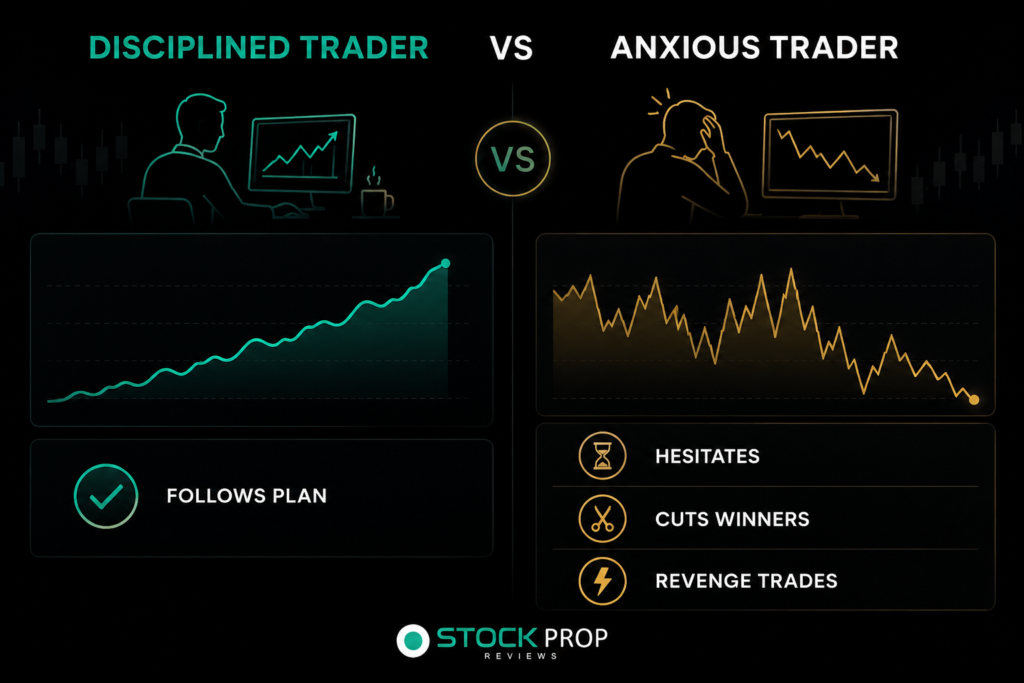
One of the most common symptoms of drawdown anxiety is hesitation.
Imagine a trader who has followed the same setup for months. After several losses, the next signal appears. Everything matches the plan, but confidence is gone.
The trader waits for additional confirmation.
The trade moves without them.
Later, they discover the setup would have been profitable.
The loss did not come from the market. It came from abandoning the process.
Profits Are Taken Too Early
Anxiety changes how traders view risk.
During a drawdown, many become more focused on avoiding another loss than maximizing good opportunities.
As a result, profitable trades are often closed long before reaching their intended targets.
The trader feels relief in the moment. Over time, however, this habit damages the strategy’s overall expectancy.
A system designed around larger reward-to-risk ratios cannot perform properly if winners are consistently cut short.
Traders Start Chasing Recovery
Not every anxious trader becomes defensive.
Some move in the opposite direction.
After a series of losses, the temptation to recover quickly becomes stronger. Position sizes increase. More trades are taken. Patience disappears.
Many funded account failures begin this way.
The trader is not trying to make money anymore. They are trying to erase discomfort.
That shift in mindset is dangerous because emotional recovery becomes more important than following a trading plan.
What Most Psychology Articles Miss
There is no shortage of research showing that anxiety affects decision-making. Most of it is accurate.
What many discussions fail to explain is how anxiety interacts with a performance-based activity like trading.
Trading is unusual because every decision has an immediate financial consequence. Unlike many professions, mistakes are visible almost instantly.
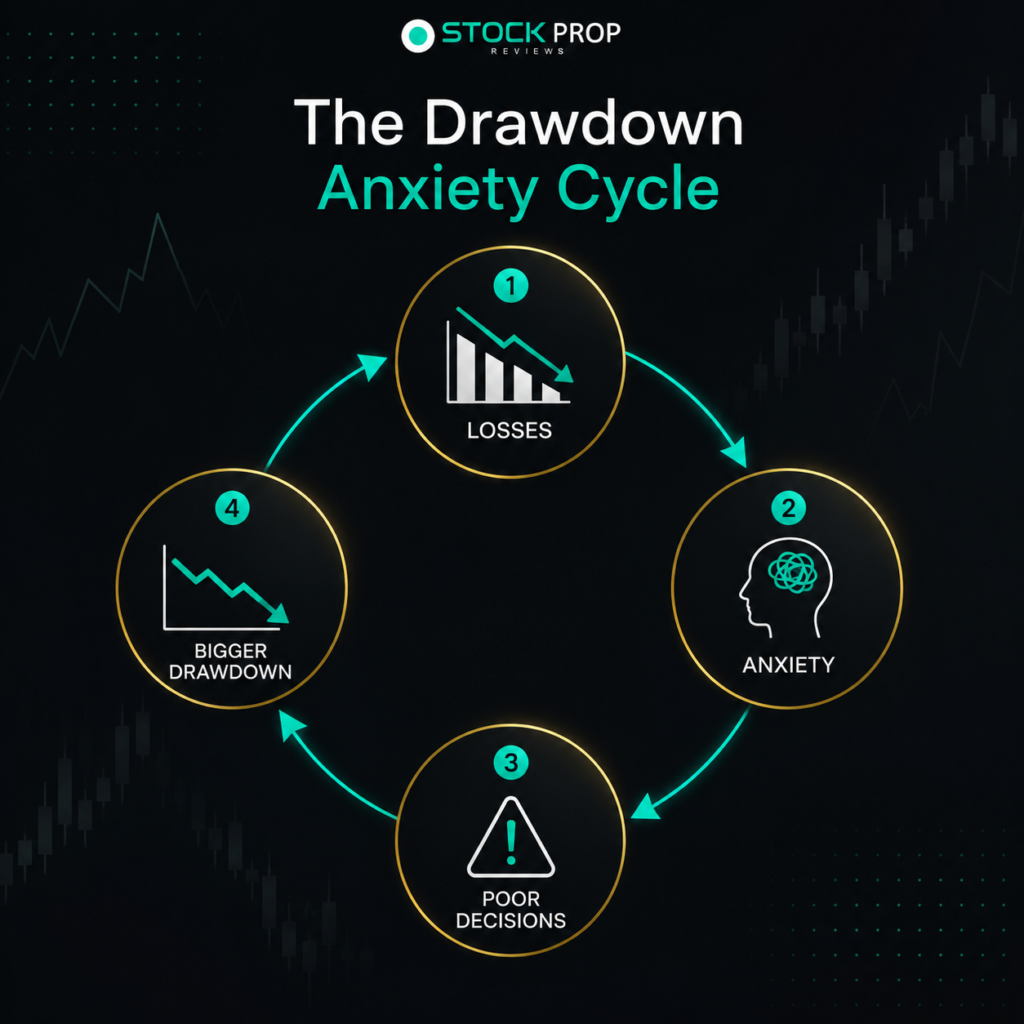
This creates a feedback loop.
Losses increase anxiety.
Anxiety affects decisions.
Poor decisions create additional losses.
The cycle continues until something interrupts it.
Another point often overlooked is that anxiety does not always look the same.
Some traders become extremely cautious. Others become aggressive. Both reactions can come from the same emotional source.
The common factor is that neither trader is making decisions according to their plan.
Real Trading Situations Where Drawdown Anxiety Shows Up
A funded trader makes 4 trades in a row and begins to avoid valid setups. They tell themselves they are being choosy. In truth they are trading scared.
A futures trader reaches 50% of their daily loss limit early in the session. They don’t ease up, they work twice as hard to find opportunities. Trade quality falls and losses speed up.
A profitable swing trader begins to move stop losses as recent losses have shaken confidence. The market hits the adjusted stop and goes in the original direction.
Such cases are not uncommon.
Most traders can think of a time in their career when anxiety affected their judgement more than the market.
Why Funded Traders Feel It More
Drawdown anxiety exists in every type of trading, but funded traders often experience it more intensely.
The reason is simple.
Most prop firms operate with strict risk parameters. Daily drawdown limits and maximum account drawdowns create additional pressure.
A retail trader can often step away and reassess. A funded trader approaching a risk limit may feel a strong urge to fix the situation immediately.
Unfortunately, urgency rarely improves decision-making.
Many traders start focusing on the account balance rather than the quality of their execution. Once that happens, emotional decision-making becomes more likely.
This is one reason transparent risk structures matter when evaluating prop firms. For example, TradeThePool has built much of its reputation around clear stock trading rules and defined risk parameters. Readers can get up to 10% discount when purchasing through our TradeThePool link.
Common Mistakes Traders Make During Drawdowns
The mistakes themselves are usually predictable.
What changes is the trader’s ability to recognise them while they are happening.
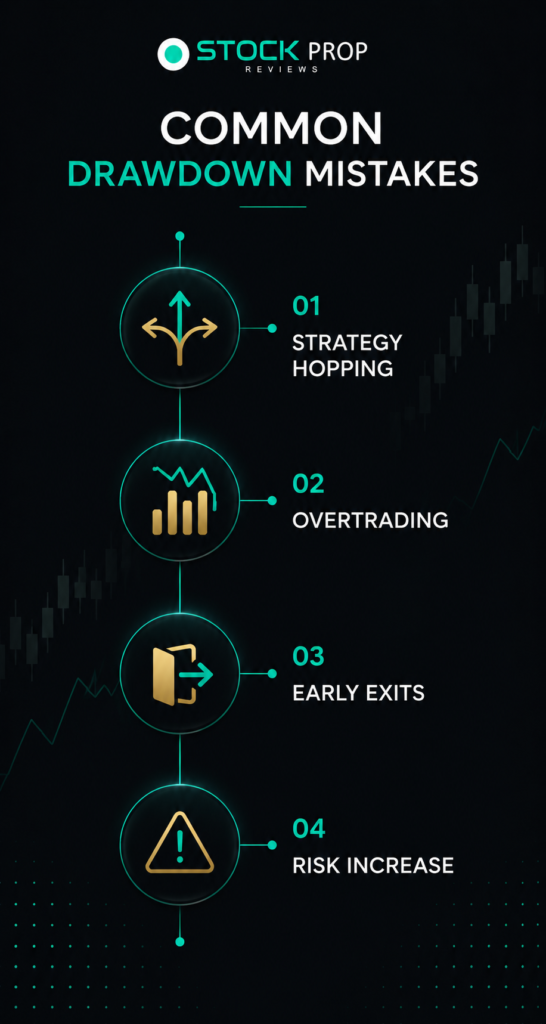
One common mistake is changing a strategy before gathering enough evidence that something is actually wrong. A short losing streak does not automatically mean a trading edge has disappeared.
Another is becoming obsessed with profit and loss. Constantly checking account fluctuations tends to increase emotional involvement and reduce objectivity.
Some traders make the opposite error and reduce risk so dramatically that meaningful recovery becomes impossible. Lowering exposure can be sensible, but fear-based position sizing creates its own problems.
The most damaging mistake, however, is often abandoning routine. Journaling stops. Reviews become inconsistent. Preparation declines.
When traders need structure most, they often move away from it.
How Experienced Traders Handle Drawdown Anxiety
Even experienced traders can get nervous.
The difference is they rarely let emotion dictate the execution.
Most build systems protect them against each other.
They depend on data, not on recent results. They know that a strategy is not to be judged on a handful of trades, but over a meaningful sample size.
Many also decouple performance from results.
Rather than asking whether they made money today, they ask if they followed their process.
It’s a small difference that sounds simple but changes everything.
A trader can do well and still lose money. They can also make money while trading badly.
The secret to long-term success is knowing the difference.
Practical Ways to Reduce Drawdown Anxiety
The first step is understanding what a normal drawdown looks like for your strategy.
Many traders know their profit targets but have never studied their historical losing streaks. Without that context, every drawdown feels like an emergency.
Keeping a detailed trading journal can also help. Patterns become easier to spot when emotions are documented alongside trading decisions.
Another useful tactic is to cut back on activity temporarily after a tough patch. It doesn’t mean no trading at all. That means giving yourself enough space to be able to be objective about performance.
Most importantly, traders should focus on process metrics.
Did you follow your rules?
Did you manage risk correctly?
Did you execute the setup according to plan?
These questions provide far more useful information than the account balance alone.
The Hard Truth About Drawdown Anxiety
Drawdowns rarely destroy trading accounts on their own.
What causes the damage is the behaviour that follows.
A trader who continues following a tested process can usually survive a difficult period. A trader who begins making emotional decisions often turns a manageable drawdown into a major setback.
That is why psychology matters in trading.
Not because emotions can be eliminated, but because they influence decisions long before traders realise it.
If you read enough prop firm reviews, compare evaluation models, or study why traders struggle after passing challenges, the same pattern appears repeatedly. Strategy problems are often blamed first. Behaviour problems are usually the real issue.
Understanding drawdown anxiety trading is ultimately about recognising that losses are part of the business. The challenge is making sure those losses do not change how you think.
FAQs
What is drawdown anxiety trading?
Drawdown anxiety trading is the emotional stress traders experience during periods of account decline, often leading to poor decisions such as hesitation, overtrading, or abandoning a trading plan.
Can drawdown anxiety make a profitable trader unprofitable?
Yes. Many profitable strategies fail when traders stop following them during losing periods and begin making emotionally driven decisions.
Do experienced traders experience drawdown anxiety?
Yes. Experience does not remove anxiety. It usually helps traders manage it better through structured processes and risk management.
Why do funded traders have more drawdowns?
Funded traders typically have very tight drawdown limits which can lead to more pressure and more likely emotional responses.
How can traders reduce drawdown anxiety?
Understanding historical drawdowns, keeping a trading journal, focusing on process over outcomes, and sticking to predefined risk rules can help minimize anxiety-driven decisions.