Passing a prop firm challenge is like a breakthrough.
For many traders this is the first time they have seen any measurable result from their trading. They had a plan, they respected risk and they hit a target. And then something weird happens.
The patient trader during evaluation suddenly begins to push trades. “Creep” in size. The rules go fluid. A small drawdown becomes a much bigger drawdown.
This is the problem of funded account overconfidence.
It’s affecting new traders, experienced traders and even traders who have already received payouts. Indeed, some traders are most vulnerable immediately after their first success, because they start to believe that a short period of good performance is evidence that they have mastered the market.
If you are on the way to funding or already trading a funded account then this article is for you. If you are looking to make some quick money in prop firms, it is probably not.
Quick Verdict
Most funded accounts are not lost because traders suddenly forget how to trade.
They are lost because traders stop doing the things that got them funded in the first place.
The challenge phase forces discipline. The funded phase tests whether that discipline is genuine.
Overconfidence sits right in the middle of that transition.
What Is Funded Account Overconfidence?
Funded account overconfidence is the tendency to overestimate your trading ability after achieving a milestone such as passing a challenge, receiving a payout, or putting together a strong winning streak.
A trader starts believing their recent results reflect permanent skill rather than a combination of skill, discipline, and market conditions.
That belief changes behaviour.
The danger is rarely obvious. Few traders wake up and decide to become reckless. The process is usually gradual.
One extra trade here. A slightly larger position there. A stop loss moved because the market will “probably come back.”
Weeks later, the account looks completely different.
Why Passing a Challenge Can Create Bad Habits
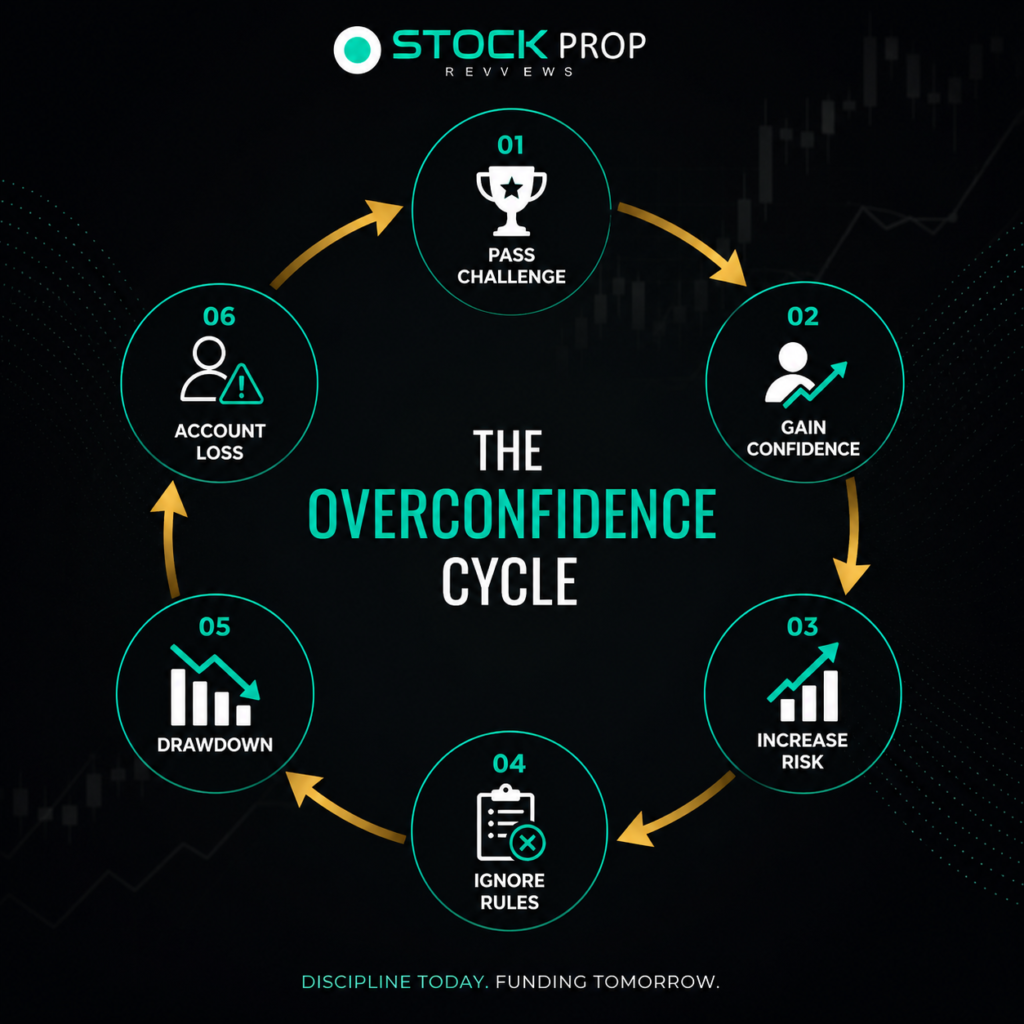
One thing many psychology articles miss is that prop firm challenges can unintentionally create a false sense of certainty.
A trader passes an evaluation and naturally assumes their trading has reached another level. That confidence is understandable. The problem is that passing a challenge does not eliminate risk.
Markets do not care whether a trader passed yesterday.
The same setup that worked during evaluation can fail repeatedly next month. Conditions change. Volatility changes. Market participation changes.
The traders who understand this tend to survive longer.
The traders who believe they have figured everything out usually discover otherwise during their first meaningful drawdown.
A Pattern Seen Across Failed Funded Accounts
A recurring theme becomes obvious when looking through trader experiences from different prop firms.
The account doesn’t get wiped out overnight.
Performance starts to suffer long before the breach itself.
A trader that used to risk .5% per trade now risks 1%.
A trader, who has been patiently waiting for A-grade setups, begins to take B-grade opportunities.
A trader hits a loss limit and decides to continue trading because they feel confident about the next setup.
Individually none of these decisions seem catastrophic.
Together they are often the reason for losing an account.
The Winning Streak Trap
Ironically, some of the most dangerous periods in a trader’s career happen during profitable stretches.
Most traders prepare themselves emotionally for losses.
Few prepare themselves for success.
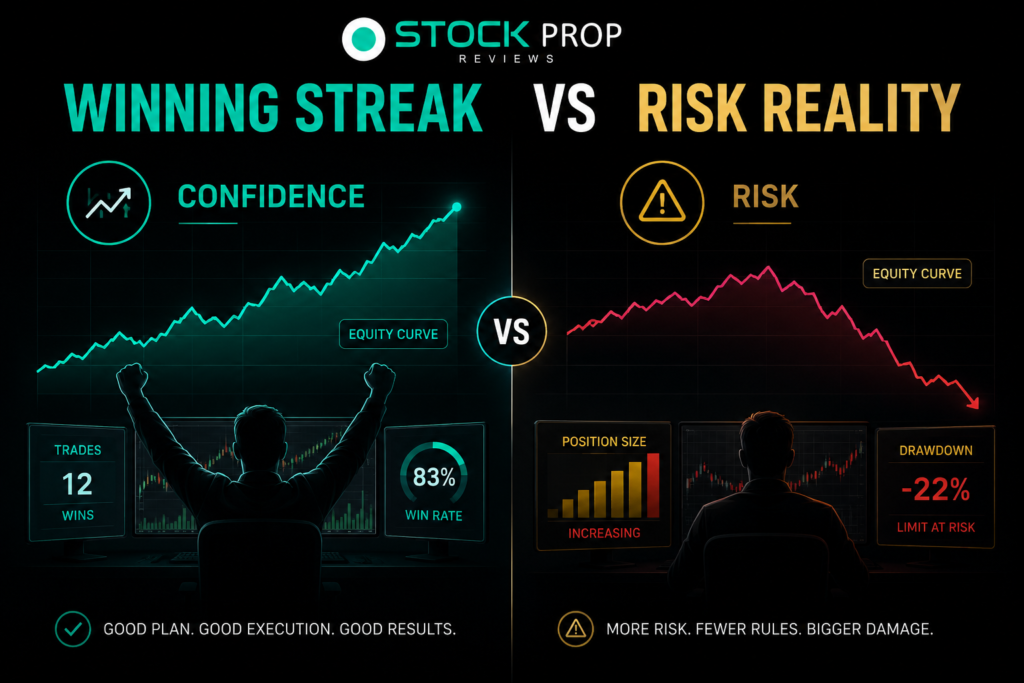
A five-trade winning streak can be more damaging than a five-trade losing streak if it convinces a trader that normal risk controls are no longer necessary.
The market has a way of exposing that belief.
When a larger position finally encounters a normal losing trade, the damage is amplified. Traders then find themselves trying to recover losses they would never have experienced had they maintained their original risk profile.
The Difference Between Confidence and Overconfidence
Confidence is useful.
Without confidence, traders hesitate, second-guess entries, and struggle to execute a plan.
Overconfidence is different.
| Healthy Confidence | Overconfidence |
| Trusts a proven process | Trusts personal judgement over the process |
| Accepts losing trades | Tries to avoid losses at all costs |
| Respects risk limits | Looks for reasons to bypass risk limits |
| Focuses on execution | Focuses on being right |
| Learns from results | Assumes success proves expertise |
The distinction sounds simple, but it becomes difficult to spot when profits are flowing.
What Competitors Often Leave Out
Many articles describe overconfidence as a psychological bias.
That is true, but it only tells part of the story.
The practical issue is behavioural drift.
Behavioral drift happens when traders slowly move away from the habits that originally produced success.
The changes are often so small they go unnoticed.
The trader still believes they are following the same strategy.
Their journal tells a different story.
Position sizing has changed.
Trade frequency has increased.
Entry quality has deteriorated.
The system that passed the challenge no longer exists, even though the trader believes it does.
This is why funded account reviews should focus on behaviour as much as profits.
Why Drawdown Rules Make Overconfidence Expensive
Retail traders sometimes have the luxury of learning from large mistakes.
Funded traders usually do not.
Most prop firms operate with strict loss parameters.
| Rule Type | Purpose |
| Daily Drawdown | Prevent excessive daily losses |
| Maximum Drawdown | Protect firm capital |
| Consistency Requirements | Discourage reckless profit spikes |
| Position Restrictions | Limit concentration risk |
These rules are designed to protect capital, but they also expose traders who become overconfident.
A trader can be right on market direction and still lose a funded account because risk management deteriorated.
That reality surprises many first-time funded traders.
Practical Ways to Stay Grounded
The best defence against overconfidence is structure.
Few professional traders trade on motivation or self-control alone. They construct systems that minimise the effect of emotions.
One example is to keep position size constant for a defined period of time after funding.
Another is to keep a detailed trading journal.
Some traders also do weekly reviews that are focused on rule compliance only and not profitability. This helps spot behavioural drift before it becomes a serious issue.
The aim is not to kill confidence.
The goal is to stop confidence from changing how risk is managed.
Who Struggles Most With This Problem?
Certain trader profiles tend to be more vulnerable.
Traders coming off a fast challenge pass often experience a confidence spike. So do traders receiving their first payout.
Aggressive traders are particularly exposed because larger position sizes magnify the consequences of poor decisions.
On the other hand, traders who view funded accounts as long-term opportunities generally handle success better. They are less focused on proving themselves and more focused on preserving access to capital.
Alternative Approaches for Traders Working on Discipline
If you’ve been hurting your results with overconfidence, then cutting back might be surprisingly effective.
Smaller account is often better training ground than big one.
Some traders also prefer stock-specific prop firms because of the structure. This encourages a more cautious approach to risk. TradeThePool, for instance, is a regulated stock trading environment with clear-cut rules and risk parameters.
Readers can get up to 10% off when they purchase through our TradeThePool link.
You shouldn’t base your decision on discounts alone. Much more important is knowing the rules that the company has and if they fit your trading style.
We also have a number of in-depth prop firm reviews, comparison guides and analysis articles that may be useful as they discuss whether challenge models really find good traders or just reward short-term discipline.
Final Thoughts
Most traders expect the market to be their biggest challenge.
In reality, success often creates problems that failure never could.
A trader who has just passed a challenge is usually more confident than ever. That confidence can improve execution, but it can also create blind spots.
The market does not punish confidence.
It punishes traders who stop respecting risk.
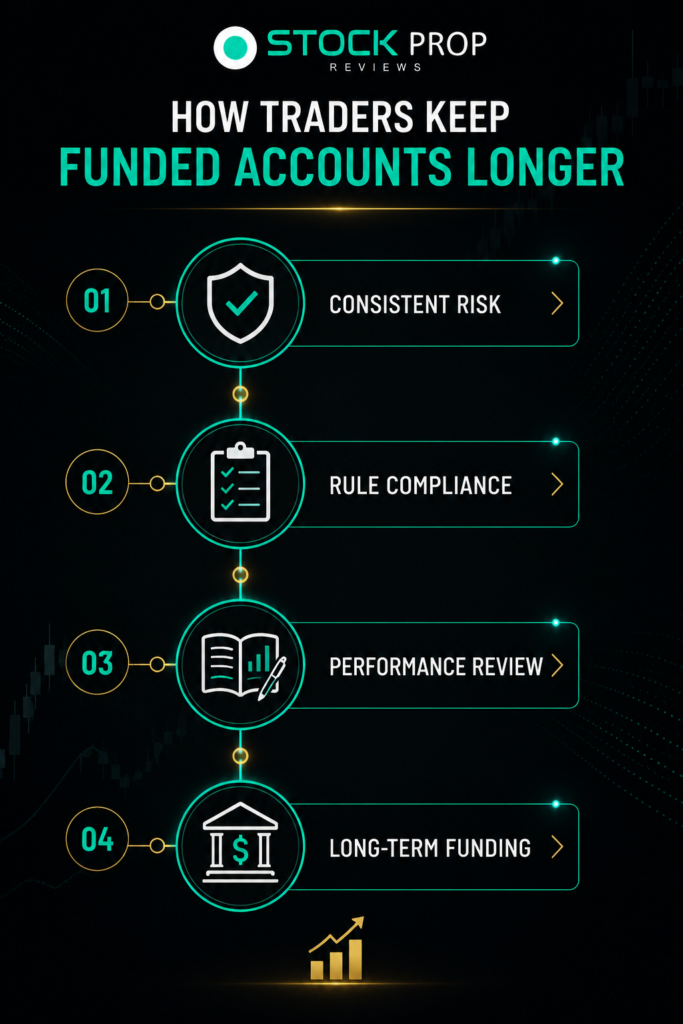
The traders who keep funded accounts for years are rarely the ones making the boldest decisions. More often, they are the ones still following the same boring process that got them funded in the first place.
FAQ
Why do people become over confident after getting funded?
Because passing a challenge creates a sense of achievement that can lead traders to overestimate their skill level. Many start taking risks they had avoided in the assessment phase.
Is confidence a bad thing for trading?
No. Execution takes confidence. The issues are when confidence turns into certainty and traders ignore risk management.
How do funded traders blow accounts so fast?
It is not the poor performance of the strategy that causes the accounts to be lost but the increased position sizing, revenge trading and the gradual abandoning of the trading rules.
Can even profitable traders be overconfident?
Yeah. A trader can be profitable and still underestimate risk. Winning periods tend to breed overconfidence, not losing periods.
How to avoid overconfidence of funded accounts for traders?
Do not change strategy because of recent winning streaks. Monitor adherence to your rules. Keep risk constant and check trades often.