The hard part is supposed to be passing a prop firm challenge.
But many traders find something frustrating, after getting a funded account they perform worse.
They take trades they would have ignored during review. They get obsessed with daily PnL. Lost streaks seem suddenly bigger than they should be. In a few cases traders who pass comfortably lose their funded accounts within weeks.
If you are struggling with challenge issues and are trading worse after passing them, you are not alone. It happens to forex traders, to futures traders, to scalpers and to swing traders, respectively.
If you are a trader who has already faced a challenge or is about to face one, this article is for you. This is not for people who want shortcuts to pass evaluations. The emphasis is on the post funding, as that is where many careers stall.
The Strange Reality of Funded Trading
One of the biggest misconceptions in the prop industry is that passing a challenge proves you’re ready for funded trading.
It proves you can meet a target while respecting a set of rules for a limited period of time. That’s valuable. But it doesn’t automatically prepare you for managing a funded account month after month.
In fact, some traders perform better during evaluations than they do after funding.
That sounds backwards until you consider the incentives.
During a challenge, the objective is simple. Follow the rules, avoid major mistakes, and hit the target. The mission is clear.
Once funded, the goal becomes less defined. Now there are payouts to think about. Scaling plans. Account preservation. Expectations from yourself. Sometimes expectations from friends or family who know you’ve been funded.
The account may be larger, but the mental load is often larger too.
Most Traders Change Their Behaviour Without Realising It
When traders tell me they lost a funded account after passing comfortably, the strategy is rarely the first thing I examine.
Usually the charts look familiar.
The setups are similar.
The market conditions are not dramatically different.
What changed was the trader.
A common example is position management.
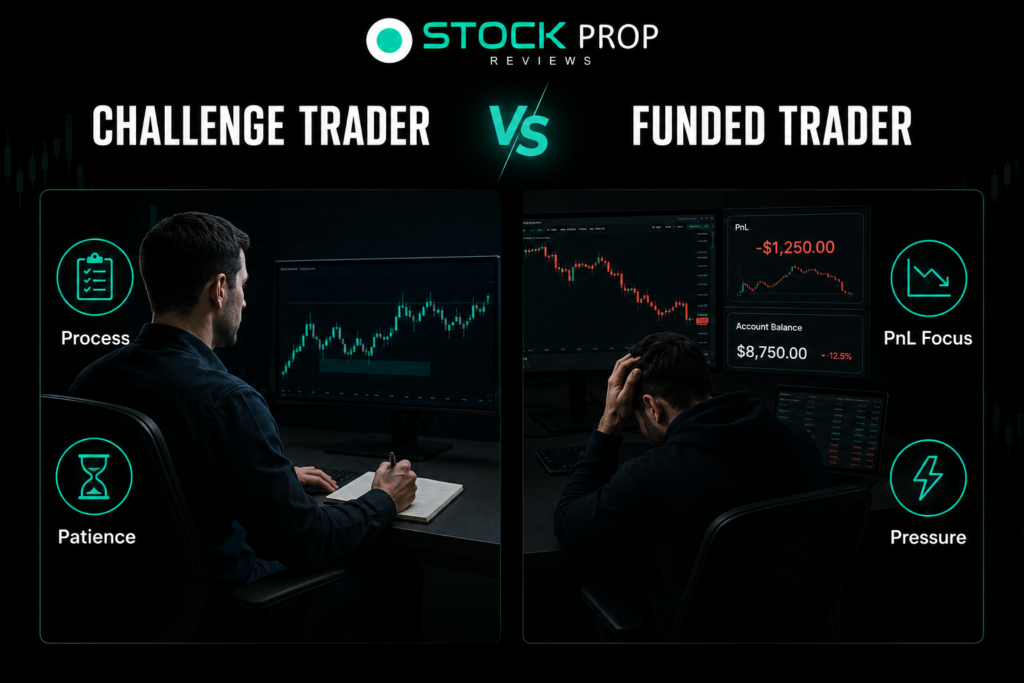
During the challenge, a trader follows their plan because they understand they need consistency to pass. After funding, the same trader starts protecting open profits too aggressively. Trades are closed early. Stops are moved unnecessarily. Winners become smaller while losers remain roughly the same size.
Nothing changed in the strategy. The execution changed.
The trader became focused on the money rather than the process
Why Passing Can Create Problems
Success creates its own risks.
Failing traders tend to doubt themselves too much. Newly funded traders often experience the opposite problem.
After passing a challenge, confidence naturally increases. That’s not necessarily bad. Confidence is useful in trading.
The problem appears when confidence quietly turns into certainty.
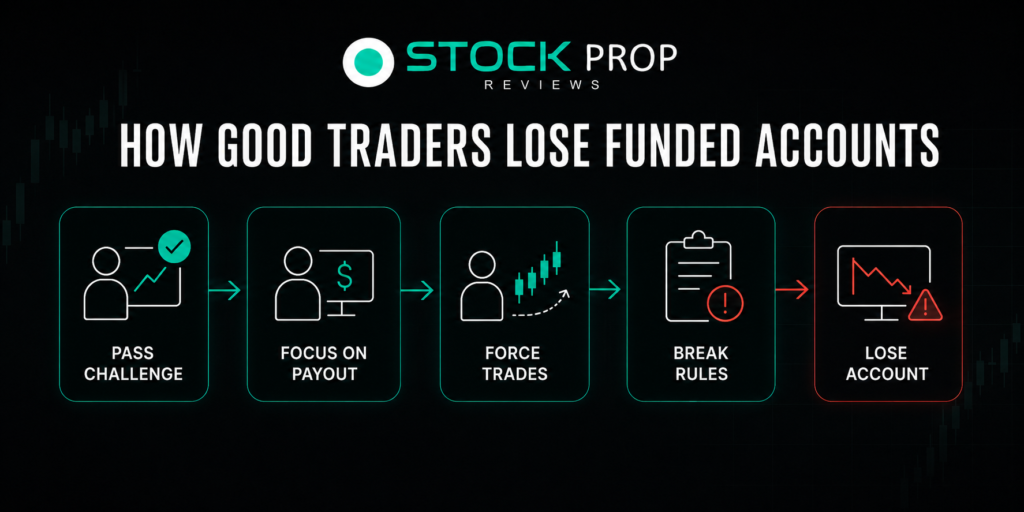
A trader who respected risk during evaluation may suddenly feel comfortable increasing size. Someone who patiently waited for high-quality setups may start believing they can read the market better than they actually can.
This isn’t arrogance in the traditional sense. It’s a subtle shift in decision-making.
The trader begins giving themselves exceptions.
And trading usually punishes exceptions.
The Payout Trap Nobody Talks About
Most discussions focus on challenge targets.
Very few discuss payout psychology.
The first payout often becomes an unhealthy obsession.
A trader sees they’re only a few winning trades away from withdrawing money. Suddenly every trading decision feels more important.
A setup that would normally be skipped gets traded.
A planned stop loss gets widened.
A daily loss limit starts feeling restrictive.
Ironically, the desire to secure a payout often leads traders away from the disciplined behaviour that would have produced the payout in the first place.
Experienced funded traders understand something newer traders often learn the hard way.
Payouts are usually a result of good trading, not a goal that should influence trading decisions.
What Competitors Usually Miss
Most prop firm articles are about why traders don’t pass the evaluations.
This subject is drawing attention due to the low success rates of the challenge.
But a funded account requires a different skill set.
Success in a challenge is mainly about hitting a target without breaking any rules.
In funded trading, it is all about repetition.
Can you do the same plan next month?
Can you go through a losing week without changing your system?
Can you go through a flat market without forcing trades?
These questions are far more important after funding than during evaluation.
A Realistic Example
Think of 2 traders taking the same test.
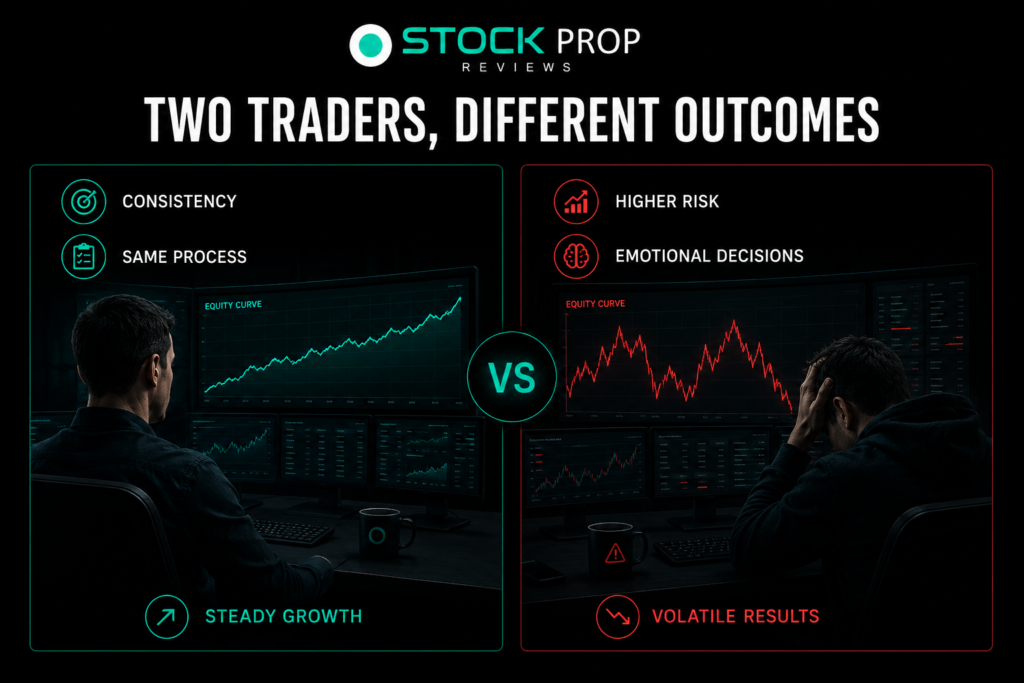
The first trader immediately doubles his position size after funding as the account seems to be more important. You start to feel emotionally uncomfortable with normal drawdowns in about two weeks. Decision quality deteriorates and the account finally breaks.
Almost nothing changes for the second trader. Same setups. Same danger. Same shit. The only difference is that now you can get paid.
The second trader is usually slower.
They also tend to remain funded for much longer.
That’s the trade-off that many traders have trouble accepting.
Better slow and boring than exciting and aggressive.
Should You Trade Differently After Passing?
In most cases, no.
Many traders assume funding should trigger a new approach.
The opposite is usually true.
If a particular process helped you pass, there should be a strong reason before changing it.
That doesn’t mean traders should never adapt. Markets change and strategies evolve. But adjustments should come from data and review, not from excitement about a funded account.
The traders who last longest tend to treat funding as an administrative change rather than a reason to reinvent their trading.
Where TradeThePool Fits
TradeThePool is a regulated stock prop firm environment for traders who prefer equities over forex or futures, and who like clearly defined risk parameters and transparent rules.
That transparency can help traders concentrate on execution rather than figuring out complicated restrictions. Readers buying through TradeThePool link get 10% discount.
The firm itself is not the important thing. It’s about finding an environment where the rules are clear enough that trading decisions are still the main thing.
FAQs
Why do traders do worse after getting funded?
The most frequent cause is a change in behaviour. In the evaluation phase, traders will be less concerned with payouts, keeping their accounts, and making profits than they are today.
Is it normal to feel more pressure after passing a challenge?
“Yep. Many traders say that once they have a funded account, it feels even more stressful than taking the challenge, because they now have something valuable to lose.
Should I increase position size after funding?
Not automatically. Many funded account losses start with unnecessary risk increases right after passing.
Why was I more disciplined in the challenge?
The evaluation was a good clear objective and framework. Once traders are funded they tend to lose that structure and start to make more discretionary decisions.
What’s the best way to maintain a funded account?
Keep doing what it earned. The longest funded traders are often the ones who make the fewest changes after they pass.