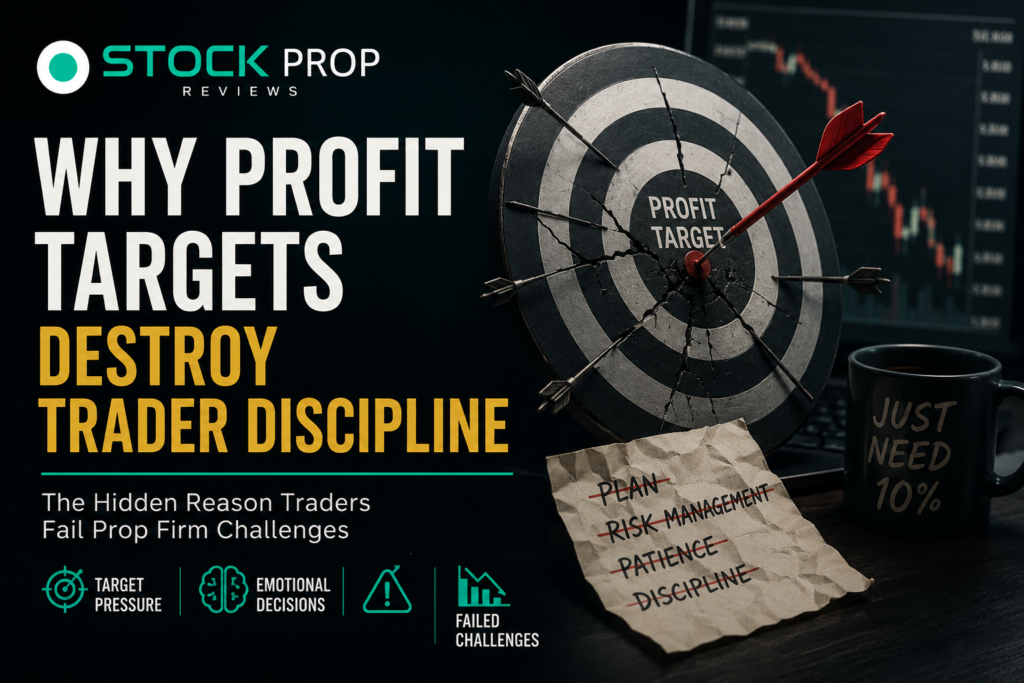
If a trader fails a prop firm challenge, it’s normally assumed their strategy wasn’t good enough. Sometimes it is. More often the problem begins elsewhere.
I’ve seen traders with good systems, good risk management and months of consistency start doing things they would never do on a personal account. The common denominator wasn’t a lack of skill. It was pressure,
More accurately, it was the pressure of profit targets.
This is for traders trying evaluations, funded traders trying to stay consistent and anyone wondering why their behaviour changes the instant a challenge starts. It’s not for the long term investor or trader with no performance deadlines.
The sad reality is that many traders don’t fail because they can’t trade. They fail because profit targets make them stop trading properly.
Profit Targets Are Not the Real Problem
Before blaming prop firms, it’s worth acknowledging that profit targets serve a purpose.
A firm allocating capital needs some way to measure performance. Asking traders to generate a return while respecting drawdown limits is a reasonable concept. Without a target, evaluations would be difficult to standardise.
The issue is not the target itself.
The issue is what happens when a trader becomes emotionally attached to reaching it.
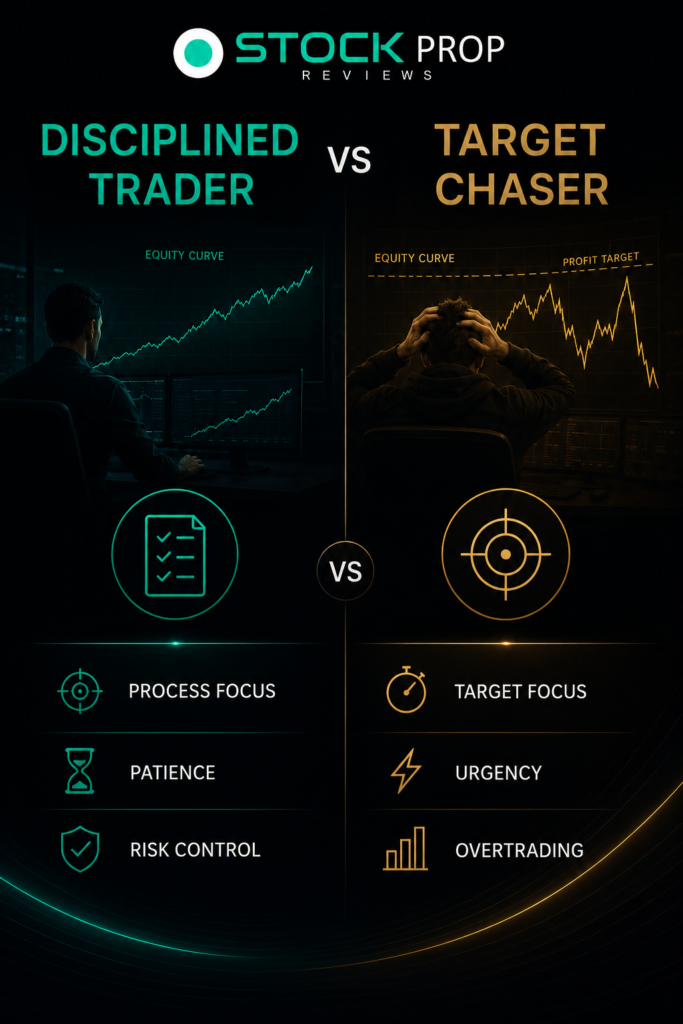
A trader who is focused on execution thinks about risk, setup quality, and market conditions. A trader who is focused on the target starts calculating percentages, remaining days, and how quickly they can close the gap.
That shift in focus sounds harmless, but it often marks the beginning of poor decision-making.
The Behaviour Change Nobody Talks About
Most discussions about trading discipline focus on mindset. Traders are told to be patient, follow their plan, and control emotions.
That advice is correct, but it doesn’t explain why disciplined traders suddenly become undisciplined during evaluations.
The answer is surprisingly simple.
The environment changes.
A trader may spend months risking half a percent per trade and waiting for high-quality opportunities. Then they purchase a challenge with a fixed objective and a limited timeframe.
At first, everything looks normal. Trades are taken according to plan. Risk remains controlled.
Then a few losses occur.
Or the market becomes slow.
Or the trader reaches week three and realises they are only halfway to the required target.
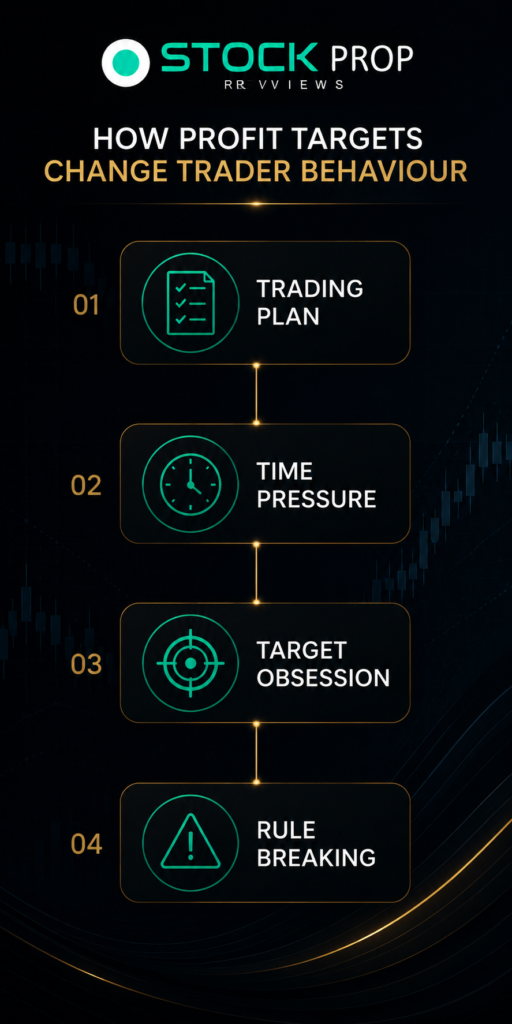
This is where behaviour starts to change.
Trades that would normally be skipped begin to look attractive. Risk gradually increases. Patience becomes harder to maintain.
The trader rarely notices these changes in real time. Looking back, however, the pattern is obvious.
They stopped trading their strategy and started trading their challenge statistics.
Why Good Traders Suddenly Take Bad Trades
One of the biggest misconceptions in the prop industry is that rule-breaking comes from a lack of discipline.
In many cases, discipline isn’t the original problem.
The original problem is pressure.
Imagine a trader who normally risks one percent per position. They have followed that rule for months.
Now they are sitting at seven percent profit with a ten percent target. The finish line appears close enough to touch.
At that point, many traders stop thinking about probabilities and start thinking about outcomes.
Instead of asking whether a setup deserves capital, they ask whether it can get them over the line.
That distinction matters.
Professional traders understand that no individual trade is responsible for their results. Traders under target pressure often behave as though one trade can solve everything.
Ironically, that belief is responsible for countless failed evaluations.
What Most Articles Get Wrong About Discipline
Read enough trading psychology content and you’ll notice a recurring theme.
The responsibility is placed entirely on the trader.
If you failed, you lacked discipline.
If you broke rules, you weren’t patient enough.
If you exceeded risk limits, you lost emotional control.
There is some truth in that argument, but it ignores an important factor.
Human behaviour is heavily influenced by incentives.
When traders are rewarded for reaching a specific number within a specific period, it should not surprise anyone that many become fixated on the number.
A challenge structure can encourage disciplined behaviour, but it can also encourage short-term thinking.
The best traders recognise this conflict early and actively protect themselves against it.
The Difference Between Passing and Lasting
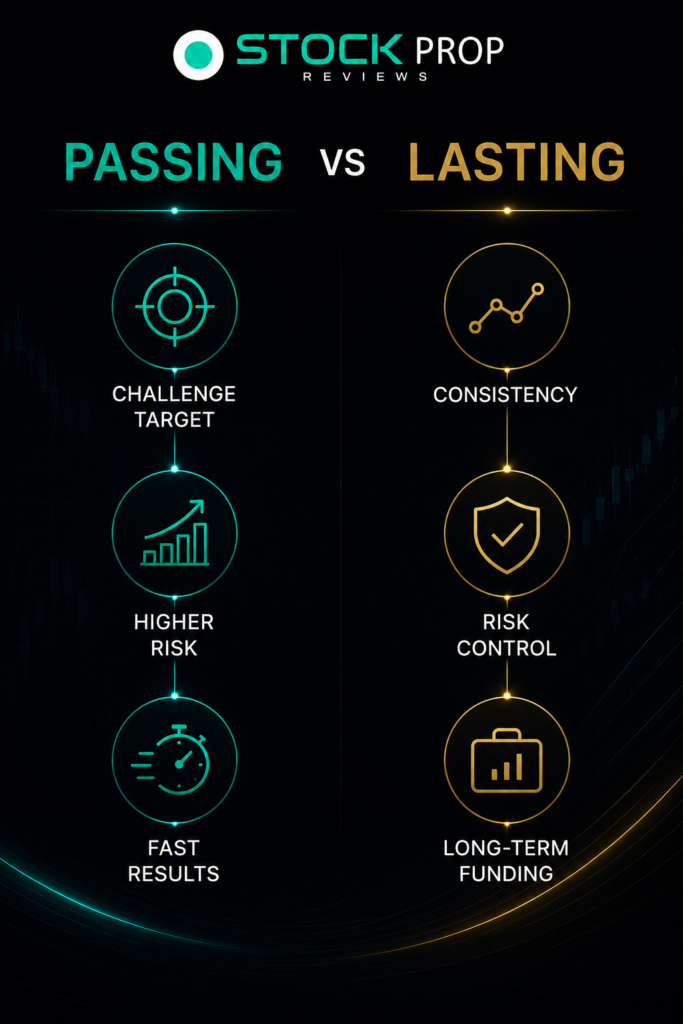
One of the strangest things about the prop industry is that passing a challenge and becoming a consistently profitable funded trader often require different mindsets.
A trader trying to pass quickly may take more risk than usual.
A trader trying to keep a funded account for years usually does the opposite.
This is why some traders pass evaluations repeatedly but struggle to keep funded accounts.
The skills required to hit a target are not always the same skills required to manage capital over the long term.
The traders who survive tend to develop a process-first approach. They stop measuring success by whether they hit a target this week and start measuring success by whether they executed correctly.
Over time, that mindset usually produces better financial results as well.
A Fair Counterargument
To be balanced, profit targets are not inherently harmful.
Many traders appreciate having a clear objective. Targets can provide structure, accountability, and motivation. They also help firms filter out traders who cannot generate returns consistently.
The problem emerges when the target becomes the primary focus rather than the trading process.
Some traders handle that pressure exceptionally well. Others find that it gradually changes their behaviour in ways they don’t recognise until the account is gone.
Neither group is necessarily more talented.
They simply respond differently to the environment.
Where TradeThePool Fits Into This Discussion
Some traders prefer stock-focused firms like TradeThePool for its focus on regulated markets and transparent rules.
Clear rules do not remove psychological pressure, but they can reduce uncertainty. Traders are often better able to concentrate on execution, rather than trying to interpret complex evaluation requirements, when they know exactly what is expected.
Readers can purchase through our TradeThePool link and receive up to 10% off.
Such issues should never be a determining factor. The question that matters more is whether a firm’s structure suits how you naturally trade.
The Real Lesson
Most traders spend years searching for a better strategy.
In reality, many already have a strategy that works well enough.
What they don’t have is an environment that allows them to follow it consistently.
Profit targets are not destroying trader discipline because the targets themselves are evil or unfair.
They destroy discipline because they tempt traders to prioritise results over process.
The market has always punished that approach.
A trader who remains focused on execution may miss a target from time to time. A trader who becomes obsessed with the target often loses the discipline that made success possible in the first place.
That is why some of the best funded traders rarely talk about profit targets at all.
Their attention is somewhere else.
It’s on the next trade, the next setup, and the next decision.
Everything else takes care of itself.
FAQs
Do profit targets lead to overtrading?
Yes, they can. Many traders feel the pressure of being behind schedule and start taking setups they would normally ignore.
Why do traders fail challenges when they have winning strategies?
The trader can lose the strategy, even if it is profitable, by changing his risk management, increasing his position size, or giving up his process under pressure.
Are prop firm profit targets achievable?
It depends on the firm, the market conditions and the time horizon. Some can be achieved through normal trading activity while others encourage more aggressive behaviour.
What should traders focus on instead of the target?
Short term, don’t rely on profit milestones; instead look at execution quality, risk management and consistency, as these are generally better performance indicators.
Can lower profit targets help with discipline?
They can take the pressure but discipline is really a matter of how the trader responds to the evaluation environment.