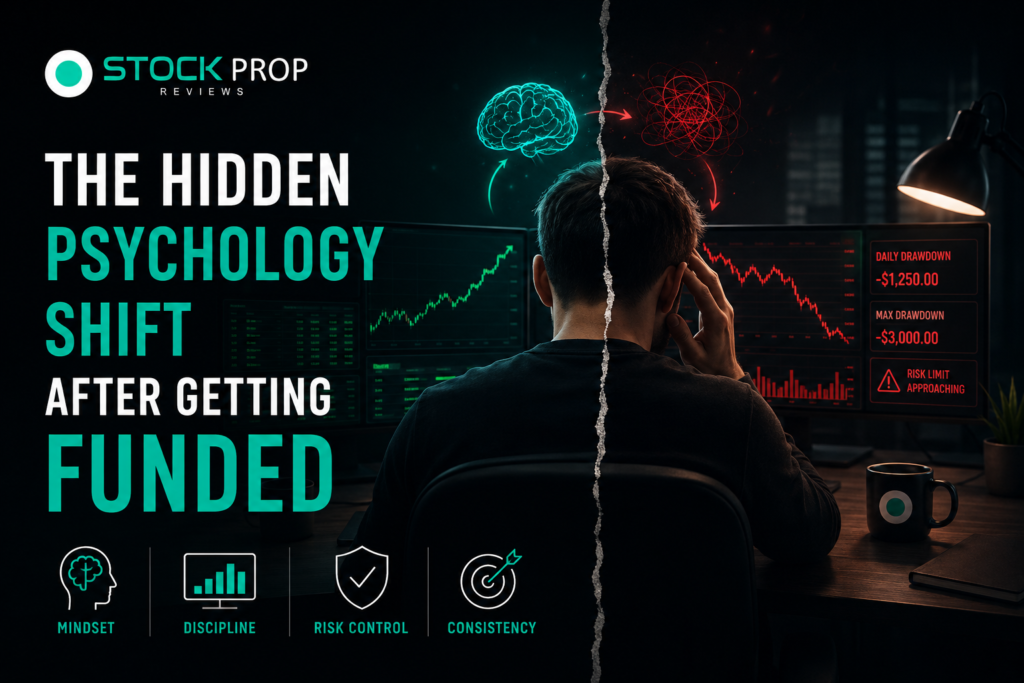
Most traders think the hard part is passing the evaluation. In fact, for many, the real work starts after the money comes in.
That’s where the psychology of funded traders comes into play.
A trader can follow rules to the letter in the heat of a challenge and then suddenly get emotional, inconsistent, or reckless when it’s time for real payouts and account protection. The strategy might be the same but the mindset often changes completely.
This article is for traders preparing for funded accounts and traders who passed the evaluations but felt their execution is getting worse after. It is not for those looking for motivational trading content or unrealistic income expectations from prop firms.
So the target is simple. Explain the psychological shift that occurs after funding and why so many traders suffer quietly from it.
Why Funded Trader Psychology Changes So Fast
Traders usually have one thing in mind before they get funded . That is to pass the challenge .
The aim seems simple. “Follow rules, hit the target and don’t breach drawdown. This is when many traders become surprisingly disciplined, for the mission is clear.
The focus shifts after funding.
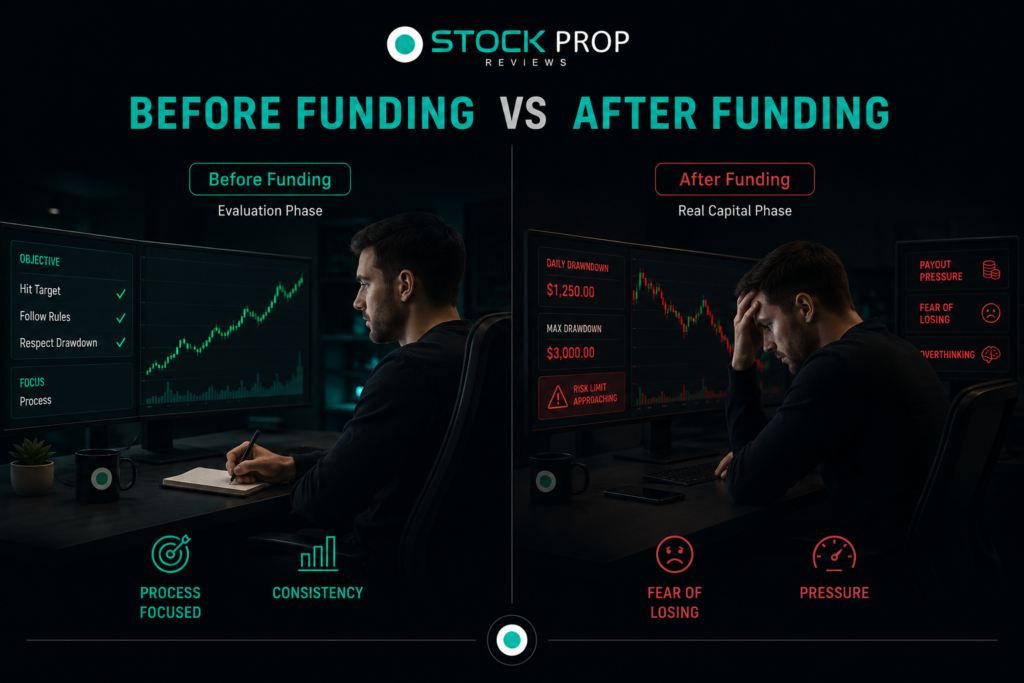
Now the trader begins to think about keeping the account, qualifying for payouts, fast recovery of losses or finally making trading an income. The emotional pressure becomes heavier even if the size of the account is the same.
Here is where many traders lose the consistency that helped them pass in the first place.
“A funded account creates a different emotional environment than a demo challenge or even a personal account. Sometimes the pressure is not immediately obvious, but it slowly influences decision-making.
The Fear of Losing Becomes Stronger Than the Desire to Trade Well
One of the biggest hidden changes after funding is that traders stop trading to execute properly and start trading to avoid losing the account.
That difference matters more than most people realize.
A trader who normally lets winners run may suddenly close trades too early. Another trader may hesitate on setups that previously felt easy to take. Some become obsessed with checking remaining drawdown instead of reading the market itself.
This usually comes from fear, not lack of skill.
The trader starts thinking:
- “I cannot lose this account.”
- “I am close to payout.”
- “One bad trade could ruin everything.”
That internal pressure slowly changes behavior.
Discipline is something that competitors tend to speak about in a general way, but they rarely speak about how prop firm structures can impact emotions. Traders with profitable systems can also find tight drawdown limits and payout targets stressful.
Passing an Evaluation Does Not Mean You Are Emotionally Ready
Many traders believe that passing a challenge makes them ready to trade professionally.
Sometimes it does. Sometimes it just shows they were capable of doing well for a short time under certain conditions.
Those are not identical.
Traders will often make an evaluation with a cool head and then blow the funded account in days. Most of the time it’s not about the quality of the strategy or the technical analysis. It’s emotional adaptation.
Suddenly, the account feels more important.
The funded account is opportunity, income or validation and the trader begins to give meaning to every trade. Losses seem weightier. Winning is urgent.
That sense of urgency is often a mistake.
The Most Common Psychological Mistakes After Funding
One pattern appears repeatedly among funded traders.
They begin trading differently than they did during evaluation.
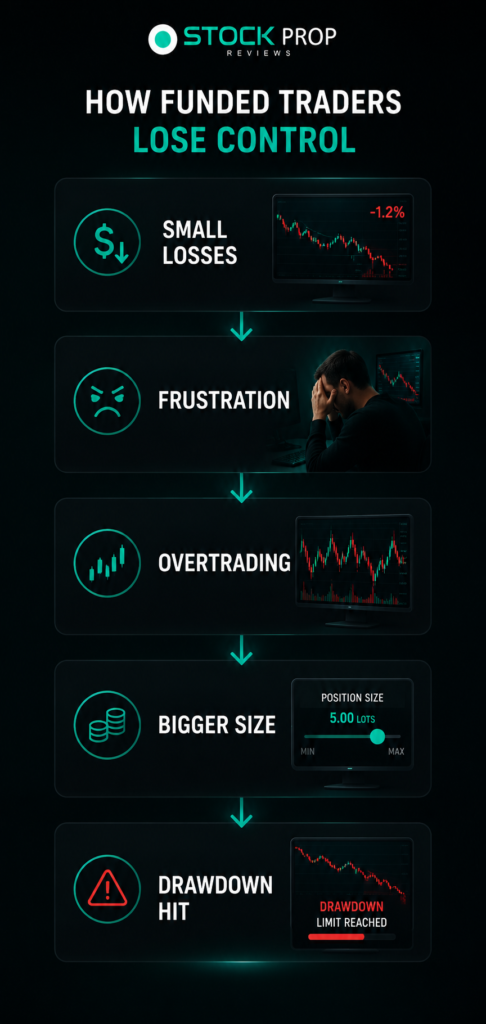
Sometimes the changes are subtle. A trader increases position size slightly after a loss. Another trader starts forcing trades because they feel pressure to stay active. Others abandon their system after two or three losing trades because they fear failing the account.
These mistakes usually happen in stages.
First comes caution. Then frustration. Then emotional decision-making.
For example, a trader may start the week trading carefully. After taking two losses, they become impatient and try to recover faster. Position size increases slightly. One impulsive trade during volatility hits the daily drawdown limit.
The account is gone, even though the trader originally passed with discipline.
This happens far more often than many prop firms publicly acknowledge.
Why Payout Thinking Can Damage Performance
One of the biggest psychological traps after funding is becoming too focused on payouts.
Social media has made this worse.
Many traders now see funded accounts as quick income opportunities instead of structured risk environments. Once the trader starts mentally counting future withdrawals, emotional pressure rises immediately.
Instead of focusing on good execution, the trader begins protecting unrealized profits emotionally.
That often leads to poor decisions like:
- Closing trades early
- Avoiding valid setups
- Trading too aggressively after losses
- Watching profit and loss constantly
Ironically, traders who focus least on payouts often survive longer in funded programs.
Experienced traders understand that consistency comes before withdrawals.
What Most Funded Trading Content Misses
In many articles on psychology the problem is presented as easy. They talk about confidence, patience and mindset routines without mentioning the actual structure of prop trading.
But structure does matter.
Some strategies are just more prop firm rule friendly than others. Traders working with wider stops or slower swing systems could get caught up within tight drawdown systems. Scalpers can run into execution limits or emotional overtrading.
That’s how profitable traders can blow up several funded accounts and still be profitable elsewhere.
Their behaviour is altered by the environment.
That’s why traders should also spend more time studying firm rules and risk structures before buying evaluations. Some companies make cleaner conditions than others.
For example, stock traders often mention TradeThePool because the rules and risk structure are fairly transparent compared to many new prop firms coming into the market. Readers can get up to 10% off when buying through our TradeThePool link.
That’s not to say the firm is perfect, or right for everyone. It just shows why clarity of rules is more important than promises in marketing.
The Identity Problem Nobody Talks About
Another large change in funded trader psychology is identity attachment.
Trading is mostly personal development first then funding. Many traders after getting funded start to see it as proof that they are finally becoming successful.
That mentality builds the hidden pressure.
The trader might feel that if he fails the account, he fails himself. Losses are not numbers, they are emotional. Minor setbacks loom larger than they should.
This often results in over management.
The trader begins to interfere with trades all the time, changing plans mid-session, or avoiding risk altogether. Rather than probabilities, they seek certainty.
Markets are uncertain, professional traders know that.
That’s something new funded traders often struggle with.
Experienced Funded Traders Think Differently
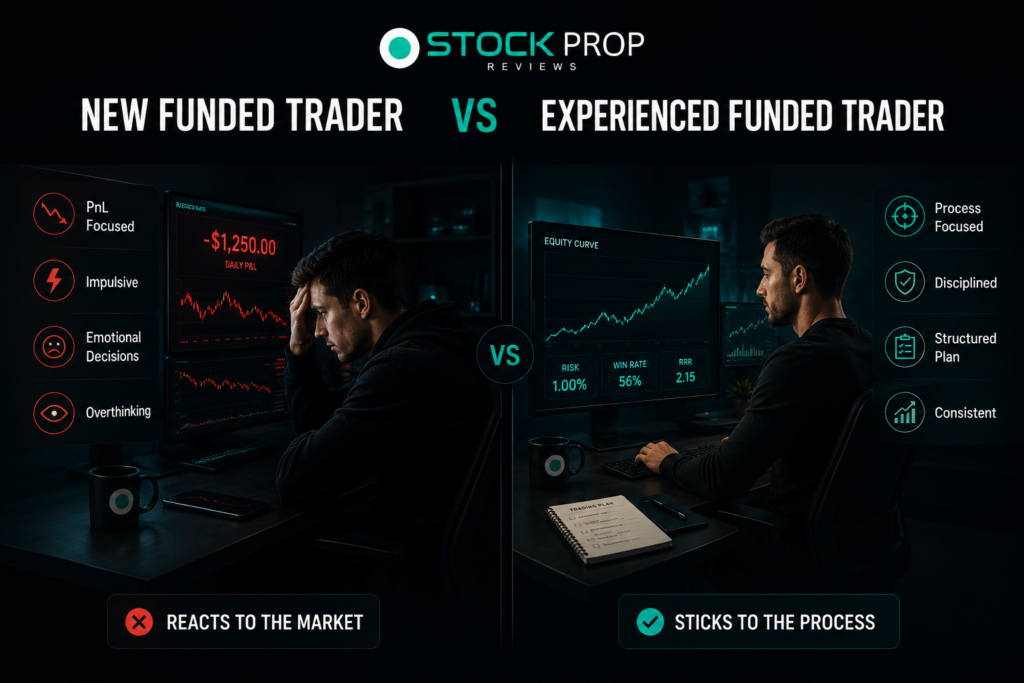
The traders who survive long term usually become emotionally quieter over time.
They stop treating funded accounts like life-changing events.
Instead, they approach them as structured business environments with rules that must be respected. Losses no longer feel personal. Winning streaks no longer create emotional highs.
Their focus shifts toward process.
A newer funded trader may obsess over payout dates or account size. An experienced trader usually cares more about whether they followed their plan correctly.
That difference sounds small, but it changes everything.
Long-term funded traders also understand something many beginners ignore: protecting mental stability matters as much as protecting capital.
Why Some Traders Should Avoid Prop Firms Entirely
Funded accounts aren’t for every trader.
It’s not something the industry likes to admit very often.
Strict rule structures often do very poorly for those traders who make decisions based on emotion. Same applies to traders desperate for trading income right now. Financial issues only exacerbate emotional errors.
Some traders also do better with personal accounts where they themselves control drawdown and strategy flexibility.
Prop firms are good for traders that have structure, patience and tested systems. They can be harder for traders still looking for consistency.
That’s important because many traders keep buying evaluations without dealing with the psychological issues that are causing the failures.
How Traders Can Adjust After Getting Funded
The adjustment period after funding is important.
Many experienced traders actually reduce risk during their first funded weeks. That may sound counterintuitive, but it helps stabilize emotions while adapting to the new environment.
Another useful shift is focusing less on money and more on execution quality.
Instead of tracking every dollar, traders should review:
- Whether entries were consistent with the plan
- If risk was kept in check
- Were emotions part of the decision
- Forced trades or patient trades
This keeps attention on behavior rather than outcome.
It is also important to accept that funded trading progress is usually slower than social media suggests. Consistency rarely looks exciting from the outside.
The Reality Most Traders Learn Too Late
Getting funded does not remove emotional problems. In many cases, it exposes them faster.
That is the hidden side of funded trader psychology.
The trader who survives long term is usually not the most aggressive or the most confident. It is often the person who adapts emotionally to the pressure without abandoning their process.
That adaptation takes time.
Many traders fail funded accounts not because they cannot trade, but because they underestimate how differently they behave once real pressure enters the picture.
If you are researching different firms and trading environments, it also helps to compare structured stock-focused options alongside forex prop firms. Our partial guides covering stock prop firm reviews, prop firm comparisons, and the reality behind trading freedom can help traders evaluate risk models more realistically before purchasing another challenge. Firms such as TradeThePool are frequently discussed among stock traders because of their regulated structure and clearer risk rules. Readers can get up to 10% discount when purchasing through our TradeThePool link.
FAQs
Why do traders blow funded accounts so fast?
Many traders change their behaviour after funding. Fear of losing the account often causes hesitancy, revenge trading or inconsistent risk management.
Funded trading is more stressful than trading your own money.
Yes, for many traders. Strict drawdown rules and payout pressure can create emotional stress that is absent from personal accounts.
Passing a prop challenge doesn’t mean you’re making money.
Not always. Passing an evaluation shows that a Trader performed well under certain conditions over a finite period of time. “That is a different form of long-term consistency.”
Why Do Funded Traders Take Profits Too Early?
Much of the time traders are emotionally protective after funding. They are more worried about losing than about a proper risk to reward execution.
Are prop firms suitable for all traders?
Nope. Some traders perform better with their own accounts and flexible risk setups rather than strict funded account rules.