Most comparison articles make finding good prop firms for high frequency trading seem much easier than it actually is. Most firms brag about supporting scalping or active day trading but the reality is often different when traders start to push higher volume, faster execution or aggressive momentum entries.
Some companies have a hard time with news volatility. Others silently tighten the execution conditions, monitor the consistency too tightly or create some psychological pressure with the trailing drawdown systems.
This guide is for the active scalper, futures trader and short-term momentum trader who cares more about the realities of trading than marketing hype. It is not for the casual swing trader or the trader looking for slow position style execution.
A prop account can look good on paper, and turn out to be a bad fit for high frequency execution. The most important details are generally concealed within the rule structure, the spread behaviour and the way the firm reacts in volatile situations.
What High-Frequency Trading Means in Retail Prop Firms
Retail prop firms lack the institutional high frequency infrastructure. Traders are not using co-located servers and exchange level latency systems.
In the prop world, high frequency trading usually means:
- Rapid intraday execution
- Multiple scalps in a session
- High trading frequency
- Momentum trading in news
- Algorithm assisted entries
- Short time periods
The problem is that a lot of firms market themselves as scalper friendly but still prohibit the very behaviour that active traders need.
For example, a trader may succeed in the evaluation with aggressive execution, only to find that funded trading becomes more difficult due to consistency monitoring or changes to execution during volatile sessions.
That disconnect is why so many funded accounts disappear in weeks.
Comparison Table for Prop Firms for High Frequency Trading
| Prop Firm | Best Fit | Main Weakness | Drawdown Style | Scalping | Market Focus |
| FTMO | Structured forex scalpers | Strict daily limits | Static | Allowed | Forex & CFDs |
| Funding Pips | Aggressive intraday traders | Can encourage overtrading | Model dependent | Allowed | Forex & CFDs |
| The5%ers | Consistency-focused traders | Slower growth pace | Static | Allowed | Forex |
| TradeThePool | Stock momentum traders | Smaller market window | Fixed risk model | Allowed | Stocks |
| Topstep | Futures scalpers | Trailing drawdown pressure | Trailing | Allowed | Futures |
FTMO
Quick Verdict
FTMO still has one of the more stable environments for active forex traders. It is not the loosest firm in the industry, but experienced scalpers often prefer structure over flexibility because stable conditions matter more than flashy payout numbers.
The Real Experience
FTMO works best for traders who already have discipline.
The firm’s rules are straightforward, but the daily drawdown creates pressure once traders get close to profit targets. Many traders start increasing risk near the end of evaluations because they want to finish quickly. That usually ends badly.
The execution quality is generally stronger than lower-tier firms, especially during normal market conditions. During major news events, slippage still exists, but that applies almost everywhere.
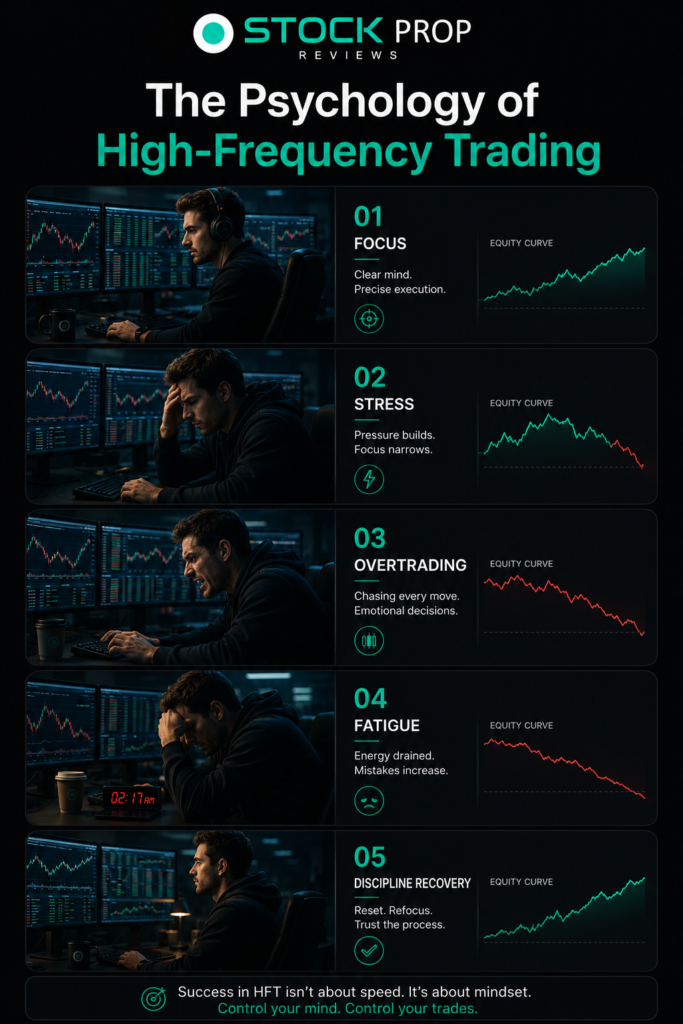
Another thing traders overlook is psychological fatigue. High-frequency trading inside a strict risk framework can become mentally exhausting after several sessions.
Rules That Matter
| Rule | Details |
| Max Daily Loss | 5% |
| Overall Drawdown | 10% |
| Profit Split | Up to 90% |
| News Restrictions | Limited around major events |
| EAs | Allowed with restrictions |
Who FTMO Fits Best
FTMO is perfect for traders who are already viewing trading as a process, not a get-rich-quick scheme.
It is less suitable for traders who rely heavily on oversized risk, aggressive averaging, or unrestricted news gambling.
If you have already struggled with emotional overtrading, FTMO’s structure can either help you improve or expose every weakness very quickly.
You can also compare this with our partial breakdown on “why most prop traders fail” because evaluation pressure changes trader behaviour more than most people expect.
Funding Pips
Quick Verdict
Funding Pips became popular quickly because of flexible models and aggressive payout marketing. For active traders, the appeal is obvious. The danger is that flexible environments often encourage poor habits.
The Real Experience
A lot of traders perform well initially at Funding Pips because they feel less restricted.
The issue appears later.
When traders know the environment is more forgiving, they often start forcing trades, increasing position size, or chasing fast payouts. That behaviour works temporarily during strong market conditions but usually falls apart during losing periods.
This is something many reviews ignore completely.
A prop firm is not just about rules. It also shapes trader psychology.
Funding Pips can work very well for experienced intraday traders with strong risk management. It can also become dangerous for traders who confuse trading freedom with unlimited aggression.
Rules That Matter
| Rule | Details |
| Profit Split | Up to 95% |
| Drawdown | Depends on account type |
| News Trading | Allowed on some models |
| Scalping | Allowed |
| Weekend Holding | Model dependent |
Who Should Avoid It
Traders with inconsistent discipline usually struggle here.
The flexibility that attracts traders often becomes the exact reason accounts fail.
If your trading history already includes revenge trading, emotional sizing, or impulsive execution, a stricter environment may actually improve performance.
The5%ers
Quick Verdict
The5%ers is not usually the first choice for aggressive high-frequency traders, but it deserves more attention than it gets.
The firm focuses more on sustainability than excitement.
The Real Experience
Many traders eventually realise that trading less often can improve results.
The5%ers fit traders who already understand that lesson.
The environment feels calmer compared to firms pushing aggressive scaling or huge payout percentages. Some traders dislike that because progress can feel slower. Others trade far better once the pressure to constantly perform disappears.
One overlooked advantage is that slower growth expectations can reduce emotional decision-making.
Fast traders often damage their own accounts by trying to force activity during poor market conditions. The5%ers indirectly discourages that behaviour.
Rules That Matter
| Rule | Details |
| Daily Drawdown | Around 4% to 5% |
| Scaling | Long-term focused |
| Overnight Holding | Usually allowed |
| Profit Split | Scaling available |
Who It Fits Best
The5%ers is for disciplined traders who want consistency, not adrenaline.
It is a less fit for traders looking for very fast payoffs or very aggressive intraday momentum.
TradeThePool
Quick Verdict
TradeThePool stands out because it focuses on stocks rather than synthetic CFD pricing.
For stock momentum traders, that difference matters.
The Real Experience
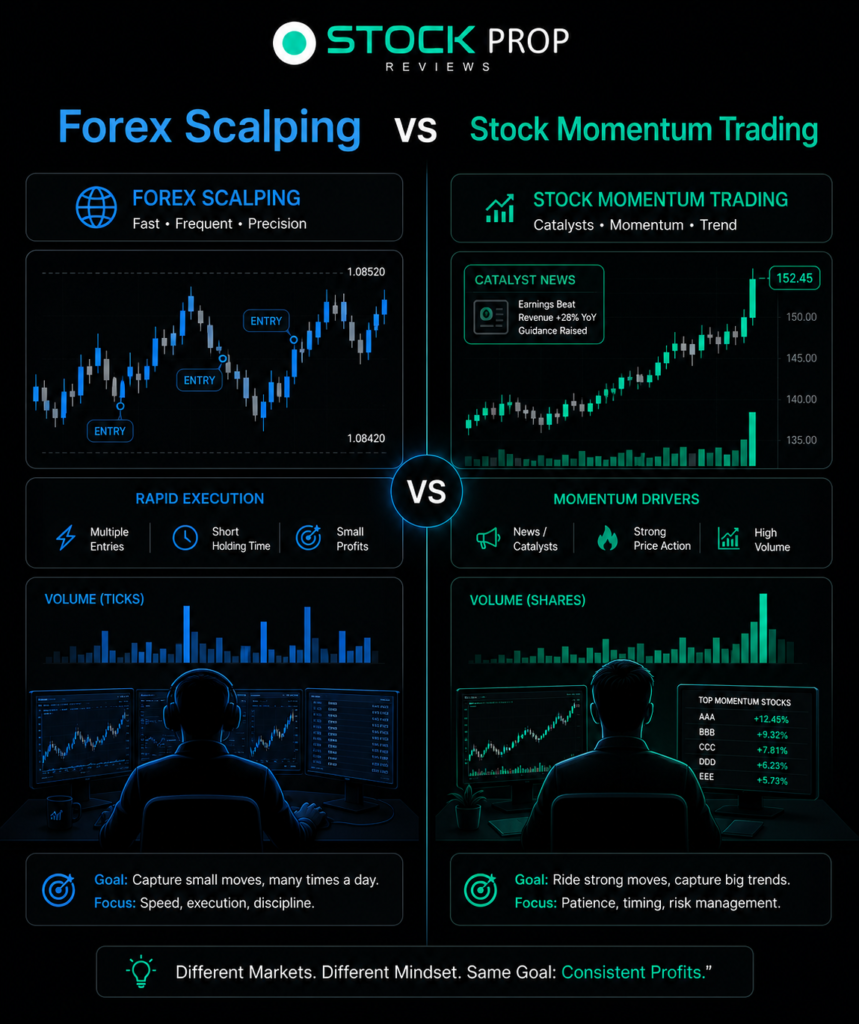
Stock-based high frequency trading is a very different proposition to forex scalping.
In a constantly moving market, forex traders often make dozens of quick trades. Stock traders tend to wait for catalysts like earnings reports, unusual volume, analyst upgrades or breaking news.
This creates less chances but the moves can be cleaner.
TradeThePool also enjoys the advantage of operating in a more transparent stock trading environment compared to many of the offshore CFD-style firms. The risk structure is usually more transparent especially for traders originating from the traditional equity markets.
The drawback is that stock momentum trading can be really volatile during opening sessions.
Many traders underestimate the emotional difficulty of managing fast-moving stock positions during halts or sudden reversals.
Rules That Matter
| Rule | Details |
| Market Type | Stocks |
| Profit Split | Up to 80% |
| Scalping | Allowed |
| Risk Model | Fixed structure |
| Momentum Trading | Strong fit |
Readers can get up to 10% discount when purchasing through our TradeThePool link.
Who It Fits Best
TradeThePool works best for traders who specifically want stock momentum exposure.
It is not ideal for traders who only understand forex-style execution or traders uncomfortable with catalyst-driven volatility.
You can also read our comparison article on “forex vs stock prop trading pressure” because the psychological demands are very different.
Topstep
Quick Verdict
Topstep remains one of the more recognised names for futures traders.
For active futures scalpers, liquidity and direct market movement are major advantages.
The Real Experience
The largest issue with Topstep is not the speed of execution.
It’s the loss of the trail behind.
Many futures traders start out well and then get too defensive as the drawdown limit gets smaller with the growth of profits.
It changes behaviour quite a bit.
Some traders begin cutting winners too early. Some get scared to trade normally after making an account cushion.
This psychological effect is hardly ever explained properly in prop firm reviews.
Futures trading itself is also more brutal than many new traders expect. Market movement is quick, leverage is high and emotional control becomes critical during volatile sessions.
Rules That Matter
| Rule | Details |
| Market | Futures |
| Profit Split | Up to 90% |
| Drawdown Type | Trailing |
| Scalping | Supported |
| News Trading | Allowed |
Who Should Avoid It
Topstep is not a good fit for traders that are already struggling with emotional discipline concerning leverage.
Impulsive execution is quickly punished in the futures markets.
Which Firm Is Actually Best?
There is no one answer to this as different trading styles create different problems.
For disciplined forex scalpers, FTMO is probably the best all-around choice.
Funding Pips is for aggressive traders who want flexibility.
The5%ers caters to traders looking for long-term consistency.
Stock momentum traders who like to have exposure to regulated markets will understand TradeThePool better.
Topstep still has appeal for futures traders who know how to work around trailing drawdown pressure.
The key is matching the firm to your real behaviour not your ideal self
A trader who overtrades his own accounts habitually will probably overtrade funded accounts too.
That truth is more important than payout percentages.
What Most Competitor Reviews Still Miss
Many comparison articles focus almost entirely on discounts, payout splits and challenge pricing.
That information is important but it doesn’t explain why traders blow accounts.
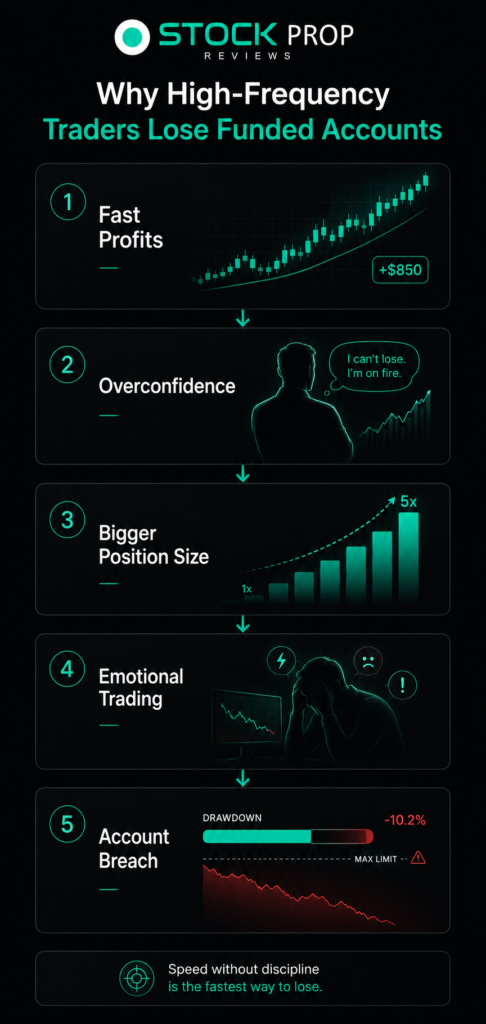
Most failures are caused by:
- Increasing risk on assessment targets
- Overtrading in drawdown.
- Emotional revenge trading.
- Bad adaptation in volatility
- Skipping consistency requirements
- Different treatment of funded accounts and demo evaluations.
The prop firm industry is often known for rewarding aggressive behaviour during evaluations but expects controlled behaviour after funding.
A lot of traders fall into that contradiction.
You can see this pattern clearly in our opinion breakdown on “what real trading freedom actually means” because most traders have a completely wrong understanding of freedom.
FAQ
What is the best prop firm for high frequency trading?
It depends on what market you are trading. FTMO is good for disciplined forex scalpers, Topstep is good for futures traders and TradeThePool is for traders of stock momentum.
Are Prop Firms Permitted to Employ Scalping Techniques?
Most firms permit scalping but may have restrictions on news trading, latency arbitrage, or checks on consistency.
Is TradeThePool good for day traders?
TradeThePool can be very useful for active stock traders that like catalyst driven momentum trading in a regulated stock environment.
Why do funded accounts fail for high-frequency traders?
Most failures are mistakes of emotion, not mistakes of strategy. Fast execution leads to pressure, fatigue and revenge trading.
Are prop firms better for scalpers? Futures?
Futures markets can offer great liquidity to scalpers but volatility and leverage also increase risk significantly. Companies like Topstep are better for more experienced traders than beginners.