If you are a beginner, you just want a prop firm with simple rules. You want certainty. No surprises. Fair enough. The last thing you want is a rule book that feels like a trap, especially not if you’re still working on consistency.
The guide is for beginner and early-stage traders, who want clear-cut conditions and predictable risk limits. Not for aggressive scalp traders or traders that want to get through challenges fast with high risk strategies.
Here’s the truth most competitors don’t see. Simple rules do not make a prop firm easy . They just clear up confusion. “There is still a need for discipline many times and simple rules reveal mistakes faster.
What “Simple Rules” Actually Means
In prop trading, simple means fewer rules. It is about clarity.
A firm is really quite simple when:
- Risk limits are tight and easily tracked
- No hidden consistency / scaling traps
- Clear unconditional profit goals
- All rules are reading once to understand easy
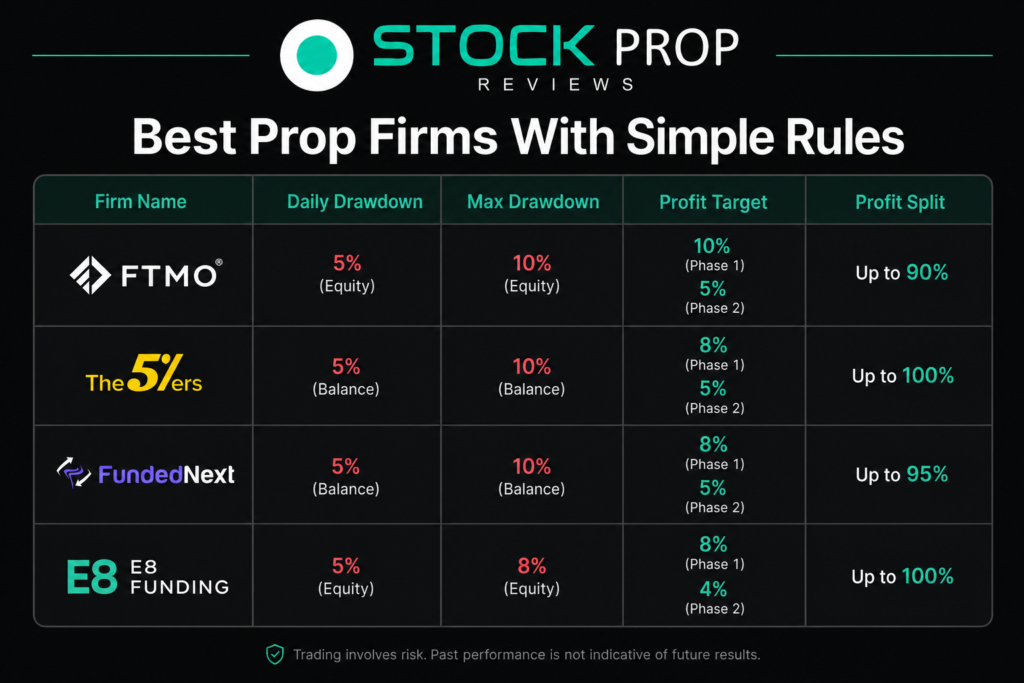
For example, a fixed 5 percent daily loss is simple. But trading inside that limit consistently is where most beginners fail.
That difference matters more than any comparison table.
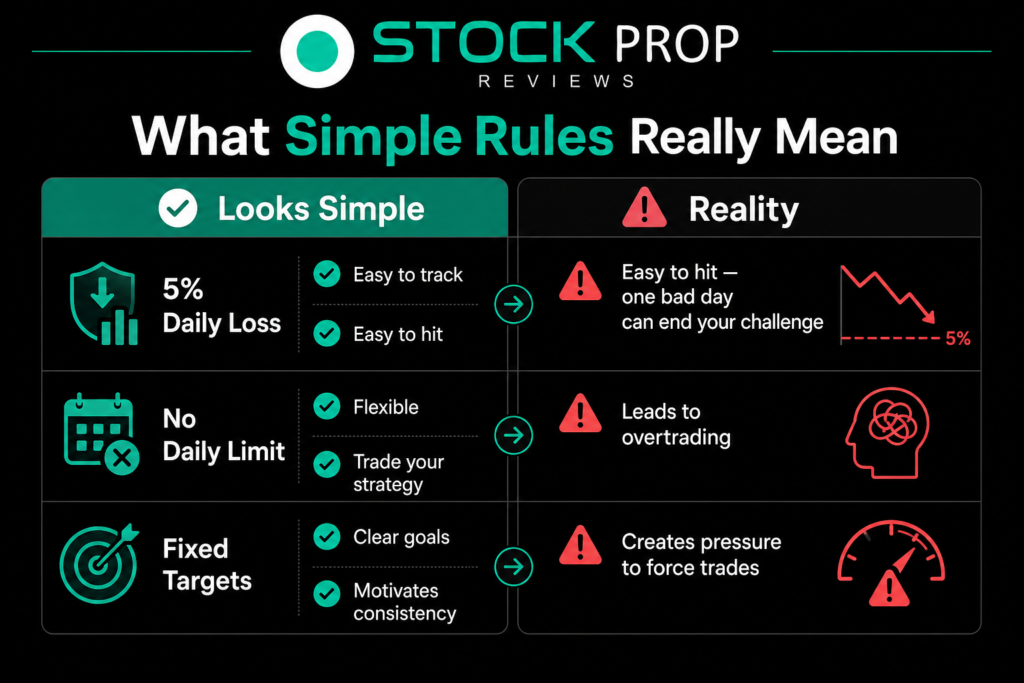
Comparison: Best Prop Firms With Simple Rules
| Firm | Daily Drawdown | Max Drawdown | Profit Target | Profit Split | Overall Simplicity |
| FTMO | 5% | 10% | 10% | 80–90% | Very structured |
| The5ers | Flexible | 6–10% | Scaling model | Up to 100% | Flexible but risky |
| FundedNext | 5% | 10% | 8–10% | 80–90% | Clear phases |
| E8 Funding | 5% | 8–10% | 8–10% | 80% | Clean but tight |
Numbers look similar across firms. The experience trading them is not.
FTMO: Clear Rules, Zero Flexibility
Quick verdict
FTMO is one of the cleanest rule-based firms in the industry. Everything is defined. Nothing is negotiable.
Rules overview
| Rule Type | Value |
| Daily loss | 5% |
| Max loss | 10% |
| Profit target | 10% |
| Minimum days | 4 |
| Profit split | 80–90% |
What traders usually miss
Simple structure, but not much room for error. 5 percent daily limit is tight if you are not precise with position sizing.
Real scenario
A beginner risks 1.5 to 2 percent on each trade. Two losses and a spike in the spread later, and the daily limit is no more. No second chances for him that day.
The rule is not the issue. It is about how quickly it is triggered in real conditions.
Who this fits
Traders who already respect risk limits and are able to stop trading after a loss. .
Who should avoid it
Anyone who tends to increase the lot size after a win or tries to recover losses quickly.
The5ers: Simple on Paper, Hard in Practice
Quick verdict
The5ers eliminates harsh daily limits, which sounds beginner friendly. But often the freedom is a mistake in practice.
Rules overview
| Rule Type | Value |
| Daily loss | No fixed cap |
| Max loss | 6–10% |
| Profit target | Scaling based |
| Profit split | Up to 100% |
What competitors don’t explain
Without a daily stop, the responsibility shifts entirely to you. Most beginners do not have that level of control yet.
Real scenario
A trader goes down 3 percent and keeps trading to recover. Instead of stopping, they push deeper into drawdown and end the account in one session.
A fixed daily rule would have stopped that.
Who this fits
Traders with robust personal discipline and experience of drawdown.
Who should avoid it
Newcomers who follow rules for behaviour.
FundedNext: Straightforward but Mentally Demanding
Quick verdict
FundedNext keeps rules simple but adds pressure through its two-phase structure.
Rules overview
| Rule Type | Value |
| Daily loss | 5% |
| Max loss | 10% |
| Profit target | 8–10% |
| Profit split | 80–90% |
What traders underestimate
Passing one phase doesn’t mean consistency. In phase two many traders change behaviour and fail.
Real scenario
In phase one the trader does well and keeps risk in check. Phase two they increase frequency to finish faster. This change causes unnecessary losses.
Who this fits
Traders with strong personal discipline and experience of drawdown.
Who should avoid it
Anyone who gets impatient after early success.
E8 Funding: Clean Structure, Less Room for Error
Quick verdict
E8 offers simple and modern rules, but slightly tighter risk limits increase pressure.
Rules overview
| Rule Type | Value |
| Daily loss | 5% |
| Max loss | 8–10% |
| Profit target | 8–10% |
| Profit split | 80% |
What competitors overlook
Any change in drawdown even slight, changes your trading. You get more careful, sometimes too careful.
Real scenario
A few losses make a trader gunshy about valid setups. Missed trades are frustrating and this often leads to forced trades later on.
Who this fits
Traders who like structure but can handle the mental stress.
Who should avoid it
Beginners who lose confidence after losing.
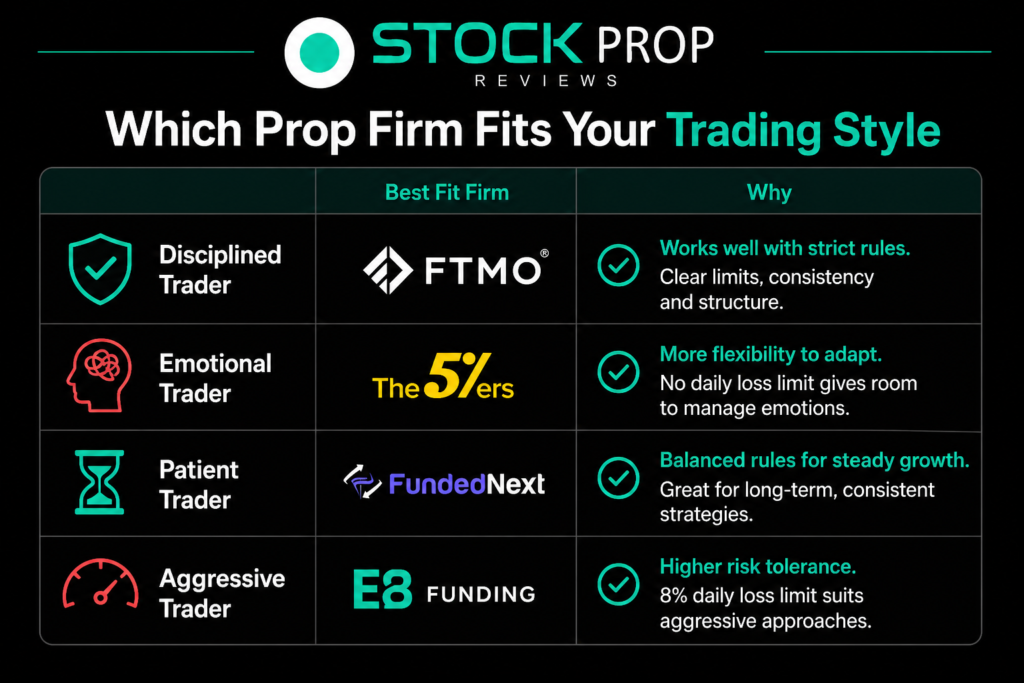
Strategy Fit: Matching Rules to Your Behavior
“It’s less about the numbers, but more about how you do under pressure when choosing between these companies.
FTMO works best if you agree to hard limits and stop trading when you need to.
The5ers is for you if you already manage your risk without external rules.
It’s great for traders who are consistent over time, not just a couple of times.
E8 is for the structured, but can accept tighter margins.
There is no one-size-fits-all “best” here. The wrong fit will expose weaknesses quickly.
What Most Articles Get Wrong
Most comparisons are over which company is easier. That’s not the right question.
The better question is which firm makes your mistakes more visible?
– I’m not sure if I can make it. I have a lot on my plate.
- Strict daily limits reveal overtrading
- Lack of discipline shown by flexible rules
- Inconsistency of multi-phase models
This is how two traders can run the same firm, and have totally different results.
Common Mistakes Beginners Make
Across all prop firms with simple rules, the same patterns show up.
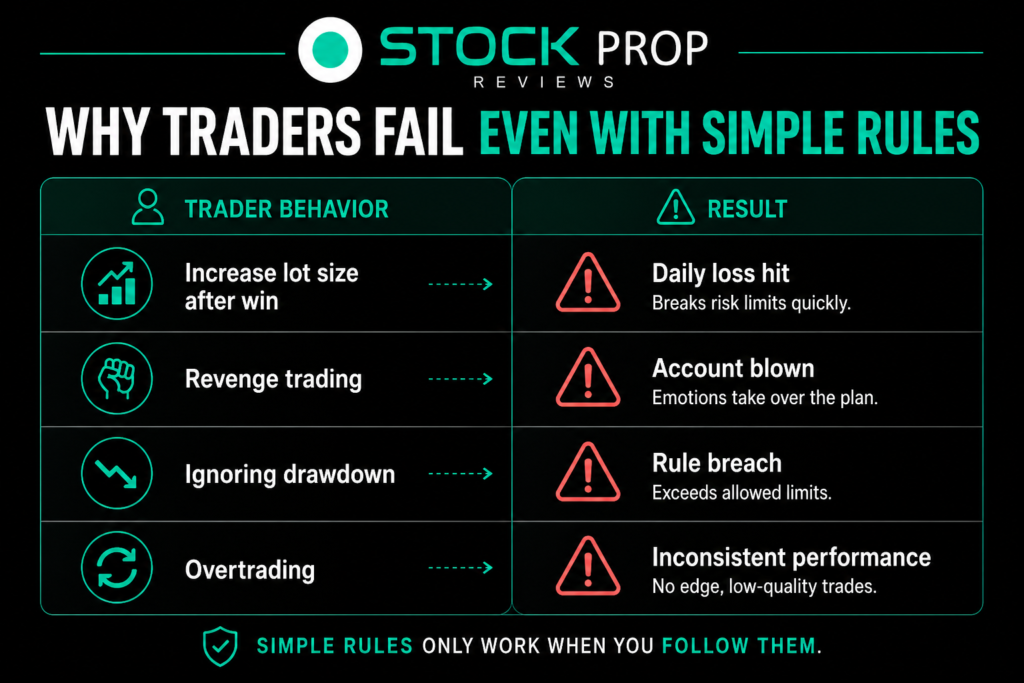
Traders increase risk after a winning streak. They try to recover losses too quickly. They ignore floating drawdown and only focus on closed trades.
Another common issue is trading during conditions they do not understand, especially high-impact news. Simple rules do not protect you from bad timing.
If anything, they punish it faster
Alternatives Worth Considering
If these firms seem too restrictive, it may be worth looking outside of forex-style prop models.
TradeThePool is an example. It’s a regulated stock prop firm, with clear rules and real market experience. The structure is more convenient for those traders who prefer equity trading to forex.
TradeThePool link: Our readers get up to 10% discount when buying.
It isn’t about comfort. It’s about clarity and a different environment to trade in.”
A More Realistic Way to Choose
Don’t ask yourself which firm is easiest. Ask yourself:
Can I have a loss of less than 5 percent, day after day?
When you hit your limits, do you stop trading or try to recover?
Can I keep with the same strategy, without changing it halfway?
Your answer is more important than any rule comparison.
FAQs
What prop firm has the least rules and is easiest?
There is no easy real choice. FTMO and FundedNext are easier to understand but still require a lot of discipline.
Are firms without daily drawdown more beginner friendly?
Not usually. Daily limits are there for protection. Without them, losses can add up quickly.
Are simple rules associated with higher success rates?
They enhance clarity, not performance. The outcome still depends on your behaviour.
Who is the best broker for first-time traders?
Many beginners are starting with structured firms like FTMO because the rules help enforce discipline.
The biggest mistake beginners make is . . .
Taking too much risk per trade and trying to recoup losses quickly. This breaks even the most basic rule sets .
Final Insight
Prop firms don’t get easier with simple rules. They’re just more honest.
They clear confusion and put you face to face with your trading habits. That is the advantage and the danger for beginners.